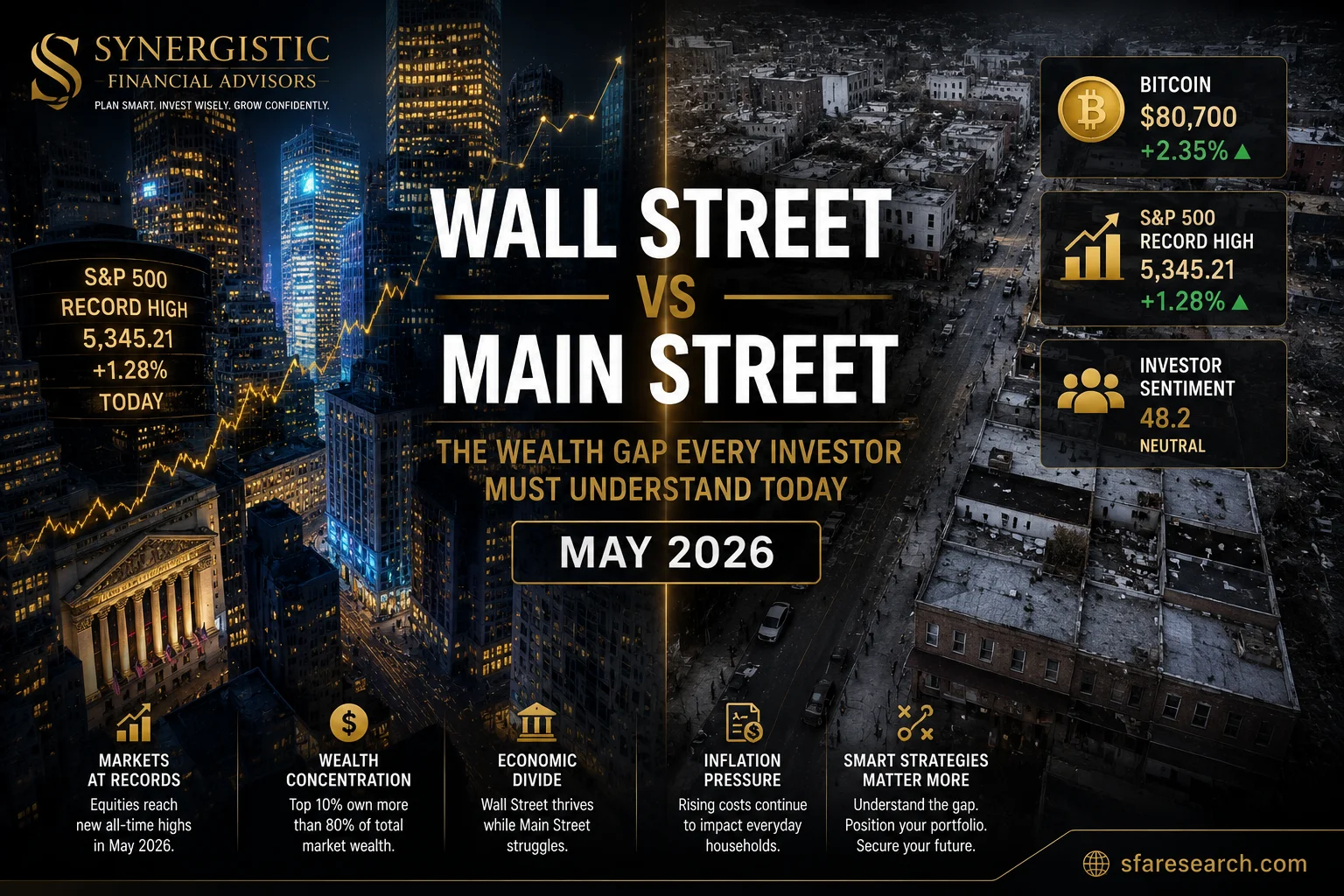
Something extraordinary — and deeply revealing — is happening in financial markets right now. This morning, the Nasdaq is sitting at record highs. Bitcoin has surged nearly 12% this month. Asian chipmakers are hitting all-time peaks. South Korea’s market just gained 5% in a single session. The AI trade is roaring.
And yet — simultaneously — American consumer confidence has just collapsed to its lowest level ever recorded. Households are being squeezed by inflation, gas prices, and tariff-driven costs. The University of Michigan’s closely watched sentiment survey has fallen to a historic low of 48.2. Ordinary people are deeply worried about their financial future.
Two realities. One economy. And the gap between them is the most important financial story of 2026.
For investors, business owners, and anyone managing their wealth management strategy, understanding this divergence is not just intellectually interesting — it is practically essential. Because how you position your financial planning and investment management strategy in response to this split will significantly determine your outcomes for years to come.
Today’s Markets — Records Built on the AI Trade
Let’s start with what is actually happening in markets this morning. Bitcoin surged 11.8% in May to $80,700 — its biggest monthly increase since April 2025 — as the Nasdaq climbed 22% since April 1 to reach a record 23,235 points. The broader S&P 500 also advanced over 12% in the same period.
These are extraordinary numbers. And the engine behind them is increasingly clear. Asian stocks climbed today as traders doubled down on the AI trade — brushing aside Middle East tensions even after President Trump rejected Iran’s latest peace proposal. MSCI’s Asia Pacific equities gauge rose 0.6% with technology shares outperforming. South Korea, a poster child for AI investments, gained 5% to a new record. A Bloomberg gauge of Asian chipmakers hit a peak after the Philadelphia Semiconductor Index surged to an all-time high on Friday.
The AI trade is not a theme anymore — it is the dominant structural force reshaping global equity markets. And the corporate news this morning reinforces exactly that. Tech hit fresh records after the Wall Street Journal reported Intel landed a deal to make chips for Apple. Micron crossed $700 for the first time. AMD broke through a $700 billion market capitalisation. Top chip names added over $400 billion in value on the day.
For investors with well-positioned portfolio management strategies that include semiconductor and AI infrastructure exposure, this has been an extraordinary period of wealth creation. But here is the critical question that every serious investor needs to be asking right now.
The Other Side of the Story — A Consumer Under Serious Pressure
While markets celebrate, the real economy is telling a very different story. Despite this financial rally, the University of Michigan’s consumer sentiment survey showed sentiment at a record low of 48.2 — down 7.7% year-over-year — driven by inflation concerns such as gas prices and tariffs. Experts highlight a growing gap between Wall Street, fuelled by institutional investment in tech and digital assets, and Main Street, where households face economic pressures.
This divergence is not a temporary anomaly. It is a structural feature of today’s economy — one that carries serious implications for financial planning, investment management, and long-term wealth management strategy.
Consider what it means in practical terms. The households driving consumer spending — the engine of the US economy — are cutting back. They are worried about inflation. They are being squeezed by elevated energy costs. They feel financially vulnerable. And their confidence in the economic outlook has never been lower on record.
Meanwhile, asset prices are at all-time highs. The investors who own equities, cryptocurrency, and AI-exposed portfolios are watching their wealth grow at a remarkable pace. This divergence underscores rising asset prices amid weak consumer confidence — a K-shaped economy where financial markets and everyday household experience are moving in opposite directions.
What does this mean for your investment management strategy? Several things — each of which deserves serious attention from every investor and financial advisor right now.
What the Wall Street-Main Street Split Means for Your Portfolio
Consumer-Facing Sectors Carry Hidden Risk
When consumer sentiment collapses to record lows, the companies most exposed to household spending face real earnings pressure. Retail, consumer discretionary, and some areas of consumer staples all become more vulnerable in an environment where ordinary people are tightening their belts.
This does not mean abandoning these sectors entirely. But it does mean that a disciplined portfolio management approach needs to be thoughtful about concentration in consumer-dependent businesses — and should ensure that defensive positioning and genuine diversification are embedded in the overall strategy.
A qualified financial advisor can help you assess your current sector exposure and identify whether your portfolio is inadvertently overweight in areas that are most vulnerable to the consumer confidence collapse playing out right now.
The AI Trade Is Real — But Selectivity Matters More Than Ever
The semiconductor and AI infrastructure story is genuine, powerful, and multi-year in nature. Micron crossing $700, AMD breaking $700 billion market cap, and Intel landing the Apple chip deal are all signals of an AI investment cycle that is broadening and deepening rather than narrowing.
But at these valuation levels — with the Nasdaq up 22% in just six weeks — the margin for error is thin. Stocks priced for perfection deliver maximum pain when they disappoint. The investors who benefit most from the AI theme over the next few years will not necessarily be those who bought the most aggressively at today’s record prices. They will be those who built disciplined, diversified AI exposure through a thoughtful investment management framework — capturing the upside while managing the downside risk that comes with any historic bull run.
Dividend Stocks Are Quietly Becoming More Attractive
In an environment of consumer stress, geopolitical uncertainty, and elevated valuations in growth stocks, income-generating investments are worth serious consideration. Three dividend stocks stand out right now: Vici Properties — a real estate investment trust focused on casinos and entertainment — delivering a robust 6.19% dividend yield with full occupancy supporting steady cash flow; PepsiCo offering a 4.1% dividend yield following a sharp 27% rise in earnings per share in Q1 2026; and T. Rowe Price Group, which combines asset management expertise with consistent dividend income.
For investors seeking to balance growth exposure with income stability — particularly those approaching or in retirement planning — quality dividend stocks provide a valuable counterweight to the volatility inherent in a market driven by AI momentum.
UK Equities Are Offering Compelling Value Right Now
While US markets grab the headlines, a quieter opportunity is building elsewhere. UK shares on the FTSE are drawing investor attention due to a favourable value outlook — with market watchers observing that despite recent volatility, valuations remain attractive compared to other global indices.
This is the kind of global portfolio management insight that separates sophisticated wealth management from simple index tracking. When US markets are at record valuations and consumer stress is building domestically, international diversification into attractively valued markets like the UK creates genuine portfolio resilience — and the potential for meaningful relative outperformance.
The Iran Situation — Why Your Portfolio Cannot Assume Peace
One of the key drivers of today’s market complexity is the continuing uncertainty around Iran. And today brings a significant development that every investor needs to understand.
President Trump rejected Iran’s latest peace proposal — sending crude oil higher and Treasuries lower even as Asian technology stocks continued to rally.
US jets disabled two Iran-flagged oil tankers trying to break the naval blockade today. Secretary Rubio told reporters the US “should know something today” on Iran’s response to the proposed peace framework — but a senior Iranian official called the plan “unrealistic” and demanded reparations.
This is a sharp reversal from the optimism of last week. And it has immediate, practical implications for financial planning and investment management strategy.
Energy prices — which had been falling on peace hopes — are rising again. Bond markets are under pressure as geopolitical risk premiums rebuild. And the equity market’s ability to simply brush off Middle East tensions — as it has been doing remarkably well — will eventually have limits if the conflict escalates rather than resolves.
For investors, this is a powerful reminder of why geopolitical risk must be a permanent feature of portfolio management thinking — not something that gets factored out during periods of market optimism. Building genuine resilience through diversification, maintaining appropriate defensive positions, and working with a financial advisor who actively monitors these developments is not optional in today’s environment. It is essential.
The Tariff Dimension — Trade Policy Is Still Reshaping Investment Strategy
Beyond the Iran story, another structural force continues to reshape the investment management landscape: US trade policy and its cascading effects on global supply chains, corporate earnings, and inflation.
Following the US Supreme Court’s ruling on 20 February 2026 that the International Emergency Economic Powers Act does not authorise the President to impose tariffs, the legal basis for US tariff policy has shifted — with a new global tariff of 10% on most imports now in place under a different legal framework, valid for 150 days unless Congress extends the term.
US firms including Microsoft, Nvidia, and OpenAI have committed approximately $130 billion in capital investment to build out digital infrastructure in the United Kingdom as part of the evolving US-UK economic relationship — representing a significant flow of American capital into international markets.
For investors and business owners with international exposure, these developments create a complex but navigable landscape. Tax planning around international investment structures, supply chain exposure analysis, and financial management frameworks that account for tariff-driven cost changes are all areas where professional financial advisory guidance delivers measurable value.
What Smart Investors Are Doing Right Now — Today, 11 May 2026
Given everything happening simultaneously — record markets, record-low consumer confidence, Iran peace collapse, AI trade acceleration, dividend opportunities, and international value emerging — here is the disciplined, evidence-based response that a qualified financial advisor would recommend:
Review your AI exposure and take disciplined profits where appropriate. After a 22% Nasdaq rally in six weeks, some profit-taking and rebalancing is not bearish — it is prudent portfolio management. Use proceeds to diversify into areas of the market with better risk-reward profiles at current valuations.
Add income-generating assets to balance your growth exposure. Quality dividend stocks, bond ladders, and income-generating REITs provide stability and cash flow that pure growth portfolios lack — particularly valuable when consumer confidence is at historic lows and economic uncertainty is elevated.
Do not let geopolitical optimism lower your guard. The Iran situation is deteriorating again today. Maintaining appropriate defensive positioning in your wealth management strategy ensures you benefit from the upside while remaining protected if energy prices spike and market sentiment reverses.
Explore international diversification seriously. UK equities and select emerging market exposures offer compelling valuations relative to US markets right now. A globally diversified portfolio management strategy is not just risk management — it is genuine opportunity capture.
Prioritise tax efficiency given today’s market gains. If you have significant unrealised gains from the recent rally, now is an excellent time to review your tax planning strategy. Harvesting losses elsewhere in your portfolio, reviewing your account structures, and optimising your realisation strategy can make a meaningful difference to your after-tax wealth position.
Check your retirement plan against today’s inflation reality. Record-low consumer confidence driven by inflation and gas prices is a reminder that retirement planning projections must account for real-world cost pressures — not just historical averages. A certified financial planner can stress-test your retirement projections against today’s actual inflation environment.
The Bigger Picture — Why This Moment Demands a Clear Strategy
The financial landscape of May 11, 2026 is one of the most complex and contradictory in recent memory. Markets are celebrating at record levels. Ordinary consumers are experiencing their worst financial confidence on record. Geopolitical risk has just intensified. The AI trade is reshaping global capital flows. And trade policy continues to create both risks and opportunities across sectors and geographies.
In this environment, investors without a clear financial planning strategy are not neutral — they are exposed. Every day without a deliberate investment management framework is a day when market forces, inflation, and geopolitical events are making decisions for you rather than the other way around.
The investors who will look back on this period with genuine satisfaction are those who worked with a trusted financial advisor right now — not to react to today’s headlines, but to build a strategy disciplined enough to navigate the complexity, capitalise on the opportunities, and protect against the risks that today’s extraordinary market environment presents.
At Synergistic Financial Advisors, we help individuals, families, and businesses do exactly that. From investment management and portfolio management to retirement planning, tax planning, and comprehensive wealth management — our team is here to help you move forward with clarity and confidence, whatever the market brings next.
Want to understand what today’s Wall Street-Main Street divide means for your personal financial plan? Contact Synergistic Financial Advisors today for a personalised consultation built around your goals.