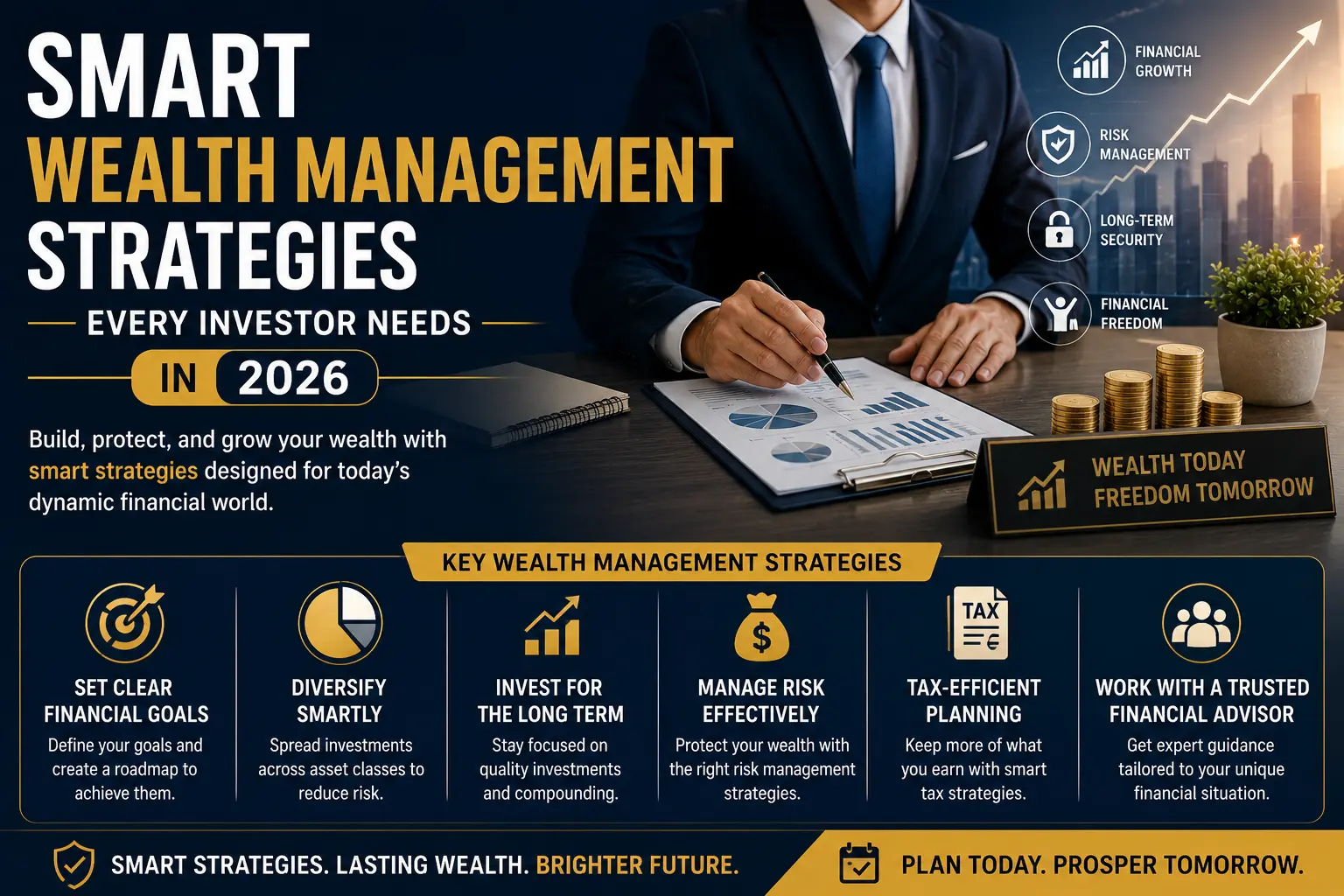
The rules of building and protecting wealth are being rewritten in real time. In May 2026, investors are navigating a financial landscape shaped by artificial intelligence, record-breaking ETF inflows, a booming private credit market, geopolitical tension, and some of the most significant tax law changes in years. Those who adapt their wealth management strategy to this new reality are pulling ahead. Those who don’t are quietly falling behind.
Whether you are a high-income professional, a business owner, or an individual building long-term financial security, this is the moment to sharpen your strategy. Here is what the smartest investors and financial advisors are focused on right now — and what you should be too.
The Wealth Landscape Has Fundamentally Changed
Before diving into specific strategies, it is important to understand just how different the environment is in 2026 compared to just a few years ago.
Two mega forces — AI and geopolitical fragmentation — have collided this year. The Middle East conflict delivered a supply shock disrupting energy and key materials, while mega-cap tech hyperscalers are spending even more than previously expected on AI infrastructure. Both developments are shifting the investment outlook in different directions simultaneously.
Fidelity International calls AI the defining theme for equity markets in 2026, while the BlackRock Investment Institute says the technology will likely keep outweighing tariffs and traditional macro drivers. JPMorgan Wealth Management has stated that the biggest risk for investors right now is not having exposure to this transformational technology.
At the same time, the wealth management industry itself is undergoing a historic transformation, with record-high deal flow and acquisition activity in 2026 as financial advisory firms race to build holistic platforms offering personalised advisory services — including expertise in alternatives beyond the traditional 60/40 stocks and bonds model.
In short: this is not a normal year. And it demands anything but a normal approach to financial planning.
Strategy 1 — Embrace Private Markets Before the Window Narrows
One of the most significant shifts in investment management in 2026 is the mainstream arrival of private markets for a broader range of investors.
Family offices are actively tapping wealth management firms to increase tax efficiency in their portfolios, while U.S. listed ETFs raised $174 billion in April alone and are on pace to raise nearly $2 trillion across 2026 — signalling extraordinary momentum in sophisticated investment vehicles.
Wealth managers are forming partnerships with firms like Carlyle to access alternative asset classes including private credit, private real estate, infrastructure, and private equity — offering clients a genuinely holistic approach to personalised advisory services that goes well beyond traditional stock and bond portfolios.
For individual investors and business owners, this matters because private markets have historically offered returns that are less correlated with public market volatility — providing genuine diversification that a standard portfolio management approach simply cannot replicate.
If your current financial advisor is not discussing private market exposure as part of your overall strategy, it is worth asking why.
Strategy 2 — Use AI as a Tool, Not a Replacement for Human Judgment
Artificial intelligence is reshaping every corner of wealth management — from how portfolios are constructed to how tax efficiency is analysed to how client communication is personalised.
Nearly nine in ten wealth management firms now use AI and data analytics to support decision-making in 2026, with almost half reporting the use of real-time insights to guide automated decision-making and business strategy.
But here is the nuance that matters for investors: while AI exploded into every part of financial technology in 2025 with bold claims about efficiency and productivity, 2026 is proving a year of more realistic assessment — separating the genuine tools that enhance advisor capability from the overhyped platforms that underdeliver.
The best financial advisors in 2026 are not replacing human judgment with AI — they are using it to enhance the speed, precision, and personalisation of the advice they deliver. Real-time portfolio management adjustments, AI-assisted tax planning modelling, and automated cash flow optimisation are all genuine value-adds when deployed by a skilled advisor who understands your individual circumstances.
What AI cannot do is understand your family situation, your risk psychology, your long-term vision, or the nuanced decisions that real life brings. That is where the human expertise of a trusted financial consultant remains irreplaceable.
Strategy 3 — Make Tax Efficiency a Year-Round Priority
Tax planning is no longer something you think about in April. In 2026 it is a continuous, proactive discipline — and the investors who treat it that way are keeping significantly more of what they earn.
The legislative landscape this year has created both risks and opportunities that demand attention. New AMT thresholds mean that high earners need to review their tax exposure carefully. Updated estate and gift tax exemptions — now at $15 million per individual — create real planning opportunities for families building multi-generational wealth. And new charitable giving rules mean that even philanthropy requires a more strategic approach.
High-net-worth individuals name financial planning, peace of mind, and achieving overall life goals as areas where their wealth management advisors can deliver the highest value — and tax efficiency sits squarely at the intersection of all three.
For business owners, the combination of tax planning and financial management is especially powerful. Qualified Business Income deductions, pass-through entity strategies, and the coordination of personal and corporate tax positions can deliver meaningful after-tax improvements that compound significantly over time.
A qualified certified financial planner with expertise in tax strategy does not just file your returns — they build a year-round framework that minimises your liability while keeping you fully compliant and strategically positioned.
Strategy 4 — Rethink Your Portfolio for Today’s Market Reality
The 60/40 portfolio — 60% stocks, 60% bonds — served investors well for decades. In 2026 it is no longer sufficient on its own.
With no neutral stance available in today’s mega-force driven market, every investor is effectively making a call on the direction of AI and geopolitical fragmentation whether they intend to or not — making genuine diversification across asset classes, geographies, and strategies more critical than ever.
The smartest portfolio management approaches in 2026 include:
Expanding beyond domestic equities. International diversification is finally delivering meaningful returns after years of underperformance. European and emerging markets have proven their value, and a global allocation creates resilience against US-specific risks.
Adding income-generating assets. With cash yields declining as the Fed’s rate trajectory gradually shifts, structured bond ladders, dividend-generating equities, and alternative income vehicles are becoming increasingly important components of a well-rounded investment management strategy.
Considering alternative investments. Private credit, infrastructure, and real assets all offer return profiles that complement traditional stocks and bonds — reducing overall portfolio volatility while maintaining growth potential.
Rebalancing regularly. Markets in 2026 are moving fast. A portfolio management strategy that made sense six months ago may already need adjustment given the shifts in sector leadership, bond yields, and geopolitical risk.
Strategy 5 — Plan for the Generational Wealth Transfer That Is Already Underway
One of the most significant macro trends in wealth management right now is the largest intergenerational transfer of wealth in history. Trillions of dollars are moving from Baby Boomers to younger generations — and how that transfer is structured will determine whether that wealth is preserved or significantly diminished through poor planning, tax inefficiency, or inadequate estate structures.
The transaction by Carlyle to acquire MAI Capital Management — a firm with $67 billion in AUM offering services across financial planning, investment management, retirement planning, tax advice, and family office capabilities — explicitly cited a significant generational transfer of wealth as one of the long-term trends shaping global wealth management right now.
For families at every level of wealth, this is the moment to ensure your estate plan is properly structured. Trusts, beneficiary designations, gifting strategies, and family governance frameworks all play a role in making sure the wealth you have built serves the generations that follow.
A fiduciary financial advisor with expertise in estate planning and multi-generational wealth management is the right partner for navigating this complex but critically important aspect of your financial life.
Strategy 6 — Choose Your Financial Advisor With Greater Care Than Ever
In a year of this much complexity and opportunity, the quality of your financial advisor matters more than it ever has. The gap between excellent advice and average advice is widening — and so is the financial impact of that gap on your long-term outcomes.
Wealthy clients increasingly expect services that go far beyond traditional investment management — naming financial planning, peace of mind, and achieving overall life goals as areas where their advisors can deliver the highest value.
Almost all wealth management firms project revenue growth in 2026, with 63% expecting gains of 8% or more — but experts caution that firms counting purely on market performance or M&A to drive growth are relying on factors outside their control. The real differentiator is the quality of client relationships and the depth of personalised advice delivered.
When selecting or reviewing your financial advisor, ask the right questions. Are they a fiduciary at all times? How do they incorporate tax planning into their investment management approach? How do they handle market volatility with clients? How frequently do they proactively communicate? What is their philosophy on alternative investments and private markets?
The answers will tell you everything you need to know.
Bringing It All Together
Wealth management in 2026 is not simply about picking the right stocks. It is about building a comprehensive, coordinated financial strategy that integrates investment management, tax planning, retirement planning, estate planning, and risk management into a single, coherent framework — one that adapts intelligently to a financial environment that is changing faster than at any point in recent memory.
The investors building genuine, lasting wealth in 2026 are doing so not by chasing trends, but by working with expert advisors who help them stay disciplined, diversified, and strategically positioned for the long term.
At Synergistic Financial Advisors, this is exactly what we do. Our team brings deep expertise across every dimension of wealth management — from portfolio management and investment management to tax planning, retirement planning, and multi-generational estate strategy. We combine the latest analytical tools with genuinely personalised, client-first advisory — built around your goals, your timeline, and your life.
Ready to build a smarter wealth management strategy for 2026? Contact Synergistic Financial Advisors today and let’s put a plan in place that works — whatever the market brings next.