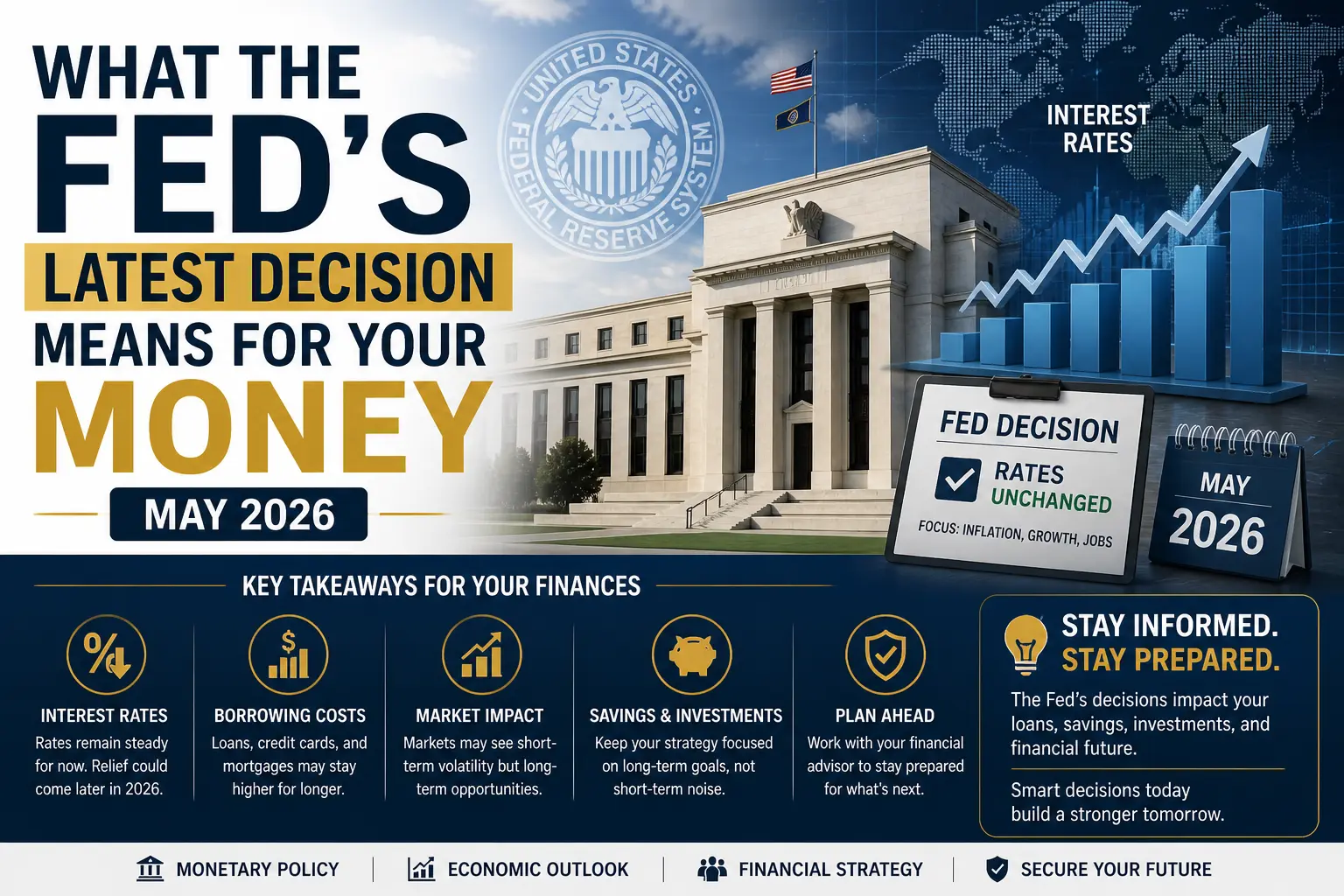
If you opened the financial news today, you would have seen a seemingly contradictory picture. Stock markets are near all-time highs. The Fed just held interest rates steady — again. A war in the Middle East is rattling bond markets. Mortgage rates are rising. And tech giants are spending three-quarters of a trillion dollars on AI.
For the average investor, business owner, or anyone planning their financial future, this kind of news cycle raises one urgent question: what does all of this actually mean for my money?
Let’s break it down — clearly, practically, and with your financial goals front and centre.
The Fed Just Held Rates Again — Here’s Why It Matters
The biggest financial story of this week is the Federal Reserve’s decision on interest rates. The Federal Open Market Committee maintained the federal funds rate in the range of 3.5% to 3.75% — marking yet another instance in 2026 where the central bank has opted for a pause in rate adjustments.
This was not a surprise. But the reasons behind it — and what it signals going forward — matter enormously for your financial planning.
The Fed cited elevated inflation, in part reflecting the recent increase in global energy prices, and noted that developments in the Middle East are contributing to a high level of uncertainty about the economic outlook.
In plain terms: the Fed wants to cut rates, but can’t yet. Inflation is still above the 2% target, energy prices are rising due to the Iran conflict, and the economic picture is too uncertain to justify easing policy right now.
Markets are priced for steady policy over the next few months, as policymakers wrestle with the economic impact of the war in Iran and spiking crude oil prices — with the Fed likely to remain on an extended pause to see how rising energy costs play out in the broader economy.
What this means for you: If you have savings in cash or short-term deposits, rates remain relatively attractive for now. But if you are waiting for borrowing costs to fall before making major investment or property decisions, that relief may be further away than you hoped.
A Leadership Change at the Fed — And Why Investors Are Watching
There is another dimension to this week’s Fed story that adds an extra layer of uncertainty. This meeting could mark the final one under Fed Chair Powell, with his nominated successor Kevin Warsh’s appointment set for May 15 — and the Senate Banking Committee has already approved the Warsh nomination.
A potential new Fed Chair may result in some uncertainty, and once a new chair is in seat, the Fed may seek to cut interest rates one or two times to bring overnight rates closer to the 3% to 3.25% range — though any changes will depend on how inflation and employment data evolves.
A change in Fed leadership always creates a period of recalibration in markets. Investors will be closely watching the tone and messaging of the new chair for signals on the future direction of investment management strategy and bond positioning.
This is exactly the kind of environment where having a financial advisor with a clear, disciplined financial planning framework — rather than reacting emotionally to headlines — makes a measurable difference to your long-term outcomes.
Markets Are at Record Highs — But the Picture Is Complex
Despite all this uncertainty, equity markets are performing remarkably well. A record-breaking run drove stocks to their longest weekly advance since 2024, fuelled by hopes for a deal to end the Iran war that has rattled financial markets and jeopardised the economic outlook.
Stocks sit near all-time highs, with earnings growth fuelling the best month for the S&P 500 since November 2020 — with Wall Street now describing the current environment as a boom.
The engine behind this boom? Artificial intelligence. The five largest technology hyperscalers — Amazon, Google, Meta, Microsoft, and Oracle — are expected to spend $751 billion in capital expenditure in 2026, representing 83% growth versus 2025. This extraordinary level of AI investment is driving earnings, lifting tech stocks, and pulling broader markets higher.
But here is the critical nuance every investor needs to understand: record market highs do not mean risk has disappeared.
Average 30-year mortgage rates are back above 6.5% — their highest levels in over a month — as renewed tensions in the Middle East have rocked the bond market, with the 10-year Treasury yield jumping to 4.45%.
In other words, equity markets are celebrating while bond markets are signalling caution. This divergence is one of the most important signals in today’s financial landscape — and navigating it well requires a carefully constructed portfolio management strategy, not guesswork.
The Middle East Conflict and Its Financial Ripple Effects
The Iran conflict is not just a geopolitical story — it is a financial one with direct implications for investors, businesses, and anyone planning their economic future.
Risk sentiment in global markets improved late last week as crude prices eased following an Iranian proposal regarding negotiations with the US, with US Treasury yields falling sharply on both sides of the Atlantic driven by easing energy prices.
But this relief is fragile. Energy prices remain elevated, and the closure of key shipping routes has added inflationary pressure across global supply chains. For businesses with international exposure, this means higher input costs and tighter margins — precisely the environment where expert financial management becomes most valuable.
For individual investors, the energy shock is affecting everything from fuel costs to the value of commodity-linked investments, and has meaningful implications for retirement planning projections that assume stable long-term inflation.
What Smart Investors Are Doing Right Now
In this kind of environment — records highs in equities, rising bond yields, geopolitical risk, Fed uncertainty, and an AI-driven tech boom — the instinct for many investors is either to chase momentum or retreat to cash. Neither extreme is the right answer.
Here is what genuinely smart investment management looks like in May 2026:
Staying diversified across asset classes. The divergence between equity and bond markets right now is a reminder that concentration in any single asset class carries real risk. A well-structured portfolio management strategy spreads exposure intelligently.
Reviewing fixed income positioning. With bond yields rising and Fed policy uncertain, the duration and composition of your fixed income holdings deserves a fresh look. A qualified financial advisor can help you assess whether your bond exposure is appropriately positioned for the current yield environment.
Not letting short-term noise derail long-term plans. The biggest mistake investors make in volatile, headline-driven markets is abandoning disciplined financial planning in response to short-term events. Your retirement date has not changed. Your long-term goals have not changed. Your strategy should reflect that.
Optimising for tax efficiency now. Some Fed officials have flagged that additional rate increases could still be warranted if inflation persists above target levels — meaning the high-rate environment that makes tax planning decisions particularly impactful may continue longer than markets originally anticipated. Tax-efficient structuring of your investments and income is one of the highest-value activities you can pursue right now.
Keeping cash working harder. With rates still at 3.5% to 3.75%, short-term cash holdings can generate meaningful returns. A certified financial planner can help you identify the optimal balance between liquidity, yield, and long-term investment management goals.
The Bigger Picture for Your Financial Future
The financial landscape of May 2026 is one defined by extraordinary opportunity and genuine uncertainty existing simultaneously. AI is creating a generational investment wave. Markets are rewarding disciplined investors. But geopolitical risk, sticky inflation, and policy uncertainty mean that navigating this environment without a clear strategy is a risk most people cannot afford to take.
This is not a moment for passivity. It is a moment for precise, proactive financial planning — the kind that accounts for today’s realities while keeping your long-term goals firmly in focus.
Whether you are an individual investor building wealth management strategies for the future, a business owner managing corporate finances through a complex environment, or someone approaching retirement who needs a clear, reliable roadmap — the guidance of a trusted financial advisor has never been more valuable than it is right now.
Final Thoughts
Today’s financial news is a reminder of something that never changes: markets will always surprise, geopolitics will always create uncertainty, and the gap between investors who plan and those who react will always widen over time.
The Fed has held rates. Markets are at records. The world is navigating a complex, volatile, but ultimately opportunity-rich financial environment. The question is not what the market will do next — it is whether your financial strategy is built to benefit regardless.
At Synergistic Financial Advisors, we help individuals and businesses cut through the noise and build financial strategies grounded in discipline, expertise, and a genuine understanding of today’s markets. From investment management and portfolio management to retirement planning, tax planning, and comprehensive wealth management — we are here to help you move forward with confidence.
Have questions about how today’s market events affect your financial plan? Contact Synergistic Financial Advisors today for a personalised consultation.