This week has been one of the most eventful in financial markets all year. Stock indexes smashed records. Oil fell below $100 a barrel for the first time in weeks. AMD delivered one of the most impressive earnings beats of 2026. Iran peace talks moved closer to a breakthrough. And the Federal Reserve is days away from its biggest leadership change since 2018.
For investors, business owners, and anyone planning their financial future — this is a week that changes things. And the question right now is not what the market is doing. The question is: what should you be doing?
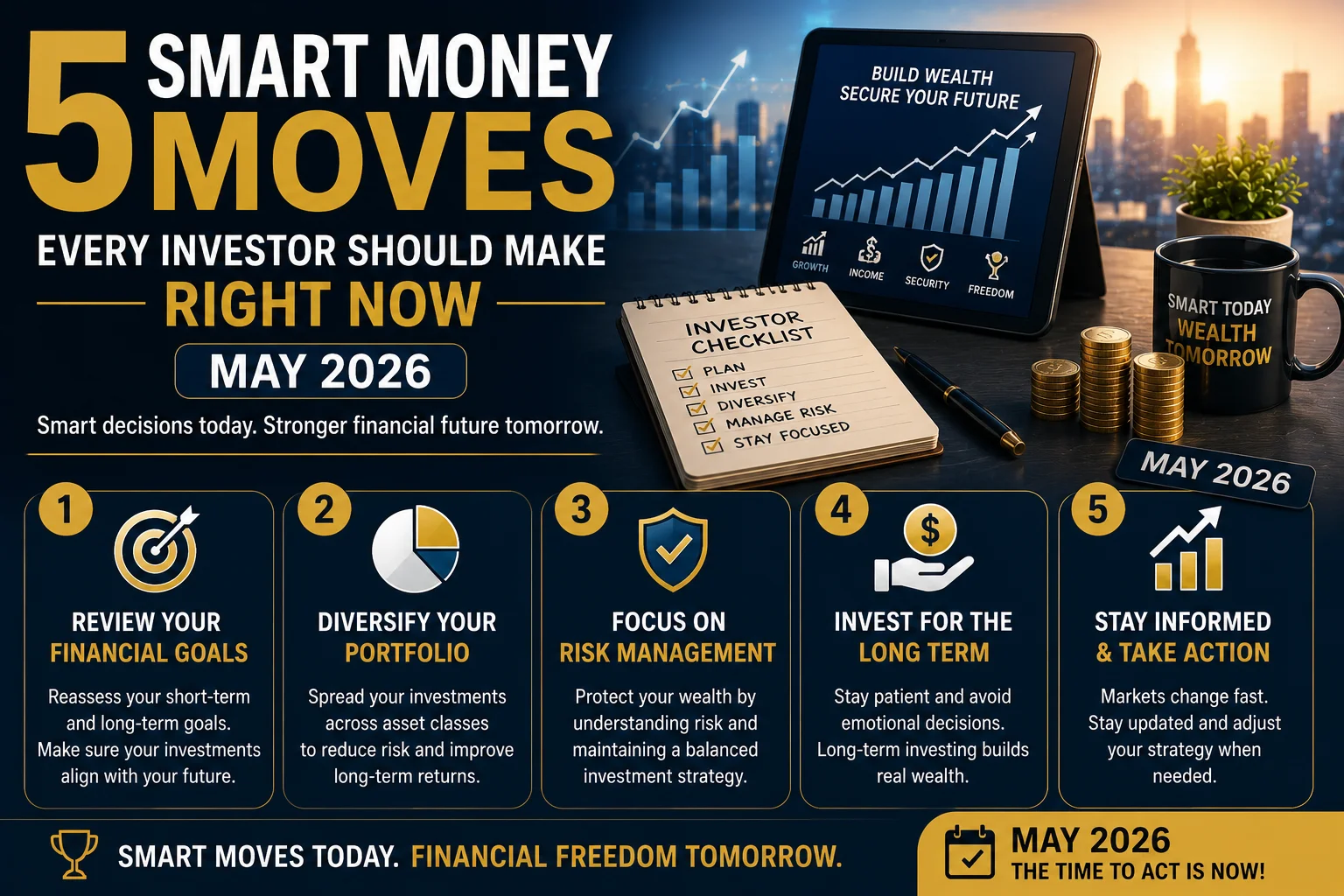
Here are five smart, actionable money moves that every investor should consider making right now — grounded in today’s news, backed by expert insight, and built around long-term financial planning principles that actually work.
1. Rebalance Your Portfolio While Markets Are at Record Highs
Let’s start with the number that is dominating financial headlines this week. The S&P 500 rose 1.46% to 7,365, the Nasdaq surged 2.02% to 25,838, and the Dow Jones gained over 600 points to close just under 49,911 — driven by AI-fuelled earnings and rising hopes of a US-Iran peace deal.
Record highs feel great. But they are also the single most important moment to review your asset allocation — because a portfolio that was perfectly balanced six months ago may now be dangerously overweight in equities simply through price appreciation.
This is one of the most overlooked principles in portfolio management: rebalancing is not about predicting a crash. It is about disciplined risk control. When equities outperform significantly — as they have throughout much of 2026 — your exposure to equity risk increases automatically unless you actively rebalance.
Analysts are already drawing parallels with previous bubble periods and looking for confirmation that the soft-landing narrative remains intact — with correction fears growing even as record highs continue to be set.
A skilled financial advisor or certified financial planner can run a full portfolio review right now, ensuring your risk exposure aligns with your actual goals and timeline — not just with what has performed best recently. This single step could protect years of wealth accumulation if markets pull back.
2. Rethink Your Energy and Commodity Exposure — The Iran Deal Is a Game Changer
The most consequential developing story for investors this week is the Iran peace negotiations — and its direct impact on energy markets.
Reports emerged that the US and Iran are close to a one-page, 14-point memorandum of understanding that would end the war and establish a framework for further nuclear negotiations — sending oil prices dipping, with US crude futures sinking below $100 a barrel for the first time since late April, closing at $95.08 per barrel.
But today, the picture has become more complicated. The rally faltered and oil whipsawed as doubts resurfaced about an imminent deal — with reports of explosions heard near a port city in southern Iran, and Iran’s state TV claiming the US military attacked an Iranian oil tanker.
This back-and-forth is exactly why reactive investment management is so dangerous. Investors who sold energy stocks on peace hopes yesterday are now watching oil spike back up today. Those who bought aggressively on the rally are now nursing losses.
The smart approach is a structured one. Asian markets have shown the way — reacting well to peace efforts but staying anchored by the AI boom, with semiconductor and data centre companies accounting for roughly 50% of Japan’s Nikkei 225 weighting according to JPMorgan, helping markets maintain momentum even amid geopolitical volatility.
What this means for your portfolio management: maintain a disciplined, diversified energy allocation rather than making binary bets on a peace deal that may or may not materialise. Work with a financial consultant to determine whether your current commodity and energy exposure is sized appropriately for your overall risk profile.
3. Get Ahead of the Fed Transition — Position Your Fixed Income Now
The Federal Reserve story this week is one that will reshape investment management strategy for months to come — and most investors are not paying it enough attention.
The stock market may have a Federal Reserve problem with Kevin Warsh replacing Jerome Powell — a transition that markets are beginning to price in ahead of the official changeover expected in mid-May.
Analysts note that a new Fed chair can change communications style and alter the pace of future rate decisions — sending ripples through the Treasury market even before equities fully react. Markets are going to be cautious as to what this change of the guard might mean.
Here is what this means in practical terms for your financial planning:
If you hold significant long-duration bonds, you are exposed to yield volatility that could intensify as markets reprice around the new Fed chair’s policy signals. If you are sitting on excess cash earning short-term yields, those returns will likely compress as the new Fed chair eventually moves toward cuts. And if your fixed income allocation has not been reviewed in the last six months, now is the time.
The smart positioning right now — as recommended by leading wealth management institutions — focuses on the intermediate part of the yield curve, bond laddering to lock in current rates, and selective high-yield and emerging market bond exposure for income generation. A qualified financial advisor can build a fixed income strategy that turns the Fed transition from a risk into an opportunity.
4. Capture the AI Earnings Boom — But Diversify Beyond the Obvious Names
The AI investment story delivered some of its most powerful validation yet this week, and smart investors are paying attention to where the opportunity is broadening.
AMD surged more than 18% after a blowout AI-driven quarter and outlook. Micron Technology extended its gains to push its market capitalisation above $750 billion. Corning jumped on a $500 million AI infrastructure deal with Nvidia, while Nvidia itself gained nearly 6%.
Investors have gone back to the comfort of where earnings are being delivered — and right now, earnings are being delivered most powerfully in artificial intelligence, semiconductors, and data centre infrastructure.
But here is where disciplined investment management differs from trend chasing: the real opportunity in the AI boom is not simply buying the names that have already run. It is identifying the expanding ecosystem of beneficiaries — from optical manufacturers like Corning to energy infrastructure providers, industrial automation companies, and financial technology firms using AI to deliver better client outcomes.
Morgan Stanley’s wealth management market research team notes that much of Asia is also poised to benefit from the AI capital expenditure cycle — meaning global diversification within the AI theme creates a more resilient portfolio management structure than concentrating purely in US mega-caps
Work with a financial planner who understands the full AI investment landscape — not just the headline names — to ensure your exposure is both meaningful and genuinely diversified.
5. Review Your Retirement Plan in Light of Today’s K-Shaped Economy
Perhaps the most important — and most overlooked — financial story of this week is not about stock records or peace deals. It is about what rising energy prices are doing to different segments of the population, and what that means for retirement planning.
The New York Fed has revealed a deeply K-shaped consumption pattern in the US economy: lower-income households are cutting consumption in response to higher gas prices — with households earning under $40,000 a year increasing nominal gas spending by just 12%, the product of actually reducing consumption by 7%. Meanwhile, higher-income households have barely changed their behaviour despite soaring costs.
The national average gas price for Americans this week reached $4.53 per gallon — with the Iran conflict continuing to keep energy costs elevated despite recent dips in oil futures.
For retirement planning specifically, the K-shaped economy raises a critical issue that most people are not actively managing: inflation risk is not equal across income levels or lifestyle profiles. A retirement planning strategy that does not account for your specific exposure to energy costs, healthcare inflation, and consumer price movements will underestimate what you actually need to live comfortably.
This is exactly the kind of nuanced, personalised analysis that separates great financial planning from generic advice. A fiduciary financial advisor who takes the time to understand your spending patterns, income sources, and lifestyle goals can build a retirement planning framework that accounts for the real-world inflation you will actually experience — not just headline CPI numbers.
Additionally, with the new SECURE Act 2.0 rules now in effect, updated catch-up contribution thresholds, and evolving tax laws affecting retirement income, this is one of the most important moments in years to have your retirement strategy professionally reviewed.
The Bigger Picture — Why Right Now Matters More Than Usual
Every week brings financial news. But this particular week — record markets, a potential historic peace deal, a Fed leadership transition, an AI earnings explosion, and a deepening split in economic outcomes between income groups — represents a genuine inflection point.
The market has gotten right back on the AI train after the Iran war-related turbulence, with Mag7 names and new AI-fuelled companies leading gains over the past month. But the rally has naysayers who remain concerned about whether markets are out of step with reality — and in the case that the geopolitical situation worsens again, markets could be ill-positioned for the comedown.
This is precisely the environment where the difference between investors who have a clear financial planning strategy and those who are simply reacting to headlines becomes most visible — and most financially significant.
The five moves outlined above are not speculation. They are disciplined, evidence-based actions that a qualified wealth management advisor would recommend in exactly this kind of environment — designed to protect what you have built, capitalise on genuine opportunities, and keep your long-term goals firmly on track regardless of what the next headline brings.
Final Thoughts
May 2026 is a week that investors will look back on. Whether they look back with satisfaction or regret will depend largely on the decisions they make right now — not the decisions the market makes for them.
At Synergistic Financial Advisors, we help individuals, families, and businesses turn complex financial moments like this one into clear, confident action. From investment management and portfolio management to retirement planning, tax planning, and comprehensive wealth management — our team is here to make sure today’s market environment works for your financial future, not against it.
Want to know exactly what this week’s market moves mean for your personal financial plan? Contact Synergistic Financial Advisors today for a personalised consultation built around your goals.