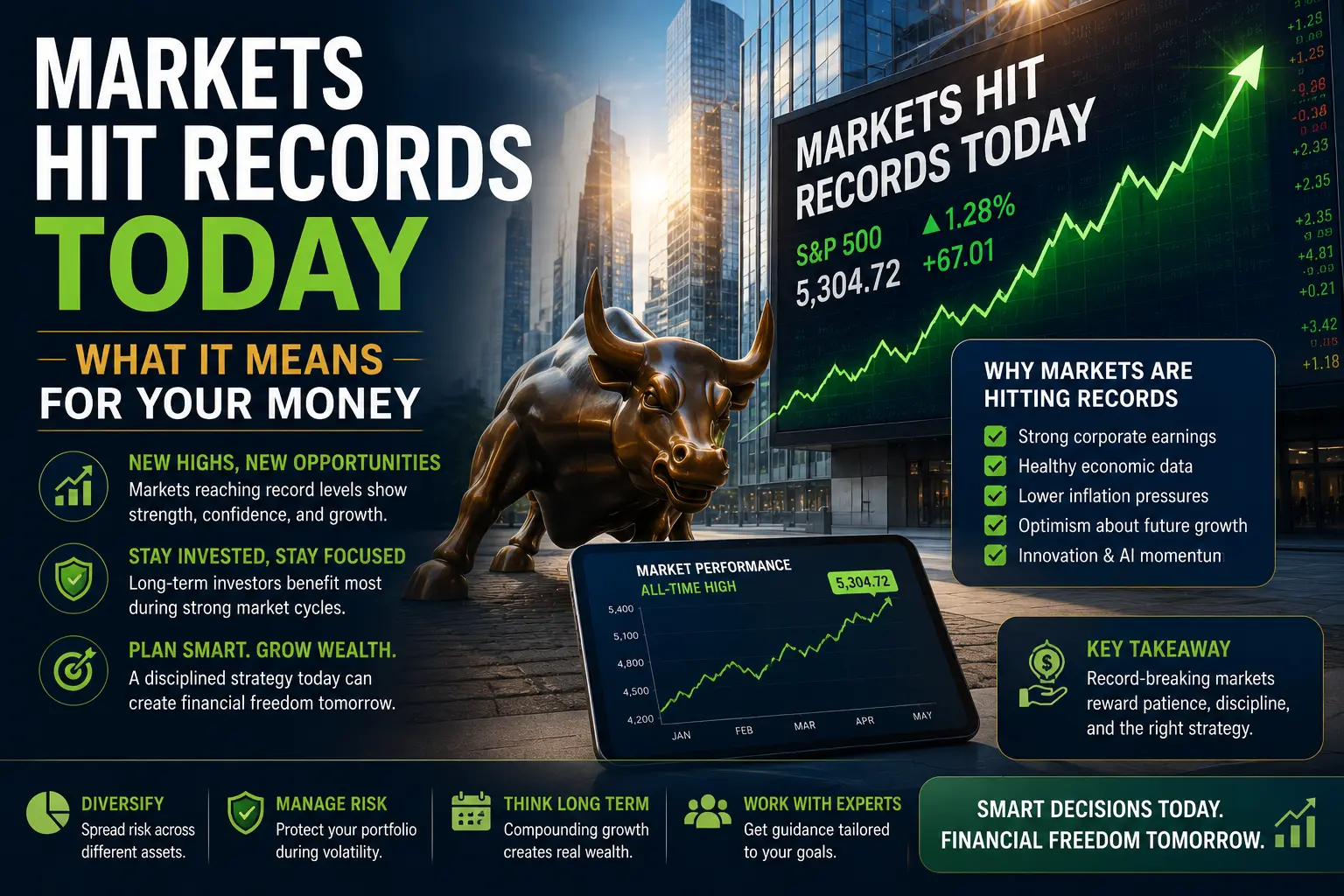
This morning, investors woke up to a remarkable set of headlines. Stock markets closed at all-time highs yesterday. The Federal Reserve is days away from its biggest leadership transition in nearly a decade. Hope is building that the Iran conflict may be nearing a resolution. And one of Wall Street’s most respected voices just issued a sobering warning about what could lie ahead in credit markets.
For anyone managing investments, planning for retirement, or making important financial decisions, today is a day that demands a clear-headed, informed response — not a reaction driven by headlines.
Here is exactly what is happening, what it means, and what smart investors should be doing right now.
The Markets: Records, Relief and Cautious Optimism
Let’s start with the headline that will dominate financial news today. The S&P 500 advanced 1.46% to 7,365.12 yesterday while the Nasdaq Composite gained 2.02% to close at 25,838.94 — both indexes touching new all-time highs. The Dow Jones Industrial Average added 612 points, closing just under 49,911.
What sparked this? Stocks surged following reports that the U.S. and Iran were nearing an agreement to end the war — a development that would remove one of the most significant sources of market uncertainty in 2026. According to reports, the proposed agreement would include a moratorium on nuclear enrichment, and an Iranian foreign ministry spokesperson confirmed to CNBC that Iran was evaluating a U.S. proposal toward a resolution.
Markets love the removal of uncertainty. And after months of geopolitical tension, rising energy prices, and bond market volatility caused by the Iran conflict, even the possibility of a deal is enough to drive a significant risk-on rally.
Industrials led sector gains rising 2.7%, followed by information technology up 2.2%, and materials gaining 2.1%. The only two sectors in the red were energy — down 4.2% — and utilities, which fell 1.2%. This pattern makes intuitive sense: a potential Iran deal means lower oil prices, which hurts energy stocks but gives everything else room to breathe.
South Korea’s Kospi also closed at a record, advancing 6.45% and building on more than 70% annual gains — while Samsung Electronics crossed $1 trillion in market capitalisation for the first time. Global markets are reflecting the same optimism.
For investors, this is encouraging — but it is also a moment to stay disciplined. A potential deal is not a confirmed deal. As President Trump himself signalled, a resolution with Iran remains a “perhaps, a big assumption.” Euphoric rallies built on hope rather than confirmed reality have a habit of reversing quickly.
The Fed: A Historic Leadership Transition Is Days Away
While markets celebrate record highs, something equally significant is unfolding at the Federal Reserve — and its implications for your financial planning and investment management strategy are profound.
In what may have been Chair Jerome Powell’s final meeting at the helm, the Federal Open Market Committee voted last week to hold the benchmark federal funds rate steady in a range of 3.50% to 3.75% — marking the third consecutive meeting where the committee chose to hold rates unchanged.
This was universally expected. But the context around it was anything but routine.
The Senate Banking Committee this week advanced Trump’s nomination of Kevin Warsh as the next Fed chair in a party-line vote, with the full Senate widely expected to follow — setting up the Fed’s first leadership change since Powell took over in 2018.
What does a new Fed chair mean for your money? Potentially quite a lot. Whenever there is a Fed transition, Treasury yields, duration risk, and credit spreads usually move faster as markets begin to reassess monetary policy. Even when there is no immediate policy move, markets start pricing in the future quickly — and a new Fed chair can change communications style and alter the pace of future rate decisions.
Once a new chair is in seat, the Fed may seek to cut interest rates one or two times to bring overnight rates closer to the 3% to 3.25% range — though any changes will depend on how inflation and employment data evolves.
For investors with significant fixed income holdings, this transition period deserves particular attention. If investors are loaded up on longer-dated bonds expecting rate cuts, they may be vulnerable if those cuts arrive late or not at all — and the 10-year Treasury has already swung sharply this year, with its current yield over 4%.
This is precisely where working with a qualified financial advisor who understands fixed income positioning can protect your portfolio management strategy from avoidable risk.
Jamie Dimon’s Warning — Don’t Ignore It
Amid all the market celebration, one voice is urging serious caution. JPMorgan CEO Jamie Dimon warned this week: “We haven’t had a credit recession in so long, so when we have one, it would be worse than people think. It might be terrible.”
Dimon is not known for empty rhetoric. His warning reflects a growing concern among senior financial figures about the build-up of risk in credit markets — particularly at a time when corporate spreads remain relatively tight, meaning investors have not been paid significantly more for taking on additional risk in bonds beyond risk-free treasury rates. That dynamic can become more problematic late in the cycle if economic and credit weakness grows.
This does not mean a credit crisis is imminent. But it does mean that now is an excellent time to review your fixed income exposure with a trusted financial consultant, ensure your portfolio management strategy is not overly concentrated in credit risk, and make sure your overall financial planning framework is built to withstand a deterioration in credit conditions if one materialises.
In wealth management, the advisors who serve their clients best are not those who simply celebrate good news — they are those who help clients prepare for risk that others are not yet talking about.
The Dollar Is Weakening — And What That Means for Investors
Today’s financial picture also includes an important development in currency markets. In FX markets today, the dollar is weakening against major peers — particularly the euro and the yen — on the risk-on backdrop, with press reports suggesting that the yen’s appreciation may also be due to new official intervention to support the currency.
A weakening dollar has meaningful implications for investors across multiple asset classes:
International investments become more attractive. When the dollar weakens, returns from international equities and bonds become more valuable when converted back to dollars. This reinforces the case for genuine portfolio management diversification across geographies — something that has already been delivering results for internationally diversified investors in 2026.
Commodities typically benefit. Gold and other commodities priced in dollars tend to rise when the dollar weakens. For investors with commodity exposure in their investment management strategy, this is a positive development in the short term.
Inflation risk increases. A weaker dollar makes imports more expensive, which can add to inflationary pressure — giving the Fed even more reason to keep rates steady or move cautiously on any future cuts.
For a comprehensive wealth management strategy, currency exposure is a dimension that is easy to overlook — but one that a skilled financial advisor will incorporate into your overall asset allocation framework.
The AI Boom Continues — With a New Manufacturing Dimension
Beyond the macro picture, today brings further evidence of the AI investment wave that is driving so much of 2026’s market momentum. Nvidia is partnering with glassmaker Corning for three new advanced manufacturing facilities in North Carolina and Texas dedicated entirely to optical technologies — creating at least 3,000 jobs and increasing Corning’s U.S. optical manufacturing capacity by tenfold. Corning shares soared 17% on the announcement while Nvidia stock gained nearly 2%.
This development matters beyond the individual stock moves. It signals that the AI investment cycle is moving from software and chips into physical infrastructure — a broadening of the theme that has historically been associated with a more durable, multi-year investment cycle rather than a short-lived bubble.
For investors building investment management strategies around AI exposure, this broadening is important. The opportunity is no longer limited to a handful of hyperscaler tech names — it is expanding into industrial manufacturing, energy infrastructure, real estate, and beyond.
What Smart Investors Are Doing Today
Given everything happening in markets right now — record highs, Fed transition, Iran deal hopes, dollar weakness, a credit warning from Jamie Dimon, and an expanding AI boom — what does a genuinely intelligent response look like?
Stay invested but stay diversified. Record highs are not a signal to exit markets — but they are a signal to ensure your portfolio management is genuinely balanced rather than concentrated in any single theme, sector, or geography. The risk of a sharp pullback increases as euphoria builds.
Review your fixed income positioning today. The Fed transition and the possibility of delayed rate cuts make this one of the most important moments in years to assess your bond duration, credit exposure, and overall fixed income strategy. A qualified financial advisor can help you position this part of your portfolio intelligently.
Don’t let geopolitical optimism lower your guard. A potential Iran deal is positive — but “potential” is not “confirmed.” Maintaining appropriate defensive positioning in your wealth management strategy ensures you benefit from the upside while remaining protected if negotiations fail.
Take Dimon’s warning seriously. When the CEO of the world’s largest bank issues a credit warning, it deserves attention. Review your credit exposure, understand your risk profile, and ensure your financial planning framework accounts for a range of economic scenarios — not just the optimistic one.
Make tax efficiency a priority. Total individual tax refunds reached $309 billion as of late April 2026 — up 16% from the comparable 2025 level and about $44.2 billion higher year-over-year. With significant capital flowing back into household finances, this is an ideal moment to review how that money is being deployed within a tax planning framework that maximises its long-term value.
Final Thoughts
May 7, 2026 is a day of genuine financial significance. Markets are celebrating, the Fed is transitioning, a war may be approaching resolution, and the AI economy continues its remarkable expansion. For disciplined investors with a clear financial planning strategy, this environment is full of opportunity.
But opportunity without strategy is just noise. The investors who will look back on this period with satisfaction are those who are working with trusted financial advisors right now — not reacting to headlines, but executing a long-term wealth management plan built for exactly this kind of complex, fast-moving world.
At Synergistic Financial Advisors, we help individuals, families, and businesses cut through the noise of days like today and make decisions grounded in strategy, expertise, and a genuine understanding of your goals. From investment management and portfolio management to retirement planning, tax planning, and comprehensive wealth management — we are here to help you move forward with confidence.
Want to understand what today’s market movements mean for your personal financial plan? Contact Synergistic Financial Advisors today for a personalised consultation.