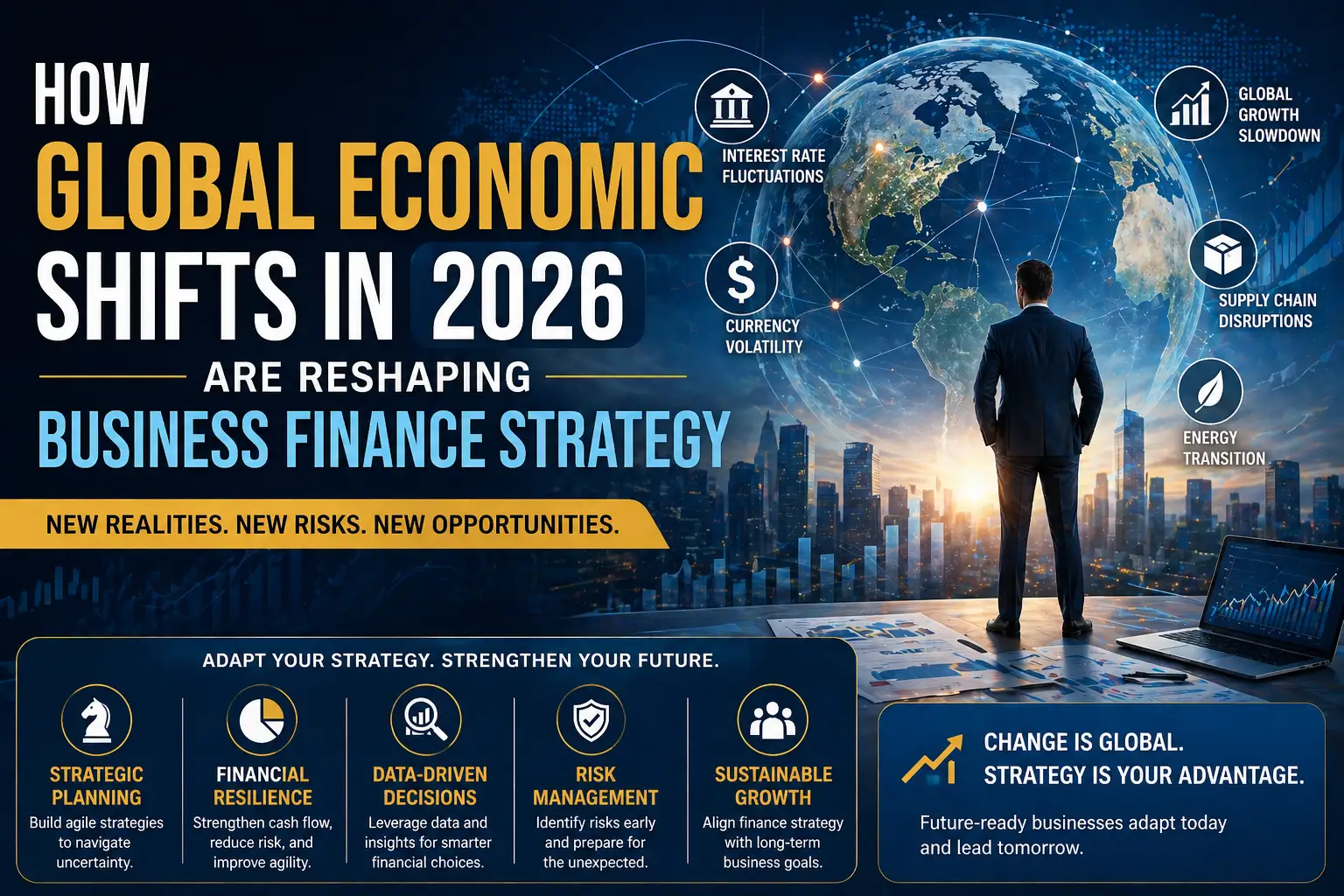
The global economy in 2026 is not broken — but it is under significant pressure. Trade tensions, geopolitical instability, rising AI investment, and uneven growth across regions are creating a financial landscape that is more complex than anything most businesses have navigated in recent memory. For business owners, corporate leaders, and investors, understanding these shifts isn’t just interesting — it’s essential for survival and growth.
This is exactly where strategic financial planning and expert financial advisory services become not just valuable, but critical.
The Big Picture: Where the Global Economy Stands Right Now
Global GDP growth in 2026 is projected at 2.7%, broadly in line with 2025 — reflecting continued resilience even as momentum remains uneven across regions. On the surface, that sounds stable. But dig deeper and a more complex story emerges.
Economic growth in 2026 is increasingly reliant on a narrower set of drivers than in past cycles — particularly AI-driven investment, supportive fiscal policy, and confidence in financial markets — and each of those comes with new constraints.
For business owners and corporate clients, this matters enormously. A surface-level reading of “global growth continues” can mask serious risks that affect your cash flow, investment decisions, and long-term financial planning strategy.
The IMF has revised its global growth forecast to 3.1%, down from 3.4% in 2025, citing a major new test from conflict in the Middle East, with the forward view remaining highly uncertain. The message is clear: the global economy is resilient, but fragile — and businesses that don’t plan accordingly will feel it.
Trade Disruption Is Reshaping Business Finance
One of the most significant forces reshaping corporate financial management in 2026 is the new global trade order. The United States raised significant barriers to trade in recent years, disrupting supply chains and creating financial market volatility — and while trade deals have since been struck with numerous countries, these come at higher costs.
For businesses with international exposure — whether through imports, exports, or global supply chains — this has direct implications:
- Input costs are rising, pressuring margins and requiring sharper financial management
- Currency volatility is creating new risks for cross-border transactions
- Supply chain restructuring is forcing capital reallocation decisions
Beneath the surface of steady global growth, major structural shifts — trade protectionism, the AI boom, and active fiscal policy — are shaping fundamentally different realities across countries, sectors, and cities.
This is not a time for passive financial strategy. Business owners need a proactive financial consultant who can help them read these signals early and adjust their portfolio management and corporate finance structure accordingly.
AI Is Changing How Businesses Invest — and the Risks That Come With It
Perhaps no trend is more dominant in 2026 than the rise of artificial intelligence in business finance. Investment in AI and generative AI continues to be the most reported high priority for business leaders, particularly in technology, media, telecommunications, and professional financial services. McKinsey & Company
Banks are scaling more autonomous AI systems into core operations, and there is a continuing shift towards private credit as companies seek faster, more flexible funding amid tighter bank capital rules and lending standards.
For SMEs and corporate clients, this creates both opportunity and risk. On one hand, AI tools are improving investment management efficiency and opening access to smarter financial products. On the other hand, elevated interest rates, rapidly rising input costs, and policy uncertainty are causing many companies to remain hesitant to invest — even as AI hyperscalers push aggressive capital expenditure plans.
The key for any business is making sure technology investment decisions are grounded in solid financial planning — not just trend-chasing. A qualified financial advisor or financial consultant can help you evaluate whether AI-related investments align with your cash flow, risk profile, and long-term business goals.
Geopolitical Instability Is the New Business Risk
Survey respondents in 2026 no longer see changes in trade policy as the foremost disruptor of business — instead, they point to geopolitical instability as the principal risk.
New allegiances, shifting trading blocs, and heightened strategic pressures are adding to the complexities for businesses trying to navigate this new world order.
What does this mean in practical terms for business finance?
Market volatility is harder to predict. Traditional models for investment management need to account for geopolitical risk in ways they haven’t had to before. Portfolios that looked well-diversified a few years ago may now carry concentrated exposures that need to be reassessed.
Capital flows are fragmenting. The WEF’s Global Risks Report 2026 describes an “age of competition” marked by geopolitical tension and fragmented capital flows. For businesses raising capital or managing foreign investments, this creates new complexities around wealth management and treasury strategy.
Planning horizons are shortening. In an environment of high uncertainty, businesses need more frequent financial reviews and more agile financial planning frameworks — not annual strategy sessions that become outdated within months.
What Smart Businesses Are Doing Differently in 2026
The most financially resilient businesses in 2026 share a few common characteristics. They are not simply reacting to economic shifts — they are anticipating them with the help of expert financial advisory support.
They are stress-testing their financial plans. Rather than planning for a single economic scenario, they are working with financial advisors to model multiple outcomes — including recession scenarios, interest rate shifts, and demand contractions — and building strategies that remain viable across each.
They are revisiting their capital structure. Private credit is currently reshaping a $41 trillion addressable credit market, with private funds on track to replace a meaningful share of traditional bank lending. Smart businesses are exploring whether private credit, alternative financing, or restructured debt offers better terms and flexibility than traditional bank loans.
They are prioritising tax efficiency. In an environment of rising costs and compressed margins, tax planning is one of the highest-return activities any business can engage in. Reducing your effective tax rate by even a few percentage points can have a significant impact on profitability and free cash flow.
They are aligning personal and business financial goals. For business owners in particular, the line between personal wealth management and business finance is often blurry. The best outcomes come from a coordinated strategy that optimises both simultaneously — something a skilled financial advisor is uniquely positioned to deliver.
The Role of a Financial Advisor in a Complex Business Environment
There has never been a more important time for businesses to have a trusted financial advisor in their corner. The economic environment of 2026 demands more than a bookkeeper or a basic accountant — it demands strategic financial planning, proactive investment management, and expert guidance on navigating the risks and opportunities that this moment presents.
Whether you are a growing SME looking to scale efficiently, a corporate client managing complex multi-entity finances, or a business owner approaching a major transition such as a sale, acquisition, or succession — the right financial consultant can make the difference between thriving and simply surviving.
Business leaders who are ending 2025 on an optimistic note are anticipating stronger demand and profits in 2026 as they turn their attention toward customers and technology investments. But optimism without strategy is just hope. Strategy backed by expert financial advisory is what actually delivers results.
Final Thoughts
The global economic landscape of 2026 is one of “teetering resilience” — growth is holding, but the foundations are uneven, and the risks are real. For businesses that approach this environment with a clear financial planning framework, a diversified portfolio management strategy, and the guidance of a qualified financial advisor, the opportunities are significant.
For those who don’t — the costs of being caught unprepared are equally significant.
At Synergistic Financial Advisors, we specialise in helping businesses and individuals navigate exactly this kind of environment. From investment management and tax planning to comprehensive wealth management and corporate finance strategy, our team brings the expertise and insight you need to move forward with confidence in 2026 and beyond.
Ready to align your business finances with today’s economic reality? Contact Synergistic Financial Advisors today and let’s build a strategy that works — whatever the market brings next.