Wednesday, 14 May 2026
Today is a day investors will remember.
Three events are unfolding simultaneously right now that each, on their own, would dominate financial headlines for weeks. Together they represent one of the most consequential days in financial markets in years — and every investor, business owner, and anyone managing their financial future needs to understand exactly what they mean for their money.
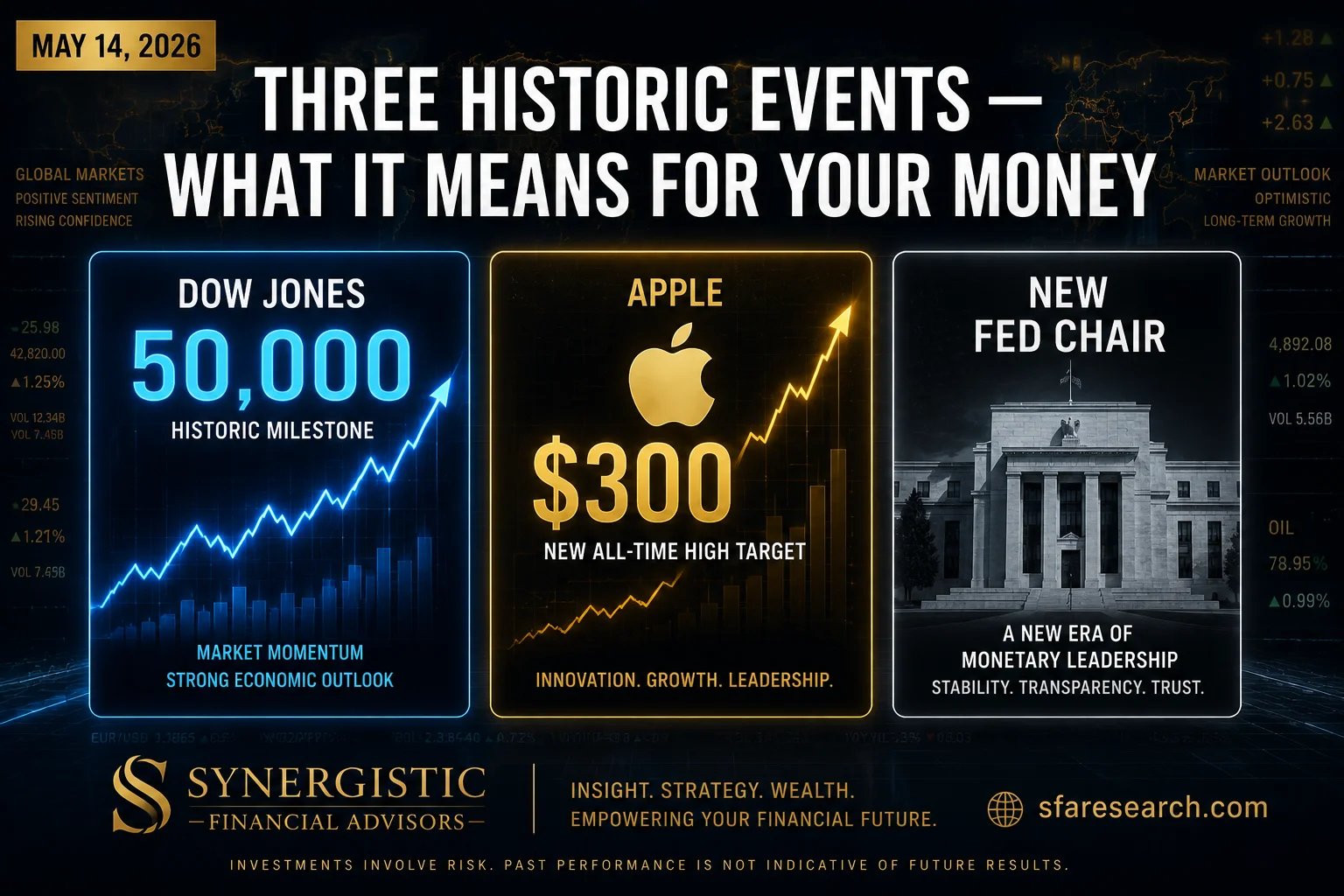
Kevin Warsh has just been confirmed as the new Chair of the Federal Reserve — the first leadership change at America’s most powerful financial institution since 2018. Dow Jones futures are touching the historic 50,000 level for the first time ever. Apple has crossed $300 per share — an all-time high for the most valuable company in the world. And President Trump is sitting in Beijing with Nvidia CEO Jensen Huang, negotiating the future of AI, trade, and global financial stability with President Xi Jinping.
This is not a normal day. And it demands anything but a normal response from investors.
Here is exactly what is happening — and precisely what it means for your financial planning, your investment management strategy, and your long-term wealth management goals.
The Fed Has a New Chair — And Markets Are Already Reacting
The single most significant financial event of the day — and arguably of 2026 — is the confirmation of Kevin Warsh as the new Federal Reserve Chair. Senate lawmakers voted to confirm Kevin Warsh as the next chair of the Federal Reserve on Wednesday, with Jerome Powell’s term as head of the US central bank set to expire this Friday, May 15 — with Powell planning to stay on the Fed’s Board of Governors.
This is a historic transition. Powell has led the Fed through the pandemic, the sharpest rate hiking cycle in forty years, and the complex, volatile economic environment of 2025 and 2026. His departure marks the end of an era — and the beginning of one whose direction investors are now urgently trying to read.
What do we know about Warsh’s likely approach? Annual Consumer Price Index gains have topped estimates, sending odds of a rate hike much higher and wiping out most chances of a 2026 rate cut in futures trading — and the 10-year Treasury yield is nearing its 2026 high, closing at 4.46% with the high of 4.48% set in March. This is the economic environment Warsh inherits — sticky inflation, elevated yields, and a market that has priced out rate cuts almost entirely.
The hot PPI data released yesterday is sending yields sharply higher — with the headline monthly PPI rising 1.4% and core PPI surging 1%, far above the consensus estimates of 0.4% and 0.3% respectively. As Cooper Howard, director of fixed income research at the Schwab Center for Financial Research noted: the headline number was bad, but stripping out energy costs still shows there is inflation in the pipeline.
This matters profoundly for your financial planning strategy right now. A new Fed chair inheriting an inflation problem — with PPI running hot, CPI at 3.8%, and energy prices elevated by the Iran conflict — faces a genuinely difficult policy environment. Rate cuts are not on the table. The possibility of rate hikes has re-entered market conversation.
For anyone with fixed income exposure, mortgage decisions pending, or retirement planning projections built on lower rate assumptions — today’s Fed transition is the single most important reason to schedule an urgent review with a qualified financial advisor. The rate environment your strategy was built for may no longer be the rate environment you are living in.
Dow Futures Touch 50,000 — What This Milestone Actually Means
Dow futures are at 50,000 this morning — up 208 points at 0.42% — with S&P futures at 7,484 and Nasdaq futures at 29,556. The Dow touching 50,000 is not just a number. It is a psychological milestone that marks an extraordinary chapter in financial market history.
To put it in context: the Dow crossed 10,000 in 1999. It crossed 20,000 in January 2017. It took another four years to reach 30,000 in November 2020. And now, in May 2026, it is touching 50,000 — a level that would have seemed extraordinary just five years ago.
But here is what every serious investor needs to understand about round-number milestones: they are psychologically powerful and fundamentally meaningless at the same time. The Dow at 50,000 does not tell you whether markets are cheap or expensive. Roughly two-thirds of the S&P 500 were lower during yesterday’s session even as the index set a new record — a clear signal that the rally is becoming increasingly narrow and concentrated in a handful of technology and AI names rather than broad-based across the economy.
This narrowing breadth is one of the most important warning signals in today’s market. When index records are driven by a small number of mega-cap names while the majority of stocks are declining, it creates a misleading picture of market health. For portfolio management purposes, it means that passive index exposure is increasingly concentrated in a few names — and that genuine diversification requires deliberate, active management rather than simple index tracking.
A skilled financial advisor can help you assess whether your current portfolio management strategy is genuinely diversified or simply riding the concentration risk of a narrow AI-driven rally.
Apple Crosses $300 — And What the AI Trade Is Really Telling Investors
Apple shares touched the $300 per share level for the first time on Wednesday, hitting a new intraday high of $300.49 — a landmark moment for the most valuable company in the world, with the stock on track to finish the day up 1.8%
Apple at $300 is a milestone that reflects something much larger than one company’s performance. It reflects the market’s extraordinary confidence in the AI-driven technology cycle that is reshaping every major sector of the global economy — from semiconductors and cloud computing to financial services, healthcare, and industrial automation.
Before the PPI data, stocks received a significant lift after Bloomberg reported that Nvidia CEO Jensen Huang would join President Trump in Beijing — signalling that AI technology is now at the centre of US-China diplomatic negotiations, not just financial markets. When the CEO of the world’s most important AI chipmaker joins a presidential summit in Beijing, it tells you everything about how central artificial intelligence has become to global economic and geopolitical strategy in 2026.
The PHLX Semiconductor Index has risen 64% since the end of March — an extraordinary run that is going against the traditional grain of rising yields normally making investors more cautious about riskier tech stocks. The AI data centre build-out and its possible impact on chipmakers’ future earnings is for now overriding traditional valuation signals.
For investors, the Apple $300 milestone and the semiconductor boom raise a critical question for investment management strategy: how much AI exposure is appropriate, and at what price? The earnings growth driving these companies is genuine and substantial. But at current valuations — with the S&P 500 trading at 20.9 times forward earnings — any stumble in the AI narrative will be punished severely.
The answer is not to avoid AI exposure. It is to size it appropriately within a diversified portfolio management framework — one that captures the upside of the technology cycle while building genuine protection against the valuation risk that record prices always carry.
Trump and Xi in Beijing — What the Summit Means for Your Portfolio
While domestic markets absorb the Fed transition and tech records, the most geopolitically significant financial event of the week is unfolding in Beijing. Global stocks are hovering near record highs as traders await further news from the China-US summit — with President Trump and President Xi Jinping meeting in Beijing. While Trump described the talks as “great,” markets have barely budged, suggesting investors want concrete outcomes rather than positive language.
The stakes of this summit for investors are enormous. The IMF says global growth may reach around 3.3% in 2026 but warns that tariffs are still slowing trade and raising inflation risks — with China’s growth projected near 4.2% to 4.5%, supported by shifts in exports to Asia and Europe.
The tariff truce struck on May 12 — reducing US tariffs on Chinese goods from 145% to 30% — was an important first step. But the deeper structural issues around AI technology transfer, semiconductor export controls, rare earth access, and China’s role in the Iran conflict remain unresolved. What emerges from Beijing in the coming hours will shape supply chain costs, corporate earnings guidance, and investment management strategy for the remainder of 2026.
For investors with exposure to technology, consumer goods, industrials, or emerging markets — the outcome of this summit is a material event that deserves active monitoring and a pre-planned response framework built with your financial advisor.
The Safe Haven Puzzle — Gold, Bonds and the Inflation Problem
One of the most fascinating and practically important stories in today’s market is the breakdown of traditional safe haven assets. UBS strategists note that the search for reliable safe havens has become increasingly difficult in this year’s volatile markets — with traditional diversifiers failing to provide consistent protection across recent bouts of stress. Havens that performed well during last year’s tariff-driven selloff — including gold, the yen, the euro, and government bonds — failed to shield investors during the latest oil-driven volatility.
Assets that gained during the 2026 oil shock, including a broad commodity index and the trade-weighted dollar, did little to offset losses in the earlier tariff-driven episode — leaving the US dollar as the closest thing to a reliable refuge, though even that signal may be overstated.
This is a genuinely important development for wealth management strategy. The traditional 60/40 portfolio — built on the assumption that bonds provide reliable protection when equities fall — is being challenged by an environment where inflation, geopolitical shocks, and policy uncertainty create correlations that conventional diversification frameworks were not designed to handle.
Gold is trading at $4,701 this morning, oil at $101.68, and the 10-year Treasury yield is at its highest levels of 2026 — a combination that tells a clear story: inflation protection, energy exposure, and duration management are the three most critical dimensions of portfolio management in today’s environment.
A certified financial planner with expertise in alternative assets, real return strategies, and dynamic asset allocation can help you build a wealth management framework that provides genuine protection across multiple shock scenarios — not just the ones that have historically been most common.
What Every Investor Must Do Today — A Clear Action Plan
Given the extraordinary convergence of events unfolding simultaneously — new Fed Chair, Dow 50,000, Apple $300, Trump-Xi summit, PPI explosion, 10-year yield at 4.48%, oil above $100 — here is the clear, disciplined action plan that a qualified financial advisor would recommend right now.
Review all interest rate assumptions in your financial plan today. With Kevin Warsh taking the helm of the Fed amid hot PPI and CPI data, rate cuts in 2026 are effectively off the table. If your retirement planning projections, mortgage strategy, or bond positioning were built on lower rate assumptions, they need immediate reassessment. This is not optional — it is urgent.
Assess your portfolio concentration honestly. With two-thirds of S&P 500 stocks falling even as the index sets records, the rally is dangerously narrow. If your portfolio management strategy is heavily weighted toward AI mega-caps after the recent extraordinary run, today’s record prices are the right moment to rebalance toward broader diversification — including international equities, dividend stocks, and real assets.
Position for inflation persistence, not transience. Both CPI and PPI are running hot. Energy prices are elevated. Food costs are surging. The new Fed Chair inherits a genuine inflation problem. Your investment management strategy needs meaningful inflation protection — through real assets, commodity exposure, inflation-linked securities, and companies with genuine pricing power.
Watch the Beijing summit outcomes closely. Any concrete progress on tariffs, AI technology agreements, or Iran-related diplomacy from the Trump-Xi meeting will have immediate market implications. Have a pre-planned response framework ready with your financial advisor so you can act on outcomes rather than react to headlines.
Do not let historic market levels create complacency. Dow 50,000 and Apple $300 are remarkable achievements — but they are also reminders that markets are priced for continued perfection. A disciplined wealth management strategy acknowledges both the genuine strength of today’s market and the real risks that elevated valuations always carry.
Final Thoughts — Why Today Changes Everything
May 14, 2026 is a day that rewrites the financial rulebook simultaneously on multiple fronts. A new Fed Chair takes the helm of monetary policy with inflation running hot. The Dow touches a number that seemed impossible a decade ago. The world’s most valuable company crosses $300. And the leaders of the two largest economies on earth are sitting across from each other in Beijing, negotiating the future of global trade, artificial intelligence, and financial stability.
For investors with a clear financial planning strategy, today is full of opportunity. For those without one, today is full of risk that is invisible until it is too late.
At Synergistic Financial Advisors, we help individuals, families, and businesses navigate precisely these kinds of historic, complex market moments with clarity, discipline, and a personalised strategy built around your specific goals. From investment management and portfolio management to retirement planning, tax planning, and comprehensive wealth management — our expert team is here to make sure today’s extraordinary events work for your financial future, not against it.
Want to know exactly what the new Fed Chair, Dow 50,000, and today’s market moves mean for your personal financial plan? Contact Synergistic Financial Advisors today for a consultation built around your goals — because today is precisely the kind of day when the right financial advisor makes all the difference.