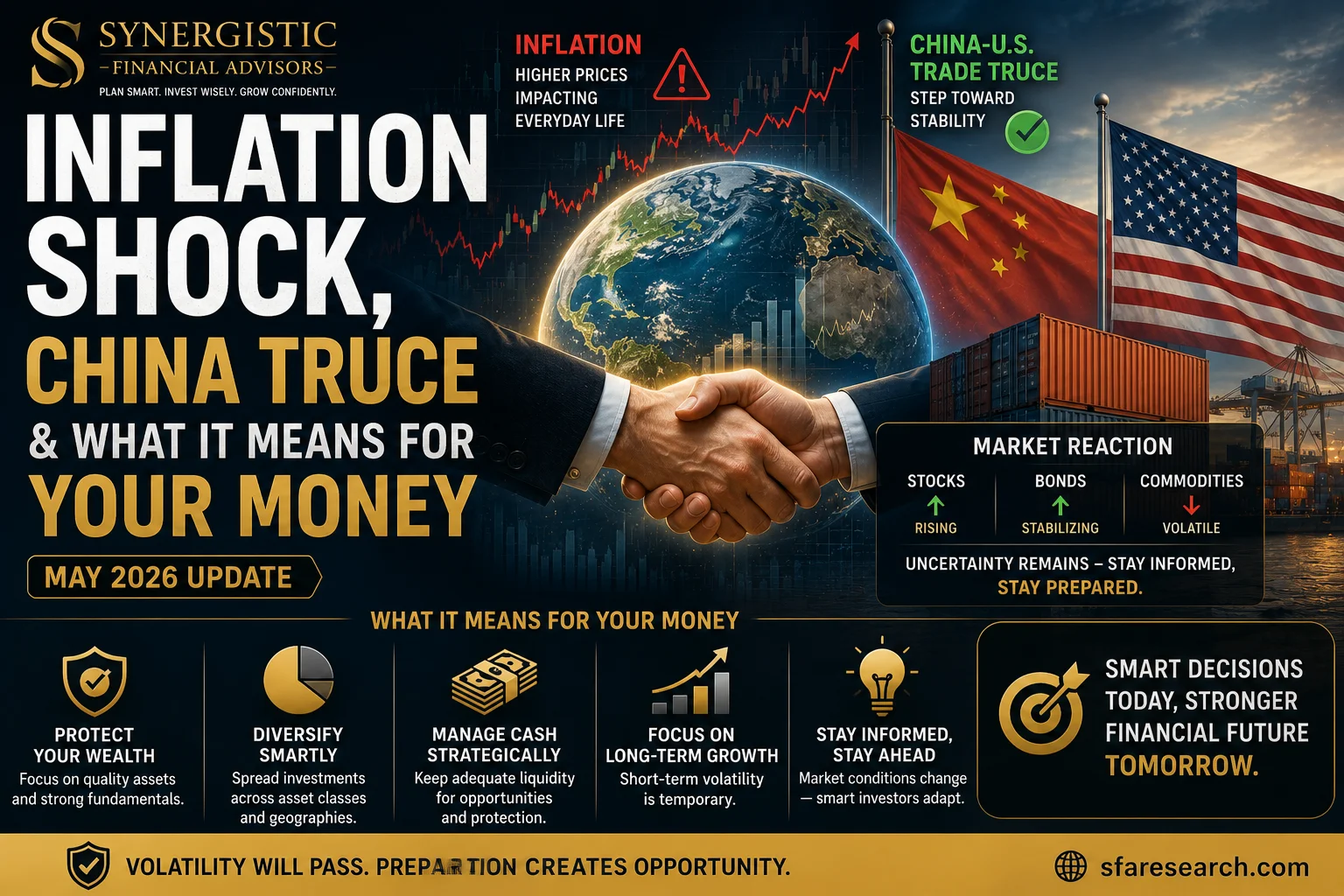
Today is one of the most financially significant days of 2026 — and most people are completely unprepared for what it means for their money.
In the last 24 hours alone: US inflation has come in hotter than expected at 3.8% — its highest reading since May 2023. President Trump is sitting in Beijing right now negotiating a historic tariff truce with China. Oil is back above $102 a barrel. Gold has surged to an extraordinary $4,724. Chip stocks just suffered their worst single-day decline since 2020. And the Iran ceasefire has been declared “on life support.”
For investors, business owners, and anyone managing a financial planning strategy, this is not background noise. This is a moment that will reshape portfolios, change retirement planning projections, and create both serious risks and serious opportunities for those paying attention.
Here is exactly what is happening — and precisely what you should be doing about it.
Breaking Now — Inflation Just Came in Hotter Than Expected
Let’s start with the number dominating every financial desk this morning. The consumer price index rose by 3.8% annually in April — the highest reading since May 2023, beating economist expectations of 3.7%. Excluding food and energy, core inflation came in at 2.8% annually.
This is not the number the Federal Reserve wanted to see. And it is not the number investors were positioned for.
The hotter-than-expected inflation reading sent investors into risk-off mode — with chip stocks dropping sharply, pulling back from a massive recent rally. Qualcomm plummeted 13% in its worst session since 2020. Intel dropped 8%. On Semiconductor and Skyworks Solutions each declined more than 6%. The iShares Semiconductor ETF tracking the sector sank 5%
Why such a sharp reaction? Because inflation above 3.5% makes Fed rate cuts increasingly unlikely in the near term. Capital Economics chief North America economist Stephen Brown specifically flagged renewed food inflation as a key concern — noting that the 2.1% monthly rise in electricity prices, 0.5% gain in monthly food prices, and a stunning 15% monthly jump in tomato prices for the second consecutive month all point to inflation pressures that are proving stickier than markets had hoped.
For your investment management strategy, this matters enormously. Markets had been pricing in rate cuts later in 2026. Hot inflation data pushes that timeline further out — keeping borrowing costs elevated, pressuring growth stock valuations, and forcing a genuine reassessment of fixed income positioning across every serious portfolio management framework.
What this means for you right now: If you have been waiting for rate cuts to refinance debt, buy property, or shift into longer-duration bonds — that timeline has just extended. Review your interest rate assumptions with a qualified financial advisor today.
Trump Is in Beijing — And a US-China Tariff Truce Has Just Been Struck
While inflation dominates domestic headlines, the most geopolitically significant financial story of the year is unfolding in Beijing right now. President Trump’s much-watched trip to China is now formally underway — with the president aiming to deliver incremental progress on issues including tariffs, communication around artificial intelligence, and China’s role in the war in Iran.
And in a development that will move markets significantly when it is fully absorbed: on May 12, the US and China reached a tariff truce — with the US reducing tariffs on Chinese goods from 145% to 30%, while China responded by reducing its tariffs on US products from 125% to 10%.
To put this in context — the Trump tariffs had represented the largest US tax increase as a percentage of GDP since 1993, amounting to an average tax increase per US household of $1,500 in 2026. The reduction from 145% to 30% on Chinese goods is therefore not a minor adjustment — it is a historic reversal that removes a significant layer of cost pressure from businesses and consumers simultaneously.
For investors, this truce has several immediate implications. Supply chain costs for businesses with Chinese manufacturing exposure will fall meaningfully. Consumer goods prices — which had been elevated by tariff pass-through — face downward pressure. And corporate earnings guidance for the second half of 2026 may be revised upward as input cost assumptions improve.
Apple is among the most direct beneficiaries — having already moved much of its iPhone production to India after incurring approximately $900 million in tariff-related costs. The tariff reduction now makes its remaining China-linked supply chain significantly more cost-efficient.
For wealth management strategies with meaningful exposure to consumer discretionary, technology hardware, and industrial sectors — this is unambiguously positive news that deserves active portfolio review to ensure you are positioned to benefit.
Oil at $102 and Gold at $4,724 — What These Numbers Are Telling You
Two commodity prices are sending powerful signals today that every serious investor needs to understand.
Crude oil is trading at $102.08 per barrel — with Iran tensions keeping energy prices elevated even as the tariff truce provides some relief elsewhere in the inflation picture.
The Iran conflict has reached an unusual state where the formal ceasefire holds but the economic standoff continues. Iran has retained the ability to selectively close or condition traffic through the Strait of Hormuz, the US is maintaining a naval blockade of Iranian ports, and the underlying disputes remain unresolved — creating a persistent energy price premium that is unlikely to disappear quickly.
Meanwhile, gold tells a different and equally important story. Gold is trading at $4,724 per ounce — an extraordinary level that reflects the combination of geopolitical uncertainty, dollar weakness, inflation concerns, and a global flight to stores of value that has characterised much of 2026.
For portfolio management purposes, these two commodity prices together signal something important: this is an environment where genuine inflation protection — through commodities, real assets, inflation-linked securities, and internationally diversified equities — should be a deliberate feature of every serious wealth management strategy.
If your portfolio does not have meaningful exposure to inflation-protective assets right now, today’s CPI reading and oil price should be the catalyst for an urgent conversation with your financial advisor.
S&P 500 at 7,412 — Record Highs Meeting Real Risks
Despite the inflation shock and chip stock carnage, the broader market is remarkably resilient. The three major benchmark indexes managed to finish modestly higher as investors continued pouring money into energy and AI-related stocks — with energy companies benefiting directly from the spike in oil prices and technology firms attracting buying interest on expectations that AI-driven demand will remain strong throughout 2026.
But underneath this surface resilience, the valuation tension is real — the forward price-to-earnings ratio for the S&P 500 stood at 20.9 by late April, above both the five-year average of 19.9 and the ten-year average of 18.9. Strong earnings have closed part of the valuation gap, but the index is still being priced for a continuation of the current trajectory — and any deceleration in the back half of 2026 will be less forgiving at 20.9 times forward earnings.
This is the market reality every investor needs to hold in mind simultaneously: record highs are justified by genuine earnings strength, but they leave very little margin for error. A certified financial planner who understands valuation risk and portfolio construction can help you participate in the upside of this market while building genuine protection against the downside scenarios that elevated valuations always carry.
What the Smartest Investors Are Doing With Their Money Today
Given the extraordinary convergence of forces active in today’s market — inflation shock, China tariff truce, oil above $102, gold at record levels, chip stock selloff, and S&P 500 near all-time highs — here is the disciplined, evidence-based response that a qualified financial advisor would recommend right now.
Reassess your tech and semiconductor exposure immediately. The chip stock selloff today is not simply noise. It reflects a genuine repricing of rate cut expectations in response to hot inflation. If your portfolio management strategy is heavily overweight semiconductors after the recent massive rally, today is the day to review whether that concentration aligns with your risk tolerance given the inflation picture.
Capture the China truce opportunity in consumer and industrial stocks. The tariff reduction from 145% to 30% is a material improvement for businesses with China supply chain exposure. Consumer discretionary, technology hardware, and select industrial names all benefit directly. A financial consultant can help you identify the most efficient way to position for this development within your existing portfolio structure.
Strengthen your inflation protection. Today’s 3.8% CPI reading is a clear signal that inflation is not yet under control. The single most important structural difference between 2026 and the 1970s is how much oil it takes to produce a unit of economic output — with the oil intensity of US GDP having declined by more than 50% since 1973 — meaning an identical oil price shock today produces a meaningfully smaller drag on GDP than it would have fifty years ago. But smaller does not mean zero. Real assets, commodity exposure, and inflation-linked bonds deserve active consideration in your financial planning strategy right now.
Recalibrate your retirement projections. Longer-term inflation expectations remain near the Federal Reserve’s 2% target despite the current spike — but today’s data is a reminder that retirement planning projections built on optimistic inflation assumptions may need stress-testing. Healthcare costs, energy bills, and food prices are all running above headline averages for many households. A certified financial planner can rebuild your retirement projections around realistic, personalised inflation assumptions rather than optimistic averages.
Review your fixed income duration. Hot inflation data today means the Fed is almost certainly on hold for longer than markets expected even last week. Longer-duration bonds face headwinds in this environment. If your investment management strategy includes significant long-duration fixed income exposure, review whether your duration positioning is appropriate for a higher-for-longer rate environment that today’s data reinforces.
Don’t panic-sell quality positions. The chip stock selloff today is dramatic — but it follows an extraordinary rally. Quality AI infrastructure companies with genuine earnings power are not in a bubble simply because inflation came in hot today. Disciplined investment management means distinguishing between short-term repricing events and fundamental changes in the investment case. Your financial advisor can help you make that distinction with clarity rather than emotion.
The Bigger Picture — Why Today Demands a Real Financial Strategy
May 13, 2026 is the kind of day that separates investors with genuine financial planning frameworks from those who are simply reacting to headlines.
Three enormous forces are colliding simultaneously right now. Inflation is proving stickier than hoped — keeping borrowing costs elevated and pressuring rate-sensitive assets. The US-China tariff truce is removing a significant cost burden from businesses and consumers — creating real earnings upside in the second half of 2026. And the Iran conflict is sustaining an energy price premium that is feeding through to every household and business in the global economy.
These forces are not cancelling each other out. They are creating a genuinely complex, genuinely opportunity-rich environment — one that rewards investors with clear, disciplined strategies and punishes those without one.
At Synergistic Financial Advisors, we help individuals, families, and businesses navigate exactly this kind of day with confidence and clarity. From investment management and portfolio management to retirement planning, tax planning, and comprehensive wealth management — our team is here to turn today’s complexity into a clear, personalised action plan built around your goals.
Want to understand exactly what today’s inflation shock, China tariff truce, and oil price surge mean for your personal financial plan? Contact Synergistic Financial Advisors today for a consultation built around your specific situation — because days like today are precisely when the right financial advisor makes the most difference.