Three days ago, everything looked perfect.
Markets were at record highs. Goldman Sachs had just called for S&P 8,000 by year-end. Oil had crashed to $88 on Iran peace hopes. The Medline IPO surged 31% on 10 times oversubscription. The SpaceX IPO roadshow was building extraordinary demand. And investors were celebrating what felt like the most powerful bull market in a generation.
Then Friday happened.
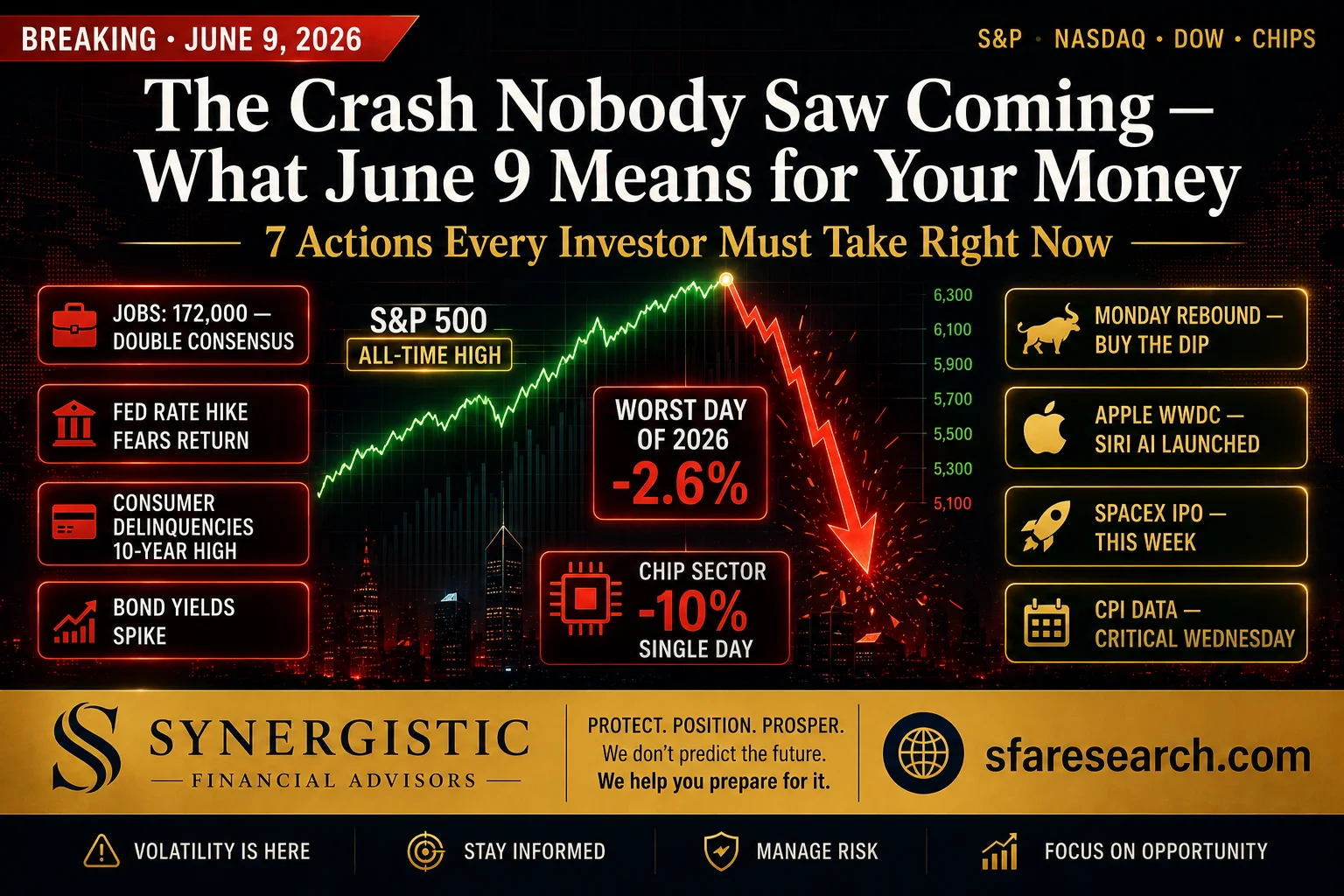
The S&P 500 Index dropped more than 2.6% on Friday to end a nine-week win streak — after May jobs growth of 172,000 doubled consensus expectations. Treasury yields spiked on fears the economy might be overheating, raising odds of the Federal Reserve hiking rates.
The chip sector suffered a 10% plunge — making Friday Wall Street’s worst day of the year. With key CPI inflation data due later this week, stocks rebounded Monday on a chip rally after Friday’s heavy tech selloff. Signs of tension calming in the Middle East also helped.
One jobs number. Double the expected. And the market that had been celebrating “everything is perfect” suddenly had to confront the possibility that “everything is perfect” might actually be the problem.
Welcome to June 9, 2026. This is the most important blog you will read this week — because what happened on Friday, what is happening today, and what is coming this week will determine the direction of financial markets for the remainder of the year. And every investor, business owner, and individual with a financial planning strategy needs to understand exactly what it means for their money right now.
What Actually Happened on Friday — The Jobs Report That Changed Everything
To understand the significance of Friday’s selloff, you need to understand why a strong jobs report caused the worst market day of the year.
May jobs growth of 172,000 doubled consensus expectations — a number so strong it immediately raised fears that the economy is overheating and that the Federal Reserve may need to hike rather than cut interest rates.
This is the cruel paradox of 2026’s financial environment — a paradox that every serious financial advisor understands but that most individual investors are caught off guard by every time it appears. Good economic news is bad market news when inflation is the primary concern.
Here is why. The entire equity market rally of the past nine weeks has been built — in part — on the hope that new Fed Chair Kevin Warsh would eventually begin cutting interest rates. Lower rates mean higher equity valuations, cheaper corporate borrowing, and better conditions for the growth stocks that have been leading markets to record highs. That hope was already fragile after the Bessent-Warsh breakfast explicitly left rate cuts off the menu. Friday’s jobs report effectively removed the hope entirely — and replaced it with something far more uncomfortable: the possibility of rate hikes.
The bond market is pricing a less comfortable future — and oil remains the lever that could tip the whole thing. For June, the questions are easy to pose and hard to answer: Does Brent stay below $100? Does the AI complex keep delivering? And how long can equities keep ignoring the message from the long end of the curve?
These are the three questions that will determine every investment management and portfolio management decision for the remainder of June 2026. And the honest answer to all three is: nobody knows. Which is precisely why disciplined financial planning — built for multiple scenarios rather than a single optimistic forecast — has never been more valuable.
The Chip Sector’s 10% Plunge — What It Reveals About Today’s Market
The most dramatic story within Friday’s selloff was the semiconductor sector’s extraordinary 10% single-day decline. And understanding what drove it — and what it means for your portfolio management strategy — is one of the most important analytical tasks facing every investor this week.
Information Technology led all sectors with 54.3% earnings growth in Q1 2026 — but excluding Nvidia and Micron, earnings gains drop to 30.1%. The market is being carried by few names, with one sector carrying the index and a handful of names carrying the earnings.
This is the fundamental vulnerability that Friday exposed. When a market rally is driven by a small number of names — and those names are simultaneously priced at historic valuation premiums — a single macro shock can produce losses that feel catastrophic because the concentration was so extreme.
Space stocks gave back gains when SpaceX trimmed its valuation target — a signal that even the most anticipated IPO in financial history is not immune to the repricing that higher rate expectations demand. Blue Origin suffered a rocket explosion during a test. Intuitive Machines fell almost 9% after losing a NASA lunar terrain rover contract.
For investors whose portfolio management strategy had accumulated significant concentration in AI and semiconductor names through the nine-week rally, Friday was a painful but important lesson. Concentration that builds silently through price appreciation is just as dangerous as concentration that is deliberately constructed — and a disciplined financial advisor who implements systematic rebalancing prevents exactly this kind of accumulated risk.
The chip sector’s 10% single-day decline is also a reminder of something that every wealth management professional understands clearly: the same structural forces that drive extraordinary gains — concentrated institutional ownership, momentum-driven flows, AI narrative dominance — can drive equally extraordinary losses when sentiment shifts. The investors who maintained disciplined portfolio management rebalancing throughout the nine-week rally are now significantly better positioned than those who let concentration drift.
Apple WWDC Today — Siri AI Launches and Tim Cook’s Final Chapter
While markets process Friday’s shock, one of the most significant technology events of the year is unfolding right now — and its implications for investment management strategy are material.
Apple kicked off its 2026 Worldwide Developers Conference today by showcasing its new AI-powered Siri, dubbed Siri AI. This is Apple CEO Tim Cook’s final WWDC keynote as chief executive before he steps down in September and takes on a new role as executive chairman.
Siri AI is not just a product launch. It is Apple’s most significant competitive response to the AI revolution that has been reshaping every corner of technology markets since 2025. And it arrives at a moment of extraordinary strategic importance — when Apple has been the largest beneficiary of the tariff truce with China, when Tim Cook’s succession creates genuine leadership uncertainty, and when the entire technology sector is being repriced in response to Friday’s rate shock.
For investment management and portfolio management strategies with Apple exposure — and given Apple’s position as the world’s most valuable company at $300 per share, most diversified portfolios have meaningful Apple exposure — today’s WWDC is a material event. A strong Siri AI launch that demonstrates genuine AI monetisation capability is the kind of catalyst that can differentiate Apple from the Meta and Microsoft pattern of AI spending without clearly demonstrated returns that markets have begun penalising.
A financial advisor who tracks these individual company-level developments within the context of your overall portfolio management strategy can help you assess whether today’s Siri AI launch changes your Apple investment thesis — and whether any adjustment is warranted given both the product news and the broader rate-shock repricing happening simultaneously.
The Hidden Warning Sign — Consumer Delinquencies at a 10-Year High
In the midst of the market excitement and the jobs report shock, one data point released this week deserves far more attention than it is receiving — and it has profound implications for every individual investor’s financial planning and retirement planning strategy.
New York Fed data shows consumer delinquencies have hit their highest level in nearly a decade.
Let that sit for a moment. Consumer delinquencies at a 10-year high. Simultaneously with stock markets at all-time highs. Record corporate profit margins. The largest IPO in financial history launching this week.
This is the most powerful illustration of the K-shaped economy that has defined 2026 — and it is a warning signal that every serious wealth management professional is watching carefully. When consumer delinquencies rise to decade highs while equity markets celebrate record earnings, it tells you that the economic strength reflected in corporate profit margins is not being experienced uniformly across the population. A significant portion of American households are under genuine financial stress — and that stress is showing up in credit data in ways that historically precede broader economic deterioration.
The earnings backdrop is as strong as it has been in two decades — but the support is narrow, with one sector carrying the index and a handful of names carrying the earnings.
Narrow market leadership. Consumer delinquencies at 10-year highs. A jobs report that doubles consensus. A Fed that is now pricing hikes. These are not individually alarming signals. Together — in the context of a market trading at the highest valuations in history — they form a picture that every financial advisor worth their credentials is taking seriously right now.
For your retirement planning specifically, consumer delinquency data is a critical input. Your retirement security depends ultimately on the health of the broader economy — through corporate earnings that support your equity portfolio, through consumer spending that drives the businesses you own, and through the inflation and rate environment that determines your real purchasing power. A certified financial planner who integrates this broader economic picture into your retirement planning framework builds strategies that are genuinely resilient rather than optimistically fragile.
The SpaceX IPO — Still On, But the Landscape Has Changed
The SpaceX IPO is still targeted for this week — and it is still potentially the most significant market event of the year. But the landscape in which it is launching has changed dramatically since last week’s universal optimism.
Space stocks gave back gains when SpaceX trimmed its target — with wealth managers urging small allocations and volatility already on display across the space sector.
SpaceX trimming its valuation target is not a catastrophic development — it is a rational adjustment to a market that has repriced significantly in the past 72 hours. A $2 trillion valuation in last week’s “everything is perfect” environment needs to be reassessed against a market that is now pricing Fed rate hikes, a chip sector that just fell 10%, and consumer delinquencies at decade highs.
For individual investors who have been planning to participate in the SpaceX IPO, Friday’s market shock and SpaceX’s valuation trimming are the most important signals you could have received — because they confirm exactly what disciplined financial planning always says about high-profile IPOs: the excitement of the roadshow is not the right time to determine your participation framework. That determination should be made in advance, with a qualified financial advisor, based on your actual risk tolerance, actual portfolio concentration, and actual tax planning situation.
The investors who built their SpaceX participation framework two weeks ago — when this column first recommended doing so — are now able to execute that framework with calm discipline regardless of whether the market is at 7,600 or 7,300. Those who were planning to decide based on opening day momentum are now navigating one of the most volatile market environments of the year without a plan.
If you have not yet built your SpaceX participation framework with a certified financial planner, this week is your final opportunity to do so before the trading begins.
CPI Data This Week — The Most Important Number of June 2026
Every investor needs to mark this on their calendar: CPI inflation data is coming later this week — and it is now the most consequential data release of the entire year.
With key CPI inflation data due later this week, stocks rebounded Monday on a chip rally after Friday’s heavy tech selloff — with the rebound suggesting some “buy the dip” action after the chip sector’s 10% plunge.
Here is why this CPI reading matters so profoundly for your financial planning and investment management strategy:
If CPI comes in below expectations — confirming that inflation is moderating despite the strong jobs report — the rate hike fears that triggered Friday’s selloff will ease. Markets will likely rally significantly. The SpaceX IPO will price into a more supportive environment. And the portfolio management strategies that maintained disciplined diversification through the nine-week rally will capture meaningful recovery gains.
If CPI comes in above expectations — confirming that a 172,000 jobs report reflects genuine economic overheating and inflationary pressure — the rate hike scenario becomes the base case. Equity valuations face a fundamental repricing at 20.9 times forward earnings in a rising-rate environment. The bond market selloff accelerates. And the retirement planning projections built on stable rate assumptions need urgent revision.
The S&P 500 is approaching the highest valuation ever, led by tech — with the Iran war likely to cause an inflationary shock, high oil prices and higher yields making this scenario more likely. The Fed still has an official easing bias but the markets are pricing hikes, meaning the Fed’s official hawkish turn in June could burst the bubble.
This is not a doomsday prediction. It is a scenario that a responsible financial advisor must prepare clients for — because the combination of record valuations, a 172,000 jobs shock, and a hot CPI reading would create exactly the conditions that historically precede significant market corrections.
Build your CPI response framework before the data releases — with your financial advisor — so you are executing strategy rather than reacting emotionally to the most important inflation reading of the year.
The 7 Most Important Actions Every Investor Must Take This Week
Given everything happening simultaneously this week — Friday’s market shock, Monday’s rebound, Apple WWDC, SpaceX IPO, CPI data, consumer delinquency warning, and the Fed rate hike scenario now firmly on the table — here is the clear, disciplined action plan for every serious investor.
Action 1 — Do Not Panic Sell and Do Not Chase the Rebound
Stocks scrambled higher early Monday, seeing some “buy the dip” action after the chip sector’s 10% plunge made Friday Wall Street’s worst day of the year.
Monday’s rebound is encouraging — but it is not a confirmation that Friday’s concerns are resolved. The jobs data is what it is. The CPI reading has not yet arrived. The Fed rate hike scenario has not been ruled out. Panic selling on Friday and chasing the rebound on Monday are both forms of the emotional, reactive behaviour that destroys long-term investment management returns.
Stay disciplined. Execute your pre-built portfolio management framework. Resist both the fear that Friday’s selloff triggers and the relief rally excitement that Monday’s rebound generates.
Action 2 — Review Your Concentration Immediately
Friday’s 10% chip sector decline is the most important concentration risk warning of 2026. A market carried by few names — where one sector carries the index and a handful of names carry the earnings — creates the conditions where single-stock or single-sector concentration can produce losses that feel catastrophic.
Review your portfolio management strategy today. If AI and semiconductor names have grown to represent more than 15-20% of your total portfolio through price appreciation alone, systematic rebalancing is warranted — not because the AI thesis is wrong, but because concentration at elevated valuations in a rising-rate environment amplifies downside risk beyond what most individual investors’ risk tolerance actually supports.
Action 3 — Prepare Your CPI Framework Before the Data Releases
The CPI reading this week will either validate the bull case or confirm the rate hike scenario. Build your response framework in advance — what you will do if it comes in hot, what you will do if it comes in benign, and what your financial advisor recommends for your specific portfolio management and retirement planning situation in each scenario.
Investors who have this framework built before the data releases will execute strategy on Wednesday. Those who do not will react emotionally — and emotional reactions to inflation data have one of the worst track records in investment management history.
Action 4 — Stress-Test Your Retirement Planning Against Rate Hike Scenarios
The bond market is pricing a less comfortable future — and the questions for June are hard to answer.
Every retirement planning projection built on rate cut assumptions needs immediate stress-testing against the rate hike scenario that Friday’s jobs report has made material. How does your retirement planning strategy perform if the Fed hikes once in 2026? Twice? If 10-year Treasury yields reach 5%? A certified financial planner can model these scenarios in a single session and identify the specific adjustments that make your retirement planning framework genuinely resilient rather than rate-dependent.
Action 5 — Use This Week’s Volatility for Tax-Loss Harvesting
Friday’s selloff created specific, measurable tax-loss harvesting opportunities in chip and technology positions that declined significantly. The chip sector’s 10% plunge created meaningful unrealised losses in positions that have been held through the nine-week rally.
A tax planning expert working alongside your financial advisor can identify positions where realising losses now — and replacing them with similar but not identical exposure through substitute securities — creates genuine tax savings that compound meaningfully across the remainder of the year. This is one of the most consistently high-return tax planning activities available in a volatile market environment — and this week’s selloff has created the conditions for it.
Action 6 — Evaluate the SpaceX IPO With Sober Clarity
SpaceX trimmed its valuation target. The market that is receiving this IPO is fundamentally different from the market of two weeks ago. Consumer delinquencies are at decade highs. The Fed may hike. These are not reasons to avoid the SpaceX IPO — Starlink’s subscription business and the xAI AI infrastructure thesis remain genuinely compelling. But they are reasons to size your participation conservatively and build your tax planning framework carefully before trading begins.
If you have not yet spoken with a financial advisor about your SpaceX participation framework — do it today. Not tomorrow. Today.
Action 7 — Schedule Your Mid-Year Financial Planning Review This Week
June is the mid-year checkpoint for every serious financial planning strategy — and this particular June has delivered more market-moving developments in a single week than most years produce in a quarter.
A comprehensive mid-year review with a qualified fiduciary financial advisor this week covers your investment management performance against goals, your tax planning position at the halfway mark including the harvesting opportunities Friday created, your retirement planning projections against the new rate hike scenario, your portfolio management concentration after nine weeks of AI-driven rally, and your estate planning currency given the new 2026 exemption levels.
The decisions made in this mid-year review will compound — for better or worse — across the remainder of 2026 and well beyond.
The Bigger Picture — What June 2026 Is Really Teaching Every Investor
Step back from the daily volatility and look at what this extraordinary month is collectively communicating about the nature of financial markets — because the lesson is one of the most important any investor can learn.
May left the market in an uneasy balance. The earnings backdrop is as strong as it has been in two decades — and that is doing real work to justify valuations and absorb shocks. But the support is narrow, and the bond market is pricing a less comfortable future.
The lesson of June 2026 is this: extraordinary earnings strength and genuine macroeconomic vulnerability can coexist simultaneously — and navigating that coexistence successfully requires exactly the kind of comprehensive, scenario-aware, continuously reviewed financial planning framework that a great financial advisor builds and maintains.
The investors who are navigating this month successfully are not those who predicted Friday’s selloff. Nobody consistently predicts specific market events. They are those who built portfolio management strategies diversified enough to absorb the shock, tax planning frameworks positioned to turn the shock into harvesting opportunities, retirement planning projections stress-tested against multiple rate scenarios, and wealth management strategies built for the full range of outcomes rather than the single optimistic one.
At Synergistic Financial Advisors, this is exactly how we build every client strategy — for every individual, at every wealth level, across every dimension of their financial life. Not optimised for the perfect scenario. Built for the real world — which includes Fridays like last Friday, weeks like this week, and months like June 2026.
Want to understand exactly what this week’s market shock, Apple WWDC, SpaceX IPO, and CPI data mean for your personal financial plan? Contact Synergistic Financial Advisors today for an urgent mid-year consultation.
👉 Visit sfaresearch.com — because the best time to build your strategy was before Friday. The second best time is right now.