Dubai is one of the most extraordinary cities on earth for building personal wealth — and one of the most dangerous places to choose the wrong financial advisor.
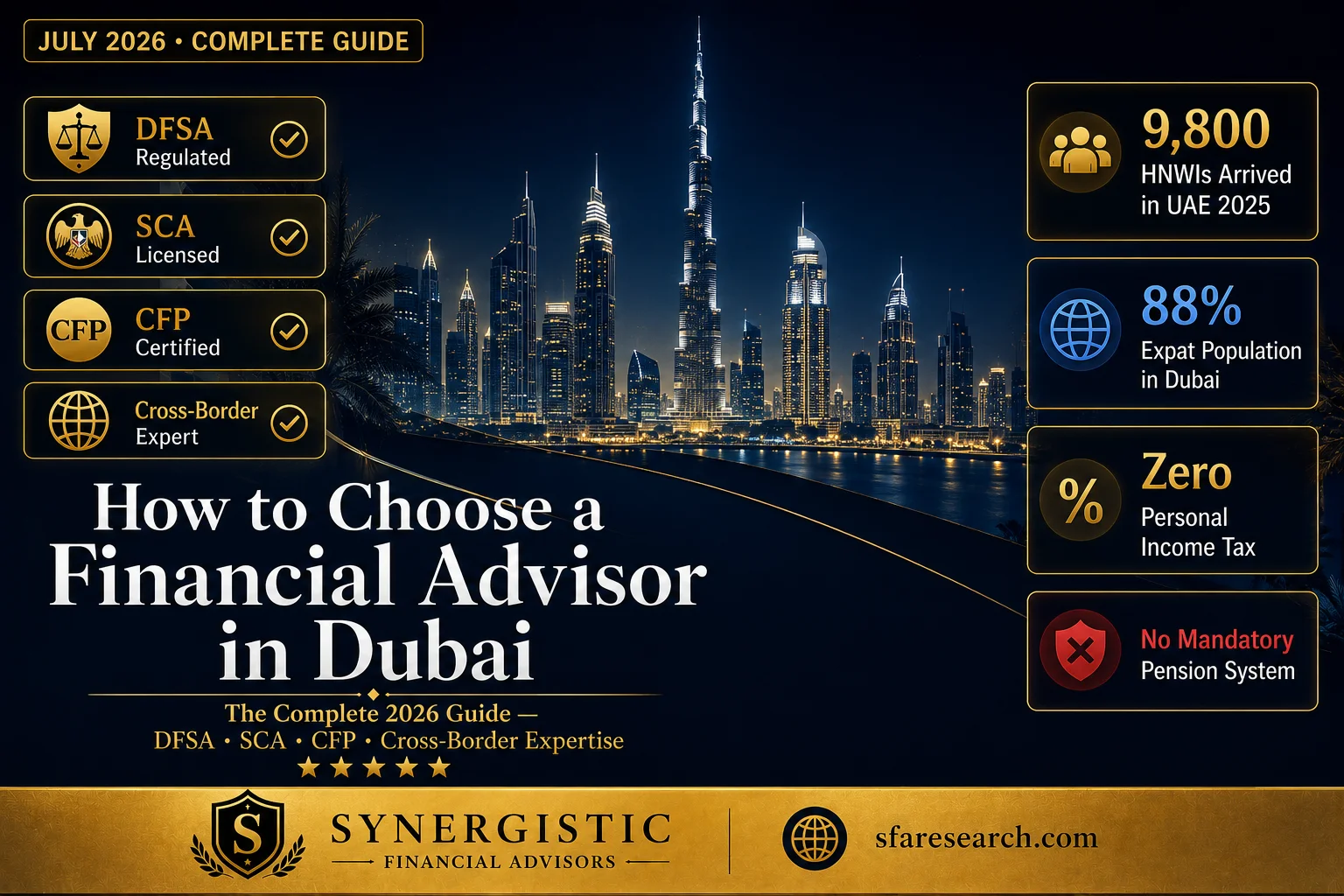
The UAE’s zero personal income tax environment, no capital gains tax, no inheritance tax, and rapidly expanding financial ecosystem make Dubai genuinely exceptional for wealth accumulation. In 2025, the UAE gained an estimated 9,800 high-net-worth individuals — more than any prior year — with 2026 almost certain to mark a continuation of that trend. Expats now represent over 88% of the UAE’s total population, with approximately 9.2 million foreign residents calling the country home.
But here is the warning that every individual searching for a financial advisor in Dubai in 2026 needs to read first: in Dubai, almost anyone can call themselves a financial advisor. The UAE does not require anyone to hold a specific licence before using the title. Generic titles like “wealth specialist” or “financial consultant” are not regulated terms and carry no mandatory competency standard. This creates a market where credible, expert, genuinely regulated professionals operate alongside individuals with no verifiable qualifications, no regulatory accountability, and no legal obligation to act in your best interest.
The right financial advisor in Dubai can mean the difference between building genuine, lasting wealth across your years in the UAE and discovering — often years too late — that you have been sold high-commission insurance products dressed up as investment management, locked into inflexible savings plans that serve the advisor’s income more than your goals, or left without a retirement planning strategy in a country with no mandatory pension system for most expats.
This guide gives you everything you need to find, evaluate, and engage the right financial advisor in Dubai in 2026 — covering the regulatory framework, the credentials that genuinely matter, the fee structures to understand and the red flags to avoid, and the specific services that every expat and resident in Dubai genuinely needs from a professional financial planning relationship.
Why Dubai’s Financial Landscape Is Genuinely Different
Before examining how to choose a financial advisor in Dubai, it is essential to understand the specific dimensions of the UAE’s financial environment that make this decision uniquely consequential compared to choosing an advisor in the US, UK, or most other major financial centres.
No Personal Income Tax — But Global Tax Obligations Remain
Dubai and the UAE do not impose income tax on individuals. However, financial advisors can help in structuring income and assets to reduce global tax liabilities. This may involve offshore structures, tax-efficient investments, and strategic use of UAE residency status.
The critical nuance that most expats discover too late is that the UAE’s tax-free environment does not eliminate your home country tax obligations. US citizens remain liable for US tax on worldwide income regardless of where they live — a genuinely significant compliance burden requiring specific expertise from an advisor who understands both UAE regulations and the tax laws of your home jurisdiction. UK residents face the UK’s temporary non-residence and return-to-residence rules, which can bring previously untaxed gains back into charge. Australian expats face complex superannuation rules. The ORB rule — your Origin, Residence, and Banking location — creates a three-way interaction that requires specialist cross-border expertise rather than generic UAE-focused advice.
No Automatic Pension System
Potential expatriates may be surprised to learn that there are no automatic pension savings in the UAE. Unlike in the UK and other countries, there are no automatic workplace pension enrolments. It is down to you to set up a pension plan.
This is one of the most consequential and most commonly overlooked financial realities for expats arriving in Dubai. In the UK, Australia, and most European countries, employer pension contributions are mandatory. In the UAE, End of Service Gratuity payments provide a limited form of severance entitlement, but they are not a pension — and they are entirely inadequate as a sole retirement planning vehicle for most professionals who spend significant years working in the UAE.
Without proactive retirement planning — through international pension structures, personal savings plans, or investment portfolios specifically designed to fund retirement — many expats who spend years in Dubai’s tax-free environment arrive at retirement with significantly less financial security than their home-country peers who benefited from mandatory employer pension contributions throughout their careers.
UAE Inheritance Laws
In the UAE, inheritance laws strictly adhere to Sharia principles, making estate planning essential for expats. All inheritance matters in the UAE follow the guidelines set by Sharia law. Your financial advisor will handle estate planning duties that direct money distribution throughout your assets properly.
For expats whose family and asset structures are not designed for Sharia-compliant succession, the absence of a properly registered will and estate plan creates genuine, significant risk. A DIFC or Abu Dhabi Global Market registered will — or a carefully structured trust arrangement — is essential for expats who want their assets distributed according to their own wishes rather than UAE intestacy law.
Potential 2026 Tax Reforms
In 2026, the UAE may be poised to introduce a number of tax reforms, impacting VAT, excise duty, and potentially corporate and income tax. Growing speculation around the potential introduction of a small personal income tax, while unconfirmed, means that expats have been advised to plan for all eventualities. Financial advisers in Dubai can serve as a crucial ally for those monitoring potential regulatory changes to the UAE’s tax environment.
The UAE Regulatory Framework — Who Actually Has Authority
Understanding who regulates financial advisors in Dubai is the foundational prerequisite for making a safe, informed advisor selection decision.
A qualified financial advisor in Dubai should be regulated by a recognised authority. Always verify an advisor’s registration number and regulatory status. A regulated advisor provides transparency, accountability, and investor protection — essential safeguards in wealth management.
The three primary regulatory bodies governing financial services in the UAE are:
The Dubai Financial Services Authority (DFSA) — the independent regulator for financial services conducted in or from the Dubai International Financial Centre (DIFC). The DFSA regulates firms providing financial advisory, investment management, banking, and wealth management services within the DIFC. The DFSA register is publicly accessible and allows anyone to verify a firm’s active licence status.
The Securities and Commodities Authority (SCA) — the primary federal regulator for financial services conducted in mainland UAE, outside the DIFC and Abu Dhabi Global Market (ADGM). The SCA regulates investment management, financial brokerage, and financial advisory services across the UAE mainland.
The Central Bank of the UAE — the regulator for banking, insurance, and payment services across the UAE.
The critical practical implication: before engaging any financial advisor in Dubai, verify their active registration status on either the DFSA register (for DIFC-based firms) or the SCA register (for mainland UAE firms). This verification takes minutes and is one of the most important consumer protections available in the Dubai financial planning market.
Firms regulated by the DFSA are generally held to the highest standards — including specific conduct of business rules, disclosure requirements, and client money protections. The DIFC is designed as a regulatory environment that meets international standards equivalent to major financial centres like London and New York.
Credentials That Actually Matter in Dubai
The credential landscape for financial advisors in Dubai is particularly important to understand — because the absence of mandatory licensing means that the presence of verified professional credentials is the primary signal of genuine expertise and ethical commitment.
Verify professional qualifications independently. Chartered Financial Planner and Certified Financial Planner designations are meaningful markers of competence. Generic titles like “wealth specialist” or “financial consultant” are not.
The credentials that carry genuine weight in the Dubai financial advisory market include:
Certified Financial Planner (CFP) — the internationally recognised gold standard in comprehensive financial planning, requiring rigorous examination, documented professional experience, ongoing continuing education, and strict ethical standards. The CFP designation is awarded and monitored by the CFP Board and is verifiable through their public database. In the UAE, advisors who hold the CFP demonstrate comprehensive expertise across investment management, tax planning, retirement planning, estate planning, and wealth management.
Chartered Financial Analyst (CFA) — the gold standard in investment management expertise, requiring three rigorous examinations covering portfolio theory, quantitative methods, economics, and ethical standards. CFA charterholders demonstrate exceptional investment management and portfolio management expertise — particularly valuable for clients seeking sophisticated portfolio construction and ongoing management.
Chartered Financial Planner (CFP UK) — the equivalent UK designation awarded by the Chartered Insurance Institute, carrying equivalent professional rigour to the international CFP for clients with UK financial connections.
Chartered Wealth Manager (CWM) — a professional designation that covers comprehensive wealth management across investments, tax planning, and estate coordination.
These credentials demonstrate that the advisor has received extensive training and adheres to international ethical standards. Additionally, the advisor should be licensed with the Securities and Commodities Authority or regulated by the Dubai Financial Services Authority.
When evaluating any financial advisor in Dubai, verify credentials independently — through the issuing body’s public database — rather than relying solely on the advisor’s own representation. This verification is a basic consumer protection that takes minutes and provides genuine confidence.
The 10-Question Checklist for Choosing a Financial Advisor in Dubai
With the regulatory framework and credential requirements established, here is the complete practical checklist every individual should apply when evaluating any financial advisor in Dubai in 2026.
Question 1 — Are You Regulated by the DFSA or SCA?
This is the non-negotiable first question for every financial advisor in Dubai. Ask for the firm’s registration number and verify it independently on the DFSA or SCA public register. An unregulated advisor — however impressive their credentials or marketing — has no mandatory oversight, no client money protections, and no regulatory accountability if things go wrong.
Question 2 — Do You Hold the CFP, CFA, or Equivalent Credential?
Verify the credential independently through the issuing body rather than relying on the advisor’s word. A certified financial planner or CFA charterholder has met externally evaluated competency standards and is bound by ethical requirements that generic titles carry no requirement to meet.
Question 3 — Do You Have Specific Cross-Border Expertise for My Nationality?
If you are a US citizen, UK national, Australian, or citizen of any other country with global tax obligations, your financial advisor in Dubai must understand not just UAE financial regulations but the specific tax and regulatory requirements of your home jurisdiction. A seasoned financial planning advisor in Dubai should be able to handle both UAE laws and international financial practices. Advisors who specialise in your specific nationality’s cross-border challenges — US-connected persons, UK expats, or Australian superannuation holders — are significantly more valuable than generalists with only UAE-specific expertise.
Question 4 — How Are You Compensated?
Understanding fee structure is fundamental in the Dubai market — where commission-based products are widespread and the incentive to sell high-commission insurance-based investment products is significant.
The cost of financial advice in Dubai varies depending on factors including the type of service provided and the advisor’s experience level. Some financial advisors will charge a flat fee, while others charge management fees — usually a percentage based on assets under management. Regardless, the fee structure should be transparent, so you know the expense upfront.
Fee-only advisors — who earn exclusively through client fees with zero product commissions — have the most fully aligned incentives with your outcomes. Fee-based advisors — who charge fees but may also earn product commissions — require specific disclosure of all commission income. Commission-only advisors — who earn through product sales alone — carry the most significant conflicts of interest in the Dubai market, where high-commission offshore bonds and savings plans are commonly sold as investment management solutions.
Question 5 — Do You Understand UAE Inheritance Law and Sharia Succession?
For expats and residents with assets in the UAE, the interaction between UAE inheritance law, Sharia succession principles, and your home country’s estate law creates genuine complexity that requires specific expertise. An advisor who can coordinate the DIFC will registration process and cross-border estate planning alongside your overall wealth management strategy is providing genuinely comprehensive protection.
Question 6 — What Does Your Retirement Planning Strategy Look Like for UAE Expats?
With no mandatory pension system in the UAE, proactive retirement planning is entirely the individual’s responsibility. An advisor who does not proactively address your retirement planning strategy — with specific recommendations for international pension structures, personal savings vehicles, and investment management portfolios designed to fund retirement — is leaving one of the most consequential gaps in your financial life unaddressed.
Question 7 — Do You Offer Shariah-Compliant Investment Options?
Dubai is a diverse city with people from various cultural and religious backgrounds. Your advisor should respect and understand your values — whether you are seeking Shariah-compliant investments, tax-saving strategies, or ethical investing options. An empathetic financial planning advisor will respect your priorities and incorporate tools and investment structures that align with your values.
For Muslim clients, the availability of Shariah-compliant investment management options — Islamic funds, sukuk, halal equity portfolios — is a specific and important service requirement that not all advisors in Dubai can genuinely deliver.
Question 8 — Can You Serve Both My Personal and Corporate Needs?
If you are a business owner or investor in Dubai, look for a firm that can serve both your personal financial planning needs and your corporate financial advisory requirements under one roof. Most firms in the Dubai market are equipped to do one or the other, not both.
Corporate financial advisory services in Dubai cover business valuation, capital structure optimisation, project finance, feasibility studies for new ventures, and strategic financial planning for businesses across sectors including real estate, energy, manufacturing, and hospitality.
Question 9 — What Does Your Fee Schedule Look Like in Full?
Trustworthy financial advisors will clearly explain their fees and commissions. Request a complete, written disclosure of all fees — advisory fees, product commissions, platform charges, and any other compensation the advisor or their firm receives in connection with recommendations made to you. In the Dubai market, the most damaging advisor relationships are frequently those where fee disclosure is partial, delayed, or buried in product documentation.
Question 10 — Do You Have Client References I Can Contact?
A credible, established financial advisor in Dubai should be able to provide references from existing clients in similar situations to yours — expats of similar nationality, similar asset profile, and similar financial goals. Speaking directly with existing clients provides the most authentic, most practically useful signal of what an advisory relationship with that firm actually delivers.
The Most Common Red Flags in the Dubai Financial Advisory Market
Understanding the warning signs that indicate an advisor relationship likely to serve the advisor’s income more than your financial wellbeing is as important as knowing what to look for in a great advisor.
Red Flag 1 — High-Pressure Sales Tactics. A genuine financial advisor does not pressure you to make financial decisions quickly. Any advisor who creates artificial urgency, suggests that a product opportunity is “closing soon,” or discourages you from taking time to verify credentials and seek independent opinions is displaying the behaviour pattern of a product salesperson rather than a fiduciary advisor.
Red Flag 2 — Recommending Offshore Bonds or Long-Lock-Up Savings Plans Immediately. One of the most consistent patterns in the Dubai financial advisory market involves advisors who recommend complex, high-commission offshore savings plans or insurance bonds before conducting any genuine assessment of your financial situation, goals, or risk tolerance. These products typically lock clients into 10-25 year commitment periods with substantial surrender penalties and high ongoing charges that erode returns significantly. They are frequently the highest-commission products available to commission-based advisors and are often sold as investment management or retirement planning solutions when they are neither the most appropriate nor the most efficient vehicle for either purpose.
Red Flag 3 — Using Generic Titles Without Verified Credentials. Titles like “wealth specialist,” “financial consultant,” “investment consultant,” or “savings advisor” are completely unregulated in the UAE. They communicate nothing about the holder’s qualifications, regulatory status, or legal obligations to you. Always verify verifiable credentials — CFP, CFA, CWM — independently through the issuing body’s public database.
Red Flag 4 — Unable or Unwilling to Provide Regulatory Registration Number. Any financial advisor operating in Dubai who cannot or will not provide a verifiable regulatory registration number — either DFSA or SCA — is operating without the oversight and accountability that regulated advisory requires. Walking away from this situation is the correct response.
Red Flag 5 — Unclear or Evasive Fee Disclosure. If a financial advisor cannot clearly, completely, and immediately tell you exactly how they are compensated — in every dimension, including product commissions, platform rebates, and referral fees — that lack of transparency is itself the answer to whether you should trust them with your wealth management.
What a Great Financial Advisor in Dubai Does for You
Understanding what genuine, expert financial advisory in Dubai actually delivers — beyond the generic marketing promises — helps you set appropriate expectations and evaluate whether a prospective advisor can genuinely serve your needs.
Retirement Planning Without a Safety Net. Because the UAE provides no mandatory pension, a qualified financial advisor builds your complete retirement planning strategy from scratch — determining how much you need, what vehicles are most appropriate for your nationality and cross-border situation, and how to invest and manage the assets that will fund the retirement that no UAE employer or government programme will provide.
Cross-Border Tax Structuring. Tax planning is crucial to your broader financial plan to ensure you are as tax efficient as possible. A financial advisor who understands both UAE residency rules and your home country’s taxation of UAE-sourced income, offshore holdings, and foreign pensions can structure your financial affairs to minimise global tax liability while maintaining full compliance across every relevant jurisdiction.
Investment Management Built for Your Goals. Building a strong investment management portfolio is a long-term strategy and is an important component of creating future wealth management outcomes. Working with an experienced financial advisor in Dubai who knows the market well helps you find suitable options based on your needs and risk tolerance — across both UAE-listed and globally diversified investments.
Estate Planning Within UAE Legal Frameworks. Estate planning is particularly important for expatriates and high-net-worth individuals in the UAE because inheritance laws and cross-border assets can create legal and financial complications. A financial advisor can help structure your estate to ensure that wealth management outcomes are transferred efficiently and according to your wishes — through DIFC-registered wills, trust structures, and beneficiary designation coordination across all your accounts and assets.
Education Planning. For families in Dubai, private school fees are significant — and education funding for children who may eventually attend universities internationally requires specific, long-term financial planning that accounts for currency risk, investment timeline, and the specific cost trajectory of international higher education.
Insurance Planning. A financial advisor in Dubai can also help recommend ideal insurance policies to protect your income and family in unforeseen events — covering life insurance, critical illness, disability, and international health plans appropriate for expats without access to domestic healthcare systems.
Synergistic Financial Advisors — Excellence in Financial Advisory for the Global Client
At Synergistic Financial Advisors, we understand that the financial lives of globally mobile professionals, expats, and high-net-worth individuals are genuinely complex — crossing jurisdictions, currencies, regulatory frameworks, and tax systems simultaneously.
Whether you are based in Dubai, planning a move to the UAE, building cross-border wealth management strategy across multiple countries, or navigating the intersection of UAE residency with home-country tax obligations, Synergistic Financial Advisors brings the comprehensive, fiduciary-standard expertise that your financial situation genuinely demands.
Our certified financial planner team provides genuinely integrated financial planning — coordinating investment management, portfolio management, retirement planning, tax planning, estate coordination, and comprehensive wealth management under one advisory relationship built entirely around your specific goals, your specific cross-border complexity, and your specific life.
We operate with complete fee transparency, zero hidden commissions, and the fiduciary commitment that legally requires every recommendation we make to serve your best interests — not our revenue.
Ready to build a financial strategy that captures Dubai’s extraordinary wealth-building opportunity while protecting your interests with expert, fiduciary-standard guidance? Contact Synergistic Financial Advisors today for a personalised consultation.
👉 Visit www.sfaresearch.com — because in a market where anyone can call themselves a financial advisor, the right choice matters more than anywhere else.
Final Thoughts — In Dubai’s Unregulated Market, Your Diligence Is Your Protection
Dubai’s financial environment is genuinely exceptional — and so is the risk of choosing the wrong financial advisor in a market where the title carries no mandatory competency standard.
Choosing the right financial advisor in Dubai is not just about credentials — it is about trust, transparency, and understanding your goals. The right advisor does not just manage your money — they guide you through every stage of your financial journey, from investments and tax planning to retirement planning and wealth management.
The checklist, credential requirements, regulatory verification steps, and red flag warnings in this guide give you the practical framework to make a genuinely informed decision — one that protects your interests and positions you to make the most of Dubai’s remarkable wealth management opportunity.
At Synergistic Financial Advisors, we hold ourselves to the highest standards of expertise, transparency, and fiduciary commitment — for every client, in every market, across every dimension of their financial life.