Here is the most consequential financial decision most Americans make in retirement — and the one they spend the least time preparing for.
When you claim Social Security.
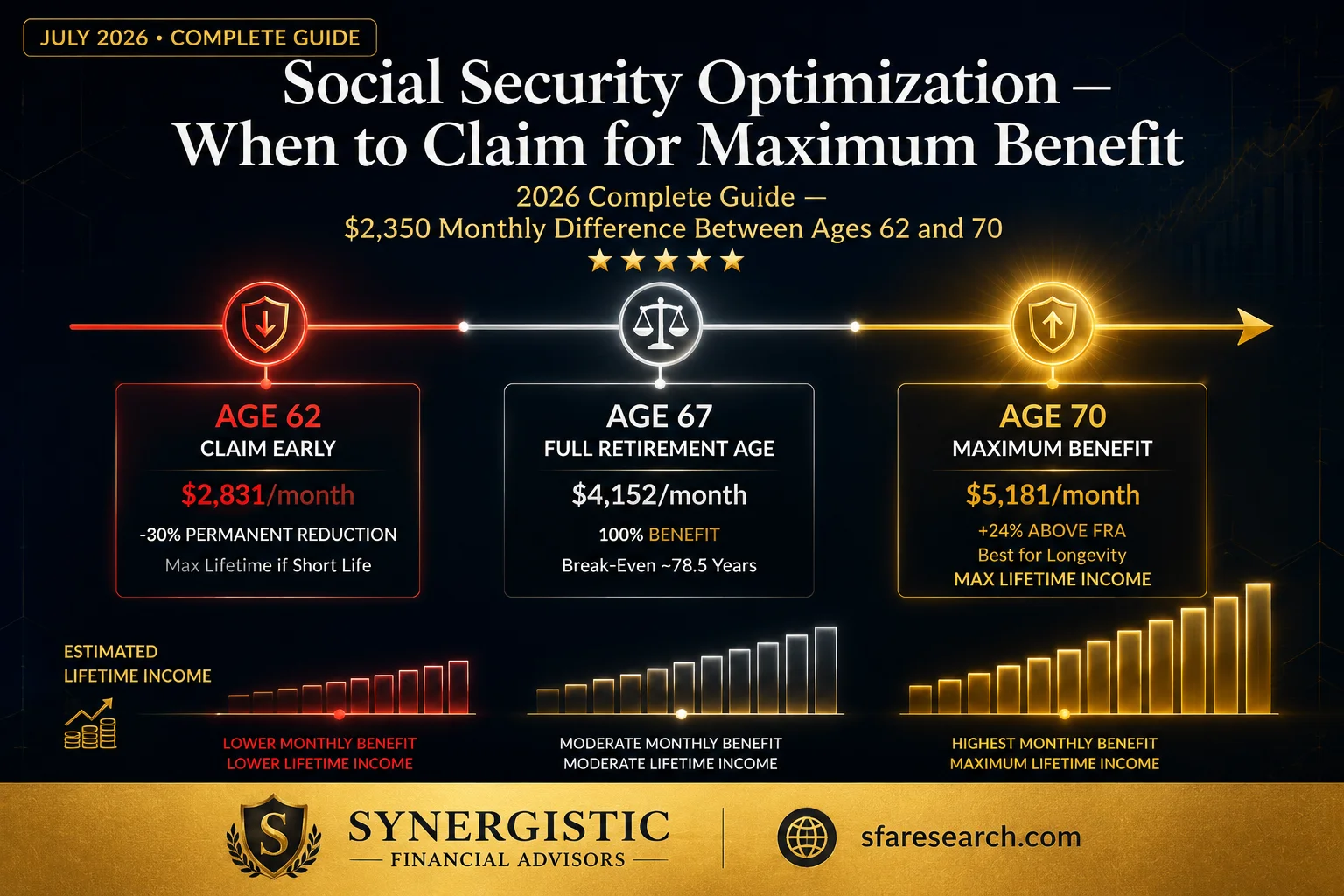
In 2026, the maximum Social Security benefit is $5,181 per month if you delay claiming until age 70. If you claim at your full retirement age of 67, that maximum drops to $4,152 per month. If you claim at the earliest possible age of 62, the reduction is 30% below your full retirement age benefit — permanent, for the rest of your life.
The difference between the worst claiming decision and the best one — for a high earner who lived to age 85 — can easily exceed $200,000 in lifetime benefits. For married couples coordinating two Social Security records strategically, the difference between the best and worst combined household claiming strategy frequently exceeds $100,000 to $300,000 in total lifetime income.
And yet the majority of Americans claim Social Security before age 65 — often because they do not understand the claiming mechanics, do not have a financial advisor walking them through the analysis, or simply default to the earliest available option without running the numbers.
This guide gives you everything you need to make the single most important retirement planning decision in your financial life — with the actual 2026 numbers, the break-even analysis framework, the spousal coordination strategies most people miss entirely, and the specific situations where early claiming actually is the right answer.
Social Security Basics — The 2026 Numbers You Must Know
Before any optimization strategy makes sense, the foundational mechanics of Social Security benefit calculation need to be clearly understood. These are the actual 2026 figures that govern every claiming decision.
Your Full Retirement Age
For anyone born in 1960 or later, full retirement age is 67. This is the reference point against which every early-claiming reduction and delayed retirement credit is calculated. If you were born between 1943 and 1954, your full retirement age is 66. For those born between 1955 and 1959, it increases by two months per birth year — reaching 67 for everyone born in 1960 or after.
Full retirement age matters because it is the baseline — the age at which you receive exactly 100% of your calculated benefit, with no reduction and no bonus.
The Maximum Monthly Benefit in 2026
The maximum Social Security benefit at each claiming age in 2026:
| Claiming Age | Maximum Monthly Benefit | Annual Maximum |
|---|---|---|
| Age 62 | ~$2,831 | ~$33,972 |
| Age 67 (FRA) | $4,152 | $49,824 |
| Age 70 | $5,181 | $62,172 |
The maximum benefit of $5,181 per month is available only to those who claimed Social Security beginning at age 70 and who worked for at least 35 years at or above the taxable wage base — which is $184,500 in 2026.
The 2026 Cost-of-Living Adjustment
The 2026 COLA is 2.8% — increasing every beneficiary’s monthly check by that percentage from January 2026. Critically, once you claim, your COLA adjustments are calculated on your initial benefit amount. This means a higher initial benefit — from delaying — results in larger dollar COLA increases every year thereafter. A 2.8% COLA on $5,181 per month generates $145 in additional monthly income. The same 2.8% COLA on a $3,000 reduced benefit generates only $84 per month. The compounding advantage of a higher base benefit grows more significant with every passing year.
The 2026 Earnings Test
Working while collecting Social Security before your full retirement age triggers a penalty. In 2026, the SSA withholds $1 for every $2 you earn above $24,480. That threshold changes in the year you reach FRA — the SSA withholds $1 for every $3 earned above $65,160, but only in the months before your birthday. Once you reach full retirement age, this earnings test disappears entirely — you can earn any amount with no benefit reduction.
The nuance worth understanding: the withheld benefits are not lost permanently. The SSA recalculates your monthly benefit at FRA to credit back the months that were withheld. The early work penalty defers income rather than erasing it.
The Three Claiming Ages — What Each One Means
Claiming at 62 — The Earliest Possible Date
You can begin collecting Social Security checks as early as age 62, but your benefits will be higher the longer you wait to claim.
Claiming at age 62 reduces the monthly benefit by 30% below the full retirement age amount — and this reduction is permanent, applying for the rest of your life including to every future COLA increase. On a $2,000 full retirement age benefit, claiming at 62 locks in $1,400 per month rather than $2,000 — a $600 per month permanent reduction that compounds across every year of retirement.
This 30% reduction also interacts with cost-of-living adjustments applied to the reduced base — meaning the dollar gap between your reduced benefit and what you would have received at FRA grows wider with every annual COLA rather than closing over time.
There are genuine, specific situations where claiming at 62 is the mathematically correct decision — they are covered in detail below. But the default should never be “claim as early as possible” without a careful break-even analysis based on your specific health, income needs, and spousal situation.
Claiming at Full Retirement Age (67) — The Baseline
Claiming at full retirement age gives you exactly 100% of your calculated primary insurance amount — the benefit the SSA has determined you have earned based on your 35 highest-earning years. For most people with average health and a typical retirement timeline, FRA is a reasonable compromise — but it is still not the optimal strategy for most individuals who can afford to delay further.
Claiming at 70 — Maximum Benefit for Life
For each year you delay claiming between full retirement age and age 70, your monthly benefit increases by approximately 8%. Over the three years between FRA of 67 and the maximum delay age of 70, that compounds to a 24% increase above your full retirement age benefit — permanently, for the rest of your life.
Just make sure to claim your benefits no later than age 70. There is no additional benefit from delaying past 70 — the delayed retirement credits stop accruing at that age. If you have not yet claimed by your 70th birthday, you should file immediately.
The Break-Even Analysis — The Most Important Calculation in Retirement Planning
Comparing lifetime household income across different claiming combinations is the only way to find the right strategy for your household. When you claim early, you collect for more months at a lower amount. When you delay, you collect for fewer months at a higher amount. The monthly comparison can feel intuitive — but the lifetime calculation is what actually matters.
The break-even analysis determines at what age you come out ahead by delaying rather than claiming early. Here is how it works with real 2026 numbers.
Example: Choosing Between 62 and 67 (FRA)
Assume your full retirement age benefit is $2,500 per month.
At 62, you receive $1,750 per month (30% reduction).
At 67 (FRA), you receive $2,500 per month.
From age 62 to 67 — the 60 months you delay — you forgo 60 months of $1,750 = $105,000 in early benefits.
After 67, you gain an extra $750 per month by having waited.
Break-even: $105,000 ÷ $750 per month = 140 months = approximately 11.7 years after FRA.
Break-even age: approximately 78.5 years old.
If you live past 78.5, delaying to FRA produces more lifetime income. If you die before 78.5, claiming at 62 would have produced more.
Example: Choosing Between 67 (FRA) and 70
Assume the same $2,500 FRA benefit.
At 70, your benefit increases by 24% to $3,100 per month.
From age 67 to 70 — the 36 months you delay — you forgo 36 months of $2,500 = $90,000 in FRA benefits.
After 70, you gain an extra $600 per month by having waited.
Break-even: $90,000 ÷ $600 per month = 150 months = approximately 12.5 years after age 70.
Break-even age: approximately 82.5 years old.
If you live past 82.5, delaying to 70 produces more lifetime income.
What Does This Mean Practically?
The average life expectancy for a 62-year-old American in 2026 is approximately 82-84 years. For a healthy individual with above-average longevity expectations — family history of longevity, good current health, non-smoking, active lifestyle — life expectancy may extend well into the late 80s or beyond. For this individual, delaying to 70 is almost certainly the mathematically optimal strategy.
If your family history and current health suggest a shorter-than-average lifespan, the break-even analysis shifts significantly — and earlier claiming may produce more lifetime benefit.
The break-even analysis is the foundational calculation — but it is only the beginning. A comprehensive Social Security optimization strategy must also account for spousal benefits, survivor benefits, tax implications, portfolio withdrawal sequencing, and the specific bridge income strategy that funds your lifestyle during the delay period.
Spousal Benefit Strategies — The Most Commonly Missed Optimization
For married couples, Social Security optimization becomes significantly more complex — and significantly more valuable — because two separate benefit records can be coordinated to maximise the combined household lifetime income rather than each record in isolation.
Couples should coordinate to maximize survivor benefits. This is the most important spousal coordination principle — and the one that most couples fail to apply.
How the Spousal Benefit Works
A spouse who has limited or no work history is entitled to a spousal benefit equal to up to 50% of their partner’s full retirement age benefit. In 2026, if your spouse’s FRA benefit is $3,000 per month, you are entitled to a spousal benefit of up to $1,500 per month — simply by virtue of being married, regardless of your own work history.
The spousal benefit is claimed at its maximum when the claiming spouse reaches their own full retirement age. Claiming the spousal benefit before FRA reduces it, just as early claiming reduces the primary benefit.
The Survivor Benefit — The Most Critical Planning Consideration
The survivor benefit is where spousal Social Security coordination becomes most consequential. When one spouse dies, the surviving spouse is entitled to receive the higher of their own benefit or their deceased spouse’s benefit. The survivor benefit is based on the deceased spouse’s actual monthly benefit at the time of death — which means a higher-earning spouse who delayed to 70 leaves a significantly larger survivor benefit for their partner.
Optimizing survivor benefits is one of the strongest arguments for the higher-earning spouse to delay claiming as long as possible. By maximising the higher earner’s benefit through delay, the couple simultaneously maximises the survivor income for whichever spouse outlives the other — protecting the surviving spouse from a significant income drop at the very moment their financial vulnerability is greatest.
The Classic Couple Strategy for 2026
The most commonly recommended household coordination strategy for couples in 2026 — where the age difference and health situations are broadly similar — is:
The lower-earning spouse claims at or near full retirement age to begin generating household Social Security income. The higher-earning spouse delays as long as possible — ideally to age 70 — to maximise their own benefit and the survivor protection it creates.
This strategy generates cash flow from the lower earner’s benefit during the delay period while maximising the higher earner’s benefit for both their own retirement and the eventual survivor situation. The specific optimal strategy varies significantly based on the age difference between spouses, health situations, relative benefit sizes, and household income needs during the delay period. A certified financial planner who runs a comprehensive household analysis across multiple claiming scenarios consistently finds meaningful optimisation opportunities that the general framework cannot capture.
The Tax Dimension — How Social Security Is Taxed and What to Do About It
Taxes are the dimension of Social Security optimization that most people never fully understand — and that creates some of the most counterintuitive planning implications.
The goal for high-net-worth clients is not simply to receive a benefit, but to maximize the inflation-adjusted benefit within their comprehensive wealth plan.
Up to 85% of your Social Security benefits may be subject to federal income tax depending on your combined income — defined as your adjusted gross income plus non-taxable interest plus 50% of your Social Security benefits. The specific thresholds and taxation percentages:
For individuals: benefits become partially taxable when combined income exceeds $25,000, and up to 85% taxable when combined income exceeds $34,000.
For married couples filing jointly: benefits become partially taxable when combined income exceeds $32,000, and up to 85% taxable when combined income exceeds $44,000.
These thresholds have not been adjusted for inflation since they were established in the 1980s — meaning that the percentage of Social Security recipients subject to taxation has grown dramatically over time and continues to grow every year.
The Roth Conversion Window — The Most Powerful Tax Planning Opportunity
The period between retirement and Social Security claiming creates one of the most valuable tax planning opportunities in all of retirement planning — the Roth conversion window.
During the years between retirement and Social Security claiming, your taxable income is typically at its lowest point of your entire adult financial life. You are no longer earning a salary, and your Social Security — which will eventually be partially taxable — has not yet begun. This low-income window allows strategic Roth conversions that:
Fill your current tax bracket at the lowest available rates. Reduce the traditional IRA balance that will eventually generate taxable RMDs. Reduce the income that will eventually make Social Security partially taxable. And build tax-free Roth assets that are never counted toward the combined income calculation that triggers Social Security taxation.
A financial advisor who coordinates your Social Security claiming strategy with a multi-year Roth conversion programme during the delay period creates a compounding tax advantage that extends across decades of retirement — reducing lifetime tax liability by tens of thousands of dollars compared to a claiming strategy that ignores the tax dimension entirely.
IRMAA — The Hidden Medicare Surcharge
High-income retirees face an additional complication: Medicare Income-Related Monthly Adjustment Amounts (IRMAA). When your modified adjusted gross income exceeds specific thresholds, your Medicare Part B and Part D premiums increase significantly — based on your income from two years prior.
Social Security claiming timing affects IRMAA because it determines the level and composition of your retirement income. A financial advisor who models your projected IRMAA exposure across different claiming ages and Roth conversion amounts can identify the specific income management strategy that minimises Medicare surcharges across multiple years of retirement.
8 Specific Social Security Optimization Strategies for 2026
Strategy 1 — Work at Least 35 Years at Maximum Earnings
Your Social Security benefit is calculated based on your indexed monthly earnings for your 35 highest-earning years. If you have fewer than 35 years of earnings, zeros are averaged in for each missing year — significantly reducing your calculated benefit.
If you can increase your take-home pay today, it could result in more income tomorrow. In 2026, the maximum taxable earnings amount is $184,500. Working longer — even part-time — to replace low-earning years with higher-earning ones can meaningfully increase your calculated benefit before you ever make a claiming decision.
Working past 70 can still increase your benefit if those earnings fall in your top 35 years. Even after claiming, if you return to work and earn more than one of your previous 35 highest years, the SSA recalculates your benefit automatically at year-end.
Strategy 2 — Delay to 70 If Your Health Allows
Delaying retirement benefits past full retirement age earns delayed retirement credits of 8% per year of delay past full retirement age. For someone with a $2,000 FRA benefit, delaying to 70 generates $2,480 per month — $480 more every single month, permanently, for the rest of their life.
If your family’s longevity is strong and your health is good, delaying often increases lifetime benefits. Health and longevity are the most important inputs to the break-even analysis — and for individuals with above-average health and family longevity, the mathematics of delaying to 70 are almost always compelling.
Strategy 3 — Bridge Income During the Delay Period
One of the most common objections to delaying Social Security is “but I need the income.” The bridge income strategy addresses this directly — by drawing from retirement accounts or other savings to fund living expenses during the delay period, allowing Social Security to continue accruing delayed retirement credits.
Other income sources — pensions, annuities, or portfolio withdrawals — can bridge cash flow while delaying Social Security to increase your benefit. The mathematics of this strategy are often compelling: drawing down a traditional IRA during the delay period simultaneously reduces future RMDs, creates Roth conversion opportunities, and funds the delay that increases your lifetime Social Security income.
Strategy 4 — Coordinate Spousal Benefits for Maximum Household Income
As described above, coordinating two Social Security records — with the lower earner claiming near FRA and the higher earner delaying to 70 — typically maximises both the combined lifetime household income and the survivor benefit for whichever spouse outlives the other.
Coordinating with your broader retirement paycheck so your monthly income is stable while you pursue the highest lifetime value is the core principle of household Social Security optimisation.
Strategy 5 — Maximise Survivor Benefits Through Delay
When the higher-earning spouse delays to 70, they simultaneously maximise their own monthly benefit and the survivor benefit available to their spouse if they die first. This is one of the most powerful forms of low-cost longevity insurance available anywhere in the financial system — and it is entirely within the control of the claiming decision.
For couples where there is a significant age difference, health disparity, or meaningful difference in the size of the two Social Security records, the survivor benefit dimension of the claiming decision can be even more important than the individual break-even analysis.
Strategy 6 — Consider the Restricted Application for Divorced Individuals
Divorced individuals who were married for at least 10 years are entitled to claim spousal benefits on an ex-spouse’s record — even if the ex-spouse has not yet claimed. The ex-spouse’s own benefit is not affected by this claim. This is one of the most consistently overlooked Social Security optimisation opportunities available to divorced individuals approaching retirement.
Strategy 7 — Avoid the Earnings Test If Working Before FRA
Working while collecting Social Security before FRA triggers the $24,480 earnings threshold in 2026. If you plan to continue working and expect to earn above this threshold, delaying your Social Security claim until you reach full retirement age — when the earnings test disappears entirely — may be the more financially efficient approach.
After FRA, you can earn any amount with no penalty — making Social Security claiming and continued employment fully compatible for those who reach their full retirement age.
Strategy 8 — Review Your Earnings Record for Errors
Your Social Security benefit is calculated from the earnings record the SSA maintains for you — and errors in that record, while not common, do occur. Reviewing your earnings record annually through your Social Security account ensures that every year of income you have paid FICA taxes on is correctly recorded, and that your projected benefit calculation is based on your actual earnings history.
If you find a missing year or an incorrect earnings amount, the SSA can correct the record — potentially increasing your projected benefit permanently.
When Early Claiming Actually Makes Sense
Social Security optimization is not a one-size-fits-all analysis. There are specific, genuine situations where claiming early — at 62 or before FRA — is the mathematically or practically correct decision.
Health concerns and reduced life expectancy. If your current health or family history suggests a shorter-than-average lifespan, the break-even analysis may support earlier claiming. An individual who does not expect to live past their mid-70s will typically receive more total lifetime Social Security income by claiming earlier at a lower amount for more months.
Immediate financial necessity. If you face genuine financial hardship and have no other income source to bridge expenses, the practical need for current income may override the mathematical advantage of delay. In this situation, Social Security provides necessary income that preserves other retirement assets from being depleted at an even faster rate.
Single individuals without survivor benefit considerations. For single individuals, the break-even analysis focuses purely on the individual’s own lifetime benefits without the survivor benefit complication that often tips the scales toward delay for married couples.
Very high income and significant RMD exposure. For high-net-worth individuals whose retirement income from other sources will already push them into the 85% Social Security taxation zone regardless of when they claim, the incremental tax cost of a higher Social Security benefit may reduce the after-tax advantage of delay. A financial advisor who models the after-tax rather than gross benefit of delay for high-income clients sometimes finds that the pre-tax advantage of delaying is partially offset by the tax cost of higher benefits.
How Synergistic Financial Advisors Optimises Your Social Security Strategy
At Synergistic Financial Advisors, Social Security optimization is not a generic recommendation — it is a personalised, data-driven analysis that integrates your claiming decision with your complete retirement planning, tax planning, portfolio management, and wealth management strategy.
Our certified financial planner team models your specific claiming options across multiple scenarios — individual break-even analysis at every claiming age from 62 to 70, household coordination strategies across two Social Security records, survivor benefit optimisation for married couples, Roth conversion coordination during the delay period, IRMAA exposure modelling across multiple income scenarios, and the specific bridge income strategy that funds your lifestyle during the delay without unnecessarily depleting retirement assets.
Social Security represents a foundational source of inflation-adjusted lifetime income for most retirees — and the claiming decision that maximises your lifetime benefit is worth more than almost any other single retirement planning action available to you. Getting it right — with a genuinely personalised analysis rather than a generic rule of thumb — is precisely the work that a qualified financial advisor performs better than any calculator, any article, or any general recommendation can.
Ready to find out exactly when you should claim Social Security to maximize your lifetime benefit? Contact Synergistic Financial Advisors today for a personalised Social Security optimization analysis.
👉 Visit sfaresearch.com — because the difference between the best and worst Social Security claiming decision can be worth more than $200,000. That difference deserves expert guidance.
Final Thoughts — The Decision That Lasts a Lifetime
Social Security optimization considers various factors including health, earnings, and spousal benefits. Use break-even analysis to compare claiming at 62, your FRA, or age 70. Coordinate with your broader retirement paycheck so your monthly income is stable while you pursue the highest lifetime value.
The Social Security claiming decision is genuinely irreversible. Once made, it determines your monthly benefit — and your survivor’s benefit — for the rest of your life. The 2026 numbers make the stakes clear: $5,181 per month if you optimize, $2,831 per month or less if you do not. For a couple living 25 years in retirement, the difference between the best and worst combined household claiming strategy is not measured in dollars per month — it is measured in hundreds of thousands of dollars of cumulative lifetime income.
No other single decision in your retirement planning journey has this kind of permanent, compounding impact. None.
At Synergistic Financial Advisors, we ensure every client approaches this decision with the complete, personalised analysis it deserves — not a generic rule of thumb, not a quick online calculator, but a genuinely tailored strategy that accounts for your health, your household, your tax situation, and your complete financial picture.
The most important retirement planning decision you will ever make deserves the most thorough analysis you can get.