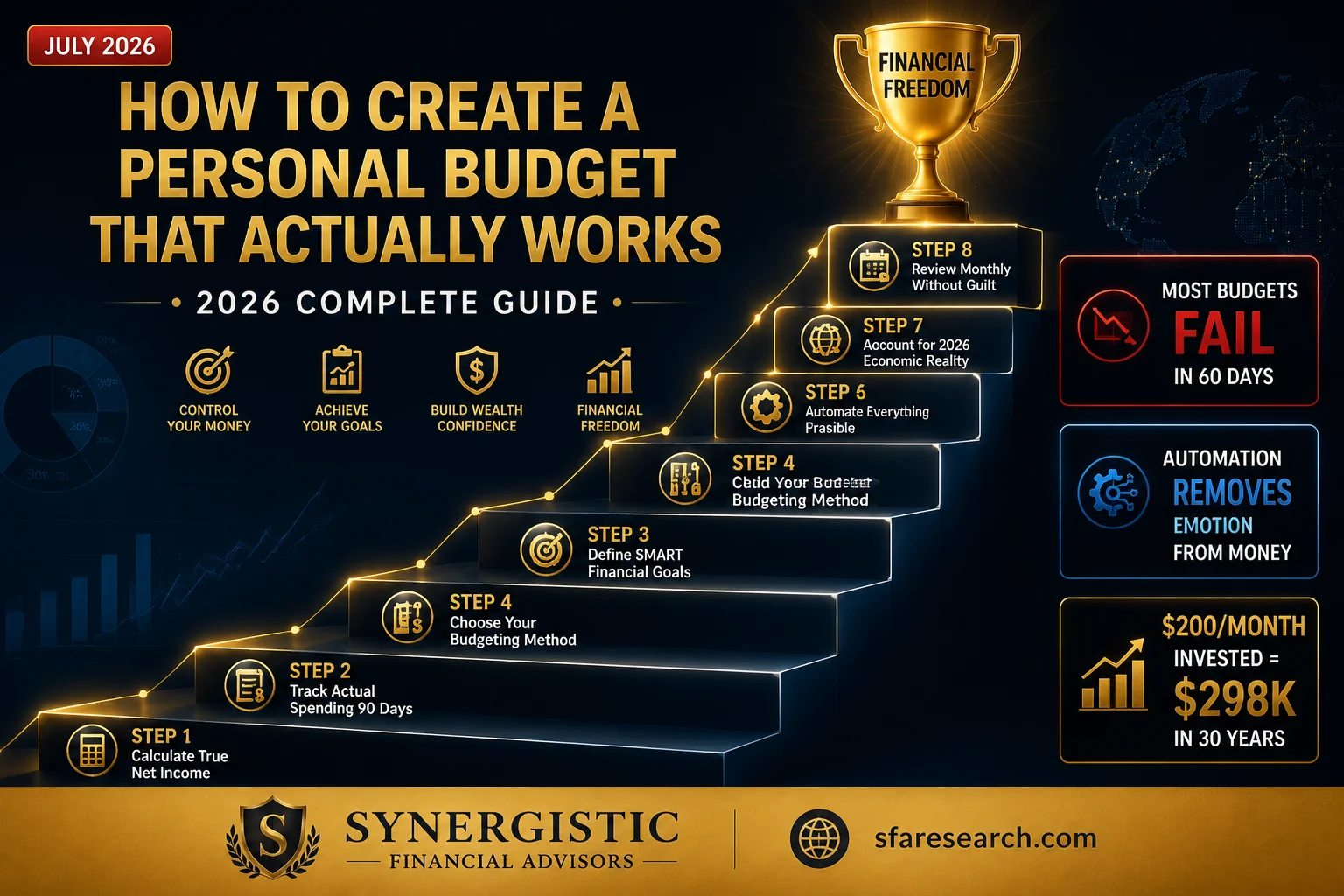
Most budgets fail within 60 days. Not because the math was wrong. Not because the person who made it was irresponsible. But because almost every standard budgeting approach treats money as a pure mathematics problem — cut expenses here, save more there — and completely ignores the psychology that determines whether any financial system actually survives contact with real life.
Most budgeting advice treats money like a math problem. Cut expenses here, save more there, and everything works out. Money management is not about deprivation or tracking every penny obsessively. It is about creating systems that align your spending with what actually matters to you while building protection against life’s inevitable surprises.
That distinction — systems versus willpower, alignment versus restriction — is the difference between a budget that transforms your financial life and one that sits in a spreadsheet until February.
In 2026, with CPI running at 4.2%, housing costs elevated across every major market, subscription services quietly consuming hundreds of dollars per month that most households have never consciously approved, and the most dynamic economic environment in recent memory creating genuine uncertainty about income and expenses — the ability to build a budget that actually works has never been more consequential.
This guide gives you the complete, honest, step-by-step framework for creating a personal budget that you will actually stick to — covering the psychology of why most budgets fail, every proven budgeting method, the specific 2026 considerations that make this year’s budget different, and how to connect your daily spending decisions to the long-term financial planning strategy that builds genuine wealth.
Why Most Budgets Fail — And How This Guide Is Different
Before building your budget, understanding the specific failure modes of conventional budgeting is essential — because the most common reasons budgets fail are entirely preventable with the right approach.
The key is to start where you are, with what you have, and build momentum through consistent, small actions rather than dramatic overhauls that rarely stick.
The four most common reasons budgets fail — and the approach this guide takes to prevent each one.
Failure Mode 1 — Built on aspirational numbers rather than actual ones. Most people build their budget on what they wish they spent rather than what they actually spend. A budget based on fiction fails the moment reality intrudes. This guide starts with your actual numbers from the last 90 days — not what you think you spend, what you actually spent.
Failure Mode 2 — Too restrictive to survive the first unexpected expense. A budget with zero flexibility breaks at the first deviation — a birthday dinner, a car repair, a sale on something genuinely needed. This guide builds flexibility deliberately into the system, because a budget that survives imperfect months is worth infinitely more than a perfect budget that collapses after two.
Failure Mode 3 — Too complicated to maintain. A household budget only works when it is realistic, flexible, and simple enough to follow throughout the year. A budget with 47 categories tracked to the penny requires more cognitive bandwidth than most people sustainably allocate to financial administration. This guide keeps the system as simple as it can be while still being comprehensive enough to work.
Failure Mode 4 — Not connected to goals that genuinely matter. A budget that exists to restrict spending is psychologically unsustainable. A budget that exists to fund a specific, personally meaningful life — a home, a retirement, financial freedom, a child’s education — is motivated by genuine desire rather than willpower alone. This guide connects every spending category to the goals that make the discipline worth it.
Step 1 — Calculate Your True Net Income
Be sure to calculate your budget based on your net income, not your gross income. You want to use the amount of money after taxes are taken out. If you have a regular income, it is easy to just look at your pay stubs.
This first step seems obvious — and yet it is the one most commonly done wrong. Gross income is what your employer pays you. Net income is what actually lands in your bank account. A budget built on gross income will be wrong by 20-30% from the first line.
Your true monthly net income includes every reliable source of money that actually arrives in your bank account — your take-home salary after all tax withholding and deductions, any regular side hustle income you can reliably count on, rental income net of expenses, child support or alimony you receive consistently, and any other recurring income that is genuinely dependable.
What not to include: bonuses you might receive, overtime that is not guaranteed, tax refunds, or any income that is irregular and uncertain. These are windfalls — powerful when they arrive, but dangerous to budget around before they materialise.
For people with variable income — freelancers, business owners, commission-based earners, gig workers — calculate your average monthly income using the lowest three months of the past year as your baseline rather than the average. Building your budget on your lowest reliable income creates a system that works in tight months and generates a genuine surplus in strong ones.
When you start to create your new monthly budget, begin by anticipating big or seasonal expenses like insurance, taxes or back-to-school costs. Break them into monthly amounts so they do not catch you off guard.
The annual expense trap is one of the most consistent budget-busters for households that have otherwise sound month-to-month finances. Car insurance paid twice yearly, property taxes paid annually, holiday spending in December, back-to-school spending in August — these are entirely predictable expenses that destroy budgets not because they are unexpected but because they were not planned for monthly. Divide every annual or semi-annual expense by 12 and treat it as a fixed monthly budget item, setting that money aside each month in a dedicated savings bucket.
Step 2 — Track Your Actual Spending for 90 Days
This is the step most people skip — and skipping it is why most budgets fail.
This step can feel uncomfortable, but it gives you clarity and control. Review your bank and card statements for the last two to three months. Look for patterns and totals, not perfection. As you review, flag categories that surprise you, like dining out, daily coffee runs, subscriptions, convenience spending, and impulse buys.
Pull every bank statement and credit card statement for the past 90 days. Categorise every transaction into the major spending categories that will form your budget. This process typically takes 60-90 minutes — and produces revelations that fundamentally change how most people understand their own spending patterns.
The most commonly surprising categories in 2026 include:
Subscriptions and digital services — the average household pays for 7-10 subscription services but actively uses fewer than half of them. Review subscriptions quarterly, as many people overspend on unused services. A quarterly subscription audit — identifying and cancelling services you have not used in the past 30 days — typically frees up $50-$200 per month that was invisible in the daily spending experience.
Food spending — the combination of groceries and dining out is almost universally underestimated. Most households spend 20-40% more on food than they believe they do when they mentally add up their spending. The 90-day review replaces the guess with the reality.
Small daily purchases — individually insignificant purchases that aggregate to surprising monthly totals. The daily coffee that is $6 in 2026 is $180 per month and $2,160 per year. Whether $2,160 annually for daily coffee is “worth it” is a values question that only you can answer — but knowing the actual number makes the decision a conscious one rather than an invisible default.
Convenience spending — grocery delivery fees, last-minute rideshares, premium app subscriptions, and other convenience costs that individually seem trivial but collectively represent a meaningful monthly drain.
The goal of the 90-day spending review is not guilt or judgement. It is replacing assumption with reality — because a budget built on actual numbers has a fundamentally better chance of surviving than one built on optimistic guesses.
Step 3 — Define Your Financial Goals
Clearly state what you want your money to do — maybe you would like to build up your savings, pay down debts or save up for a big family vacation. Then turn those goals into measurable actions, like “put $500 a month into savings” or “limit takeout to $300 a month.”
A budget without goals is a restriction without a reason. The specific goals that motivate your budget are what make the discipline sustainable across months and years rather than weeks.
Your budget should support both short-term and long-term goals. Creating SMART goals helps ensure your objectives are clear and actionable: Specific — clearly define what you want to achieve. Measurable — determine how you will track progress. Achievable — ensure the goal is realistic and attainable. Relevant — make sure the goal aligns with broader objectives. Time-bound — set a deadline for achieving the goal.
Define two to three specific financial goals for 2026 — one short-term goal achievable within the year, one medium-term goal for the next two to three years, and one long-term goal connected to your financial planning vision for the decade ahead. Here is what SMART goal-setting looks like in practice:
Vague goal: “Save more money.”
SMART goal: “Save $2,400 by December 31, 2026, by setting aside $200 per month in a dedicated high-yield savings account.”
Vague goal: “Pay off credit cards.”
SMART goal: “Eliminate my $4,200 Visa balance by March 2027 by directing $350 per month to extra payments beyond the minimum.”
Vague goal: “Invest for retirement.”
SMART goal: “Increase my 401(k) contribution to 12% of gross salary by September 2026 and maintain it through year-end.”
Connecting your budget to specific, measurable, time-bound goals transforms it from a restriction into a roadmap — and that transformation is what makes the difference between a budget that dies in February and one that runs effectively for years.
Step 4 — Choose Your Budgeting Method
The method should fit your habits and lifestyle rather than forcing you into a rigid structure you will abandon. Not all budgets work for everyone.
The right budgeting method is not the one with the most enthusiastic Reddit community — it is the one you will actually maintain given your specific personality, income structure, and lifestyle. Here are the four most effective methods for 2026, with honest assessments of who each one suits best.
Method 1 — The 50/30/20 Rule (Best for Beginners)
The CFPB suggests using a flexible budgeting approach such as the 50/30/20 rule, which allocates approximately 50 percent of your income to needs, 30 percent to wants, and 20 percent to savings and debt repayment.
The 50/30/20 framework divides your after-tax income into three broad categories:
50% to Needs — housing, utilities, groceries, transportation, insurance, minimum debt payments, and other genuine necessities. If your needs exceed 50% — which in high-cost cities in 2026 they very often do — the framework signals that either income needs to increase or fixed costs need structural reduction.
30% to Wants — dining out, entertainment, subscriptions, clothing beyond basics, travel, hobbies, and other lifestyle expenditures. The wants category is where most people both overspend and where they have the most immediate, meaningful control.
20% to Savings and Debt Repayment — emergency fund, retirement contributions, debt elimination above minimums, and other savings goals.
The 50/30/20 rule is ideal for beginners because it is simple enough to understand in 60 seconds and flexible enough to accommodate imperfect months without collapsing. Its weakness is that the broad categories offer limited insight into where within each category your money is going — making the 90-day spending review especially important for 50/30/20 users who want to understand their actual spending patterns.
Method 2 — Zero-Based Budgeting (Best for Detail-Oriented Personalities)
In zero-based budgeting, every dollar is assigned a purpose until income minus expenses equals zero. This method works well if you want detailed control over your finances.
Zero-based budgeting requires you to assign every dollar of income to a specific category — savings, bills, groceries, entertainment, debt repayment — until your income minus your assigned categories equals zero. The name refers to the budget balance — zero — not your bank balance.
This method works exceptionally well for people who want granular control over their spending and find satisfaction in detailed tracking. It makes every financial decision conscious and deliberate rather than default and habitual. Its weakness is that it requires consistent maintenance — every month the budget must be rebuilt from zero, and unexpected expenses require real-time category adjustment.
Method 3 — Pay Yourself First (Best for Wealth Builders)
Pay-yourself-first budgeting means you set a savings or debt payoff amount first, then build the rest of your budget around what remains. This approach helps you make progress on goals before day-to-day spending fills up the month. Use this method if you have steady income and you want to prioritise saving or paying down debt.
The pay-yourself-first method reverses the conventional budgeting sequence. Instead of covering expenses and saving whatever remains — which is typically nothing — you automate your savings transfer the moment your paycheck arrives, then build your spending around what remains.
This method is particularly powerful in 2026 because it leverages automation rather than willpower. When your 401(k) contribution, Roth IRA transfer, emergency fund deposit, and extra debt payment happen automatically within 48 hours of every paycheck, they cannot be crowded out by the spending decisions that fill the rest of the month.
Method 4 — The Envelope System / Category Buckets (Best for Visual Spenders)
The traditional envelope method allocates physical cash to labelled envelopes for each spending category — when the envelope is empty, the category is done for the month. The digital equivalent uses separate bank accounts or designated savings buckets for different categories.
This method works exceptionally well for categories where discretionary spending tends to overrun — dining out, entertainment, clothing, and personal care. The concrete, visual nature of the limit — a physical or digital bucket with a specific balance — creates a spending boundary that abstract budget percentages do not provide for many people.
Step 5 — Build Your Actual Budget Framework
With your actual spending data, your SMART goals, and your chosen method, you are ready to build the specific numbers that form your 2026 budget.
To keep budgeting simple, break the entire budget into three categories: Fixed Expenses — housing, insurance, utilities, childcare. Variable Expenses — groceries, gas, dining out, entertainment. Savings and Debt Repayment — emergency fund, retirement, debt payments.
The complete budget framework for most individuals and households looks like this:
Category 1 — Fixed Monthly Expenses (your committed costs)
Rent or mortgage payment, utilities (averaged across seasonal variation), car payment, insurance premiums (health, auto, renters/homeowners, life), minimum debt payments, childcare, and subscriptions you have deliberately chosen to keep after your audit. These are the costs that are essentially non-negotiable month-to-month — your financial floor.
Category 2 — Variable Necessary Expenses (needs with flexibility)
Groceries, gasoline, household supplies, and other necessary spending where the category is fixed but the monthly amount varies. Setting a monthly target for each variable necessary category — based on your actual 90-day average — is more realistic than zero-based precision and more specific than the 50/30/20 framework’s broad “needs” bucket.
Category 3 — Discretionary Spending (wants)
Dining out, entertainment, clothing, hobbies, personal care, and all other lifestyle spending that reflects your preferences rather than your necessities. This is where the tension between enjoying life now and building wealth for the future is most acute — and where intentional allocation rather than default spending creates the most meaningful budget results.
Category 4 — Savings and Investments (future self)
Emergency fund contributions until fully funded, retirement account contributions, and any other savings goals. This category is non-negotiable in a healthy budget — treated as a fixed expense that is paid first through automation rather than a residual that receives whatever is left.
Category 5 — Debt Repayment (above minimums)
Any extra payment directed toward debt elimination beyond the minimum payments included in your fixed expenses. This category fuels your debt payoff strategy and shrinks over time as balances are eliminated — eventually becoming available to redirect entirely into savings and investment management.
Category 6 — Sinking Funds (irregular but predictable expenses)
Monthly contributions to dedicated savings buckets for annual insurance premiums, car maintenance, holiday spending, travel, home repairs, and other expenses that do not occur monthly but are entirely predictable in aggregate. A sinking fund contribution of $150 per month means you have $1,800 available for holiday spending in December without it appearing as a budget emergency.
Step 6 — Automate Everything You Possibly Can
Automation is essential for successful budgeting in 2026. Automation helps reduce missed payments, builds consistency, and removes emotion from financial decisions.
Automation is the most powerful tool in personal budgeting — not because it is high-tech, but because it replaces willpower with systems. Every financial decision that requires active willpower to execute correctly is a decision that will eventually fail. Every financial decision that happens automatically is a decision that happens correctly every time, regardless of how tired, distracted, or tempted you are.
The complete automation framework for a functioning 2026 budget:
Day of paycheck: Automatic transfer of your savings amount to a separate high-yield savings account. Automatic 401(k) contribution through payroll. Automatic Roth IRA transfer if you are using the pay-yourself-first method.
Within 48 hours: Automatic payments for all fixed monthly bills — rent or mortgage, utilities, insurance, subscription services, minimum debt payments.
Mid-month: Automatic extra debt payment to your highest-priority payoff target — whichever debt you are attacking with your avalanche or snowball strategy.
Quarterly: Calendar reminder for subscription audit — review every recurring charge and cancel anything unused in the past 30 days.
The money you never see in your checking account is money you never spend impulsively. The bills that pay themselves are bills that are never missed, never late, and never trigger late fees or credit score damage. Automation is not laziness — it is the engineering of a financial system that works without requiring you to be at your best every single day.
Step 7 — Account for 2026’s Specific Economic Reality
2026 brings new challenges and opportunities: Inflation and Interest Rates — factor in potential price increases and borrowing costs. Technology Investments — businesses may need to allocate funds for AI tools, automation, or cybersecurity. Lifestyle Changes — remote work, travel trends, and subscription services can impact personal budgets.
A 2026 budget must account for the specific economic environment that makes this year’s financial management uniquely challenging.
Inflation at 4.2%. With CPI running at 4.2%, a budget built on last year’s grocery, gasoline, and utilities costs is already outdated. Your 2026 budget should use current prices — not 2025 prices — for every variable expense category, and should build in a 4-5% buffer for categories where inflation is most pronounced.
Elevated interest rates. With the Federal Reserve projecting rates at 3.8% by year-end, borrowing costs remain elevated. Any variable-rate debt in your budget — adjustable mortgages, HELOC balances, credit cards — is costing more in 2026 than it did in 2022, and that cost should be reflected accurately in your budget’s debt repayment categories.
Subscription creep. The average household in 2026 pays for more subscription services than ever before — streaming, software, fitness apps, food delivery, and dozens of other recurring digital services that each individually seem trivial but collectively consume a meaningful monthly budget share. The quarterly subscription audit is not optional in 2026’s subscription economy — it is the most reliable source of immediate monthly savings available to most households.
High-yield savings opportunity. With interest rates at elevated levels, high-yield savings accounts are offering 4-5% annual returns on liquid savings — making the emergency fund not just a safety net but a genuinely productive holding. Every dollar of your emergency fund and sinking fund contributions should be in a high-yield savings account rather than a traditional savings account paying near-zero interest.
Step 8 — Review Monthly and Adjust Without Guilt
Once you have established your budget, it should not change much month-to-month. But it is important to review it periodically to make sure you are on track. Try to look at your income, spending, and savings at least every month so you can ensure your budget is still valid.
The monthly budget review is where most budgets either survive or die — and the psychological approach to it determines which outcome occurs.
Most people treat a budget overage as a failure — evidence that they lack the discipline to stick to a budget, reason to feel guilty, and occasionally a trigger for giving up entirely. This is precisely the wrong framing. A budget overage is information — data about where your real spending patterns diverge from your planned ones, and an opportunity to either adjust your behaviour or adjust your plan.
The monthly review process that actually works:
Compare your actual spending in each category against your budgeted amount. For every overage, ask one question: was this an unusual, non-recurring expense, or is it a systematic pattern that reveals my budget was unrealistic? If it is a pattern, adjust the budget to reflect reality — then find the corresponding cut elsewhere to maintain the overall structure. If it is a genuine one-time event, note it and move on.
Celebrate the wins honestly. If you came in under budget in a discretionary category, acknowledge that and decide consciously how to redirect the surplus — toward debt payoff, savings, or a future-period discretionary reward that honours the discipline without undermining the budget structure.
If you have started a side hustle, recently moved, or need to buy a new car, your budget will shift, and you will need to make some changes. Major life changes — income increase, new household member, home purchase, job change, major expense — are specific triggers for a full budget rebuild rather than a monthly tweak. Your budget should evolve with your life rather than constraining it to the circumstances of the moment you first built it. Stellar Bank
The Budget-to-Wealth Bridge — Connecting Daily Spending to Long-Term Financial Goals
Here is the insight that transforms a personal budget from a spending restriction into a genuine wealth management tool: every dollar you redirect from unconscious spending to deliberate saving is a dollar that can compound into extraordinary long-term wealth through investment management.
The mathematics are as powerful as they are simple. $200 per month — the amount most households could redirect from subscription audit savings and discretionary category optimisation — invested in a diversified investment management portfolio at a historically reasonable 8% annual return:
Over 10 years: $36,590
Over 20 years: $118,589
Over 30 years: $298,072
A single subscription audit that frees up $200 per month, combined with consistent investment management discipline, generates nearly $300,000 over 30 years. That is the real value of a budget that actually works — not the monthly restriction, but the compounding wealth that consistent discipline enables.
This connection between daily spending decisions and long-term financial planning outcomes is precisely where a financial advisor adds the most value for individuals who have built a working budget and are ready to deploy their monthly surplus optimally across retirement planning, tax planning, and investment management goals.
The 6 Most Common Budgeting Mistakes — And How to Avoid Each One
Mistake 1 — Starting with ideal numbers rather than actual ones. Your budget must be built on what you actually spend, not what you wish you spent. The 90-day review is the antidote.
Mistake 2 — Forgetting annual and irregular expenses. Car insurance, holiday spending, property taxes, and annual subscriptions destroy budgets that treat them as surprises. Sinking fund contributions convert them into planned monthly costs.
Mistake 3 — Making the budget too restrictive. A budget that eliminates every discretionary pleasure is a budget that will be abandoned within weeks. Build deliberate, guilt-free spending categories for the things that genuinely matter to you.
Mistake 4 — Treating savings as the residual rather than the first allocation. If you save what is left after spending, you will almost never save. If you save first and spend what remains, you will almost always save. The pay-yourself-first method and automation make this structural.
Mistake 5 — Reviewing too infrequently. A budget reviewed annually is a budget that has been wrong for months before anyone notices. Monthly reviews keep the system calibrated and momentum alive.
Mistake 6 — Abandoning the budget after the first imperfect month. A budget that survives imperfect months — through built-in flexibility and an honest review process — is infinitely more valuable than a perfect budget abandoned after the first deviation.
How Synergistic Financial Advisors Connects Your Budget to Your Complete Financial Plan
At Synergistic Financial Advisors, a working personal budget is not the endpoint of financial planning — it is the foundation that makes every other dimension of financial planning possible.
Our certified financial planner team helps individuals build the bridge between their monthly budget and their comprehensive financial planning strategy — determining the optimal allocation of monthly savings across retirement accounts, taxable investment management accounts, debt payoff priorities, and emergency fund building. We coordinate your budget surplus with your tax planning strategy to ensure every saved dollar is directed into the most tax-efficient vehicle for your specific income and bracket situation. And we model how today’s budgeting discipline compounds into the retirement planning security and wealth management outcomes that your long-term financial goals require.
The most powerful financial planning relationships we build with individual clients start exactly here — with the honest spending inventory and the deliberate budget that replaces financial anxiety with financial clarity. Everything that follows — the investment management strategy, the retirement planning framework, the tax planning optimisation — is built on this foundation.
Ready to build a budget that actually works — and connect it to a complete financial plan that builds genuine, lasting wealth? Contact Synergistic Financial Advisors today for a personalised consultation.
👉 Visit www.sfaresearch.com — because a budget that works is where every great financial life begins.
Final Thoughts — The Best Budget Is the One You Actually Keep
The perfect budget that sits abandoned in a spreadsheet is worth nothing. The imperfect budget that runs consistently for 12 months — adjusted monthly, automated strategically, connected to goals you genuinely care about — is worth more than almost any other single financial planning action available to you.
Whether you are starting from scratch or refining an existing approach, the strategies in this guide will help you take meaningful steps toward financial stability in 2026. The key is to start where you are, with what you have, and build momentum through consistent, small actions rather than dramatic overhauls that rarely stick.
The eight steps in this guide — calculating your true net income, tracking your actual spending, defining your SMART goals, choosing the right budgeting method, building your framework, automating everything possible, accounting for 2026’s economic reality, and reviewing monthly without guilt — give you a complete, honest system that is designed to survive real life rather than an idealised version of it.
Start today. Start imperfect. Start with real numbers rather than aspirational ones. And connect every spending decision to the life you are genuinely trying to build — because that connection is what makes the discipline sustainable, and sustainability is what makes the difference.
At Synergistic Financial Advisors, we help every client make that connection — from the first budget to the complete financial planning, retirement planning, tax planning, and wealth management strategy that a functioning budget makes possible.