One of the longest-running debates in personal finance — index funds versus active investing — has a clearer answer in 2026 than at almost any point in history. And the data is not subtle.
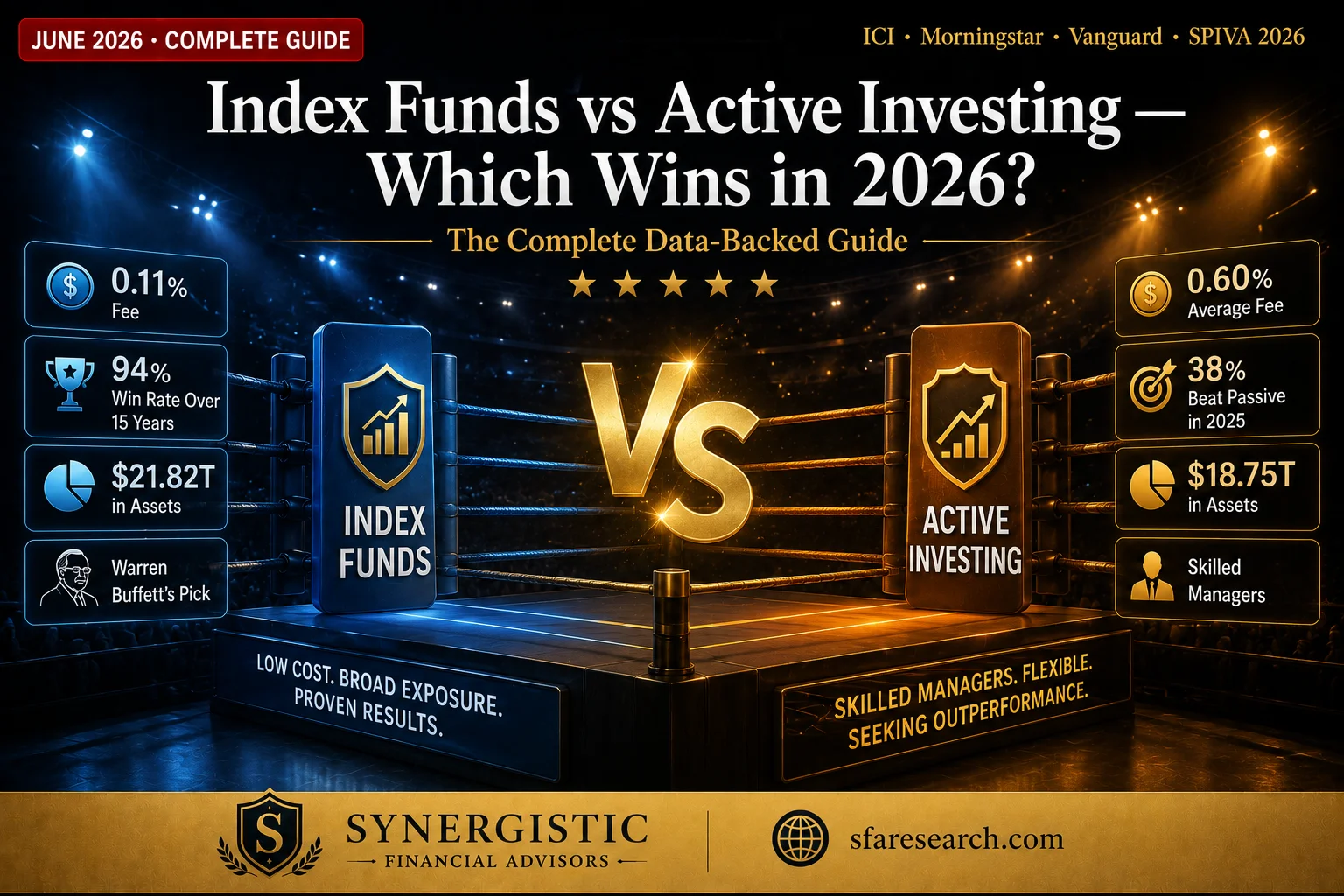
The combined assets of the nation’s indexed mutual funds and ETFs reached $21.82 trillion in May 2026 — surpassing active fund assets of $18.75 trillion — marking a genuine structural shift in how individual investors manage their wealth. Among active funds, only 38% beat their passive peers in 2025 after accounting for fees, down from 42% in 2024, according to Morningstar’s semiannual Active/Passive Barometer, which evaluated the performance of 9,248 funds.
But the story is more nuanced than a simple “index funds always win” conclusion — and understanding the nuance is what separates genuinely great investment management from simplistic advice. “I don’t treat passive and active funds as rivals,” said certified financial planner Mike Casey, founder and president of AE Advisors. “I treat them as teammates.”
In June 2026 — with the S&P 500 near record highs, the Federal Reserve eliminating forward guidance, CPI at 4.2%, and emerging markets up 20% year-to-date — choosing the right investment management approach has never been more consequential. This guide gives you the complete, data-backed picture.
What Is an Index Fund? The Complete Definition
Before comparing the two approaches, it is essential to understand exactly what each one means.
An index fund tries to match the performance of a specific market benchmark as closely as possible — buying all or a representative sample of the stocks or bonds in the index it tracks, aligning directly to the risks involved with the specific stock or bond market the fund tracks, and usually distributing fewer taxable capital gains because the portfolio manager trades less frequently.
An S&P 500 index fund owns all 500 companies in the same proportion as the index. The goal is not to beat the market — it is to match it for minimal cost. Index funds are passively managed, meaning they replicate the index rather than trying to beat it.
The average expense ratio for index funds is 0.11% annually. For active funds, it’s 0.60% — more than five times higher. For a $500,000 portfolio, that’s $330 per year (index) versus $3,000 per year (active). Over 20 years, that 0.49% annual difference compounds into a $29,000 or more gap, even before counting performance differences.
What Is Active Investing? The Complete Definition
An actively managed fund tries to outperform its benchmark — using the portfolio manager’s deep research and expertise to hand-select stocks or bonds for the fund.
A fund manager uses research, analysis, and skill to pick stocks that will beat the benchmark. They might avoid certain companies, overweight others, or take bets on market timing. At the advisor level, active management often includes services beyond fund selection — behavioural coaching, tax-loss harvesting, rebalancing, and estate planning consultation.
Active funds can be specialised, focusing on niche sectors or specific investment styles — such as small-cap value, emerging markets, AI infrastructure, or dividend income — areas where a skilled manager’s research can add genuine value beyond what a passive index exposure delivers.
The Performance Data — What the Numbers Actually Show in 2026
Here is where the debate becomes most important — and where the most frequently cited statistics deserve careful, honest examination.
The data is remarkably clear: 94% of active funds underperform index funds over 15-year periods according to SPIVA data. In large-cap investing, it’s even starker — just 14% of active US large-cap funds beat the S&P 500 over 15 years. The longer the time horizon measured, the more consistent that underperformance pattern becomes.
Just 21% of active funds survived and came out ahead over the 10 years ending in 2025, according to Morningstar’s research.
Vanguard’s own data, based on funds’ excess returns relative to their prospectus benchmark for the 10-year period ended March 31, 2026, shows that about 79% of active stock fund managers and 83% of active bond fund managers have underperformed their designated benchmarks.
According to Standard and Poor’s Index vs Active scorecard, 65% of all actively managed large-cap US equity funds underperformed the S&P 500 in 2024 — and this despite the kind of geopolitical and economic volatility that typically augurs well for shrewd active management.
These numbers are genuinely difficult to argue with — and they form the foundation of the case for passive investment management that Warren Buffett, Jack Bogle, and now Mark Cuban have all publicly endorsed. Billionaire Mark Cuban has been successful as an active investor. But for the average investor, he says index funds make more sense — giving investors access to a diversified basket of securities without requiring them to understand the ins and outs of financial markets.
But here is the critical nuance that most summaries of this debate miss: the 94% underperformance figure applies to fund managers trying to beat large-cap US equity benchmarks. It does not apply uniformly across every market segment, every asset class, or every investment objective.
Where Index Funds Genuinely Win — The Data-Backed Cases
The evidence for index funds is strongest — and most practically important — in the following specific contexts.
Large-Cap US Equities
Passive funds shine when markets are highly efficient and costs matter most, according to certified financial planner Mike Casey. Large-cap US equities are the most efficiently priced market in the world — followed by thousands of professional analysts, algorithmic trading systems, and institutional investors whose collective activity ensures that prices reflect available information almost instantaneously. In this environment, a fund manager’s research advantage is minimal, their trading costs are real, and their fees are compounding drags that are very difficult to overcome through stock selection alone.
You can find plenty of index funds with similar or better performance than their active peers that have expense ratios below 0.10%.
For core large-cap US equity exposure, the evidence for low-cost index funds is overwhelming and essentially settled.
Long Time Horizons
Investing $10,000 in a low-cost S&P 500 index fund over 20 years could grow to roughly $58,000, assuming an 8% average annual return — demonstrating the power of compounding with a low-fee, long-term strategy.
The mathematics of fee compounding make index funds increasingly dominant over longer time horizons. An active fund that charges 0.60% annually is not simply 0.49 percentage points more expensive than an index fund charging 0.11% — it is 0.49 percentage points in the hole every single year, compounding against the investor’s wealth accumulation across decades of retirement planning.
For retirement savers in their 30s or 40s, “you can build most of the portfolio out of passive funds and be in very good shape,” according to one CFP advisor.
Tax Efficiency in Taxable Accounts
Index funds usually distribute fewer taxable capital gains because the portfolio manager trades less frequently. This tax efficiency advantage is one of the most consistently underappreciated benefits of index funds — and one that compounds meaningfully over long time horizons. Active funds, with their higher portfolio turnover, generate capital gains distributions that reduce the investor’s after-tax return even when the fund itself is outperforming its pre-tax benchmark.
For investors building wealth in taxable brokerage accounts — alongside tax-advantaged retirement accounts — the tax efficiency of index funds creates a genuine structural advantage that a financial advisor with integrated tax planning expertise can help you fully capture.
Where Active Management Can Genuinely Add Value — The Honest Cases
The most important and most frequently ignored dimension of the index versus active debate is that the evidence does not support a blanket dismissal of all active management in all contexts. Many financial advisors say there are parts of the market where passive, index-based investing makes more sense, and other areas that are better suited to active management.
Less-Efficient Market Segments
Active funds can earn their higher fees in less-efficient corners of the investment world where skilled managers can add real alpha.
Small-cap stocks, emerging market equities, high-yield bonds, and specialised sector funds all represent markets where professional research, local expertise, and active security selection can deliver genuine value that passive exposure cannot. The same overwhelming inefficiency argument that applies to large-cap US equities does not apply to a Vietnamese small-cap fund, a frontier market bond portfolio, or a specialised biotech fund where deep domain expertise translates directly into better security selection.
While around 90% of active equity funds underperform their index, a minority are still able to beat the trackers — doing so on the basis of their ability to spot under or over-priced stock in a given index, an expertise that can also help drive efficiency in the market by figuring out the true value of assets. The issue for investors is identifying these outliers in advance, which is notoriously difficult because past performance is not a reliable indication of future market returns.
Approaching and During Retirement
The closer you get to retirement, the more active management begins to matter because you just cannot accept the volatility of the general index. Once you start taking withdrawals, the risk profile changes. Active bond and equity managers can shorten duration of bonds, raise cash, or tilt defensively when conditions warrant.
This is perhaps the most practically important nuance in the entire index versus active debate for individual investors. A 30-year-old building wealth through a volatile market can absorb the swings of a passive index fund without lasting damage. A 68-year-old drawing down retirement income cannot afford a 30% portfolio decline at the beginning of their withdrawal period — the sequence-of-returns risk alone makes the flexibility of active risk management genuinely valuable regardless of average long-term performance comparisons.
The Cost-Adjusted Threshold
Over 10 years, through 2025, 31% of active funds in the cheapest quintiles of their respective categories bested their passive peers, compared with 17% for the priciest funds.
This finding is critically important: the most significant predictor of whether an active fund outperforms is not the manager’s skill or strategy — it is the fund’s cost. The most expensive active funds almost never justify their fees. The least expensive active funds — those charging 0.25% or less — have a meaningfully better chance of delivering genuine net value.
If you are going to use active management, the first screen is always cost. A high-cost active fund is almost always a bad choice. A low-cost active fund in a less-efficient market segment may be a genuinely excellent one.
The Hidden Cost That Changes Everything
The fee gap between active and index funds is not simply the management expense ratio — it is a compounding drag that builds relentlessly across every year of an investor’s wealth-building journey.
An investor starting with $100,000 who earns 4% annually would have about $208,000 after 20 years with a 0.25% fee, versus $179,000 with a 1% fee, according to the Securities and Exchange Commission. This $29,000 difference emerges entirely from the fee gap — before even counting performance differences.
Fees matter because even small differences compound over decades of investing.
We know that index funds have consistently outperformed actively managed funds for more than 10 years. When you factor in the cost of managing them — most charge investors around 1% in annual fees compared to 0.5% or less for passive funds — it’s hardly surprising that most people walk away with better outcomes from index funds.
This fee arithmetic is the single most powerful argument for index funds — not because active managers lack skill, but because the fee they charge creates a structural headwind that very few managers overcome consistently over long time horizons.
Survivorship Bias — The Statistical Illusion That Misleads Investors
One of the most important and most consistently overlooked dimensions of the active versus index debate is survivorship bias — and understanding it is essential for evaluating any active fund’s performance track record.
According to SPIVA research over the past 20 years, nearly 64% of domestic stock funds and almost two-thirds of international equity funds were shuttered or folded into other managers’ portfolios — a practice that may obscure underperformance and mislead investors comparing active management against benchmarks.
What this means practically: when you look at the average performance of active funds over the past 10 or 20 years, you are only looking at the survivors — the funds that stayed open and continued operating. The worst-performing funds closed, their poor track records disappeared from the average, and the published comparison understates how badly the full universe of active funds actually performed.
The true underperformance of active management — when survivorship bias is fully corrected — is even worse than the already-damning headline statistics suggest.
The 2026 Flow Data — What Investors Are Actually Doing
The most definitive real-world verdict on the index versus active debate is not any academic study — it is the actual investment decisions made by millions of individual investors with their own money in real time.
In May 2026, long-term index funds had a net inflow of $96.47 billion — versus an inflow of just $11.08 billion for active funds over the same period.
Indexed mutual funds and ETFs now hold $21.82 trillion in assets, surpassing the $18.75 trillion held in active funds.
This is a structural shift that has been building for decades and is now complete — for the first time in history, more money is invested in passive index funds than in actively managed funds. This is not a temporary trend or a product of any single market cycle. It reflects the accumulated experience of millions of investors who have directly compared their active fund outcomes against passive benchmarks and drawn their own conclusions.
A Complete Side-by-Side Comparison
| Feature | Index Funds | Active Investing |
|---|---|---|
| Goal | Match the market | Beat the market |
| Management | Passive — tracks index | Active — manager selects |
| Average Expense Ratio | 0.11% | 0.60%+ |
| 10-Year Outperformance | 79% of active underperform | 21% beat index over 10 years |
| Tax Efficiency | High — less trading | Lower — more taxable events |
| Best For | Large-cap, long horizons, taxable accounts | Less-efficient markets, retirement income, risk management |
| Behavioural Support | None — just tracks index | Can include coaching and planning |
| 2026 Asset Flows | $96.47B monthly net inflows | $11.08B monthly net inflows |
| Warren Buffett’s Recommendation | ✅ For most investors | ❌ Only exceptional managers |
The Real Answer — It Is Not Either/Or
Here is the insight that separates genuinely great investment management from the oversimplified debate that dominates most financial media: for most individual investors, the right answer in 2026 is not index funds or active management. It is index funds and active management, deployed strategically across the different segments of your portfolio where each delivers the greatest value.
A balanced portfolio with both fund types can combine the broad diversification of index funds with the targeted opportunities of actively managed funds — helping investors pursue long-term growth while managing concentration risk and aligning investments with specific goals.
Many advisors use passive funds to keep core costs low and add active strategies in areas where risk management, diversification, or investment selection may improve risk-adjusted returns.
The practical framework that a skilled financial advisor implements looks like this: use broad, low-cost index funds for core large-cap US equity exposure, investment-grade bonds, and international developed market equity — the most efficiently priced, most cost-sensitive segments of the market. Use carefully selected, low-cost active strategies for less-efficient segments — small-cap value, emerging markets, high-yield bonds — where research and security selection can add genuine net value. And use tax planning discipline to ensure both index and active positions are held in the most tax-efficient account types.
Research from Vanguard and Morningstar suggests that an advisor’s highest-value contribution comes from behavioural coaching — preventing investors from chasing performance, which costs them 2-3% annually, and managing rebalancing discipline. A skilled advisor might deliver 1-3% annually in alpha through behavioural coaching alone, independent of fund selection.
This last finding is perhaps the most important in the entire debate: the greatest source of alpha available to most individual investors is not fund selection — it is the behavioural discipline provided by a qualified financial advisor who prevents the costly emotional mistakes that consistently destroy long-term investment management returns regardless of which funds are held.
How to Choose Between Index Funds and Active Investing for Your Situation
Given everything the data shows, here is the practical decision framework every individual investor should apply to their own investment management strategy.
Choose index funds when:
You are investing in large-cap US equities — the most efficiently priced market in the world where active management has the weakest track record. Your time horizon is 20 years or longer — where the compounding cost advantage of index funds is mathematically dominant. You are investing through a taxable brokerage account — where the tax efficiency of low-turnover index funds creates genuine, measurable after-tax advantages. You want simplicity and minimal time commitment — index funds require no ongoing monitoring or manager evaluation. You are early in your retirement planning journey and building wealth through systematic contributions.
Consider active management when:
You are investing in less-efficient market segments — small-cap, emerging markets, high-yield bonds — where research and security selection can add genuine net value. You are approaching or in retirement — where downside risk management, income generation, and the ability to tilt defensively during market stress can justify active management fees. You are selecting low-cost active funds — those charging 0.25% or less — in the specific categories where active management has a demonstrated, research-supported performance edge. You need specialised risk management that passive exposure cannot provide — such as options-based income strategies, tactical asset allocation, or factor-based tilting.
Always consider both when:
You are working with a qualified financial advisor who builds an integrated portfolio management strategy — using index funds for efficient core exposure and active management selectively in less-efficient segments — within a comprehensive financial planning framework that coordinates tax planning, retirement planning, and wealth management under one coherent advisory relationship.
How Synergistic Financial Advisors Approaches Index Funds vs Active Investing
At Synergistic Financial Advisors, we do not have a dogmatic commitment to either index funds or active management. We have a commitment to the approach that delivers the best risk-adjusted, after-tax outcome for each individual client — which means using index funds where the evidence overwhelmingly supports them and active management where it can genuinely add value.
Our investment management philosophy builds on core positions in low-cost, broadly diversified index funds for large-cap equity and investment-grade bond exposure — capturing market returns at minimal cost with maximum tax efficiency. We selectively add active management in less-efficient market segments and in retirement planning portfolios where downside risk management and income generation justify the approach. And we integrate every investment management decision with our comprehensive tax planning, portfolio management, and wealth management services to ensure that the right fund in the wrong account structure never undermines the right overall strategy.
Most importantly, we provide the behavioural coaching and ongoing advisory relationship that research consistently identifies as the single greatest source of investment management value — preventing the emotional mistakes that cost investors 2-3% annually regardless of whether they hold index funds or active strategies.
Ready to build an investment management strategy that uses both index funds and active management exactly where each adds the most value for your specific goals? Contact Synergistic Financial Advisors today.
👉 Visit sfaresearch.com — because the best answer to index funds vs active investing is usually the one that combines both intelligently.
Final Thoughts — The Debate Is Important. The Application Is Everything.
The debate over index funds versus active management has been described as “essentially over, and indexing wins, hands down” — particularly in large-cap US equities over long time horizons.
But “indexing wins” is a statistical conclusion about averages — not a prescription for every investor in every market segment at every life stage. The data overwhelmingly supports low-cost index funds as the default, core approach for most investors in most situations. It does not support the elimination of all active management in all contexts for all investors.
The right investment management strategy in 2026 combines the cost discipline and market efficiency of index investing with the selective, targeted application of active management where the evidence genuinely supports it — within a comprehensive financial planning framework that ensures every investment decision serves your actual long-term goals.
At Synergistic Financial Advisors, that is the strategy we build for every client — combining the best of both approaches with the expert portfolio management, tax planning, and wealth management coordination that transforms good fund selection into genuinely great long-term outcomes.