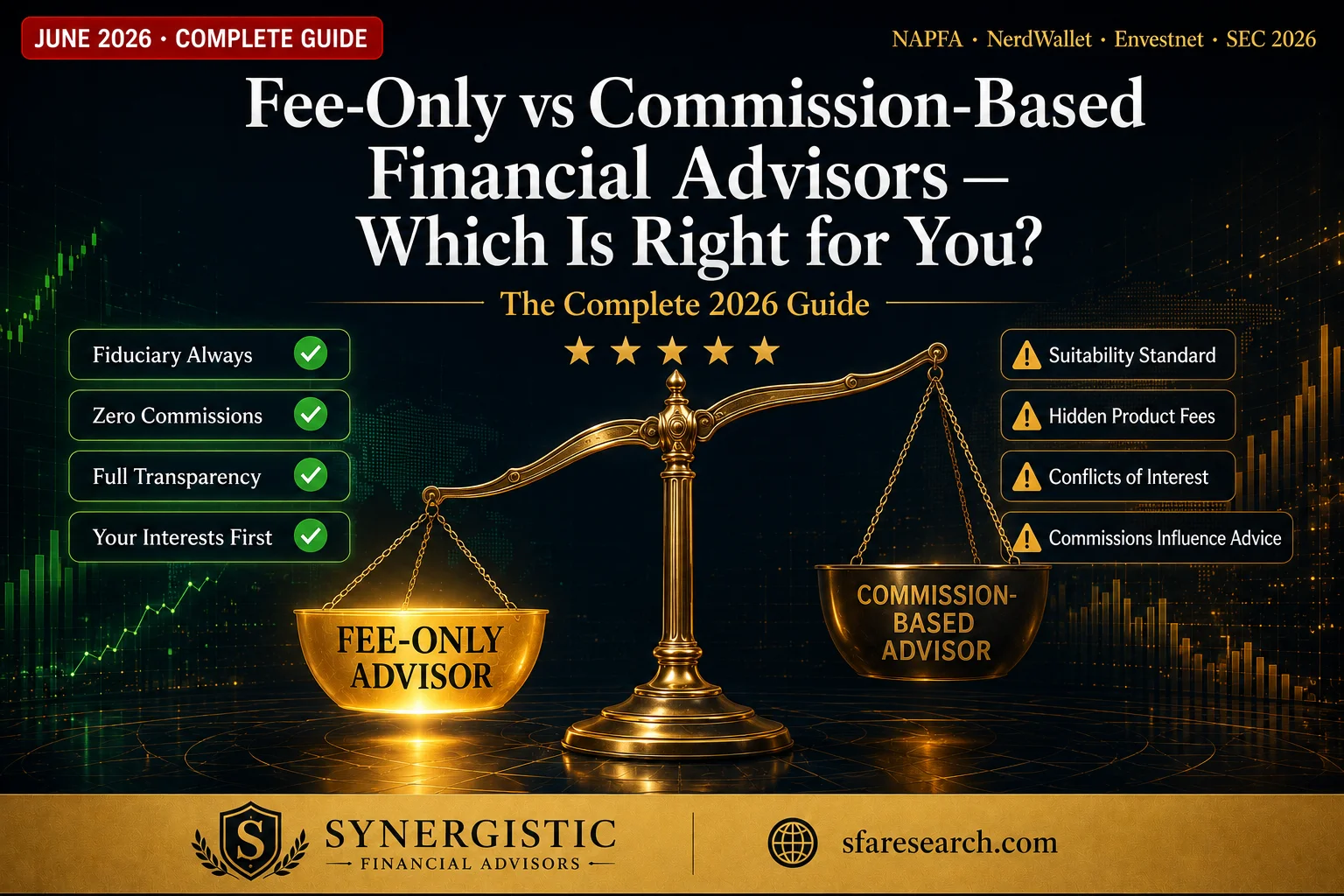
When you search for a financial advisor, you will encounter a bewildering array of terms — fee-only, fee-based, commission-based, fiduciary, suitability standard, AUM fee, flat fee, retainer. Most people read these descriptions, feel confused, and eventually choose an advisor based on a referral or a familiar brand name — without ever fully understanding how that advisor gets paid.
That is a costly mistake. How your financial advisor is compensated is not a technical footnote. It is the single most important factor shaping whether the advice you receive is genuinely designed around your best interests or quietly influenced by financial incentives you cannot see.
Choosing a financial advisor is one of the most important decisions you will make for your financial future. How your advisor gets paid can directly impact the advice you receive.
In June 2026 — with new permanent tax laws reshaping every financial decision, markets at record highs, CPI at 4.2%, the Federal Reserve eliminating forward guidance, and 90% of financial advisors now charging a fee for financial planning, driven by a move toward comprehensive, planning-led services — understanding the difference between fee-only and commission-based advisors has never been more important or more consequential.
This guide gives you everything you need to understand every compensation model, what each means for your interests, and how to make the right choice for your specific situation.
The Three Compensation Models — Clearly Defined
Before comparing the models, it is essential to understand exactly what each one means — because the terminology in this space is genuinely confusing, and some advisors deliberately blur these distinctions to their advantage.
What Is a Fee-Only Financial Advisor?
A fee-only financial advisor charges a fee to manage your financial portfolio. This fee could be a percentage of the assets under management (AUM), a flat fee regardless of AUM, a retainer, or hourly or project-based. A fee-only advisor receives no compensation from anyone other than their clients.
Fee-only planners do not receive commissions or other payments from the providers of financial products they recommend to clients. This structure eliminates the fundamental conflict of interest that exists when an advisor can earn additional income by recommending specific products — because a fee-only financial advisor has no financial incentive to recommend anything other than what is genuinely best for you.
To be licensed by the SEC, all fee-only financial advisors must act as fiduciaries — they are required by law to act in a client’s best interests. Certified financial planners (CFPs) are also fiduciaries who have earned special licences that attest to their expertise in financial planning services.
The most common fee-only structures in 2026 include:
AUM-based fees — the average flat percentage rate/AUM fee for a financial advisor is 0.96% according to the Envestnet/MoneyGuide 2026 State of Financial Planning Fees Study — typically collected quarterly based on assets managed.
Flat annual retainer fees — a fixed annual or monthly fee for ongoing comprehensive financial planning and wealth management services, regardless of portfolio size.
Hourly fees — only 9% of advisors are using this model in 2026, compared to 18% in 2023 — a decline that reflects a broader industry shift away from transactional, time-based pricing toward relationship-oriented fee structures.
Project-based fees — a one-time fee for a specific financial planning deliverable, such as a comprehensive retirement planning projection or tax planning review.
What Is a Commission-Based Financial Advisor?
Advisors whose entire earnings come in the form of commissions on investment accounts they open or products they sell are known as “commission-based,” and are typically referred to more as brokers.
A commission-based advisor earns money when you buy or sell a financial product — a mutual fund, an insurance policy, an annuity, or other investment vehicles. The critical implication is straightforward: if the advisor has an incentive to invest you in a mutual fund or sell you an insurance policy, how do you know if they are working in your best interest?
Commission-based advisors are typically held to a suitability standard, which means their recommendations only need to be “suitable” for you, not necessarily the best option available. This is a meaningfully weaker standard than the fiduciary requirement that governs fee-only advisors — and the gap between “suitable” and “optimal” can represent thousands of dollars over time.
Commission-only advisors have an even larger incentive than fee-based advisors to push clients into certain products that pay them commissions — even if the products are not in the client’s best interest — because that is the only compensation they receive for their services.
What Is a Fee-Based Financial Advisor? (The Critical Middle Ground)
This is where most consumers become confused — and where the confusion can be most costly.
A fee-based advisor is compensated by their client and can receive compensation from commissions from the sale of financial products like insurance, annuities, and mutual funds. Fee-based advisors charge client fees like fee-only advisors — but they can also earn product commissions like commission-based advisors.
It makes sense that consumers would find this confusing. The terminology used by advisors when it comes to fees can feel vague, and fee-based advisors may even try to benefit from the fact that consumers are actively looking for fee-only advisors.
The critical distinction: a fee-based advisor may act in the best interest of their clients, but the presence of commissions can create potential conflicts of interest. Fee-based advisors are not fiduciary financial planners.
Some fee-based financial advisors have a fiduciary duty — but many of them are fiduciaries only when they are providing advice under the fee part. It does not apply when they are selling products. When they switch to a sales role, that legal obligation may no longer apply.
Understanding this distinction — that fee-based is not the same as fee-only — is one of the most important consumer protections available to anyone choosing a financial advisor in 2026.
The Fiduciary Standard vs The Suitability Standard — Why It Matters More Than You Think
At the heart of the fee-only versus commission-based debate is a deeper distinction about the legal standard governing the advice you receive.
A fiduciary financial advisor is legally required to act in the best interests of clients at all times. The fiduciary standard requires both a duty of care and a duty of loyalty — meaning recommendations must be prudent, well-researched, and aligned with your objectives, and advisors must place your financial interests ahead of their own. A fiduciary financial advisor is legally bound to provide full disclosure of conflicts of interest and must manage those conflicts appropriately.
Think of it this way: a fiduciary is like a doctor who prescribes the medication you need, not the one that earns them the biggest kickback from a pharmaceutical company.
The suitability standard — which governs most commission-based advisors — requires only that recommendations be suitable for your economic situation at the time they are made. Suitable and optimal are not the same thing.
Commissions are common in the financial services industry, but you can see how they might present a conflict of interest: if a planner can earn a 1% commission for recommending mutual fund A and a 2% commission for recommending mutual fund B, the temptation to swing your portfolio toward mutual fund B could be strong. A fee-only planner has set up their payment structure to eliminate that temptation.
The practical implication for your financial planning strategy is direct and measurable. An advisor with no commission incentives is structurally positioned to give you genuinely unconflicted advice — about your investment management strategy, your tax planning options, your retirement planning approach, and every other dimension of your financial life. An advisor with commission incentives, however well-intentioned, faces a structural temptation that can subtly shape recommendations in ways that serve their income more than your outcomes.
The Hidden Cost Nobody Tells You About
One of the most powerful myths around commission-based advisors is that they are free — or at least cheaper than fee-only advisors. This is a misconception worth addressing directly.
One common misconception is that commission-based advisors are cheaper because you don’t pay them directly. Here’s the reality: you’re still paying. The cost is just hidden. When you purchase a financial product with embedded commissions, those fees come out of your investment returns. Over time, this can add up to thousands — or even tens of thousands — of dollars. With a fee-only advisor, costs are transparent and upfront. You see exactly what you’re paying, which makes it easier to evaluate whether you’re getting good value for your money.
This hidden cost compounds silently over years — eroding the very investment returns that your wealth management strategy depends on. A 1% embedded commission on a $200,000 mutual fund position is $2,000 per year in hidden cost — before any AUM-based advisory fee. Over 20 years, assuming 7% annual growth on that capital if retained, the compounding cost of that single hidden fee is extraordinary.
Transparency is not just an ethical preference — it is a genuine financial advantage. A fee-only financial advisor who charges a visible, agreed-upon fee for explicitly defined services gives you the ability to evaluate what you are paying against what you are receiving — a basic consumer right that commission structures consistently obscure.
A Side-by-Side Comparison — Fee-Only vs Fee-Based vs Commission-Based
| Feature | Fee-Only | Fee-Based | Commission-Based |
|---|---|---|---|
| How They Earn | Client fees only | Client fees + commissions | Commissions only |
| Fiduciary Status | Always fiduciary ✅ | Sometimes fiduciary ⚠️ | Rarely fiduciary ❌ |
| Legal Standard | Fiduciary | Mixed | Suitability |
| Conflicts of Interest | None | Possible | Significant |
| Fee Transparency | Complete ✅ | Partial ⚠️ | Hidden ❌ |
| Best For | Comprehensive planning | Specific services | Product purchases |
| CFP Compatibility | High | Medium | Low |
| Recommended For | Wealth management, retirement planning, tax planning, comprehensive financial planning | Specific investment needs | One-time product purchases |
6 Questions to Ask Every Financial Advisor Before Committing
Understanding the theoretical differences between fee structures is one thing. Applying that understanding in an actual advisor selection process is another. Here are the six questions that every individual should ask any prospective financial advisor before signing any agreement.
Question 1 — “Are you a fiduciary at all times, without exception?”
This is the single most important question. Always ask finance professionals how they get paid and whether they’ve signed a fiduciary oath before committing to work with them. Accept only an unqualified yes. Any qualification — “in most situations” or “when providing advice in my fee capacity” — signals a fee-based model where the fiduciary duty is not continuous.
Question 2 — “How exactly are you compensated — and can you show me in writing?”
A genuine fee-only financial advisor can answer this question simply and completely — listing their specific fee structure without any mention of commissions, referral fees, or product-based compensation. Advisors registered with the SEC are usually bound by fiduciary duty when acting as advisors. They also have to file a document called Form ADV, which clearly outlines their fee structure and potential conflicts of interest. Request this document. Review it carefully.
Question 3 — “Do you or your firm receive any compensation from third parties based on your recommendations?”
This question specifically uncovers the hidden commission arrangements that fee-based advisors may not volunteer. Referral fees, revenue sharing arrangements, and insurance company commissions all represent third-party compensation that can influence recommendations. A fee-only financial advisor answers this question with an unambiguous no.
Question 4 — “Are you a member of NAPFA?”
NAPFA — the National Association of Personal Financial Advisors — is the leading organisation for fee-only advisors. Members must adhere to strict fiduciary and ethical standards. NAPFA membership is one of the most reliable third-party verifications of genuine fee-only status available. It requires that members earn no commissions of any kind — a standard that fee-based advisors cannot meet.
Question 5 — “How do you handle situations where a commission-paying product might genuinely be appropriate for my situation?”
This question reveals an advisor’s ethical framework around the specific tension between their compensation model and your best interests. A fee-only financial advisor will explain that they recommend the most suitable available product without regard to compensation — because their compensation is entirely separate from any product recommendation. This is the answer that demonstrates genuine unconflicted advice.
Question 6 — “What credentials do you hold and can I verify them independently?”
The certified financial planner designation is the gold standard in financial planning credentials — verified through the CFP Board website. Confirm that your prospective advisor’s credentials are current, that their regulatory record is clean through FINRA BrokerCheck and the SEC’s IAPD database, and that their stated compensation model matches their regulatory filings.
Who Benefits Most From Each Model?
Understanding which compensation model is appropriate for different situations helps every individual make the right choice for their specific circumstances.
Fee-only financial advisors are the right choice for:
Individuals seeking comprehensive, ongoing financial planning across multiple dimensions — investment management, tax planning, retirement planning, portfolio management, and wealth management — all integrated under one advisory relationship with zero conflicts of interest.
High-income earners and business owners with complex financial situations where the unconflicted advice of a fiduciary financial advisor creates measurable, compounding value across every financial decision.
Anyone approaching retirement planning who needs coordinated Social Security timing, withdrawal strategy, tax planning, and healthcare cost planning — disciplines where conflicted advice can cost tens of thousands of dollars over a retirement lifetime.
Individuals who want complete transparency about what they are paying and what they are receiving — and the ability to evaluate their advisory relationship on clearly defined, openly disclosed terms.
Commission-based advisors may be appropriate for:
A commission-based financial advisor can be a valuable resource if you don’t plan to buy or sell investments frequently.
Individuals with simple, specific product needs — a one-time insurance purchase or a specific investment product — who do not require ongoing comprehensive financial planning guidance.
Those in the early stages of wealth accumulation who are not yet ready for a comprehensive ongoing advisory relationship but need specific product guidance.
The important caveat: if a financial advisor pressures you to take action on something that makes you uncomfortable, move your business to another firm. Always ask your financial advisor to explain why they recommend buying or selling stocks or mutual funds before agreeing to make the trade.
The 2026 Industry Shift — Why Fee-Only Is Winning
The broader financial advisory industry in 2026 is moving decisively toward the fee-only model — and understanding why helps every investor assess both the current landscape and the direction of travel.
According to the Envestnet/MoneyGuide 2026 State of Financial Planning Fees Study, 90% of financial advisors charge a fee for financial planning, driven by a move toward comprehensive, planning-led services. The era of the commission-only advisor who focuses purely on product transactions is being steadily replaced by a planning-first advisory model in which the comprehensive financial planning relationship — not the individual product sale — is the primary value delivered.
This structural shift reflects both consumer demand and regulatory direction. Investors are increasingly aware of the conflict of interest embedded in commission-based compensation — and increasingly willing to pay explicit, transparent fees for genuinely unconflicted advice. At the same time, regulatory developments like the SEC’s Regulation Best Interest have raised the standard for all advisors — though the fiduciary standard that fee-only advisors have always operated under remains meaningfully stronger.
For investors, this industry-wide shift has a practical implication: the supply of genuinely fee-only, fiduciary financial advisors is growing — making this the most accessible moment in history to find and engage a genuinely unconflicted financial advisor for your specific needs.
How Synergistic Financial Advisors Operates — Complete Transparency
At Synergistic Financial Advisors, transparency about how we operate and how we are compensated is not a marketing position — it is the foundational commitment that makes every other aspect of our advisory relationship possible.
Synergistic Financial Advisors operates as a genuinely client-first financial advisory firm — with fiduciary commitment that governs every recommendation we make, every strategy we build, and every conversation we have with every client. Our approach integrates investment management, portfolio management, retirement planning, tax planning, and comprehensive wealth management under one coordinated advisory framework — built entirely around your specific goals, your specific situation, and your specific financial future.
Our compensation structure is designed to eliminate the conflicts that commission-based and fee-based models cannot avoid — because we believe that genuinely great financial planning is only possible when the advisor’s interests are completely aligned with yours.
Whether you are an individual building long-term wealth management strategy, a high-income professional navigating complex tax planning decisions, a business owner seeking coordinated personal and corporate financial planning, or a family approaching retirement planning with both urgency and confidence — Synergistic Financial Advisors delivers the expert, transparent, genuinely fiduciary-standard advisory that your financial future deserves.
Ready to experience the difference that genuinely unconflicted financial advice makes? Contact Synergistic Financial Advisors today for a personalised consultation.
👉 Visit sfaresearch.com — because the right financial advisor has nothing to hide.
Final Thoughts — The Most Important Question Is the Simplest One
The fee-only versus commission-based debate can feel technically complex. But it ultimately reduces to a single, simple question that every investor deserves a clear answer to: is your financial advisor earning money from recommending specific products to you?
If the answer is yes — through commissions, referral fees, revenue sharing, or any other form of product-based compensation — then every recommendation they make carries a potential conflict between their financial interest and yours. That conflict may never manifest in a way that harms you. But it is always present, always possible, and always invisible.
If the answer is no — because your advisor earns exclusively through transparent client fees with no product-based compensation of any kind — then you have found the foundational quality that makes genuinely great financial planning possible: advice that is structurally, legally, and ethically required to serve your interests and only your interests.
Fee-only advisors are fiduciaries at all times, and are only paid by their clients under a transparent fee structure. Many regard this as an ideal structure — since fee-only financial advisors are only incentivised by the fee paid to them by their clients, they have no reason to invest their clients in financial products that may not align with the client’s portfolio strategy.
That is the standard every investor deserves. And it is the standard Synergistic Financial Advisors delivers.