Market volatility is not an exception to investing. It is a defining feature of it.
In 2026 alone, investors have experienced the S&P 500’s worst single day of the year — a 2.6% plunge when a jobs report doubled consensus expectations. They have watched semiconductor stocks fall 10% in a single session. They have navigated oil prices swinging from $102 to $88 and back to $95 within weeks. They have processed a new Federal Reserve Chair eliminating three decades of forward guidance. And they have simultaneously watched the same index deliver its 11th winning week in 12, SpaceX complete the largest IPO in financial history, and Goldman Sachs call for S&P 8,000 by year-end.
Market volatility is a normal part of investing, but it can feel unsettling, especially during uncertain economic periods. In 2026, with ongoing concerns around interest rates, inflation, and economic growth, many investors are questioning whether they should make changes to their portfolios. For individuals focused on retirement planning and financial planning, staying disciplined during volatile markets is often one of the most important factors in long-term success.
The investors who navigate volatility successfully are not those who predict market movements most accurately. They are those who have built the right investment management strategies in advance — strategies that work across the full range of market environments rather than being optimised for any single predicted path.
This guide gives you the 10 most powerful, most evidence-based investment management strategies for market volatility in 2026 — backed by research from Morgan Stanley, BlackRock, Fidelity, Ameriprise, and iShares.
Why Market Volatility Feels Worse Than It Is — And Why That Feeling Is Your Biggest Risk
Before examining the strategies, it is essential to understand the psychological mechanism that makes volatility so dangerous for individual investors — because every strategy in this guide is partly a defence against this mechanism.
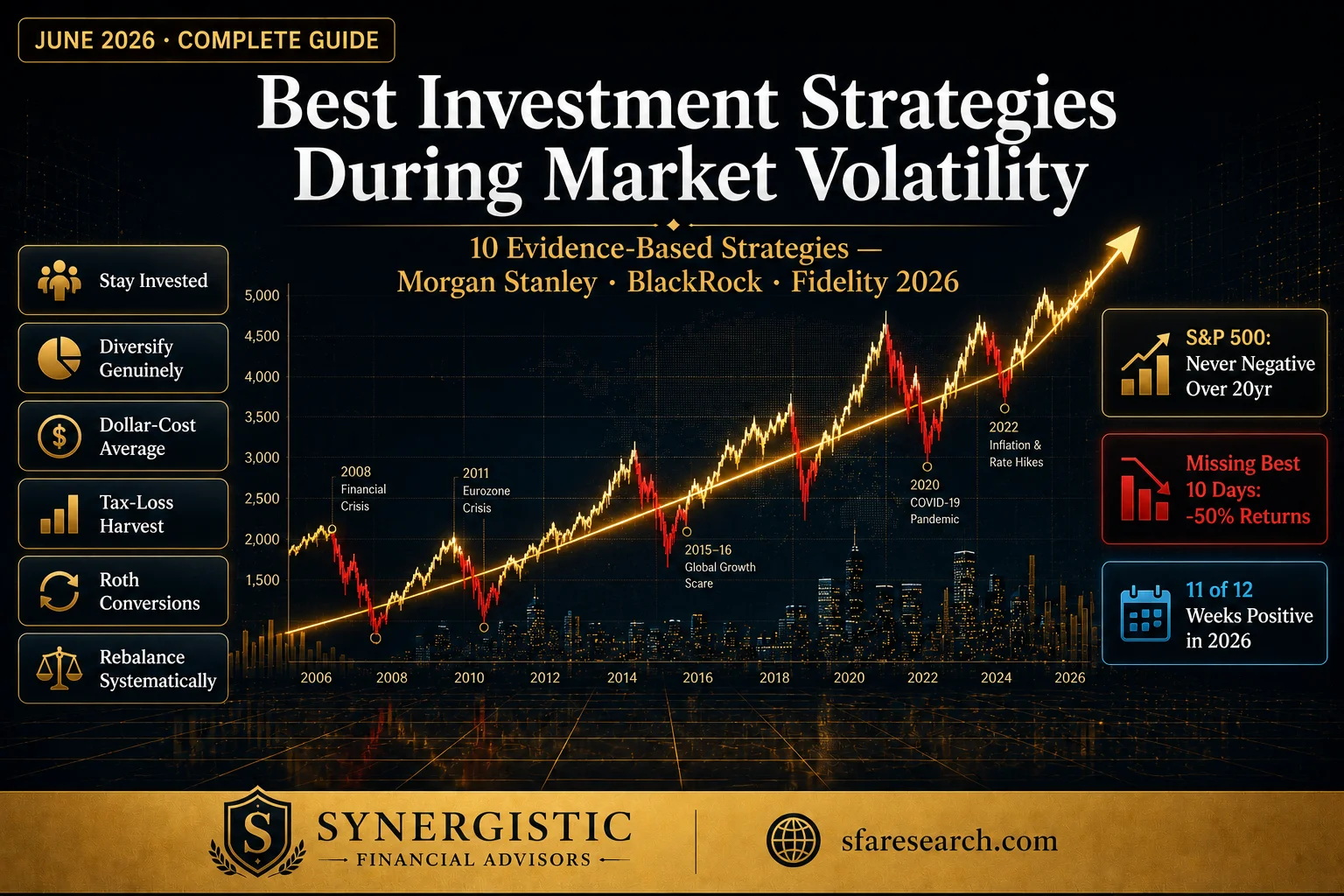
Remaining invested through market volatility is generally one of the best ways to build wealth management over the long term. Missing out on the market’s best days by reactively selling can erode an investor’s long-term return potential and reduce the probability of investment success. Often, the stock market’s biggest down days occur near the market’s largest up days.
Read that last sentence carefully. The market’s biggest up days cluster near its biggest down days. This means that investors who sell during the worst moments — driven by the very real pain of watching their portfolio management value decline — are the most likely to miss the recovery that immediately follows. And missing even a handful of the market’s best days destroys long-term returns in a way that is mathematically devastating.
During times of volatility, remind yourself of the reasons you invested in the first place and the long-term goals you are working toward. It is crucial to stay grounded in the knowledge that markets have historically recovered over time and that a disciplined mindset — and the support and guidance of your financial advisor — can help you navigate these fluctuations with confidence.
The enemy of great investment management during volatility is not the market itself — it is the emotional reaction to the market. Every strategy below is designed to systematically replace emotional reaction with disciplined, pre-built action.
Strategy 1 — Stay Invested and Resist the Urge to Time the Market
The most fundamental and most consistently validated investment management strategy during market volatility is the one that requires the least action: stay invested.
Market fluctuations are not new. Periods of decline and recovery are a natural part of the investment cycle. While short-term movements can be unpredictable, long-term market trends have historically rewarded investors who stay invested and avoid emotional decision-making.
The mathematics of this principle are unforgiving in both directions. The S&P 500 has never produced a negative return over any 20-year rolling period in history — meaning long-term investors who stay invested through every volatility episode, every market correction, and every bear market have historically been rewarded for that discipline.
Conversely, attempts to time the market — selling during downturns and waiting for the right moment to re-enter — consistently underperform a simple buy-and-hold strategy across virtually every time horizon studied. The reason is straightforward: the moments of maximum fear that trigger selling are statistically clustered near the market’s best subsequent recovery days.
The safest investment management strategies in 2026 include US Treasury bonds and I-Bonds for capital preservation — but for long-term investors who can tolerate short-term volatility, a diversified index fund portfolio is considered very safe over 10-plus year periods.
Financial Planning Insight: A qualified financial advisor helps you build a portfolio management strategy you can actually stay invested through — sized appropriately for your genuine risk tolerance rather than your theoretical one. The portfolios that get abandoned during volatility are almost always those built for the risk tolerance investors claim to have, not the risk tolerance they actually experience when markets fall.
Strategy 2 — Maintain a Genuinely Diversified Portfolio
Maintaining a diversified portfolio — in which you spread your investments across a wide array of assets — can mitigate the phenomenon known as “volatility drag,” by cushioning the impact of market dips and helping you achieve steadier growth over time.
Diversification in 2026 means something broader than simply owning stocks and bonds. International equities, specifically emerging markets in Asia, can help investors diversify within the AI theme, while those wanting to diversify outside of the AI trade may also consider developed market strategies, which tend to have a tilt toward value and lower earnings volatility or pay out dividends. Additionally, to address concentration risk and reduced reliability of traditional hedging assets, consider what BlackRock calls a “diversified diversifier” — using alternative strategies and asset classes that have a low correlation to stocks.
The specific diversification challenge of 2026 is AI-driven concentration risk. The S&P 500’s extraordinary performance this year has been significantly driven by a narrow group of AI and semiconductor names — creating a situation where investors who hold broad market index funds believe they are diversified, while their actual exposure is increasingly concentrated in a handful of technology companies.
Dividend-paying equities can also serve as potential diversifiers in an AI-led equity sell-off. Their tilts toward value and lower earnings volatility can help counterbalance long-duration AI exposures. International dividend payers, in particular, can offer income stability and sector diversification at a time when recent US equity returns have largely been tied to a relatively narrow group of AI beneficiaries.
Financial Planning Insight: A certified financial planner can map your actual underlying exposures — not just your account labels — and identify where genuine concentration risk has built up through 2026’s AI-driven rally that standard diversification metrics are understating.
Strategy 3 — Rebalance Systematically, Not Emotionally
Over time, market fluctuations can cause your asset allocation to drift from its original targets, potentially exposing you to unintended risks. Your long-term financial plan should determine your asset allocation, which accounts for 80-90% of portfolio returns, making it essential to review and rebalance periodically. By adjusting your portfolio with an eye toward your long-term goals, you can maintain the desired balance between different asset classes such as stocks, bonds, and cash.
Systematic rebalancing — adjusting your portfolio back to its target allocation on a predetermined schedule or when allocations drift beyond predetermined thresholds — is one of the most powerful and most consistently underused portfolio management disciplines available to individual investors.
The counterintuitive power of rebalancing is that it forces disciplined buy-low, sell-high behaviour without requiring any market prediction. When equities surge — as AI and semiconductor stocks have in 2026 — rebalancing trims the positions that have grown expensive and reallocates to the asset classes that have lagged. When equities fall sharply — as they did on June 9 — rebalancing adds to equity exposure at lower prices.
Market volatility can cause your portfolio to drift away from its target allocation — making systematic rebalancing one of the most important ongoing portfolio management disciplines for any investor navigating uncertain markets.
Financial Planning Insight: A financial advisor who implements systematic, rules-based rebalancing removes the emotional component from one of the most important ongoing investment management decisions — ensuring your portfolio management strategy stays aligned with your actual goals rather than with market momentum.
Strategy 4 — Dollar-Cost Averaging — The Power of Buying Consistently
Dollar-cost averaging — investing a fixed dollar amount at regular intervals regardless of market conditions — is one of the most consistently effective investment management strategies during volatile markets, and one of the most psychologically powerful.
Dollar-cost averaging is recommended for beginners as the best investment management strategy — investing fixed amounts regularly, regardless of market conditions, taking the emotion out of investing and automatically buying more shares when prices are low and fewer when prices are high.
The mathematics of dollar-cost averaging are particularly compelling during volatile markets. When prices fall sharply — as they did during June 9’s selloff — a fixed dollar investment buys more shares at lower prices. When prices recover, those shares generate proportionally greater gains. This systematic approach creates a natural buying-low dynamic that emotional, discretionary investing almost never replicates.
For investors making regular 401(k) or IRA contributions throughout 2026’s volatile market environment, dollar-cost averaging is already working automatically — and working powerfully. Each payroll contribution has been buying shares at varying prices across one of the most volatile and most consequential market environments in recent memory.
Financial Planning Insight: A certified financial planner can help you extend dollar-cost averaging beyond automatic 401(k) contributions into your broader investment management strategy — identifying optimal contribution timing, amounts, and account structures that maximise the after-tax compounding power of systematic investing.
Strategy 5 — Tax-Loss Harvesting — Turning Volatility Into Tax Savings
Market volatility creates one of the most consistently valuable tax planning opportunities available to any investor — and most individual investors either miss it entirely or implement it incorrectly.
While no one likes to lose money, your financial advisor may be able to help you take advantage of a down market. Tax rules may let you use losses on some of your investments to reduce your future tax bills or use lower share prices to convert to a Roth IRA at a lower tax cost. Down markets may also be a good time to meet with your advisor to discuss adjusting your investment mix or taking advantage of opportunities when prices are low.
Tax-loss harvesting involves selling investments that have declined in value to realise a tax loss, then immediately reinvesting in a similar — but not identical — investment. The realised loss offsets capital gains elsewhere in your portfolio, reducing your tax bill. Best for investors in taxable brokerage accounts with significant gains. Potential tax savings of $1,000-$3,000 or more per year for active investors.
June 9’s 10% chip sector selloff created specific, measurable tax-loss harvesting opportunities in semiconductor and AI positions that had accumulated significant gains through the nine-week rally. A financial advisor who identified and executed these opportunities during the selloff — replacing sold positions with similar but not identical exposure to maintain market participation — captured genuine, compounding tax planning value from the very volatility that terrified most investors.
The wash-sale rule — which prevents repurchasing the same or substantially identical security within 30 days of the loss sale — requires careful implementation that a certified financial planner can navigate systematically without disrupting your overall investment management strategy.
Financial Planning Insight: Tax-loss harvesting is one of the highest-return tax planning activities available during volatile markets — converting the pain of temporary price declines into permanent, compounding tax savings that enhance your after-tax wealth management outcomes year after year.
Strategy 6 — Use Volatility for Roth Conversions
One of the most powerful and most consistently underutilised investment management strategies during market downturns is the Roth conversion — converting traditional IRA or 401(k) assets to Roth accounts when asset values are temporarily depressed.
Your financial advisor may be able to help you use lower share prices to convert to a Roth IRA at a lower tax cost during a market downturn — creating a window to lock in tax-free growth on assets that you expect to recover in value, at a reduced conversion cost.
The logic is straightforward and powerful. If a traditional IRA account that was worth $200,000 falls to $170,000 during a market correction, converting that $170,000 to a Roth IRA incurs ordinary income tax on $170,000 rather than $200,000 — a $30,000 reduction in the taxable conversion amount. When the account subsequently recovers to $200,000 — and history suggests it will — that recovery occurs entirely within the Roth account, generating tax-free growth rather than taxable growth in a traditional account.
In 2026 — with permanent tax brackets under the One Big Beautiful Bill Act providing genuine long-term planning certainty — Roth conversion modelling during volatility episodes has become one of the most consistently valuable integrated financial planning and tax planning activities available.
Financial Planning Insight: A certified financial planner with integrated tax planning expertise can model the optimal Roth conversion amount during each volatility episode — determining how much to convert within your specific tax bracket to maximise long-term after-tax retirement planning outcomes.
Strategy 7 — Build a Bond Ladder for Predictable Income
A bond ladder involves buying bonds with staggered maturity dates — so that some bonds mature every year. This provides regular income, reduces interest rate risk, and preserves capital better than stocks during market downturns. Best for conservative investors, retirees, or anyone within five years of needing the money. With interest rates at elevated levels in 2026, bonds offer meaningful returns with significantly less volatility than stocks.
A bond ladder is particularly powerful in 2026’s interest rate environment — where the Federal Reserve’s dot plot now projects rates at 3.8% by year-end, creating genuinely attractive yields across the intermediate portion of the curve. The intermediate portion of the yield curve — the “belly” — provides an appealing mix of ballast and income.
For investors approaching retirement planning or in the distribution phase, a bond ladder that ensures specific, predictable cash flows for the next three to five years eliminates the need to sell equity positions during market downturns to fund current expenses — the most damaging sequence-of-returns risk in retirement planning.
Financial Planning Insight: A financial advisor can build a personalised bond ladder — calibrated to your specific retirement planning income timeline, tax situation, and interest rate expectations — that provides the psychological confidence to leave your equity portfolio management strategy intact through every volatility episode.
Strategy 8 — Increase Exposure to Real Assets and Inflation Hedges
Real assets are in a stealth bull market. Natural-resource equities and other real-asset exposures are outperforming this year as under-the-radar beneficiaries of AI infrastructure, energy transitions, and re-shoring. We are still in the early innings of a decade-long real-asset super-cycle. Debasement is becoming the shadow financial strategy for funding liabilities and future ambitions. That risk needs to be hedged with scarce assets such as gold and Bitcoin. Gold is one of the strongest major assets this year, and experts expect that momentum to carry it to $5,000 in 2026.
In 2026’s environment — with CPI at 4.2%, a new Fed Chair eliminating forward guidance, and oil volatile between $88 and $95 — inflation protection is not a marginal allocation consideration. It is a structural necessity for any portfolio management strategy with a multi-year horizon.
Real assets — including commodities, real estate investment trusts, infrastructure equities, and natural resource companies — provide returns that are less correlated with traditional stock and bond markets, creating genuine diversification benefit during the kind of multi-factor volatility that 2026 has consistently delivered.
Options income strategies can help investors with a differentiated source of return by seeking to capture volatility risk premium through covered call writing, generating income while maintaining some exposure to the equity market’s long-term growth potential.
Financial Planning Insight: A financial advisor with expertise in alternative investment management can help you build appropriate, diversified real asset exposure — sized correctly for your overall portfolio management strategy and aligned with your specific inflation protection needs.
Strategy 9 — Maintain Your Cash Reserve and Emergency Fund
One of the most consistently overlooked but most practically important investment management strategies during market volatility is ensuring that your liquid cash reserve is adequate before volatility strikes — not scrambling to build one during it.
For those approaching or in retirement, market volatility can feel especially concerning. However, a well-structured retirement planning strategy should account for these fluctuations by maintaining sufficient liquid reserves — reducing the need to sell investments during market downturns to fund current expenses.
The investors who are most damaged by market volatility are not those whose portfolios decline — every investor’s portfolio declines during corrections. They are those who are forced to sell portfolio positions at depressed prices to meet immediate liquidity needs — crystallising temporary declines into permanent losses.
An emergency fund of three to six months of essential expenses in an accessible, liquid account — completely separate from your investment management portfolio — eliminates the forced-selling risk entirely. In 2026’s elevated rate environment, high-yield savings accounts and money market funds are offering 4-5% yields on this emergency reserve, making the opportunity cost of maintaining liquidity lower than at any point in the past decade.
Financial Planning Insight: A certified financial planner can determine the optimal size and structure of your liquid reserve — accounting for your specific income stability, upcoming expenditure needs, and retirement planning timeline — ensuring your investment management strategy is never at risk of forced selling during the worst market moments.
Strategy 10 — Work With a Fiduciary Financial Advisor
Consult with a financial advisor: if you are unsure about your strategy, seeking professional advice can provide clarity. No-return, flat markets are an invitation to rethink your investment management strategy.
Every strategy in this guide is more powerful, more consistently implemented, and more effectively calibrated to your specific situation when executed within a genuine professional advisory relationship. But not every advisory relationship delivers equal value — particularly during volatile markets when the behavioural coaching dimension of great financial advisory is most critical.
If you are unsure if your portfolio is prepared to weather periods of market volatility, reach out to a financial advisor for a consultation. Remaining invested through market volatility is generally one of the best ways to build wealth management over the long term.
A fiduciary financial advisor — legally required to act in your best interest at all times, compensated exclusively through transparent client fees with no commission incentives — brings three specific advantages during volatile markets. First, objective, unconflicted assessment of whether your current portfolio management strategy is genuinely appropriate for your situation or requires adjustment. Second, systematic implementation of the nine strategies above — dollar-cost averaging, rebalancing, tax-loss harvesting, Roth conversions, bond laddering, and real asset allocation — coordinated across your complete financial picture rather than implemented in isolation. Third, and perhaps most valuably, the behavioural anchor that prevents the emotional decisions that consistently destroy long-term investment management outcomes.
The difference between an investor who panicked and sold on June 9 and one who stayed disciplined often comes down to a single conversation with a trusted financial advisor who provided the context, the reassurance, and the strategic framework to stay the course.
Financial Planning Insight: The 10 strategies in this guide are not independent — they are most powerful when coordinated within a comprehensive financial planning framework that integrates investment management, tax planning, retirement planning, and wealth management under one coherent, expert-guided advisory relationship.
The 2026 Volatility Landscape — What Every Investor Needs to Understand
The specific volatility drivers of 2026 are worth naming explicitly — because understanding what is causing the volatility helps every investor assess whether it demands a strategic response or disciplined patience.
In a technological revolution, volatility is a feature. It creates entry points. The long game is unchanged: AI and robotics will over-deliver. Just don’t expect the full payoff in 2026.
The AI investment cycle is transitioning from Phase 1 — where capital deployment and narrative drove extraordinary returns — to Phase 2, where actual demonstrated ROI from AI investment determines which companies continue to be rewarded by markets. This transition is inherently volatile, as investors separate genuine AI value creators from companies spending enormous capital without clear return timelines.
Alongside AI transition volatility, 2026’s interest rate uncertainty — with a new Fed Chair, a 9-of-18 dot plot hike signal, and CPI at 4.2% — creates genuine duration risk across fixed income allocations that demands active portfolio management attention. And the Iran peace deal, which was signed in Switzerland on June 19, has begun removing the energy price premium that drove much of the inflationary pressure that shaped the first half of the year.
Navigating all of this simultaneously — with discipline, strategy, and genuine expertise — is precisely the work that a qualified financial advisor performs for every client, every day, in every market environment.
How Synergistic Financial Advisors Manages Market Volatility for Clients
At Synergistic Financial Advisors, market volatility is not an emergency — it is an environment we plan for in advance, navigate with discipline, and leverage for specific, measurable client benefit through tax-loss harvesting, Roth conversion opportunities, systematic rebalancing, and the ongoing behavioural coaching that keeps every client focused on their long-term goals when short-term market noise makes clear thinking genuinely difficult.
Our investment management approach integrates every strategy in this guide within a comprehensive, fiduciary-standard financial planning framework — coordinating portfolio management, tax planning, retirement planning, and wealth management under one coherent advisory relationship built entirely around your specific goals, timeline, and risk tolerance.
Whether you are a long-term investor building wealth management through a volatile AI-driven market, a near-retiree managing sequence-of-returns risk through 2026’s interest rate uncertainty, or a business owner navigating the intersection of personal and corporate financial planning in a genuinely complex economic environment — Synergistic Financial Advisors brings the expertise, the discipline, and the genuine client-first commitment that every investor deserves.
Ready to build an investment strategy that performs through volatility, not just in spite of it? Contact Synergistic Financial Advisors today for a personalised consultation.
👉 Visit sfaresearch.com — because the best investment management strategy is the one that keeps working when markets make it hardest to stay disciplined.
Final Thoughts — Volatility Is the Price of Long-Term Returns
Market volatility is not a problem to be solved. It is the price of the long-term returns that patient, disciplined investors earn from equity markets — returns that consistently outperform every alternative over sufficiently long time horizons.
The 10 strategies in this guide — staying invested, maintaining genuine diversification, rebalancing systematically, dollar-cost averaging, tax-loss harvesting, executing Roth conversions, building bond ladders, adding real asset exposure, maintaining adequate liquidity, and working with a fiduciary financial advisor — do not eliminate volatility. They ensure that volatility works for your financial planning goals rather than against them.
The most successful investors are those who remain disciplined and focused on their long-term strategy during volatile markets — not those who react most quickly to the latest headline.
At Synergistic Financial Advisors, building that discipline — systematically, expertly, and genuinely in your best interest — is the work we do for every client, through every market environment, in 2026 and beyond.