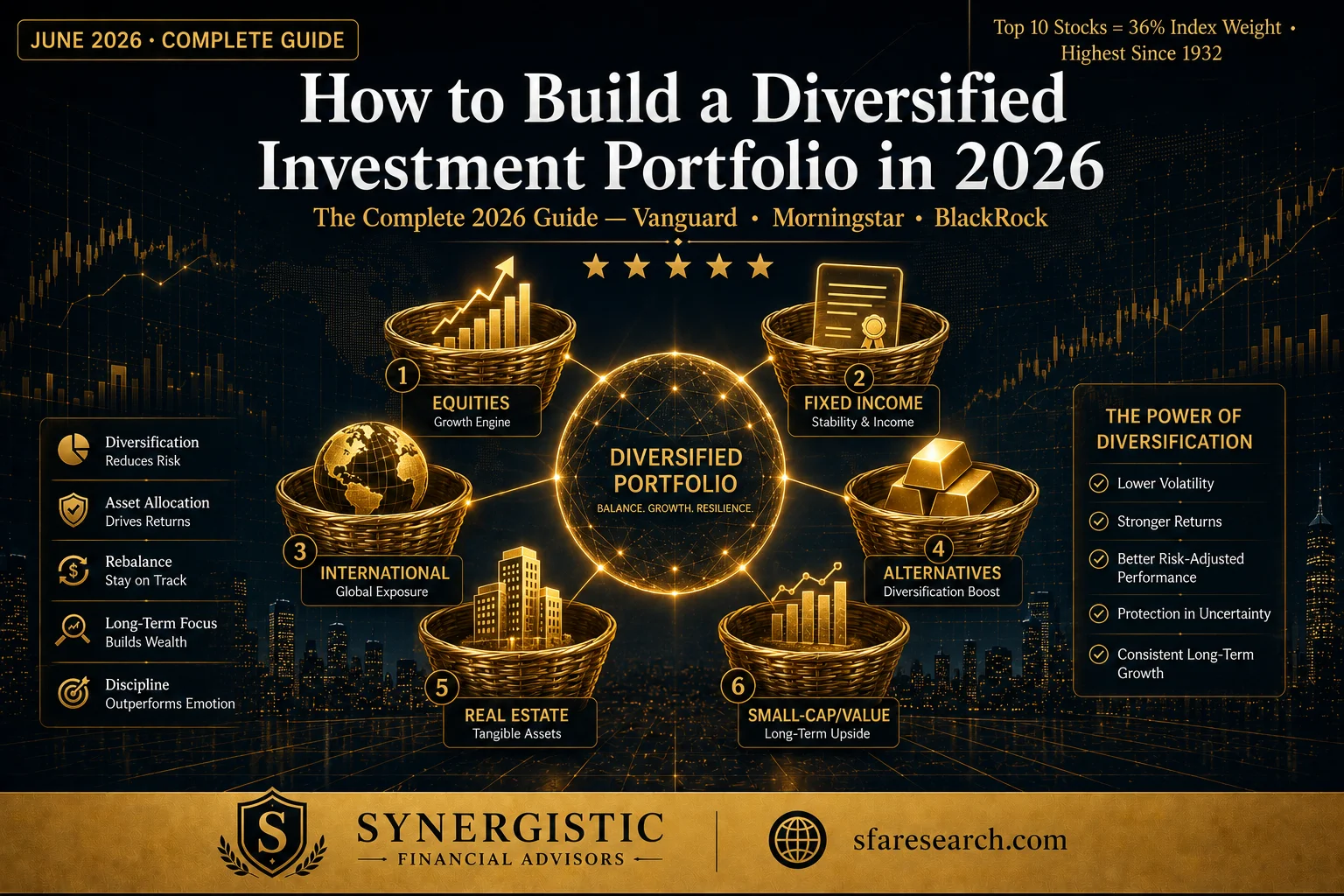
“Don’t put all your eggs in one basket.” It is the oldest piece of financial wisdom in existence — and in 2026, it has never been more urgently relevant.
The reason is that if the basket falls, you could lose everything in one fell swoop. But if your eggs are in multiple baskets, you have a much better chance of getting home safely with enough eggs to make that omelet. The same principle applies to your investment portfolio. Keeping all your money in one basket, whether that’s stocks, bonds, or real estate, exposes you to the risk of losing more during a market downturn or geopolitical event.
Here is the warning that should concern every investor reading this in 2026: most people believe their portfolio is diversified when it genuinely is not. The Morningstar US Market Index’s 10 largest constituents now consume 36% of index weight, up from 23% just five years back. Almost all are tied to AI. “Investors don’t have to think there’s an AI bubble to be concerned about the concentration risk that AI has wrought,” says Morningstar Indexes strategist Dan Lefkovitz. Concentration does not necessarily presage market crashes. But it leaves investors holding a market portfolio less diversified than in the past — by stock, sector, and theme.
If you own a standard S&P 500 index fund, an MSCI World fund, or a typical 401(k) target-date fund and believe you are genuinely diversified, this guide will show you exactly why that assumption deserves urgent reassessment — and exactly how to build a portfolio that is genuinely diversified across asset classes, geographies, sectors, and risk factors in 2026’s uniquely concentrated market environment.
Why Diversification Matters More in 2026 Than Any Year in Recent Memory
The case for diversification is not theoretical — it is being demonstrated in real time by 2026’s market performance.
One year ago, stock investors were still enamoured with the artificial intelligence trade. Rallying mega-cap stocks — several of which qualified as AI plays — were driving the US stock market to new highs. As a result, the US stock market was more heavily concentrated in its 10 largest names by the end of 2025 than it had been since 1932. Fast forward to today. Investors have grown concerned about how much money companies are spending on AI and what toll AI may take on various industries. Those worries have led to the rise of the “anything but AI” trade and to a rotation in the US stock market.
Diversification is vital: just 0.3% of US firms drove half of market wealth since 1926.
Read that statistic again. Just 0.3% of all US firms in existence over the past century have generated half of all stock market wealth created. This is not an argument against owning equities — it is the single most powerful argument for genuine diversification, because no individual investor can reliably predict in advance which tiny fraction of companies will drive the next century of returns.
“The future is inherently uncertain,” reminds Lefkovitz. “As investors, all we can do is spread our bets and build portfolios to weather different scenarios. So far in 2026, diversification has been a winning strategy.”
Step 1 — Understand True Asset Allocation, Not Just Account Labels
The foundation of a diversified portfolio lies in asset allocation. Asset allocation is the process of spreading your investments across different types of assets, each of which performs differently in various market conditions.
A well-diversified portfolio includes a mix of stocks, bonds, and potentially, alternative investments across various sectors, company sizes, and geographic regions. The right asset allocation depends on your individual risk tolerance, time horizon, and financial goals.
This is the foundational truth that most “diversified” portfolios in 2026 fail to deliver: owning multiple funds is not the same as genuine diversification. If your 401(k), your IRA, and your taxable brokerage account all hold S&P 500 index funds, you have three accounts — but one single concentrated bet on the same 500 companies, weighted toward the same handful of AI-driven mega-cap names.
A strong portfolio core means 30-70% equities and 15-50% fixed income — with alternatives potentially forming up to 40% of a portfolio for long-term investors, subject to their unique risks including illiquidity.
A certified financial planner builds genuine asset allocation by mapping your actual underlying exposures across every account you hold — identifying overlap, concentration, and gaps that account-by-account reviews consistently miss.
Step 2 — Build Your Equity Foundation With Genuine Variety
Stocks should form the growth engine of most long-term portfolios — but genuine equity diversification requires far more nuance than simply “owning stocks.”
Market capitalisation: include large-, mid-, and small-cap companies. Sectors: spread your investments across various industries like technology, health care, energy, and financials. Investment styles: balance between growth stocks and value stocks.
To offset some of the concentration risk posed by the US stock market today, investors might consider allocating some assets to smaller companies or value stocks — or diversifying into both via a small-value fund or exchange-traded fund. “Small-cap value has kind of persistently underperformed the large-cap growth stocks, and there’s arguably a pretty good value there, so investors might do a little bit of repositioning so they’re not so heavily tilted toward those mega-cap growth and technology stocks.”
Small-cap stocks began to revive last November and have extended their run into 2026. Like international and value stocks, small-cap equities have lagged the broad market for long stretches, suggesting that they may still have more room to run. In fact, small-cap stocks as a group still look undervalued to Morningstar.
Financial Planning Insight: A genuine equity allocation in 2026 deliberately balances large-cap growth exposure with small-cap, value, and dividend-paying positions that reduce reliance on the narrow AI-driven mega-cap trade that currently dominates standard index funds.
Step 3 — Diversify Internationally — Don’t Stay US-Only
International stocks did well in 2025, after underperforming US stocks for several years. But they’re still a good choice for portfolio diversification today.
After underperforming US stocks for several years, international stocks outperformed US stocks in 2025, and they’ve continued to do so in 2026. Moreover, non-US stock markets are less tied to technology and the AI trade and thereby are benefiting this year from the “anything but AI” sentiment.
Outside the US, we prefer emerging over developed market equities, given the centrality of many EM countries in the ongoing AI buildout.
Recent polling shows that our clients are increasingly looking internationally for portfolio diversification (38%), alongside traditional asset classes like alternatives and private markets.
“Even though stocks from outside the United States pulled ahead in 2025, that followed on the heels of a long run of outperformance for the US,” says Morningstar portfolio strategist Amy Arnott. “As a result, your portfolio might still be light on international exposure.”
Financial Planning Insight: Most US portfolio management strategies remain significantly underweight international exposure relative to global market capitalisation, even after 2025-2026’s strong international performance — creating an ongoing opportunity for genuine geographic diversification.
Step 4 — Build a Fixed Income Allocation That Genuinely Diversifies
A diversified portfolio starts with the understanding that you’ll have a variety of asset classes. For bonds, consider a mix of Treasury, corporate, and municipal bonds.
Higher-quality US bonds — often considered to be a great diversifier for US stocks — have edged out US stocks for the first two months of 2026. Of course, over long periods, bonds will underperform stocks. So don’t overdiversify into them if your investment goal is decades away. But even a small position in bonds can provide diversification benefits.
In her model portfolios for retirement savers, Morningstar’s Christine Benz suggests a 5% bond allocation for savers with 35-40 years until retirement. That ramps up to a 20% bond weighting once retirement is 20 years out.
In fixed income, we prioritise income and see opportunities in securitised assets over corporate credit.
Financial Planning Insight: Bond allocation in retirement planning should evolve systematically over your career — minimal early on when growth matters most, increasing meaningfully as your timeline shortens and capital preservation becomes more important.
Step 5 — Add Alternative Assets for Genuine Uncorrelated Returns
Alternatives like REITs, commodities, and cryptocurrencies can add resilience to your portfolio.
Higher real rates and a stronger US dollar have suppressed gold’s performance. Regional disruptions, including impacts from the closure of the Strait of Hormuz, alongside profit-taking after strong inflows, have added to gold’s pullback. Even so, we continue to believe in the structural case for gold. With cleaner positioning and more attractive entry levels, we favour gold as a diversified allocation in portfolios, particularly around potential debasement risks.
Hedge risks by allocating up to a mid-single-digit percentage to gold, which may shield portfolios against financial stresses and geopolitical shocks.
Despite strong interest in alternatives, advisors remain under-allocated. The average allocation among advisors who hold alternatives is approximately 7%, and only 52% of moderate-risk portfolios include alternatives — highlighting potential room for further adoption.
This last statistic deserves attention: even professional financial advisors are significantly under-allocated to alternatives relative to what BlackRock’s own research suggests is appropriate — representing a genuine, ongoing opportunity for individual investors working with a sophisticated financial advisor to add real diversification value.
Financial Planning Insight: A financial advisor with genuine alternative investment expertise can help you appropriately size real estate, commodity, and gold exposure within your overall portfolio management strategy without overconcentrating in any single uncorrelated asset class.
Step 6 — Use Core-Satellite Portfolio Design
Core-satellite portfolio design and thematic investing are powerful strategies for blending stability with growth. Core Holdings: the foundation of your portfolio, comprising broadly diversified, low-cost ETFs or index funds. Satellite Investments: smaller, high-conviction positions in emerging markets, thematic investments, or other sectors with growth potential. For example, you might allocate 70% of your portfolio to global index funds and 30% to high-growth sectors.
This framework is particularly valuable in 2026’s market environment because it explicitly addresses the AI concentration problem described earlier. The “core” of your portfolio — broadly diversified global index exposure — provides the foundation. The “satellite” positions allow you to maintain conviction-driven exposure to themes like AI, clean energy, or emerging market growth without letting that exposure dominate your entire portfolio’s risk profile.
Financial Planning Insight: A certified financial planner can help you design the appropriate core-satellite split for your specific risk tolerance — ensuring your high-conviction thematic bets remain appropriately sized rather than inadvertently becoming your dominant portfolio exposure.
Step 7 — Rebalance Systematically, Not Emotionally
Building an appropriately diversified portfolio is only the first step. Over time, market movements will cause your asset allocation to drift. For example, if stocks have a strong run, the equity portion of your portfolio may grow larger than forecasted. To maintain your preferred asset allocation, it’s important to rebalance periodically by shifting some of your portfolio’s earnings into other parts of your portfolio that may not have fared as well. This process of rebalancing helps you practise the time-honoured “buy low, sell high” strategy.
If you haven’t rebalanced in recent years, your portfolio is likely overweight in US stocks relative to bonds. “A portfolio that started with a 60% weighting in stocks and 40% in bonds 10 years ago would now contain more than 80% in stocks,” calculates Morningstar portfolio strategist Amy Arnott.
Financial advisors recommend reviewing your portfolio annually and rebalancing when an asset class drifts more than 5-10% from its target.
This is one of the most consistently undervalued portfolio management disciplines available to any investor. Rebalancing forces the systematic discipline of trimming positions that have grown large — typically your best recent performers — and reallocating to positions that have lagged. It is psychologically uncomfortable and mathematically powerful in equal measure.
Financial Planning Insight: A financial advisor who implements systematic, rules-based rebalancing removes the emotional resistance that prevents most individual investors from rebalancing on their own — ensuring your diversification strategy actually persists through every market cycle rather than drifting silently toward concentration.
Step 8 — Optimise Tax Efficiency Across Account Types
In 2026, it’s essential to take full advantage of tax-efficient investment strategies. Tax-advantaged accounts like 401(k)s, IRAs, and HSAs offer various benefits, including tax-deferred growth and tax-free withdrawals in certain cases.
Genuine diversification is not just about which assets you own — it is also about which accounts you hold them in. Tax-efficient asset location — placing income-generating, tax-inefficient assets like bonds in tax-advantaged accounts while holding tax-efficient growth assets in taxable accounts — creates measurable after-tax return improvement without requiring any change to your underlying asset allocation.
Financial Planning Insight: A certified financial planner with tax planning expertise can optimise the placement of your diversified holdings across taxable, tax-deferred, and tax-free accounts — capturing genuine after-tax value that pure asset allocation decisions alone cannot deliver.
What a Genuinely Diversified Portfolio Looks Like in 2026
Bringing together every principle above, here is a framework for what genuine portfolio diversification looks like across different investor profiles in 2026.
For investors decades from retirement (long time horizon): A core allocation of 70-90% globally diversified equities — spanning large-cap, small-cap, value, and growth across both US and international markets — combined with a modest 5-10% bond allocation for ballast, and a satellite allocation of 5-15% in alternative assets including gold and real estate exposure.
For investors approaching retirement (10-20 years out): A more balanced allocation shifting toward 50-70% equities with increased international and dividend-paying exposure, 20-35% in diversified fixed income including Treasury, corporate, and securitised assets, and 5-15% in alternatives including gold for portfolio resilience.
For retirees and near-retirees prioritising income and capital preservation: A conservative allocation of 30-50% equities emphasising dividend-paying, large-cap companies, 40-55% in high-quality bonds providing income and stability, and a meaningful allocation to real assets and gold for inflation protection across a multi-decade retirement.
Financial Planning Insight: These frameworks are starting points, not prescriptions. The right asset allocation depends on several factors, including your age, risk tolerance, investment timeline, and financial goals. A qualified financial advisor translates these general frameworks into a genuinely personalised portfolio management strategy built around your specific situation.
The Single Biggest Mistake Most Investors Make in 2026
Without some smart diversification, your “just fine” investment portfolio from 2025 may be vulnerable in 2026.
The most common and most damaging diversification mistake in 2026 is mistaking the ownership of multiple funds for genuine diversification — when those funds collectively concentrate exposure in the same handful of AI-driven mega-cap names that now represent 36% of major index weight. For instance, the SPDR S&P 500 ETF currently has nearly 8% of its assets in a single technology company, with technology stocks taking up more than a third of the portfolio.
This is precisely why a comprehensive review of your actual underlying exposures — not just your account labels — delivers more genuine value than almost any other single portfolio management activity available in 2026.
How Synergistic Financial Advisors Builds Genuine Diversification for Clients
At Synergistic Financial Advisors, we understand that genuine diversification in 2026 requires looking past account labels to your actual underlying exposures — identifying the concentration risk that AI-driven market performance has built into millions of seemingly diversified portfolios across America.
Our investment management approach builds genuine multi-dimensional diversification — across asset classes, market capitalisation, geography, sectors, and investment style — using core-satellite portfolio design, systematic rebalancing, and tax-efficient asset location within a comprehensive financial planning framework that integrates portfolio management, tax planning, retirement planning, and complete wealth management under one coordinated advisory relationship.
Whether you are decades from retirement and building your long-term equity foundation, approaching retirement and need a more balanced portfolio management strategy, or already retired and prioritising income and capital preservation, Synergistic Financial Advisors brings the genuine, personalised expertise that transforms general diversification principles into a portfolio built specifically for your goals.
Ready to find out whether your portfolio is genuinely diversified — or just appears to be? Contact Synergistic Financial Advisors today for a personalised portfolio review.
👉 Visit sfaresearch.com — because the difference between owning multiple funds and being genuinely diversified is the difference that matters most.
Final Thoughts — Diversification Is Not About Eliminating Risk. It Is About Managing It Intelligently.
Investment diversification is both an art and a science. While the principles are straightforward, implementing an effective diversification strategy requires careful planning, ongoing monitoring, and periodic adjustments. Remember that diversification is not about eliminating risk — it’s about managing it intelligently. By spreading your investments across various asset classes, geographies, and sectors, you position yourself to weather market storms while capturing growth opportunities.
In 2026 — with the highest level of market concentration since 1932, a genuine “anything but AI” rotation underway, gold pulling back from record highs, and bond yields offering genuinely attractive ballast for the first time in years — the principles of true diversification matter more than at any point in recent market history.
At Synergistic Financial Advisors, building that genuine, multi-dimensional diversification — systematically, expertly, and entirely in your best interest — is the work we do for every client, in every market environment.