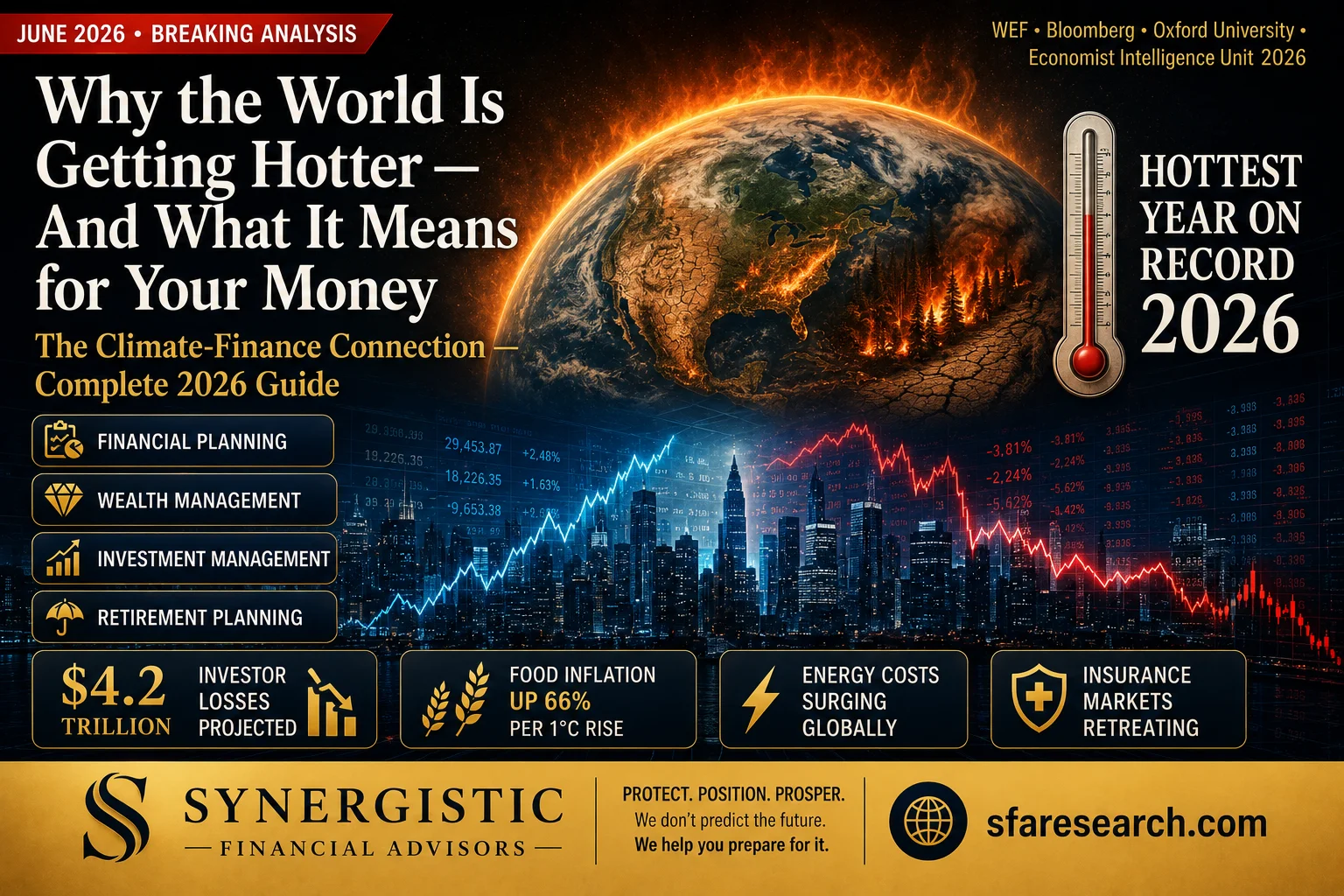
Step outside almost anywhere in the world this summer and you will feel it. The heat is different. More intense. More persistent. More oppressive than anything previous generations experienced as normal summer weather.
You are not imagining it. The science is unambiguous — and the financial consequences are arriving faster than almost anyone predicted.
2026 is on track to be the hottest year in recorded human history. Extreme heat events that were once considered once-in-a-generation occurrences are now happening multiple times per year across every inhabited continent. Cities that never needed air conditioning are installing it urgently. Agricultural systems built around historical temperature ranges are breaking down. Insurance companies are withdrawing from entire regions. And central banks — the same institutions setting the interest rates that govern your financial planning strategy — are beginning to integrate climate risk into their core economic models in ways that will reshape investment management thinking for decades.
The connection between a hot summer and your wealth management strategy may not be immediately obvious. But it is real, it is measurable, and it is growing more material with every passing year. This blog explains why the world is getting hotter, what the economic science actually shows, and — most importantly — what every individual investor needs to understand about protecting and growing their wealth in a world where climate change is no longer a future risk but a present economic reality.
Why Is the Weather Getting So Hot? The Science Explained Simply
The question millions of people are asking this summer — “why is it so hot?” — has a clear, well-established scientific answer.
The Earth’s climate system is driven by the balance between heat arriving from the sun and heat escaping back into space. For most of human history this balance was relatively stable. Over the past 150 years, the burning of fossil fuels has released enormous quantities of carbon dioxide and other greenhouse gases into the atmosphere — gases that act like a blanket around the planet, trapping heat that would otherwise escape.
Extreme weather consistently features as one of the top risks in the World Economic Forum’s 2026 Global Risks Report — with January 2026 alone bringing extreme weather events worldwide that took a heavy toll. Johan Rockström, one of the world’s leading climate scientists, stated at Davos 2026: “We are at a really, really decisive juncture.”
A 0.5°C rise in global temperatures leads to a 0.65 percentage point increase in five-year-ahead inflation expectations — with effects particularly pronounced among consumers with greater awareness of climate change, according to a DNB working paper on temperature and inflation expectations.
The mechanism connecting rising temperatures to your personal financial planning runs through several channels simultaneously — and understanding each one is essential for any serious financial advisor or investor navigating 2026.
The 6 Ways Climate Change Is Already Hitting Your Wallet Right Now
1. Food Prices Are Rising — And Climate Is a Primary Driver
Warmer average temperatures directly affect labour output, particularly in sectors such as agriculture, construction, and transport where outdoor work is common. Heat stress slows working speeds, raises health risks, and leads to higher rates of absenteeism — directly increasing the cost of producing the food, goods, and services that every household depends on.
Estimates show that for every one degree Celsius of warming, net farm income falls by 66 percent — a staggering figure that illustrates how profoundly agricultural economics are being reshaped by rising temperatures.
This is not an abstract future projection. It is happening right now. The 15% monthly jump in tomato prices that contributed to May’s hot CPI reading — the same reading that triggered last Friday’s market selloff — is partly a climate story. Heat stress, drought conditions, and disrupted agricultural seasons are feeding directly into the food inflation that is keeping the Federal Reserve from cutting rates and pressuring every household budget simultaneously.
For your financial planning strategy, food-driven inflation that is structural rather than cyclical demands a different response than temporary price shocks. It requires retirement planning projections built around persistently higher food costs, portfolio management strategies that include agricultural infrastructure exposure, and tax planning frameworks that account for inflation-eroded purchasing power across decades rather than quarters.
2. Energy Costs Are Permanently Higher
The increase in extreme heat is expected to lead to a big rise in energy demand for cooling systems as the world passes 1.5°C of global warming above pre-industrial levels. Many homes may need air conditioning installed in the next five years — but temperatures will continue to rise long after that if the world hits 2°C of global warming, says Dr Jesus Lizana, lead author and associate professor in engineering science at Oxford University. This imminent increase in demand for energy for cooling in countries set to face extreme heat increases is likely to have a significant impact on inflation.
More air conditioning. More cooling demand. More strain on electricity grids. These are not future scenarios — they are present realities that are driving energy costs higher in real time. And higher energy costs feed directly into everything — from your household electricity bill to the input costs of every business in your investment management portfolio.
By 2030, 36% of global electricity generation capacity is projected to operate in areas classified as high or extremely high water-stress regions — creating genuine supply constraints that will keep upward pressure on energy prices well beyond the current Iran-driven oil premium that has already complicated Federal Reserve policy in 2026.
3. Insurance Costs Are Rising — Or Coverage Is Disappearing
One of the most financially significant but least discussed consequences of climate change for individual investors is what is happening to the insurance market. As extreme weather events become more frequent and more severe, insurance companies are doing what rational businesses always do in the face of unacceptable risk — they are raising prices dramatically or withdrawing coverage entirely.
Physical damage to buildings, supplies, and equipment due to flooding or other extreme weather events can be costly — disrupting businesses and supply chains by halting manufacturing or making it impossible for employees to get to work
Physical climate risk could drive government debt sharply higher while eroding private asset returns over the next 15 years, according to Ortec Finance’s 2026 climate scenario update — with higher-warming pathways closest to the current global trajectory showing that extreme weather events and climate tipping points cause sharp and lasting declines in GDP, reduce tax revenues, and create large uninsured losses.
“Large uninsured losses” — that phrase deserves serious attention from every individual investor and financial planner. As insurance markets retreat from climate-exposed areas, property owners are left bearing climate risk on their own balance sheets. A home in a flood zone or wildfire corridor that cannot be insured at a reasonable cost is not just a personal safety concern — it is a wealth management liability that can erode decades of asset accumulation overnight.
4. Property Values Are Being Repriced by Climate Risk
Risk managers are increasingly integrating facility-level hazard data into lending, underwriting, and valuation models — with lenders and investors treating severe-weather exposure similarly to other operational risks that influence long-term cash flow reliability.
This shift is profound for individual investors with significant real estate exposure. Properties in climate-exposed locations — coastal areas, wildfire corridors, flood plains, extreme heat zones — are beginning to be repriced by markets that are incorporating climate risk into valuations in ways that were simply not happening five years ago.
For your portfolio management and wealth management strategy, this means that real estate exposure deserves climate risk assessment alongside traditional financial metrics. A property that looks attractive on a cap rate or price-to-rent basis may be significantly less attractive when its physical climate risk, rising insurance costs, and long-term demand implications are fully factored in.
5. GDP Growth Is Being Permanently Reduced
Climate change is no longer a theoretical concern or distant forecast — it is a present-day economic disruptor with significant implications for the global economy. Rising global temperatures, more frequent extreme weather events, and the degradation of natural environments are all exerting pressure on productivity, infrastructure, and the foundations of long-term economic planning.
Climate change alone could push the UK’s debt-to-GDP ratio to 114% by 2050 from 102% in 2025, and the US ratio to 151% from 121% over the same period — according to Ortec Finance’s 2026 analysis — representing a structural fiscal deterioration that will shape government spending, tax policy, and the economic environment in which every investor’s financial planning strategy operates for decades.
A US debt-to-GDP ratio of 151% — driven in part by the fiscal costs of climate adaptation and disaster response — has direct, material implications for interest rates, government spending priorities, tax policy, and the long-term investment environment. Every retirement planning projection built on stable long-term economic growth assumptions needs to account for the fiscal drag that accelerating climate costs will impose.
6. Investment Portfolios Are Directly Exposed
Physical hazards are escalating, the low-carbon transition is speeding up, liability cases are mounting, and systemic shocks are spreading through entire economies. Each of these forces hits portfolios differently — but together they are reshaping how capital is priced and where value is most at risk. 2026 is shaping up to be a decisive test.
Private investors stand to lose $4.2 trillion on the value of their holdings from the impact of climate change by 2100 even if global warming is held at plus 2°C — according to research by the Economist Intelligence Unit. If firm action is not taken and the Earth’s temperature warms by a further 5°C, investors face losses of almost $7 trillion at today’s prices.
$4.2 trillion in investment losses at 2°C warming. $7 trillion at 5°C. These are not fringe estimates — they come from the Economist Intelligence Unit, one of the most respected research organisations in the world. And they represent the single most important long-term risk factor that most individual investors are not yet adequately accounting for in their portfolio management strategies.
The Climate-Finance Connection — What the Data Shows in 2026
Investors are increasingly seeking clear disclosures of climate risks from companies — with financing costs now partly tied to how well firms manage these risks. Central banks warn that if markets suddenly reprice climate-exposed assets, the financial system could face instability.
Europe issued over 1,000 green bonds with adaptation-related use of proceeds — ten times the US total — despite Europe showing lower estimated long-term GDP losses from physical hazards. The disparity may indicate differing regulatory incentives, disclosure expectations, or infrastructure financing models rather than differences in underlying risk.
This gap between European and American green bond issuance is one of the most telling data points in the entire climate-finance landscape. It tells you that the regulatory and market incentive structures for climate-resilient investing are developing faster in some regions than others — creating genuine investment management opportunities for investors positioned ahead of the regulatory convergence that climate risk disclosure requirements will eventually drive globally.
For every dollar invested in nature, another 30 is spent destroying it — according to the UN Environment Programme’s State of Finance for Nature 2026 report — a ratio that illustrates the extraordinary mispricing of natural capital that represents both the most significant systemic risk and the most significant corrective investment opportunity in the global economy.
What Climate Change Means for Different Types of Investors
For Retirement Planners: Climate change is the longest-duration risk in any retirement planning strategy — operating across the 20 to 30 year time horizon of most retirement income frameworks. The food inflation, energy costs, healthcare impacts from extreme heat, and property value shifts described above all materialise progressively across exactly the timeline that retirement planning must account for. A certified financial planner who integrates climate risk into your retirement planning projections builds strategies genuinely resilient to the most predictable long-term economic force of the 21st century.
For Wealth Builders: By playing a role in tackling climate change and aiding in the transition to a lower-carbon economy, investors can aim to have positive social and environmental impact while accessing compelling return opportunities — considering companies that support natural resource efficiency, resilient infrastructure, food and water security, and sustainable agriculture. The climate transition is not just a risk to manage — it is one of the largest investment opportunity sets in economic history. The companies solving the problems of extreme heat, energy transition, water scarcity, and agricultural resilience are building businesses with structural tailwinds that will compound for decades.
For Portfolio Managers: The four climate-related risks every investor should prepare for in 2026 are physical risks from acute and chronic climate events, transition risks from the accelerating shift to low-carbon systems, liability risks from mounting legal cases against high-emitting companies, and systemic risks from climate shocks rippling through macroeconomic systems. Each of these requires a different portfolio management response — and a financial advisor who understands how to map these risks onto your specific holdings can identify both the exposures that need reducing and the transition opportunities worth adding.
For Tax Planners: Carbon capture, grid modernisation, and long-duration storage are among the sectors likely to attract significant capital due to regulatory incentives and industrial demand — creating specific tax planning opportunities around qualified opportunity zone investments, energy tax credits, and depreciation strategies for clean energy infrastructure. The intersection of climate policy and the tax code is one of the most rapidly evolving areas in personal and corporate financial planning — and one where proactive tax planning creates measurable, compounding advantages.
The Climate Investment Opportunity — The Other Side of the Story
It is important — and intellectually honest — to acknowledge that climate change is not only a story of risks and losses. It is simultaneously one of the largest investment opportunity sets in economic history.
There are significant business risks associated with climate change — and significant opportunities for investors. Physical damage to buildings from extreme weather creates demand for resilient construction and infrastructure. Energy transition creates massive demand for renewable energy, battery storage, grid modernisation, and electric transportation. Food system stress creates demand for agricultural technology, water efficiency, and alternative proteins.
Carbon capture, grid modernisation, and long-duration storage may attract capital due to regulatory incentives and industrial demand — representing sectors where the combination of structural tailwinds, government support, and growing institutional capital allocation creates compelling long-term investment management opportunities.
The investors who will look back on this decade with the greatest satisfaction are not those who simply avoided climate-exposed assets. They are those who simultaneously reduced exposure to the most vulnerable sectors and built meaningful positions in the companies and infrastructure projects solving the climate challenge — guided by a qualified financial advisor who understands both the risk and the opportunity dimensions of this extraordinary economic transition.
5 Financial Actions Every Individual Should Take in Response to Climate Change
Given everything the science and economics of climate change reveal about the financial environment of 2026 and beyond, here are the five most important actions every individual investor should take with their financial planning strategy.
Action 1 — Stress-Test Your Retirement Planning for Persistent Inflation. The food and energy inflation driven by climate change is structural — not cyclical. A certified financial planner can rebuild your retirement planning projections around realistic long-term inflation assumptions that account for climate-driven cost pressures rather than historical averages that no longer apply.
Action 2 — Audit Your Portfolio for Climate Risk Concentration. Physical hazards are escalating and systemic shocks are spreading through entire economies — reshaping how capital is priced and where value is most at risk in 2026. A financial advisor can map your specific portfolio management holdings against climate risk exposure — identifying concentrated vulnerabilities in fossil fuel infrastructure, climate-exposed real estate, water-stressed agriculture, and coastal property markets.
Action 3 — Build Exposure to Climate Transition Opportunities. The energy transition, resilient infrastructure build-out, water security technology, and sustainable agriculture sectors represent genuine multi-decade structural growth opportunities. A financial advisor with expertise in investment management can help you build appropriate, diversified exposure to these themes within a disciplined portfolio management framework that balances opportunity capture with risk management.
Action 4 — Review Your Real Estate and Insurance Position. If you own property in climate-exposed areas — coastal, wildfire-prone, flood-zone, or extreme heat corridors — review your insurance coverage and long-term valuation trajectory with a financial planner who understands the physical climate risk dimension of real estate wealth management.
Action 5 — Integrate Climate into Your Long-Term Tax Planning. The intersection of climate policy and the tax code is evolving rapidly — creating specific tax planning opportunities in energy credits, qualified opportunity zone investments, and sustainable infrastructure depreciation strategies. A certified financial planner with tax planning expertise can help you capture these opportunities within your broader financial planning framework.
How Synergistic Financial Advisors Integrates Climate into Your Financial Plan
At Synergistic Financial Advisors, we understand that the most important financial risks of the 21st century are not just the ones making headlines today — they are the structural forces that compound quietly across decades and reshape the entire environment in which wealth management, retirement planning, investment management, and financial planning operate.
Climate change is the most significant long-duration structural force in the global economy of 2026. Ignoring it in your financial planning strategy is not neutral — it is a choice to accept risks that a genuinely expert financial advisor can help you identify, measure, and manage.
Synergistic Financial Advisors integrates climate risk assessment into every dimension of our client advisory relationships — from portfolio management stress-testing against physical and transition climate risks to retirement planning projections built around realistic climate-adjusted inflation assumptions, from tax planning frameworks that capture clean energy transition incentives to wealth management strategies that balance climate risk reduction with genuine climate transition opportunity capture.
Our team brings the comprehensive expertise of a certified financial planner to every client relationship — ensuring that your financial planning strategy accounts for the full range of forces shaping your financial future, including the most consequential long-term economic force of our generation.
Ready to build a financial plan that accounts for the world as it actually is in 2026 — not the world as it was? Contact Synergistic Financial Advisors today for a personalised consultation.
👉 Visit sfaresearch.com — because the best financial planning accounts for the future, not just the present.
Final Thoughts — The Heat Is Real. The Financial Impact Is Real. The Action Required Is Real.
The world is getting hotter. The science is settled. The economic consequences are already arriving — in food prices, energy costs, insurance markets, property values, and the structural fiscal pressures that will shape tax policy and government spending for decades.
Policymakers, regulators, and investors must adopt more precautionary, robust, and transparent approaches instead of relying on narrow GDP-based scenarios — because the World Economic Forum’s 2026 Global Risks Report identifies extreme weather as one of the top risks facing the global economy, and the financial system is only beginning to price it appropriately. Shookresearch
The investors who navigate this transition successfully will be those who worked with qualified financial advisors to build strategies genuinely resilient to the world that climate change is creating — not strategies designed for a stable climate that no longer exists.
At Synergistic Financial Advisors, that is the work we do for every client, every day.
The heat is here. Your financial plan should be ready for it.