Albert Einstein allegedly called compound interest the eighth wonder of the world, saying those who understand it earn it and those who do not pay it.
Whether or not Einstein actually said it is debatable. Whether the statement is true is not.
Compound interest in 2026 remains one of the most powerful forces in personal finance — and yet most people still underestimate it. Whether you are just starting to save or refining an existing portfolio, understanding how compound interest works can mean the difference between modest savings and genuine, lasting wealth.
The concept is deceptively simple: you earn returns not just on your original principal, but on every dollar of interest and gains that accumulated before it. Over years and decades, this creates an exponential growth curve that financial educators have long called the closest thing to a superpower available to everyday investors.
And here is the most important thing about this superpower — it is completely democratic. It does not require exceptional intelligence, insider knowledge, a high income, or privileged access to special investments. It requires two things that every individual has some control over: time and consistency. The person who starts investing $300 per month at 25 and the person who starts investing $600 per month at 45 will arrive at retirement with dramatically different outcomes — not because the second person is less disciplined, but because the first person gave compound interest 20 additional years to work its mathematics.
In July 2026 — with high-yield savings accounts offering 4-5% APY, the S&P 500 at record highs, and the most consequential investment management environment in recent memory — understanding compound interest and deploying it deliberately is the most universally available wealth management tool in existence.
This guide gives you everything you need to understand exactly how compound interest works, see its power demonstrated in real numbers, understand where it works against you, and use it strategically in your financial planning to build genuine, lasting wealth.
What Is Compound Interest — The Exact Mechanism Explained
Compound interest is the process of earning interest on both the money you initially invest (the principal) and the accumulated interest from previous periods. Unlike simple interest, which is calculated only on the principal, compound interest allows your money to grow exponentially.
To make this concrete, start with the simplest possible example.
Simple Interest — What Most People Imagine
You invest $10,000 at 8% annual simple interest.
Year 1: You earn $800 (8% of $10,000).
Year 2: You earn $800 (8% of $10,000).
Year 10: You earn $800 (8% of $10,000).
After 10 years: $10,000 + ($800 × 10) = $18,000 total.
Compound Interest — How Wealth Actually Works
You invest $10,000 at 8% annual compound interest.
Year 1: You earn $800 (8% of $10,000). New balance: $10,800.
Year 2: You earn $864 (8% of $10,800). New balance: $11,664.
Year 3: You earn $933 (8% of $11,664). New balance: $12,597.
Year 10: You earn $1,587 (8% of $19,840). New balance: $21,589.
After 10 years: $21,589 total.
The difference: $21,589 versus $18,000 — a $3,589 advantage from compound interest over simple interest alone. No additional contributions. No higher return rate. Just the mathematical miracle of earning returns on your returns.
For example, if you invest $1,000 at an annual interest rate of 8% and let it compound yearly, you will earn $80 in interest after the first year. The next year, interest is calculated not just on your initial $1,000 but also on the $80 interest from the first year — bringing your total to $1,166.40 in two years.
Now extend that 10-year example across the full span of a retirement planning horizon, and the numbers become genuinely staggering.
$10,000 invested at 8% annual compound interest:
| Years | Value |
|---|---|
| 10 years | $21,589 |
| 20 years | $46,610 |
| 30 years | $100,627 |
| 40 years | $217,245 |
Your original $10,000 becomes $217,245 over 40 years — with zero additional contributions. That is the mathematical nature of exponential growth, and it is the foundation of every successful wealth management strategy ever built.
The Rule of 72 — The Simplest Way to Understand Compounding Speed
The Rule of 72 is one of the most useful mental shortcuts in all of financial planning — giving you an instant estimate of how long it takes any investment to double at a given interest rate.
Divide 72 by your annual interest rate to find the approximate doubling time in years.
At 4% annual return: $72 ÷ 4 = 18 years to double
At 6% annual return: $72 ÷ 6 = 12 years to double
At 8% annual return: $72 ÷ 8 = 9 years to double
At 10% annual return: $72 ÷ 10 = 7.2 years to double
At 12% annual return: $72 ÷ 12 = 6 years to double
This simple tool makes the relationship between return rate and wealth accumulation immediately intuitive. An investor earning 8% doubles their money approximately every 9 years — meaning a $50,000 investment at 25 becomes $100,000 at 34, $200,000 at 43, $400,000 at 52, and $800,000 at 61, all without adding another dollar.
The Rule of 72 also reveals why fees matter so profoundly to long-term investment management outcomes. An investor paying a 1% annual fee on an investment returning 8% gross effectively earns 7% net — which doubles every 10.3 years rather than 9. Over 40 years, that single percentage point of fee drag reduces a $50,000 investment’s final value from approximately $1,086,000 to roughly $749,000 — a $337,000 difference from a 1% fee.
This is why low-cost index funds consistently outperform high-fee active funds over long time horizons — not because they pick better investments, but because compound interest works relentlessly in favour of the lower-fee option across every year of a multi-decade investment horizon.
How Compounding Frequency Affects Your Returns
The number of times per year that interest is compounded — the compounding frequency — affects how quickly your money grows, even at the same annual rate.
The four most common compounding frequencies:
Annually — interest calculated and added once per year
Quarterly — interest calculated and added four times per year
Monthly — interest calculated and added twelve times per year
Daily — interest calculated and added 365 times per year
The more frequently interest compounds, the faster your money grows. Here is the real difference on $10,000 at 8% annual rate over 10 years:
| Compounding Frequency | 10-Year Value | Difference from Annual |
|---|---|---|
| Annually | $21,589 | — |
| Quarterly | $22,080 | +$491 |
| Monthly | $22,196 | +$607 |
| Daily | $22,253 | +$664 |
The difference between annual and daily compounding on this example is modest — $664 over 10 years. At larger amounts and longer time horizons, the difference becomes more significant. But the more practically important insight is that compounding frequency is much less important than return rate and time — which are the two variables that genuinely dominate long-term compound interest outcomes.
High-yield savings accounts in 2026 typically compound daily — meaning your emergency fund and short-term savings are generating the maximum possible return on their stated APY. Retirement accounts and investment portfolios effectively compound through reinvested dividends, capital gains, and price appreciation — in a way that is economically equivalent to daily compounding for long-term investors.
The Most Powerful Compound Interest Examples — Real 2026 Numbers
Nothing makes the mathematics of compound interest more motivating than seeing it applied to realistic savings scenarios with real 2026 numbers. Here are the examples that genuinely change how people think about starting early.
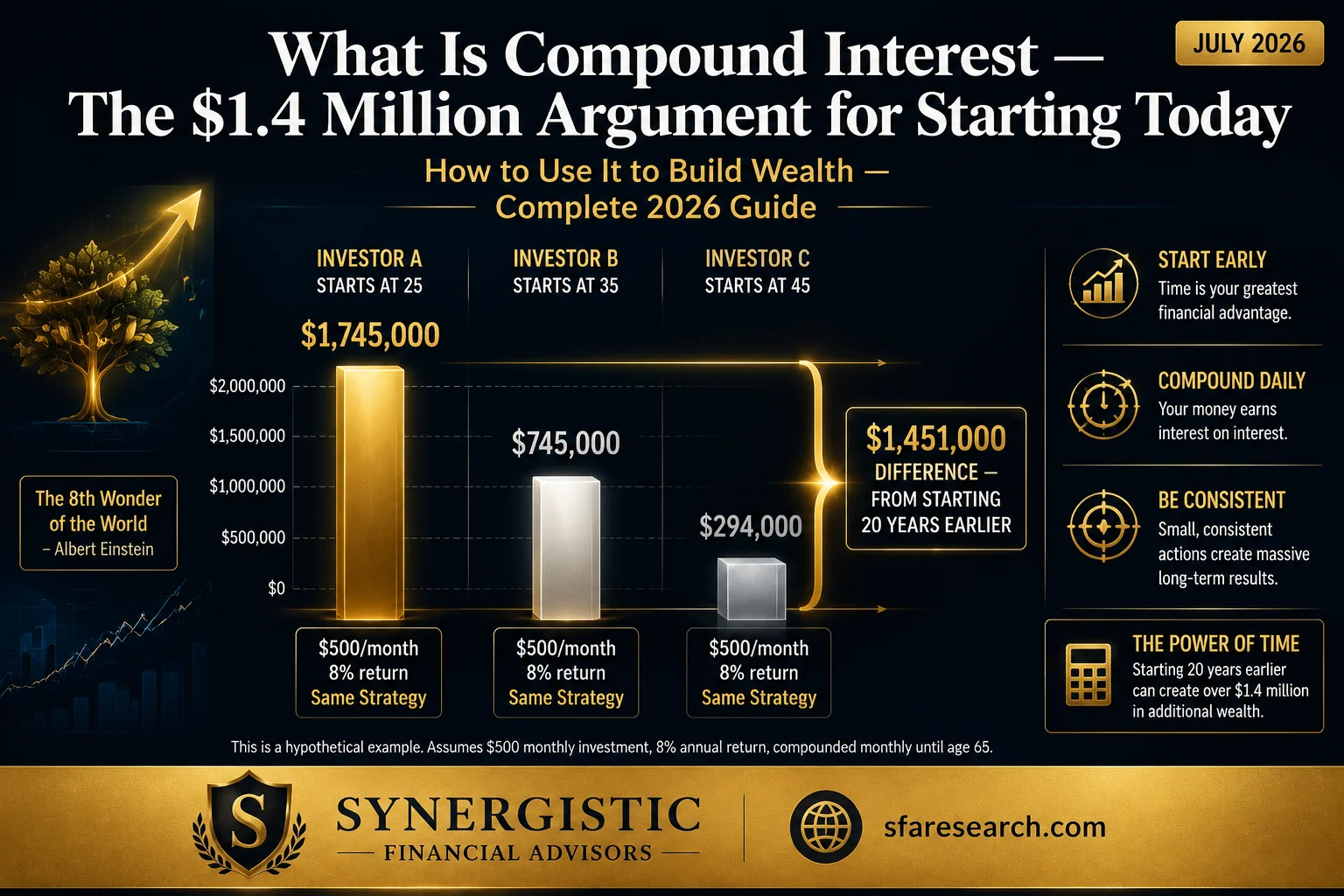
The $500 Per Month Investor — Early vs Late
This is the most powerful and most universally cited demonstration of compound interest’s time dependence — and it never loses its impact.
Investor A — Starts at 25, invests until 65 (40 years)
Monthly investment: $500
Annual return: 8%
Total contributions: $240,000
Final value at 65: approximately $1,745,000
Investor B — Starts at 35, invests until 65 (30 years)
Monthly investment: $500
Annual return: 8%
Total contributions: $180,000
Final value at 65: approximately $745,000
Investor C — Starts at 45, invests until 65 (20 years)
Monthly investment: $500
Annual return: 8%
Total contributions: $120,000
Final value at 65: approximately $294,000
Investor A ends up with $1 million more than Investor C despite contributing only $120,000 more. The extra $1 million did not come from extra contributions — it came from giving compound interest 20 additional years to work.
This example makes the cost of delay concrete and permanent. Every year of delay does not just reduce your final balance by one year of contributions — it removes one of the most productive compounding years from the entire growth trajectory.
The Lump Sum Example — Patience As a Strategy
The S&P 500 has historically averaged roughly 10% annual returns, meaning $10,000 grows to approximately $67,000 over 20 years without adding a single dollar.
A $10,000 investment in a broad market index at a historically reasonable 10% annual return:
10 years: $25,937
20 years: $67,275
30 years: $174,494
40 years: $452,593
A single $10,000 investment made at 25 becomes $452,593 at 65 — with zero additional contributions — purely through compound growth at historical market rates.
The Daily Coffee Investment — Small Amounts Over Long Periods
In 2026, a daily coffee habit costs approximately $6 per day — $180 per month — at a typical specialty coffee shop. This is not an argument to stop buying coffee. It is a demonstration of what redirecting a single daily habit into an investment management account produces over time.
$180 per month invested at 8% annual return:
10 years: $32,866
20 years: $106,591
30 years: $267,427
The $6 daily coffee, invested instead over 30 years, becomes $267,427. Whether that trade-off is worth making for any individual is a personal values decision. But the mathematics make the choice an informed one rather than an unconscious one.
Compound Interest Working For You — The 6 Best Vehicles
The real power of compounding wealth emerges when you extend compound interest principles into investing. High-yield savings accounts form a solid base.
Understanding compound interest is only the beginning — deploying it in the right vehicles maximises the growth it generates.
Vehicle 1 — Retirement Accounts (401k, IRA, Roth IRA)
Tax-advantaged retirement accounts are compound interest’s most powerful home — because the tax efficiency amplifies the already extraordinary mathematics of compounding.
In a traditional 401(k) or IRA, compound growth occurs on a pre-tax basis — meaning every dollar of return compounds without being reduced by annual taxes. The tax planning advantage means that a 10% gross return in a tax-advantaged account is a true 10% compound return — while the same 10% gross return in a taxable account might net only 7-8% after the annual tax drag on dividends and capital gains.
In a Roth IRA, compound growth occurs on an after-tax basis — but withdrawals in retirement are completely tax-free. For an investor in their 20s or 30s, the Roth IRA’s tax-free compounding across 30-40 years creates an extraordinary wealth accumulation advantage. A Roth IRA that grows from $7,500 per year of contributions to a $1 million balance over 30 years at 8% annual return — with zero federal income tax on the $700,000+ of compound growth — is one of the most tax-efficient wealth management vehicles available to any individual investor.
The 2026 contribution limits: $24,500 for 401(k)s ($32,500 for those 50 and older), and $7,500 for IRAs ($8,600 for those 50 and older). Every dollar contributed to these accounts is a dollar deployed into the most tax-efficient compound interest environment available.
Financial Planning Insight: A certified financial planner can model the specific after-tax compound growth comparison between traditional and Roth accounts for your specific income, bracket, and retirement planning timeline — determining which account type maximises your lifetime wealth accumulation.
Vehicle 2 — High-Yield Savings Accounts (Your Emergency Fund Working For You)
Before deploying capital into growth-oriented investments, most financial planners recommend maintaining three to six months of living expenses in a high-yield savings account. This cash earns compound interest while staying fully accessible — an important first layer in any wealth-building plan.
Online banks and credit unions have historically offered rates well above traditional brick-and-mortar institutions, thanks to lower overhead costs. Some analysts suggest that competitive high-yield accounts in 2026 are offering APYs that meaningfully outpace inflation for savers.
In 2026’s elevated interest rate environment, high-yield savings accounts are offering 4-5% APY — meaning your emergency fund, sinking funds, and short-term savings are generating genuine compound returns rather than sitting idle at near-zero rates.
On a $15,000 emergency fund at 4.5% APY compounded daily, you earn approximately $675 per year in compound interest — without taking any investment risk, without any market exposure, and with complete liquidity. This is compound interest at its most accessible and most risk-free form — and it is available to every individual who moves their savings from a traditional bank account to a high-yield alternative.
Vehicle 3 — Dividend Reinvestment (The Compounding Loop)
U.S. stocks illustrate compounding through dividend reinvestment and price appreciation stacking over decades. Reinvesting dividends automatically purchases more shares, which generate their own dividends — a textbook compounding loop.
When you reinvest dividends rather than taking them as cash, you purchase additional shares of the dividend-paying investment. Those additional shares generate their own dividends in the next period — which buy still more shares — which generate still more dividends. This is compound interest in its purest investment form: returns generating returns generating returns, with each cycle buying more principal that participates in the next cycle’s growth.
The difference between reinvesting and not reinvesting dividends is enormous over long periods. An investment in a dividend-paying stock index that yields 2% annually, with dividends reinvested, grows materially faster than the same investment with dividends taken as cash — because the reinvested dividends become principal that participates in every subsequent year’s price appreciation and dividend yield.
Vehicle 4 — Broad Market Index Funds (Compound Growth at the Lowest Possible Cost)
Consistent contributions over 30-plus years can turn modest savings into substantial retirement wealth purely through compounding effects.
Low-cost broad market index funds are the most accessible, most reliable, and most cost-efficient vehicle for capturing the S&P 500’s historical average of approximately 10% annual returns through compound growth. As discussed in our previous blog on index funds versus active investing, 94% of active funds underperform their passive index benchmarks over 15 years — meaning that for most investors, the compound growth of a low-cost index fund is the highest reliably achievable long-term return available.
The critical cost dimension: an index fund charging 0.03% annually versus an active fund charging 1.0% annually creates a 0.97% compound growth advantage every single year. Over 30 years on a $100,000 investment, that 0.97% annual difference compounds to a final value difference of approximately $60,000 — purely from the fee advantage. Compound interest works powerfully in both directions — for your wealth when deployed in low-cost vehicles, and against your wealth when costs compound alongside your returns.
Vehicle 5 — Real Estate (Compound Growth Through Multiple Mechanisms)
Real estate demonstrates compound interest principles through property appreciation and reinvested rental income working together over time. When rental profits are reinvested into additional properties, your returns begin generating their own returns — the same exponential growth mechanism.
Real estate compounds through three simultaneous mechanisms: property value appreciation that grows on the total value of the asset, rental income that — when reinvested — generates its own returns, and mortgage amortisation that builds equity with every payment. The combination of these three compounding forces makes direct real estate one of the most powerful long-term wealth management vehicles available.
For investors who prefer real estate exposure without direct ownership, Real Estate Investment Trusts (REITs) provide compound growth through dividend reinvestment on a liquid, diversified vehicle — accessible through any standard brokerage or retirement account.
Vehicle 6 — Health Savings Account (Triple Compound Advantage)
The Health Savings Account is the most tax-efficient compound interest vehicle in the entire US tax code — combining tax-deductible contributions, tax-free compound growth, and tax-free withdrawals for qualified medical expenses in a single account.
For 2026, the HSA contribution limit is $4,400 for individual coverage and $8,750 for family coverage, with an additional $1,000 catch-up contribution for those 55 and older. For investors who can fund medical expenses from other income and allow the HSA to compound untouched for decades, the triple tax advantage creates compounding that exceeds even the Roth IRA’s after-tax mathematics.
Compound Interest Working Against You — The Other Side
Understanding compound interest fully requires understanding how it works against you when it is debt rather than investment compounding.
High-interest debt, such as credit cards and personal loans, can quickly erode financial stability. Prioritising debt repayment while maintaining a disciplined spending habit is essential for long-term success.
The same mathematics that builds extraordinary wealth through investment compounding destroys financial stability through debt compounding at high interest rates. Credit card debt at 22% APR compounds against you with exactly the same relentless exponential force that your retirement accounts compound in your favour.
A $5,000 credit card balance at 22% APR, with only minimum payments made, grows to over $12,000 over seven years — even though you are making regular payments every month. The compound interest on the balance is accruing faster than minimum payments reduce the principal.
This is why eliminating high-interest debt before investing — with the exception of capturing employer 401(k) matching, which provides an instant guaranteed return — is the foundational principle of every sound financial planning framework. A guaranteed 22% return from eliminating credit card debt exceeds any realistic investment management return expectation, making debt payoff the highest-return investment available to anyone carrying high-interest balances.
The break-even calculation for debt versus investing is straightforward: if the interest rate on your debt exceeds your expected after-tax investment management return, eliminating the debt is the higher-return use of every available dollar. High-interest debt above approximately 7-8% almost always clears this hurdle.
The 3 Enemies of Compound Interest — And How to Defeat Each One
Enemy 1 — Time (The Most Precious and Most Wasted Resource)
The most significant variable in compound interest is not the rate of return, the amount invested, or even the compounding frequency — it is time. Every year of delay costs you the most productive compounding years in the entire growth curve.
The cure is simple and immediate: start today. Not when you have more money. Not when markets feel calmer. Not when you finish paying off a specific debt. Today — with whatever amount is available, in whatever account makes sense for your situation.
A $100 monthly investment started today, at 8% annual return, produces more than a $200 monthly investment started in 5 years. The earlier start consistently outperforms the larger-amount delayed start because the compounding years are more valuable than the additional contribution dollars.
Enemy 2 — Fees (The Silent Compounding Drag)
As demonstrated by the Rule of 72 and the fee-drag example above, annual fees compound against your wealth with exactly the same mathematical force as your returns compound in your favour. A 1% fee might appear trivial on a single year’s statement — but compounded across 30 years, it can consume $300,000 or more of what would otherwise be your retirement savings.
The solution: choose the lowest-cost investment vehicles available for your situation — broad market index funds with expense ratios below 0.10%, fee-only financial advisors whose compensation is transparent and aligned with your interests, and tax-advantaged accounts that eliminate the annual tax drag that acts like a compounding fee on taxable investment growth.
Enemy 3 — Emotional Interruptions (Compound Interest’s Worst Enemy)
The most powerful enemy of compound interest in practice is not mathematical — it is psychological. The investor who sells their portfolio during market downturns, moves to cash during periods of volatility, or stops contributing during difficult economic periods interrupts the compounding chain at precisely the most damaging moments.
The S&P 500 has recovered from every single correction and bear market in its history — and the investors who stayed invested through every one of those recoveries captured the full compound growth that followed. The investors who sold during the worst days — including June 9, 2026’s 2.6% selloff that pushed semiconductor stocks down 10% — crystallised temporary losses into permanent ones and missed the recovery that followed.
This is where the behavioural coaching provided by a qualified financial advisor delivers its most measurable compound interest value. Research consistently shows that investors who work with financial advisors earn meaningfully higher long-term returns than those who manage independently — not because advisors pick better investments, but because they prevent the emotional interruptions that destroy the compounding chain at the worst possible moments.
Practical Action Steps — Starting Compound Interest Working For You Today
The most important insight about compound interest is that understanding it is not enough. Acting on it today — rather than waiting for a better moment — is what separates the people who build wealth from those who perpetually intend to.
Action 1 — Move your savings to a high-yield account immediately. If your emergency fund is sitting in a traditional savings account earning near zero, moving it to a high-yield account offering 4-5% APY in 2026 is the simplest, lowest-risk compound interest improvement available to you. It requires 15 minutes and generates hundreds of dollars in additional compound interest annually on a typical emergency fund balance.
Action 2 — Increase your 401(k) contribution by 1% this week. A single 1% increase in your 401(k) contribution rate — set up in your employer’s payroll system in the next 24 hours — is so small you will not feel it in your take-home pay but so consistent that it compounds meaningfully across your entire remaining career. Many plans allow automatic annual escalation — set it to increase by 1% per year automatically and your contribution rate reaches 10-15% over a decade without any further decision required.
Action 3 — Enrol in dividend reinvestment for every investment account you hold. This single checkbox in your brokerage account settings activates the textbook compounding loop — dividends buying shares, shares generating dividends, dividends buying more shares — across every dividend-paying investment in your portfolio.
Action 4 — Open a Roth IRA if you are eligible and contribute the maximum. For most younger investors in lower tax brackets, the Roth IRA’s tax-free compound growth across 30-40 years is the single most powerful wealth management decision available. The 2026 contribution limit of $7,500 is a manageable $625 per month that compounds into extraordinary wealth across a full career.
Action 5 — Work with a financial advisor to build a complete compound interest strategy. The individual actions above are valuable in isolation — but the compounding advantage of coordinating them within a comprehensive financial planning framework — one that integrates investment management account selection, tax planning optimisation, retirement planning timing, and the behavioural coaching that keeps the compounding chain unbroken through market volatility — is genuinely transformational across a full investment lifetime.
How Synergistic Financial Advisors Puts Compound Interest to Work for You
At Synergistic Financial Advisors, compound interest is not a concept we explain — it is the foundational principle that we build every client’s financial planning strategy around.
Our certified financial planner team ensures that every available dollar is deployed in the most tax-efficient, lowest-cost, most compounding-optimised vehicle for your specific situation — coordinating your 401(k) and IRA contribution strategy, your Roth versus traditional account allocation, your dividend reinvestment settings, your asset location across taxable and tax-advantaged accounts, and your fee minimisation across every investment management position.
We also provide the behavioural coaching that keeps the compounding chain intact through every market environment — the voice of discipline that prevents the emotional interruptions that consistently destroy individual investors’ compound interest outcomes at the most damaging possible moments.
You have the incredible advantage of time on your side — the most powerful asset in wealth creation. By mastering budgeting, diligently managing debt, establishing an emergency fund, and strategically investing in a diversified, low-cost portfolio, you lay an unshakeable foundation for financial independence.
Ready to put compound interest to work for your specific financial goals — with the expert guidance that maximises its power? Contact Synergistic Financial Advisors today for a personalised consultation.
👉 Visit sfaresearch.com — because compound interest is the closest thing to a financial superpower that exists. Using it correctly is the work of a lifetime. Starting today is how that work begins.
Final Thoughts — The Eighth Wonder of the World Is Available to Everyone
The key is understanding how compound interest works and how to maximise its potential to build financial security.
Compound interest does not discriminate by income, education, background, or privilege. It is equally available to the 22-year-old investing their first $100 per month and the 50-year-old making catch-up contributions to their retirement accounts. What it requires — in every case, without exception — is time, consistency, and the discipline not to interrupt the compounding chain when markets make that discipline most difficult.
The investors who understand this — who start early, invest consistently, minimise fees, maximise tax efficiency, and keep the compounding chain unbroken through every market cycle — are the ones who arrive at retirement with the outcomes that most people assume require either exceptional luck or exceptional income.
They require neither. They require compound interest, time, and the right strategy.
At Synergistic Financial Advisors, building that strategy — and providing the expert financial planning, investment management, tax planning, retirement planning, and wealth management coordination that maximises compound interest’s extraordinary power — is the work we do for every client.