Here is a statistic that should concern every adult reading this: 68% of Americans have no will. More than half of all US adults have no estate planning documents whatsoever — no will, no trust, no power of attorney, no healthcare directive. Nothing.
Most people think estate planning is only for the wealthy. It is not. It is for anyone who has money, property, dependents, or wishes about their own medical care. In other words, it is for virtually every adult in America — and yet the majority of adults have done nothing to protect themselves, their families, or their legacies.
The consequences of this inaction are not abstract. Without a plan, your state’s intestacy laws decide who gets your assets — which may not be the people you would choose. Without a healthcare directive, hospitals default to next-of-kin hierarchy — and unmarried partners have no legal standing whatsoever. Without a power of attorney, your family must petition a court for guardianship just to pay your bills if you become incapacitated — a costly, public, months-long process during an already devastating time.
In 2026, estate planning has taken on additional urgency for a specific and time-sensitive reason. The federal lifetime exemption for estate, gift, and generation-skipping transfer taxes has increased to $15 million per individual under the One Big Beautiful Bill Act — creating both a remarkable wealth transfer opportunity and a planning landscape that requires careful coordination to maximise.
Estate planning is not about anticipating worst-case scenarios. It is about clarity. A well-designed plan works to protect your loved ones, ensure your wishes are honoured, and remove unnecessary uncertainty during difficult moments.
This guide gives you everything every adult needs to understand about estate planning in 2026 — the foundational documents, the critical concepts, the most common and most costly mistakes, and the 2026-specific opportunities that make this year a particularly important moment to act.
What Is Estate Planning — And Why Does Every Adult Need It?
Estate planning is the process of arranging what happens to your assets, your medical decisions, and your dependents when you can no longer make those choices yourself — whether due to death, disability, or incapacity. It is not a one-time event only for the rich. It is a set of legal documents that every adult over 18 needs.
When we talk about estate planning, it is important to clarify what we mean by the term “estate.” It refers to a person’s net worth, or the sum of financial assets they have accumulated over the course of their life. A $5 million home with a $4 million mortgage would only count as $1 million toward the estate. Your estate includes everything you own — bank accounts, investment accounts, retirement plans, real estate, business interests, life insurance proceeds, personal property, digital assets, and any other assets held in your name.
Estate planning is not just about creating a will. It encompasses a wide range of tools and strategies to safeguard your financial legacy and provide peace of mind — ensuring your wishes are carried out, reducing tax burdens so more of your wealth management goes to beneficiaries, protecting minors and dependents, and appointing trusted individuals to make important healthcare and financial decisions on your behalf if you become incapacitated.
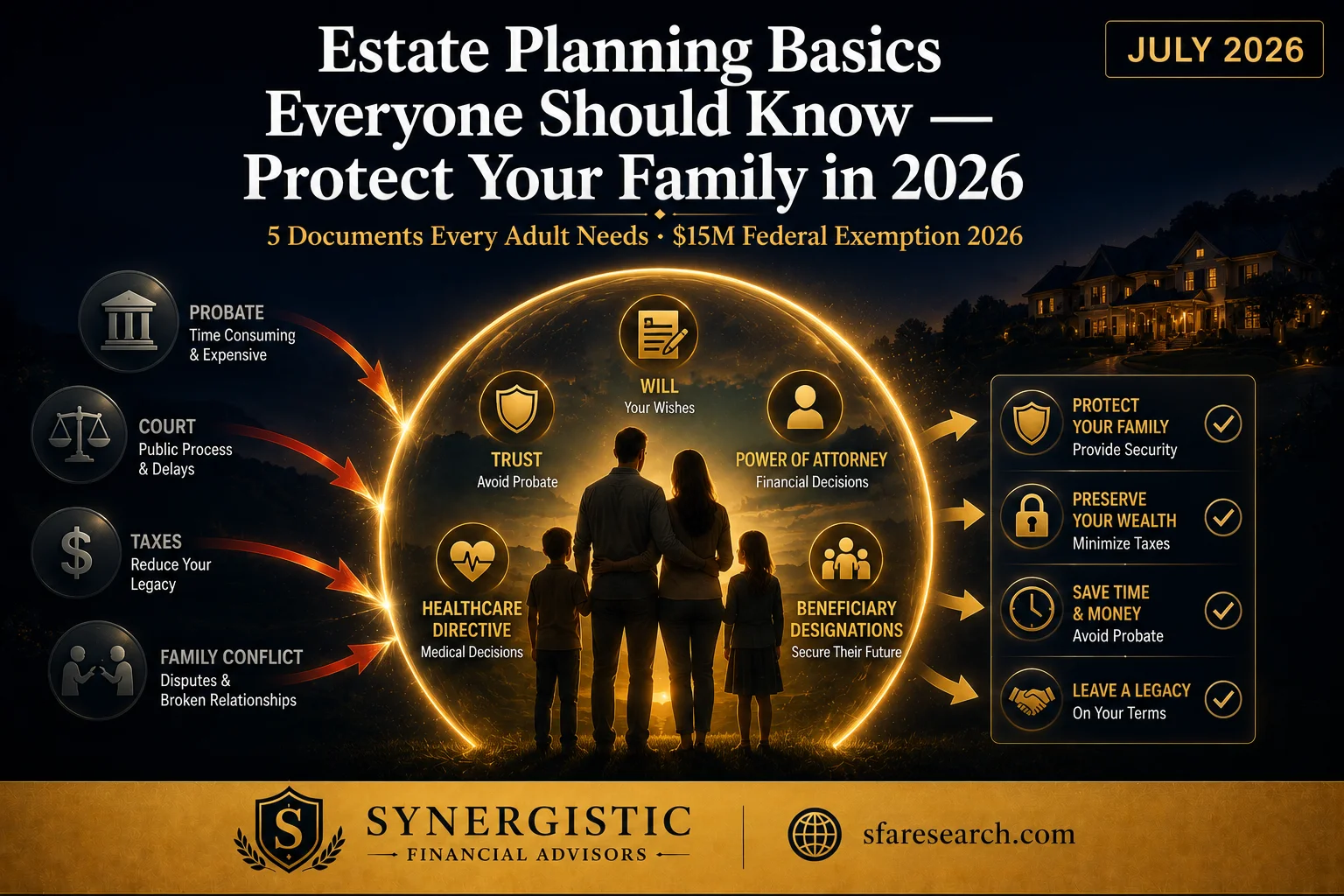
As we move through 2026, having a baseline of five core documents is essential for every family, regardless of wealth or age. These documents work together as a system — each covering a different gap that the others cannot fill.
The 5 Core Estate Planning Documents Every Adult Needs
Document 1 — Your Will — The Foundation of Every Estate Plan
Your will is a set of instructions explaining how property owned in your name should be distributed after your passing. It also names an executor and a guardian if needed.
A will allows you to designate guardians for minor children, specify how personal and financial assets should be distributed, and appoint an executor to oversee the distribution of your estate. Without a will, state laws determine your heirs — a process that may not reflect your wishes and that creates unnecessary delays, legal fees, and family conflict.
There are two primary types of wills. A simple will is straightforward and typically used for individuals with a smaller, less complicated estate. It outlines the basic distribution of assets and names an executor to carry out your wishes. A complex will is used for larger estates or those with more intricate financial situations, such as multiple properties or business interests, and might include provisions for trusts or detailed instructions for asset distribution.
One of the most important and most misunderstood limitations of a will is what it cannot control. Your will has no power over retirement accounts, life insurance, annuities, or transfer-on-death accounts. Those assets go directly to whoever is named on the beneficiary form — even if your will says otherwise. A will also must pass through probate — the court-supervised process for validating a will and distributing assets — which is public, slow, and typically costs 3-7% of the gross estate value in legal fees and court costs.
Understanding this limitation is what makes the next document — the revocable living trust — such an important companion to the will for most adults.
Document 2 — The Revocable Living Trust — Privacy, Probate Avoidance, and Control
A revocable living trust allows assets to bypass probate, maintains privacy, and provides control over distributions. Both wills and trusts are important, but they serve different purposes. A will only takes effect after death and goes through probate. A revocable living trust takes effect immediately, avoids probate entirely, and provides continuity if you become incapacitated. Most people benefit from having both — a trust for major assets and a pour-over will for anything not in the trust.
Many families are now choosing revocable living trusts to complement or replace a simple will, for three primary benefits: avoiding probate entirely, keeping your family’s financial matters completely private since trusts are not public court records, and allowing immediate asset transfers to beneficiaries after death without the months-long delays that probate typically involves.
A revocable trust can also be tailored to specific goals — providing for a child with special needs, supporting charitable causes, distributing assets over time rather than all at once to protect younger beneficiaries from financial missteps, or ensuring a steady income stream for beneficiaries across multiple generations.
The most critical warning about living trusts is what estate planning professionals call the “unfunded trust problem.” A revocable living trust only works for assets that are legally transferred into it — a process called “funding” the trust. If you create a trust but forget to retitle your home and accounts, those assets still go through probate as if the trust did not exist. Creating the trust document is only half the job — funding it correctly is the other half, and it requires deliberate, documented action for every asset you want the trust to govern.
Document 3 — The Durable Power of Attorney — Financial Decision-Making During Incapacity
A Durable Power of Attorney grants a trusted person authority to pay bills, manage investments, file taxes, and make financial decisions if you are temporarily or permanently unable to act. Without a durable power of attorney, families may need to petition the court for guardianship — a costly and stressful process during difficult times.
This is one of the most urgently needed and most consistently overlooked estate planning documents — because it addresses a scenario that most people associate with old age but that can happen to anyone at any age. An unexpected accident, a serious medical event, or a period of cognitive impairment can render any adult temporarily or permanently unable to manage their own financial affairs. Without a durable power of attorney, no one — not a spouse, not an adult child, not a parent — has the legal authority to act on your behalf without a court order.
The person you designate as your agent under a durable power of attorney should be someone you trust completely with your financial affairs — ideally someone who is organised, available, financially literate, and willing to act in your interest under what may be emotionally difficult circumstances.
Document 4 — The Healthcare Power of Attorney and Living Will — Your Medical Wishes Documented
Healthcare advance directives are key to ensuring your medical wishes are honoured. The Healthcare Power of Attorney names someone to make medical decisions on your behalf when you cannot. The Living Will specifies your preferences for end-of-life care, such as life support, feeding tubes, or palliative care.
Without a healthcare power of attorney, hospitals default to next-of-kin hierarchy — spouse, then adult children, then parents, then siblings. Unmarried partners have no legal standing without this document — meaning that a partner of 20 years may have no say whatsoever in your medical care in a critical emergency if you have not executed a healthcare directive naming them as your healthcare agent.
Without a living will, your healthcare agent must guess your wishes — or family members may disagree, leading to painful conflict during an already devastating time. These documents ensure that your values guide decisions, even if you cannot speak for yourself. They are essential for everyone, not just seniors, since unexpected medical crises can happen at any age.
The healthcare power of attorney and living will should be executed and shared with your healthcare providers, your designated agent, and your family — so that the documents are accessible at the moment they are needed rather than sitting in a drawer or safety deposit box that no one can access during an emergency.
Document 5 — Beneficiary Designations — The Most Powerful and Most Neglected Part of Estate Planning
Beneficiary designations are legally binding contracts that bypass your will entirely. They are the most powerful and most neglected part of estate planning.
Your will has no power over retirement accounts, life insurance policies, annuities, or transfer-on-death accounts. Those assets go directly to whoever is named on the beneficiary form — regardless of what your will says. If your will says “everything to my spouse” but your IRA still lists your ex-spouse or a deceased parent as the beneficiary, the IRA administrator is legally required to pay the person named on the form.
Millions of people have outdated designations naming ex-spouses or deceased relatives. This is one of the most common and most expensive estate planning mistakes in existence — and it is entirely preventable through a simple annual review of every beneficiary designation on every account.
Every account with a beneficiary designation requires annual confirmation — 401(k)s and 403(b)s from current and former employers, all IRA accounts, life insurance policies, annuities, transfer-on-death brokerage accounts, and payable-on-death bank accounts. If you have rolled over 401(k) plans to IRAs or opened new bank or brokerage accounts, make sure the beneficiary designations are correct. If you transfer a brokerage account to another firm, confirm that any beneficiary designations will also transfer.
Understanding Trusts — Revocable vs Irrevocable
Beyond the revocable living trust described above, a broader understanding of trust types helps every adult evaluate which tools are appropriate for their specific estate planning goals.
A revocable trust allows you to retain control over your assets during your lifetime and can be modified or revoked as needed. It is particularly useful for avoiding probate, maintaining privacy, and providing continuity during incapacity. The trade-off is that a revocable trust does not remove assets from your taxable estate — assets in a revocable trust are still considered yours for estate tax purposes.
An irrevocable trust, by contrast, cannot be changed once established but offers advantages that include asset protection and estate tax savings. Because assets transferred into an irrevocable trust are legally removed from your estate, they reduce your taxable estate and can provide protection from creditors. Two specific types of irrevocable trusts are particularly relevant in 2026’s estate planning environment.
The Spousal Lifetime Access Trust allows one spouse to gift assets to an irrevocable trust for the benefit of the other spouse — removing the assets from the taxable estate while maintaining the contributing spouse’s indirect access to trust assets through distributions to the beneficiary spouse. The Irrevocable Life Insurance Trust holds life insurance policies outside the taxable estate — ensuring that life insurance proceeds pass to beneficiaries without being included in the estate for tax calculation purposes.
For those with substantial assets, the revocable trust alone may not be enough to capture the full benefit of current estate tax law. Irrevocable trusts are distinct because they remove assets from your taxable estate entirely.
The 2026 Estate Tax Landscape — The $15 Million Opportunity
The 2026 estate planning environment has been dramatically reshaped by the One Big Beautiful Bill Act — and understanding the specific numbers and their implications is essential for any adult with meaningful assets.
In 2026, the federal lifetime exemption for estate, gift, and generation-skipping transfer taxes has increased to $15 million per individual, and to $30 million for married couples. Estates below this threshold owe no federal estate tax. Married couples can effectively combine their exemptions through a provision called portability — which allows the surviving spouse to use any unused portion of the deceased spouse’s exemption.
The annual gift tax exclusion is $19,000 per donor per recipient in 2026. A married couple can jointly gift $38,000 per recipient annually without any gift tax implications or use of the lifetime exemption — making systematic annual gifting one of the most accessible and most consistently underused estate planning strategies available.
In addition to the federal estate tax, 12 US states and the District of Columbia levy their own state estate taxes with exemptions that are often significantly lower than the federal threshold. State estate planning requirements must be coordinated with any federal strategies to avoid unexpected state-level tax exposure.
For families whose estate plans were drafted when the exemption was $5 million or $10 million, the increased 2026 exemption creates specific document review requirements. Many wills drafted years ago include funding formulas for testamentary trusts based on the “maximum exemption amount.” Because the exemption amount is currently very high, a formula based on the maximum exemption might accidentally disinherit a surviving spouse by funnelling the entire estate into a trust for children. This is one of the most important reasons to review existing estate planning documents against the current 2026 exemption levels.
Probate — What It Is, What It Costs, and How to Avoid It
Probate is the court-supervised process for validating a will and distributing assets. It is public, slow, and costly — typically costing 3-7% of the gross estate value in legal fees and court costs, including attorney fees, executor fees, court filing fees, and appraisal costs.
Beyond the direct financial cost, probate is time-consuming — typically taking six months to two years to complete — and creates a public record of your assets and their distribution. For families who value privacy, or who want assets transferred to beneficiaries promptly without court delays, avoiding probate is a primary estate planning objective.
The most effective probate avoidance strategies include a revocable living trust — which avoids probate entirely for all assets properly funded into the trust, beneficiary designations — which bypass probate automatically for retirement accounts, life insurance, and transfer-on-death accounts, and joint ownership with right of survivorship — which transfers assets directly to the surviving owner without probate. The most effective estate plans typically combine all three approaches to ensure comprehensive probate avoidance across every asset category.
Digital Assets — The 2026 Estate Planning Frontier
One area of estate planning that deserves specific attention in 2026 is digital assets — a category that most estate plans drafted before 2020 completely ignore.
Digital assets in estate plans include online accounts, cryptocurrencies, files, email, social media accounts, and digital media. These assets can have significant financial value — cryptocurrency holdings alone can represent substantial portions of some investors’ wealth management portfolios — and they require specific planning attention to ensure that successors can actually access and manage them.
Estate planning for digital assets requires documenting what digital assets exist, where they are held, and how they can be accessed — including passwords, seed phrases for cryptocurrency wallets, and two-factor authentication recovery codes. This documentation must be stored securely but accessibly — available to your executor or trustee without being exposed to theft or misuse during your lifetime.
A letter of intent — a non-legal document that provides personal guidance to your executor and beneficiaries — is an appropriate vehicle for digital asset instructions, funeral arrangement wishes, explanations of your estate decisions, and personal messages that you want to accompany the formal legal documents.
The 6 Most Common and Most Costly Estate Planning Mistakes
Mistake 1 — Having No Documents At All
Sixty-eight percent of Americans have no will. The consequences are entirely predictable and entirely avoidable. State intestacy laws will distribute your assets according to a formula designed for a generic family structure — not your specific wishes, values, or family circumstances. And if you have minor children, a court will decide who raises them.
Mistake 2 — Outdated Beneficiary Designations
Beneficiary designations on retirement accounts, life insurance, and annuities override everything in your will. An outdated designation naming an ex-spouse, a deceased parent, or the wrong child is legally binding regardless of your current wishes. Annual review of every beneficiary designation is not optional — it is fundamental.
Mistake 3 — The Unfunded Trust Problem
Creating a revocable living trust and then failing to transfer assets into it is one of the most consistent and most expensive estate planning failures. A trust that is not properly funded provides none of the probate avoidance, privacy, or control benefits it was designed to deliver. Every asset that should be in the trust must be deliberately retitled in the name of the trust — a process that requires specific action for each account, property, and investment.
Mistake 4 — Naming the Wrong People
Your executor manages your estate through the probate process. Your trustee manages trust assets. Your healthcare agent makes medical decisions. Your financial power of attorney agent manages your finances if you are incapacitated. Each of these roles requires a person who is willing, able, geographically accessible, financially capable, and emotionally suited to the specific responsibilities involved. Naming the wrong person — or failing to name successor agents for when your first choice is unavailable — creates unnecessary risk and potential conflict.
Mistake 5 — Outdated Formulas in Old Wills
Many wills drafted years ago include funding formulas for testamentary trusts based on the estate tax exemption amount at the time. With the exemption now at $15 million, these formulas may inadvertently direct the entire estate into a trust for children — leaving a surviving spouse with nothing outside the trust. Estate plans more than three to five years old deserve a deliberate review against current law.
Mistake 6 — Never Reviewing or Updating the Plan
An estate plan is not a one-time event — it is an ongoing process that should be reviewed every three to five years or after major life changes. Marriage, divorce, the birth of children or grandchildren, the death of a named beneficiary or executor, a significant change in asset values, a move to a different state, or a major legislative change — each of these events is a specific trigger for estate plan review.
Regular review is what converts a good estate plan into a genuinely effective one. Estate planning is not just about documents — it is about alignment. Your will, trust, beneficiary designations, investment accounts, insurance policies, and tax planning strategy should all work together.
Estate Planning for Specific Life Situations
Parents With Minor Children
For parents of young children, the guardian designation in a will is the single most urgent estate planning priority. Without a will that names a guardian, a court will make this decision — potentially choosing someone you would not have chosen. A trust should also be established to manage any assets that would pass to minor children, since courts typically require a custodian to manage assets on behalf of minors until they reach the age of majority — which in many states is 18, an age at which most parents would not want a child to receive a large inheritance outright.
Unmarried Couples and Non-Traditional Families
For unmarried couples, domestic partners, and non-traditional family structures, estate planning is even more critical than for married couples — because the legal default rules are written around traditional family structures that may not reflect your actual family. Without explicit estate planning documents, an unmarried partner has no legal right to inherit, no right to make medical decisions, and no authority to manage financial affairs during incapacity.
Business Owners
Business owners need to plan for their company’s transition in their estate plan — addressing business succession planning, buy-sell agreements, the tax treatment of business interests at death, and the coordination of business and personal assets within the overall estate plan. This often requires coordination between an estate planning attorney, a financial advisor, and a CPA to ensure that the business and personal estate plan work together coherently.
Those With Significant Retirement Account Assets
The passing of the SECURE Act changed the rules for how inherited retirement accounts must be distributed. Most non-spouse beneficiaries must now deplete an inherited IRA within ten years — creating significant tax implications for heirs that require specific planning attention. If you named a trust as the beneficiary of a retirement account, the trust language must be carefully drafted to accommodate the ten-year payout rule to avoid negative tax consequences.
How to Get Started — A Practical Action Plan
Estate planning can feel overwhelming — but the practical path forward is straightforward when broken into specific, sequential steps.
Step 1 — Take inventory of your assets. List everything you own — bank accounts, investment accounts, retirement accounts, real estate, business interests, life insurance policies, and personal property. An effective estate plan starts with a clear inventory of assets, ensuring that nothing is overlooked and making the planning process far more efficient.
Step 2 — Define your wishes clearly. Decide who will inherit your assets and consider their needs and circumstances. Identify who you would want to raise your minor children. Think about who you trust to manage your finances and make medical decisions if you cannot. These decisions are the substance of your estate plan — the documents simply codify them legally.
Step 3 — Work with qualified professionals. Draft essential documents with your attorney to create wills, trusts, powers of attorney, and healthcare directives. Estate planning laws vary by state — always work with attorneys licensed in your state to ensure compliance with local laws. Your financial advisor and tax professional should also be involved to ensure that the estate plan, your investment accounts, beneficiary designations, and tax planning strategy all work together coherently.
Step 4 — Fund your trust. If a revocable living trust is part of your plan, retitle every applicable asset in the name of the trust. This is the step that most people complete incompletely — and the one that determines whether the trust actually delivers its intended benefits.
Step 5 — Review and update regularly. Schedule periodic reviews — at least every three to five years, and after every major life event — to ensure your estate plan remains aligned with your current wishes, your current family circumstances, and the current legal environment.
How Synergistic Financial Advisors Supports Your Estate Planning
At Synergistic Financial Advisors, estate planning coordination is a fundamental component of our comprehensive financial planning and wealth management advisory service — because a financial plan without an estate plan leaves the most important dimensions of your financial legacy unprotected.
Our certified financial planner team reviews your complete asset picture against your estate planning documents — identifying gaps between your stated wishes and your actual account structure, reviewing beneficiary designations across every account for accuracy and alignment with your current intentions, modelling the estate tax implications of your current plan against the 2026 $15 million exemption, coordinating Roth conversion strategy with estate planning goals to minimise the tax burden on your heirs, and working alongside your estate planning attorney and CPA to ensure that your will, trusts, investment management accounts, beneficiary designations, and tax planning strategy all work together coherently.
We work alongside your estate attorney and tax professionals to ensure your documents reflect your wishes and your financial structure supports them. If you haven’t reviewed your estate plan recently — or if you’re unsure whether everything is aligned — we invite you to schedule a consultation.
Estate planning is not a pleasant topic. Nobody enjoys thinking about incapacity or death. But the discomfort of having the conversation is temporary. The consequences of avoiding it — for the people you love — can last years and cost far more than the plan itself.
Ready to build an estate plan that protects your family, your assets, and your legacy? Contact Synergistic Financial Advisors today for a personalised estate planning coordination consultation.
👉 Visit www.sfaresearch.com — because the best time to create your estate plan was yesterday. The second best time is today.
Final Thoughts — Estate Planning Is the Most Important Financial Document You Do Not Have
Sixty-eight percent of Americans have no will. The gap between knowing that estate planning matters and actually doing it is one of the most costly and most prevalent gaps in personal finance — costing families time, money, privacy, and peace of mind when they can least afford any of those losses.
An estate plan is not a luxury for the wealthy. It is the most fundamental act of financial responsibility available to any adult — the one decision that ensures your wishes are honoured, your family is protected, and the wealth you have spent a lifetime building reaches the people you intended it to reach.
In 2026, with a $15 million estate tax exemption, new charitable giving provisions, updated beneficiary designation rules, and a legal landscape more favourable to wealth management and wealth transfer than at almost any point in recent history, the opportunity to build a genuinely effective, genuinely protective estate plan has never been greater.
At Synergistic Financial Advisors, we help every client build that plan — coordinating the legal, financial, and tax planning dimensions of estate strategy with the expertise, the genuine care, and the fiduciary commitment that your legacy deserves.