Most investors focus intensely on which investments to buy. Very few focus on the dimension of investment management that research consistently shows has the greatest controllable impact on long-term wealth creation — how efficiently those investments are taxed.
Tax-aware financial planning is the “single most important factor in investing that you can control,” said Bill Harris, founder and CEO of Evergreen Wealth, entrepreneur and former CEO of PayPal, Intuit, and Personal Capital. “There’s a difference between should do’s and must do’s. We ‘must’ file our taxes. We ‘should’ plan our taxes.”
Most people do not plan their taxes. They react to them — once a year, at filing time, with whatever situation has emerged from a year of untaxed investment management decisions. The cost of this reactive approach is staggering and almost entirely invisible — because it shows up not as a line item on a tax return but as the compounding wealth that never materialises.
In 2026 — with the One Big Beautiful Bill Act permanently reshaping tax brackets, capital gains thresholds, estate exemptions, and retirement contribution rules, and with CPI at 4.2% making the real, after-tax return on every investment more consequential than ever — tax-efficient investing has never been more important or more actionable.
Smart investing is not just about growing your wealth management outcomes — it is about keeping them. It is not just about what you earn; it is about what you keep.
This guide gives you the 10 most powerful tax-efficient investment management strategies for 2026 — backed by research from Fidelity, Nuveen, Davis Capital, Savant Wealth, CNBC’s Financial Advisor Council, and the most current 2026 tax law analysis available.
Why Tax Efficiency Is the Most Underrated Dimension of Investment Management
Before examining the strategies, it is worth quantifying exactly what is at stake — because the numbers make a compelling case for treating tax planning as a core investment activity rather than an afterthought.
While market volatility and inflation are likely at the top of many investors’ minds, better tax awareness does have the potential to improve your after-tax returns. The question is by how much.
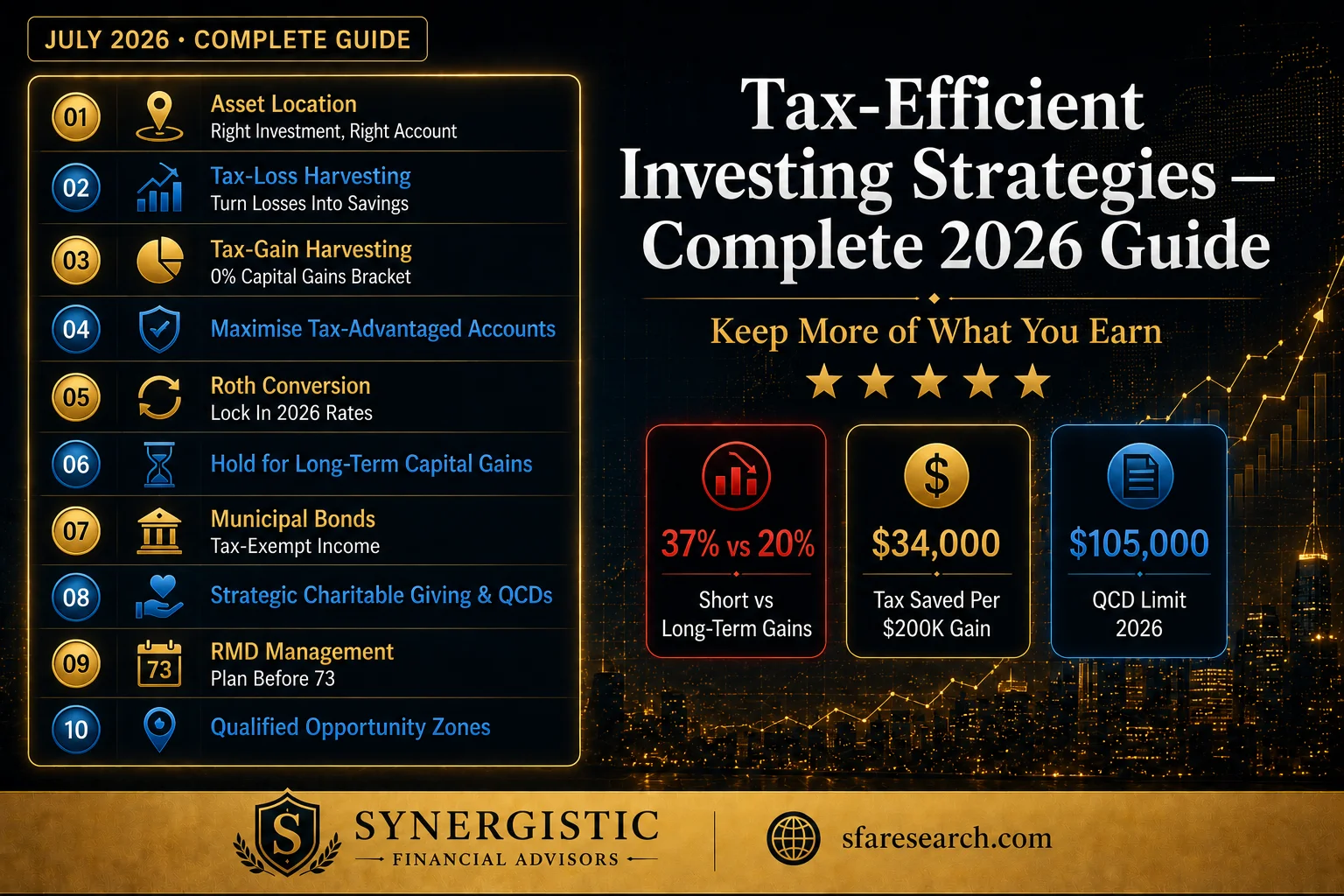
Consider this: long-term capital gains rates remain at 0%, 15%, or 20% depending on income thresholds adjusted for inflation, while short-term gains are taxed as ordinary income at rates up to 37%. The difference between holding an investment for 12 months and one day versus 11 months and 30 days — on a $100,000 gain — can be the difference between paying $20,000 and $37,000 in federal tax. That $17,000 difference, reinvested at 8% annually, grows to over $80,000 over 20 years.
“When people are searching for ways to save money — yes, you can buy in bulk, yes, you can limit eating out — but I think sometimes people forget that you can be strategic in tax planning to save money,” said certified financial planner Kamila Elliott, co-founder and CEO of Collective Wealth Partners. “Not thinking about tax planning, it can be a significant oversight for a lot of families.”
The 10 strategies below represent the most powerful, most universally applicable, and most consistently underused tax-efficient investment management approaches available to individual investors in 2026. Each one requires planning — but none of them requires market prediction. They are entirely within your control.
Strategy 1 — Asset Location — The Foundation of Tax-Efficient Investing
Asset location is the single most foundational tax-efficient investment management strategy — and the one most individual investors have never deliberately implemented.
Place tax-efficient investments like ETFs or municipal bonds in taxable accounts and tax-inefficient assets like REITs or actively managed mutual funds in tax-deferred or tax-free accounts. This approach is called “asset location,” and it can significantly improve after-tax returns.
The logic is powerful: different investments generate different types of taxable income in different amounts. Interest income from bonds is taxed at ordinary income rates — up to 37%. Short-term capital gains are taxed the same way. But long-term capital gains and qualified dividends are taxed at preferential rates of 0%, 15%, or 20%. And some investments — Roth IRA holdings — generate no taxable events at all.
Asset location matches each investment type to the account structure where its tax treatment is most favourable.
In taxable brokerage accounts: Hold tax-efficient investments — broad market index funds and ETFs with low turnover and minimal dividend distributions, municipal bonds whose interest is federally tax-exempt, and individual stocks held for long-term capital gains treatment.
In tax-deferred accounts (traditional 401k, traditional IRA): Hold tax-inefficient investments — actively managed funds that generate short-term gains and income, REITs that distribute large taxable dividends, high-yield bonds generating ordinary income, and any investment with high annual income distributions.
In tax-free accounts (Roth IRA, Roth 401k): Hold your highest-growth, highest-return investments — because every dollar of appreciation in a Roth account compounds and is eventually withdrawn completely tax-free.
Investments that give off income taxed at ordinary rates should go into retirement accounts like IRAs, said CFP Cathy Curtis, founder and CEO of Curtis Financial Planning. “I don’t know how many people understand the difference between the capital gain rate and the ordinary tax rate, but it can make a substantial difference.”
Financial Planning Insight: A certified financial planner who reviews your complete account structure — not just individual accounts in isolation — can identify specific asset location improvements that add measurable, compounding after-tax value without changing a single underlying investment.
Strategy 2 — Tax-Loss Harvesting — Turning Losses Into Tax Savings
Tax-loss harvesting involves identifying opportunities to sell assets at a loss to offset gains and reduce taxes. It is one of the most consistently powerful and most systematically underused tax-efficient investment management strategies available to individual investors.
The mechanics are straightforward: when an investment in your taxable account has declined in value below your purchase price, selling it realises a capital loss. That loss can be used to offset capital gains elsewhere in your portfolio — reducing your tax bill dollar-for-dollar. If your losses exceed your gains, up to $3,000 of the net loss can offset ordinary income annually, with any remaining losses carried forward to future tax years indefinitely.
In 2026, with the S&P 500 experiencing its worst single day of the year in June — a 2.6% decline that pushed semiconductor stocks down 10% in a single session — specific, measurable tax-loss harvesting opportunities emerged for investors with concentrated AI and technology positions. A financial advisor who executed these opportunities during the selloff captured genuine, permanent tax savings that will compound across future years.
The critical implementation requirement is the wash-sale rule — which prohibits repurchasing the same or a “substantially identical” security within 30 days before or after the sale that created the loss. Violation of this rule disallows the loss deduction. The solution is to replace the sold investment with a similar but not identical alternative — maintaining your desired market exposure while the 30-day window passes.
With long-term capital gains rates remaining at 0%, 15%, or 20% depending on income thresholds adjusted for inflation, strategic harvesting can minimise taxes on winners, especially in volatile markets.
Financial Planning Insight: Tax-loss harvesting is most valuable when implemented systematically throughout the year — not just in December. A financial advisor who monitors your portfolio management positions continuously can identify and execute harvesting opportunities whenever they arise, rather than scrambling at year-end when most opportunities have already passed.
Strategy 3 — Tax-Gain Harvesting — The Strategy Nobody Talks About
Tax-gain harvesting involves strategically selling winning investments. That can be beneficial if you qualify for the 0% capital gains bracket during a lower-income year, for example. Some investors in that situation use tax-gain harvesting to rebalance their portfolios or reset their basis on investments to save on future taxes.
If taxable income stays below $49,450 for single filers or $98,900 for married couples filing jointly, you can realise long-term gains completely tax-free. This is powerful for retirees or variable-income years — sell appreciated assets without owing federal capital gains tax.
Tax-gain harvesting is the mirror image of tax-loss harvesting — and it is equally powerful in the right circumstances. For retirees, early FIRE retirees, or anyone experiencing a lower-income year — whether from a career transition, a sabbatical, or the gap between retirement and Social Security claiming — the 0% capital gains bracket represents an extraordinary opportunity to realise investment gains at zero federal tax cost.
The strategy: during a low-income year, sell appreciated positions to realise gains at 0%, then immediately repurchase them. You have effectively reset your cost basis upward — meaning future gains will be calculated from a higher starting point, reducing the tax liability on any subsequent appreciation.
Financial Planning Insight: Tax-gain harvesting requires precise income modelling to determine how much gain can be realised within the 0% bracket without inadvertently crossing into the 15% bracket. A certified financial planner with integrated tax planning expertise can model this calculation annually for your specific situation — identifying the exact harvesting window that maximises the zero-tax opportunity.
Strategy 4 — Maximise Every Tax-Advantaged Account
Prioritise funding tax-advantaged accounts like IRAs, Roth IRAs, 401(k)s, and HSAs. These accounts offer either tax-deferred growth, as with a Traditional IRA or 401(k), or tax-free withdrawals, as with a Roth IRA or HSA.
Tax-advantaged accounts are the most powerful and most accessible tax-efficient investment management vehicles available to virtually every individual investor — and most people dramatically underutilise them.
The 401(k) — Up to $24,500 in Pre-Tax Contributions
Employees can have up to $24,500 taken out of their paychecks pre-tax in 2026 and invest in a 401(k) or 403(b). Those 50 and older can invest an additional $8,000 in catch-up contributions, while those ages 60 to 63 can make a “super catch-up” contribution of up to $11,250. Every dollar contributed to a traditional 401(k) reduces your taxable income dollar-for-dollar in the year of contribution — providing an immediate, guaranteed tax benefit before a single market move occurs.
Those who earned more than $150,000 from their current employer in 2025 must put their catch-up contributions in an after-tax Roth account. That means they don’t pay taxes upon withdrawal. While this eliminates the upfront deduction for high earners, it creates valuable tax-free growth on the catch-up amounts.
The Roth IRA — Tax-Free Growth for Decades
The Roth IRA’s compound tax advantage is extraordinary: contributions are made with after-tax dollars, but every dollar of growth — across potentially decades of compounding — is completely tax-free. The 2026 contribution limit is $7,500 ($8,600 for those 50 and older), with income limits applying for direct contributions.
For high-income earners, a mega backdoor Roth is also an option. These are for investors who have already maxed out their 401(k)s. Some are able to make after-tax 401(k) contributions and transfer the money into a Roth. The maximum total contribution limit for 401(k)s in 2026 is $72,000.
The HSA — The Most Underrated Triple-Tax-Advantage Vehicle
The Health Savings Account is the only account in the US tax code that offers three simultaneous tax advantages: tax-deductible contributions, tax-free growth, and tax-free withdrawals for qualified medical expenses. For investors enrolled in a high-deductible health plan, health-care FSAs have a maximum contribution limit of $3,400 for 2026, while the HSA limits are $4,400 for individual coverage and $8,750 for family coverage.
After age 65, HSA funds can be withdrawn for any purpose — not just medical expenses — paying only ordinary income tax, making a maximised HSA functionally equivalent to an additional traditional IRA for retirement planning purposes.
Financial Planning Insight: The sequencing of contributions across 401(k), Roth IRA, HSA, and taxable accounts — calibrated to your specific income, tax bracket, and retirement planning timeline — is one of the most consistently high-value activities a financial advisor performs for individual clients.
Strategy 5 — Roth Conversion — The 2026 Tax Planning Opportunity of the Decade
Convert traditional IRA funds to Roth for tax-free future withdrawals. With stable ordinary income rates — top at 37% — converting in lower-income years locks in today’s rates, ideal if you anticipate higher taxes or brackets later.
A Roth conversion involves transferring money from a traditional pre-tax retirement account to a Roth account — paying ordinary income tax on the converted amount now in exchange for tax-free growth and tax-free withdrawals for the rest of your life.
In 2026, the case for Roth conversions is exceptionally compelling for three specific reasons. First, the One Big Beautiful Bill Act made tax rates permanent — so converting now locks in known rates rather than gambling on what rates might be in a future legislative environment. Second, with CPI at 4.2% and the Federal Reserve projecting rates at 3.8% by year-end, the economic environment suggests that government spending pressures make future tax rate increases more plausible than decreases. Third, the gap years between retirement and Social Security claiming — when income is temporarily lowest — represent a uniquely favourable conversion window that a certified financial planner can systematically exploit.
“Don’t let the tax tail wag the dog. Most people just focus on the now, and I want to save taxes now — and it’s very short sighted,” said one CFP. “Five, 10, 15, 20 years from now, what do I want to pay? Or how do I mitigate my exposure long term? Sometimes you take the hit now and you’re not going to have to worry about paying anything in the future.”
The critical implementation nuance is conversion amount — converting too much in a single year pushes you into a higher bracket and can trigger IRMAA Medicare surcharges, while converting too little leaves the opportunity partially unexploited. A financial advisor can model the precise optimal conversion amount for your specific bracket situation every year.
Financial Planning Insight: Multi-year Roth conversion sequencing — filling each tax bracket systematically over five to ten years — can reduce lifetime tax liability on retirement income by hundreds of thousands of dollars for many investors. This is one of the highest-value tax planning activities available to any pre-retiree or early retiree.
Strategy 6 — Hold Investments for the Long-Term Capital Gains Rate
One of the simplest and most consistently impactful tax-efficient investment management decisions any investor can make is also one of the most straightforward: hold investments for more than 12 months before selling.
Investments held for more than a year benefit from lower long-term capital gains tax rates. Avoid short-term trades unless there is a clear strategic reason.
The difference is material and immediate. A short-term gain — from selling a position held less than 12 months — is taxed as ordinary income at your marginal rate, which can reach 37% for high earners. A long-term gain on the same investment, held just one additional day beyond the 12-month threshold, is taxed at 0%, 15%, or 20% — a potential saving of 17 percentage points for a top-bracket investor.
For an investor with a $200,000 gain, the difference between short-term and long-term tax treatment is $34,000 in a single year. Compounded at 8% annually for 20 years, that $34,000 in preserved capital grows to over $160,000.
The principle extends beyond individual stock sales to the overall construction of your portfolio management strategy. A financial advisor who designs your investment strategy around buy-and-hold principles — limiting unnecessary trading that generates short-term gains — creates a structural tax advantage that compounds across every year of your investing life.
Financial Planning Insight: For investors with concentrated positions approaching the 12-month holding threshold, a financial advisor can model whether waiting for long-term treatment justifies the market risk of the additional holding period — integrating tax planning with portfolio management decision-making in real time.
Strategy 7 — Municipal Bonds for Tax-Exempt Income
Municipal bonds are especially powerful in taxable accounts for higher-tax-bracket investors — their interest is typically exempt from federal and often state income tax, making them one of the most tax-efficient fixed-income options available.
Municipal bonds — debt instruments issued by state and local governments — pay interest that is federally tax-exempt and often state-tax-exempt for residents of the issuing state. For investors in the highest federal tax brackets, this tax exemption can make municipal bonds the most tax-efficient fixed-income investment available — even when their nominal yield appears lower than taxable alternatives.
The calculation that matters is the taxable equivalent yield — dividing the municipal bond’s yield by one minus your marginal tax rate. For a high-bracket investor at 37%, a municipal bond yielding 3% has a taxable equivalent yield of 4.76%. If comparable taxable bonds yield less than 4.76%, the municipal bond is the more tax-efficient choice.
In 2026’s elevated rate environment — with the Federal Reserve projecting rates at 3.8% by year-end — municipal bonds occupy an interesting position in the fixed income landscape, offering tax-exempt income that becomes progressively more valuable as overall yields remain elevated.
Financial Planning Insight: A financial advisor with fixed income investment management expertise can calculate the precise taxable equivalent yield of municipal bonds against alternatives for your specific tax bracket — determining whether municipal allocation improves or reduces your after-tax fixed income return.
Strategy 8 — Strategic Charitable Giving for Maximum Tax Efficiency
Donating appreciated assets can be another smart tax-efficient strategy. That might involve qualified charitable distributions, or QCDs, which allow retirees to transfer funds from a pretax retirement account directly to a qualifying nonprofit. A QCD doesn’t increase your adjusted gross income, and can help satisfy annual withdrawal requirements.
For charitable investors, the tax-efficient giving landscape in 2026 offers several powerful strategies that most donors are not fully utilising.
Donating Appreciated Securities Directly
Rather than selling an appreciated investment, paying capital gains tax, and donating the after-tax proceeds, donating the appreciated security directly to charity allows you to deduct the full fair market value while completely avoiding the capital gains tax. Shares acquired through an employer stock program are generally good candidates for donation if held long-term and can reduce a concentrated position.
Qualified Charitable Distributions
For retirees aged 70½ and older, QCDs allow up to $105,000 annually to be transferred directly from a traditional IRA to a qualified charity — satisfying RMD requirements without the transferred amount counting as taxable income. This is one of the most powerful combined tax planning and charitable giving strategies available, potentially reducing your adjusted gross income enough to avoid IRMAA surcharges and reduce the taxability of Social Security benefits simultaneously.
Donor-Advised Funds — “Bunching” Charitable Deductions
“Bunching” donations into one year — perhaps via a donor-advised fund — can exceed the higher standard deduction of $16,100 single and $32,200 joint in 2026 and maximise charitable impact while reducing taxable income.
Donor-advised funds allow investors to make tax-deductible charitable contributions funded by cash or the appreciation of assets. CFP Cathy Curtis prefers using highly appreciated assets or mutual funds, since they give off capital gain income at the end of the year, within donor-advised funds.
Financial Planning Insight: A comprehensive charitable giving strategy — coordinating direct security donations, QCDs, and donor-advised fund timing — can simultaneously maximise your philanthropic impact and your after-tax wealth management outcomes. A financial advisor with integrated tax planning expertise designs this coordination deliberately rather than leaving it to chance.
Strategy 9 — Manage Required Minimum Distributions Strategically
For investors approaching age 73, required minimum distributions from traditional IRAs and 401(k)s represent one of the most significant and most consistently mismanaged tax planning challenges in all of retirement planning.
If nearing age 73, strategise withdrawals to manage brackets. The failure to plan for RMDs in advance creates a predictable but preventable problem: years of tax-deferred growth in traditional accounts eventually force large mandatory distributions that push retirees into higher tax brackets, trigger IRMAA Medicare surcharges, and increase the taxability of Social Security benefits — all simultaneously.
The most powerful solution is proactive distribution management in the years before RMDs begin. Strategic withdrawals from traditional accounts during lower-income years — combined with Roth conversion of the remainder — can systematically reduce the traditional account balance that will eventually be subject to RMD rules, smoothing the tax impact across multiple years rather than concentrating it when RMDs are mandatory.
Withdrawal strategies in retirement also benefit from coordination. Drawing from different account types in a structured way can help manage taxable income and may extend the longevity of a portfolio. A coordinated approach helps ensure that each decision supports a broader strategy rather than creating unintended tax consequences.
Financial Planning Insight: RMD planning is one of the most technically complex dimensions of retirement planning tax planning — requiring multi-year modelling of income, brackets, Social Security taxation, IRMAA thresholds, and estate planning simultaneously. A certified financial planner with integrated tax planning expertise delivers genuine, measurable value in this area that most individual investors cannot replicate independently.
Strategy 10 — Qualified Opportunity Zone Investing for Capital Gains Deferral
The One Big Beautiful Bill Act made the qualified opportunity zone programme permanent, preserving one of the most generous tax incentives ever created by Congress. Taxpayers can defer capital gains by investing in a qualified opportunity fund. For investments made after 2026, taxpayers will be required to recognise the deferred gain five years after making the investment, but will receive a 10% increase in basis for holding the investment five years. For QOFs operating in a new category of rural opportunity zones, this basis increase is 30%. The more powerful tax benefit may be the tax-free appreciation of the underlying investment itself — taxpayers receive a full basis step-up to fair market value for property held 10 years.
Qualified opportunity zone investing allows investors who have realised capital gains from any source — stock sales, real estate, business sales — to defer those gains by reinvesting them in a qualified opportunity fund within 180 days of the triggering sale. The deferral period, the basis increase for long-term holding, and the potential tax-free appreciation of the underlying investment combine to create one of the most powerful tax-efficient investment management vehicles available to high-gain investors in 2026.
Financial Planning Insight: QOZ investing requires careful evaluation of investment quality, fund structure, and liquidity constraints alongside the tax planning benefits. A financial advisor with QOZ expertise can help you assess whether the investment quality of available opportunity zone funds justifies the tax deferral benefit — ensuring the tax tail never wags the investment dog.
The New 2026 Tax Law Changes Every Investor Must Know
The tax landscape of 2026 has been reshaped by the One Big Beautiful Bill Act in ways that create specific, actionable tax planning opportunities for individual investors.
The One Big Beautiful Bill Act increased the lifetime estate and gift tax exemption to $15 million, indexed for inflation starting in 2027. You can gift up to $19,000 per donor to as many individuals as you like in 2026, and if you are married, each person in the couple can gift this amount without the gift being considered taxable.
The increased SALT deduction cap of up to $40,400 in some cases benefits high-tax state residents. Coordinate with itemising to fully utilise property, income, and sales taxes paid.
Starting in the 2026 tax year, non-itemisers will be able to claim deductions for cash donations to charity — up to $1,000 for single filers and $2,000 for married couples filing jointly.
Each of these changes creates specific tax planning implications that a certified financial planner can integrate into a coordinated, year-round investment management strategy designed to capture every available opportunity.
Bringing It All Together — The Year-Round Tax Planning Framework
Rather than viewing taxes as a once-a-year event, effective planning considers how each financial decision contributes to a broader strategy. In 2026, evolving tax rules, market conditions, and income structures continue to create both challenges and opportunities.
Tax planning is not a one-and-done exercise. To help reduce taxes, it makes sense to be planning throughout the year. A tax advisor and financial professional can help you build a tax-smart investing plan that works for you.
Tax planning is most effective when your financial advisor and CPA are working together. Coordinating directly with clients’ tax professionals to align investment decisions with tax strategies produces the best outcomes.
The 10 strategies in this guide do not operate independently — they are most powerful when coordinated within a comprehensive financial planning framework that integrates investment management, tax planning, retirement planning, and wealth management under one expert-guided advisory relationship.
How Synergistic Financial Advisors Maximises Your After-Tax Returns
At Synergistic Financial Advisors, tax planning is not a separate service that sits alongside our investment management work — it is integrated into every aspect of our advisory relationship with every client.
Our certified financial planner team implements asset location strategies across your complete account structure, executes systematic tax-loss and tax-gain harvesting throughout the year, models optimal Roth conversion amounts annually, coordinates charitable giving for maximum tax efficiency, manages RMD planning in advance of mandatory distributions, and evaluates qualified opportunity zone investments against genuine investment quality standards.
We do this within the comprehensive financial planning framework that also covers your portfolio management diversification strategy, your retirement planning timeline and projections, and your complete wealth management coordination — ensuring that every tax-efficient decision serves your overall long-term financial goals rather than creating unintended consequences elsewhere in your financial life.
Using tax-efficient strategies throughout the year can help minimise an investor’s tax burden and optimise their portfolio’s value for years to come. At Synergistic Financial Advisors, this year-round, integrated approach to tax-efficient investment management is the standard we deliver for every client.
Ready to discover how much more wealth you could be building through tax-efficient investing? Contact Synergistic Financial Advisors today for a personalised tax planning and investment management consultation.
👉 Visit sfaresearch.com — because it is not just about what you earn. It is about what you keep.
Final Thoughts — The Best Return Available Is the Tax Return You Plan For
The 10 tax-efficient investment management strategies in this guide share a common characteristic: none of them require market prediction, exceptional investment skill, or large initial capital. They require only deliberate, year-round planning — and the right professional guidance to implement them systematically.
As wealth grows, taxes often become one of the most significant factors affecting long-term outcomes. Investment returns, income strategies, and wealth transfer decisions can all be influenced by how efficiently taxes are managed over time. A coordinated approach to tax-efficient wealth management can help reduce unnecessary tax exposure while supporting long-term financial goals.
In 2026’s complex tax environment — with the One Big Beautiful Bill Act reshaping brackets, estate exemptions, and contribution rules, and with 4.2% inflation making real after-tax returns more important than ever — the investors who treat tax planning as a core investment management activity will quietly and systematically outperform those who treat it as an annual filing obligation.
At Synergistic Financial Advisors, that approach — comprehensive, proactive, and integrated — is the standard we hold ourselves to for every client, every year.