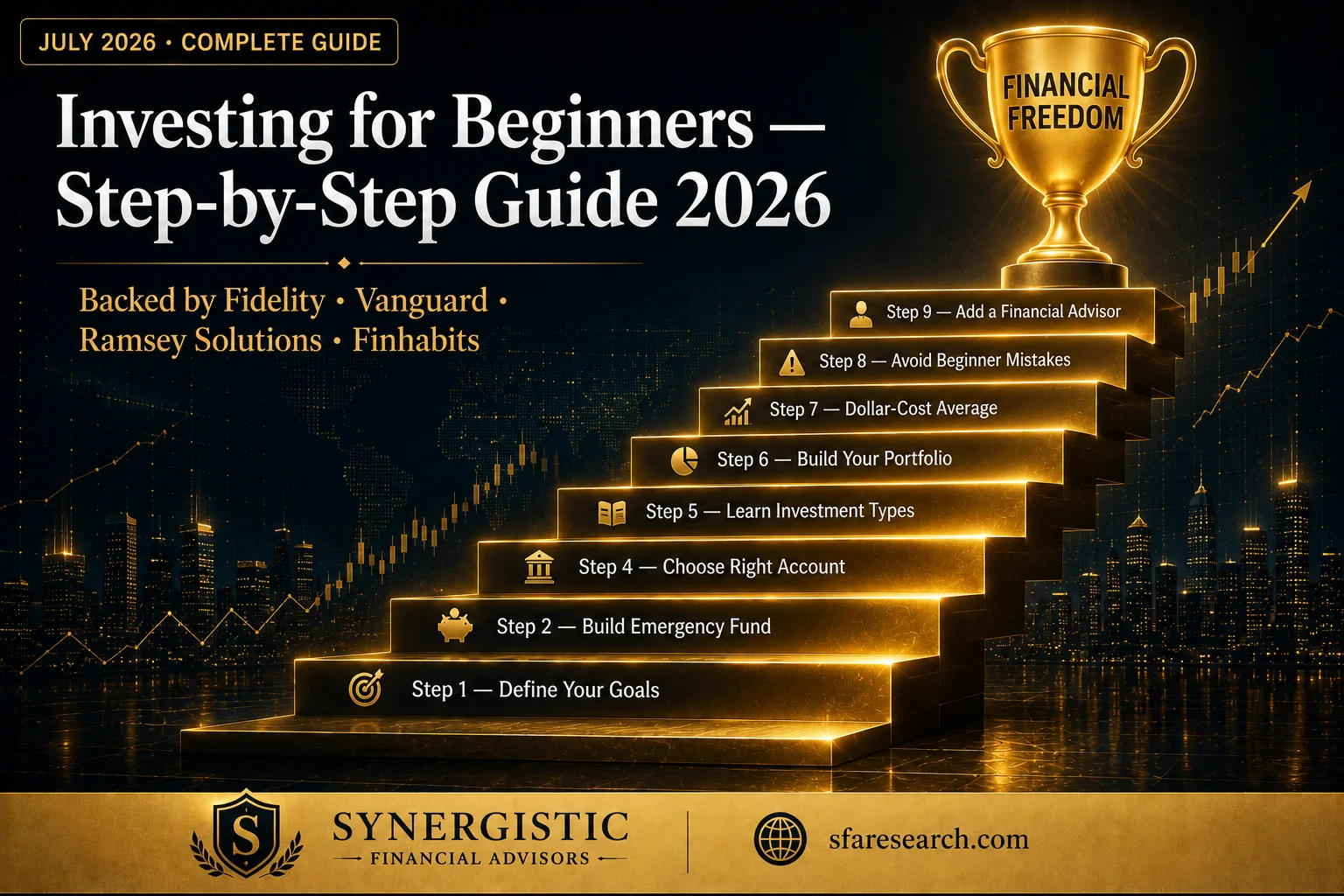
Here is the truth that most beginner investing guides never say out loud: you do not need to understand everything before you start. You do not need a lot of money. You do not need to pick the perfect stock. And you do not need to wait for the right moment — because there is no such thing.
Investing can feel intimidating when you are starting out. Terms like stocks, ETFs, index funds, and asset allocation can seem overwhelming — but the truth is, getting started with investing is simpler than most people think.
What you do need is a clear, simple, step-by-step framework — one that cuts through the noise of 2026’s extraordinary market environment and gives you the foundational knowledge to begin building real, lasting wealth. In a year that has already delivered the largest IPO in history, a new Federal Reserve Chair eliminating forward guidance, CPI at 4.2%, and markets at record highs, the temptation for new investors is either to chase the excitement or to wait until things feel calmer. Neither approach works. What works is starting with a plan.
This guide gives you that plan — backed by the latest 2026 data from Fidelity, Vanguard, Ramsey Solutions, and Finhabits.
Why Start Investing in 2026? The Case Has Never Been Stronger
Before diving into the steps, it is worth understanding precisely why beginning your investing journey in 2026 — rather than waiting — matters so profoundly.
Beginners should start investing in 2026 to capitalise on potential wealth growth, combat inflation, and pursue financial independence. The earlier you start, the more you can benefit from compound interest and market growth over time.
The mathematics of compound growth are genuinely staggering when experienced across a long enough time horizon. If Jane started investing $500 a month at the age of 25, she could have $4.3 million by the time she is 65 based on an 11% rate of return. Now if Jane waits until she is 35 to start investing that $500 a month, she could have $1.4 million at age 65.
The same monthly investment. A 10-year delay. A $2.9 million difference in outcome. That is not a marginal difference — it is the most powerful single argument for starting now that personal finance can offer.
Inflation erodes purchasing power, meaning that money today will buy less in the future. Investing helps to counteract this effect, as many assets, particularly stocks and real estate, can appreciate at rates that outpace inflation. This makes investing not just a way to grow wealth but also a necessary strategy for maintaining it.
In 2026, with CPI running at 4.2%, this argument is not theoretical — it is the lived financial reality of every person who holds their savings exclusively in cash. A savings account yielding 4% in a 4.2% inflation environment is quietly losing real purchasing power every single month.
Step 1 — Define Your Goals Before You Choose Any Investment
Successful investing generally starts with what you are investing for, not what you are investing in. Lots of people start off by investing for retirement. Although answering this question may not be as exciting as hunting down stock tips, it can help all the other pieces of your investing puzzle fall into place.
This is the step that most beginner investing guides rush past — and skipping it is the single most common reason new investors end up in the wrong investments for their specific situation.
Your goal determines everything that follows — your timeline, your risk tolerance, your account type, and your investment selection. Retirement in 30 years demands a fundamentally different strategy from a house deposit needed in three years. Money you need within 1–2 years generally does not belong in the stock market. Money you do not need for 5 or more years usually does.
Write down two things before opening any account: what you are investing for, and when you will need the money. This two-line document is the foundation of every intelligent investment management decision that follows.
Common beginner investing goals include:
- Retirement — the most powerful long-term investment management goal, with time horizons of 20-40 years that allow maximum equity exposure and compound growth
- Emergency fund growth — a short-term goal requiring capital preservation rather than growth, best served by high-yield savings rather than market investments
- Home purchase — a medium-term goal of 3-7 years requiring a balanced approach between growth and capital preservation
- Education funding — a specific-timeline goal best served through tax-advantaged 529 accounts
- General wealth building — an open-ended wealth management goal that accommodates the broadest range of investment management strategies
Step 2 — Build Your Emergency Fund Before Investing a Single Dollar
This step is non-negotiable — and every credible financial advisor, every major brokerage, and every financial planning expert agrees on it.
Before investing, set aside one month of essential expenses in a savings account you can access fast. This is not optional. Without a cash buffer, a flat tyre or a medical bill forces you to sell investments at the wrong time. Even $500 to $1,000 is enough to start; you can keep building it in parallel with your first investments.
The reason this matters so profoundly for your investment management outcomes is straightforward: if you have no emergency reserve and an unexpected expense arises, you will be forced to sell investment positions to cover it — potentially at the worst possible moment. The investors who panicked and sold during June 2026’s worst single market day — when the S&P 500 fell 2.6% and chip stocks dropped 10% — were overwhelmingly those who could not afford to stay invested.
A fully funded emergency reserve covering three to six months of essential expenses completely eliminates this forced-selling risk — allowing you to hold your investment management positions through every market correction without the anxiety of wondering whether you can afford to.
Step 3 — Pay Off High-Interest Debt First
Before deploying capital into the market, eliminating high-interest debt is the highest guaranteed return available to any investor — bar none.
Your income is your most important wealth-building tool. And as long as it is tied up in monthly debt payments, you cannot build wealth. It is like trying to fill a bucket with water when there is a hole in the bottom — it just does not work.
Credit card debt at 20-25% interest is a guaranteed negative return of 20-25% on every dollar you carry. No investment management strategy reliably generates returns that consistently exceed this hurdle. Paying off a 22% credit card is the equivalent of earning a guaranteed, tax-free 22% return — better than any investment available in any market environment.
The practical rule: pay off all high-interest debt (anything above 7-8%) before investing. For lower-interest debt — mortgages, student loans, auto loans below 5-6% — the math can justify investing simultaneously rather than paying off early, since historical market returns have exceeded these rates over long periods.
Step 4 — Choose the Right Investment Account
Your account choice matters more than most beginners realise. The two big buckets are tax-advantaged retirement accounts and regular taxable brokerage accounts. Start with any employer 401(k) match, since that match is essentially free money. Then consider a Roth or Traditional IRA, which let your investments grow tax-free or tax-deferred. After those are funded, a taxable brokerage account is the flexible catch-all for any other goal.
Understanding the difference between these account types is one of the most important financial planning decisions any new investor makes — because the account structure determines the tax treatment of your returns for decades.
The 401(k) — Start Here If Your Employer Offers One
If your employer offers a 401(k) with a matching contribution, this is your first priority — always. An employer who matches 50% of your first 6% of salary contributions is giving you an immediate 50% return on that portion of your investment before a single market move occurs. This is genuinely the best guaranteed return available anywhere in personal finance.
For 2026, the 401(k) contribution limit is $24,500 — with a catch-up contribution of an additional $8,000 for those 50 and older, for a total of $32,500.
The Roth IRA — The Best Account for Most Young Investors
Roth IRAs may be a good choice for investors at the beginning of their careers because that can be when your income and tax bracket is lowest. Taking a tax deduction may not give you as much benefit as the potential tax-free compounding over decades.
The Roth IRA’s core advantage is extraordinary: you contribute after-tax dollars today, and every dollar of growth — across potentially 40 years of compound returns — comes out completely tax-free in retirement. For a 25-year-old contributing $7,500 annually to a Roth IRA that grows at 8% annually, the tax-free retirement balance at 65 is over $2 million — with zero income tax owed on any of it.
The 2026 Roth IRA contribution limit is $7,500, or $8,600 if you are age 50 or older.
The Traditional IRA — For Those Who Need the Deduction Now
A Traditional IRA allows tax-deductible contributions today — reducing your current-year taxable income immediately. You pay taxes when you withdraw funds in retirement. This is the better choice for high earners in their peak earning years who expect to be in a lower tax bracket in retirement than they are today.
The Taxable Brokerage Account — For Everything Else
A taxable brokerage account has no contribution limits and no withdrawal restrictions — making it the right vehicle for investment management goals with timelines shorter than retirement or for investors who have maxed out tax-advantaged options. The trade-off is that investment gains are subject to capital gains tax — making tax planning and asset location considerations important for these accounts.
Step 5 — Understand the Core Investment Types
Investment terminology can be daunting for beginners, but it is essential for making informed choices. Terms like dividend, capital gains, and portfolio are foundational. By familiarising yourself with these terms, you will gain confidence in discussing investments with advisors or peers.
Here are the five core investment types every beginner needs to understand — defined simply and practically.
Stocks
A stock represents fractional ownership in a company. When you buy a share of Apple, Microsoft, or any publicly traded company, you own a tiny piece of that business — participating in its profits through dividends and its growth through price appreciation.
Stocks offer the highest long-term returns of any major asset class — the US stock market has returned approximately 7-10% annually after inflation over long periods — but they also carry the most short-term volatility. A well-diversified stock portfolio held for 20+ years has historically never produced a negative real return.
Bonds
Bonds are debt instruments — when you buy a bond, you are lending money to a government or corporation in exchange for regular interest payments and the return of your principal at maturity. Bonds are less volatile than stocks but also generate lower long-term returns. They serve as the stabilising, income-generating component of a diversified portfolio — becoming more important as your retirement planning timeline shortens.
ETFs and Index Funds
ETFs and index funds track a market index and offer diversification at low cost. The main difference is how they trade: ETFs trade on stock exchanges throughout the day like individual stocks, while index funds are priced once per day after the market closes. For most beginners, this distinction does not matter much — both are excellent choices for long-term investing.
For virtually all beginning investors, low-cost index funds and ETFs are the right starting point — providing instant diversification across hundreds or thousands of companies at minimal cost.
Mutual Funds
Mutual funds pool money from many investors to purchase a diversified portfolio of assets — managed either passively (tracking an index) or actively (with a fund manager selecting securities). As discussed in our previous blog on index funds versus active investing, passively managed index mutual funds consistently outperform their actively managed counterparts over long time horizons after fees.
Real Estate Investment Trusts (REITs)
REITs allow individual investors to own shares of professionally managed real estate portfolios — providing real estate exposure with the liquidity of a stock, income through dividends, and genuine diversification benefit within a broader portfolio management strategy.
Step 6 — Build Your First Portfolio — The Simple 3-Fund Solution
One of the simplest and most effective investment strategies for beginners involves just three funds: a US Total Stock Market Index Fund covering the entire US market, an International Stock Market Index Fund covering stocks outside the US, and a US Bond Market Index Fund providing stability and reducing volatility. A simple starting allocation for someone in their 30s might be 60% US stocks, 30% international stocks, and 10% bonds. As you age, gradually shift more into bonds.
This three-fund portfolio — first popularised by Vanguard founder Jack Bogle and still recommended by Fidelity, Vanguard, Ramsey, and virtually every credible financial planning expert — provides everything a beginning investor needs: broad diversification, low cost, tax efficiency, and simplicity that makes long-term discipline achievable.
If even three funds feels like too much, a target-date fund is the ultimate beginner solution. Choose a fund based on your expected retirement year and it automatically adjusts the stock/bond mix as you age. One fund, zero ongoing decisions.
Target-date funds are one of the most genuinely useful innovations in retail investment management — providing automatic, age-appropriate diversification and rebalancing without requiring any ongoing decision-making from the investor. For a new investor who is not yet ready to manage a multi-fund portfolio, a single target-date fund is a completely legitimate starting point.
Keep your eye on expense ratios. A fund charging 0.03% leaves more in your pocket than one charging 0.75%, and the gap compounds over decades.
Step 7 — Invest Regularly Using Dollar-Cost Averaging
Consistency beats intensity. Automating contributions matters more than perfect timing. Direction matters more than daily movement. Short-term volatility is noise; long-term trends are signal.
Dollar-cost averaging — investing a fixed amount at regular intervals regardless of market conditions — is the single most powerful and most beginner-friendly investment management strategy available.
You can start investing with as little as $5 a week through automated, recurring contributions.
The psychological power of automation is its greatest practical advantage. When your contributions transfer automatically on a set date every month, you remove the temptation to wait for a “better” entry point — a temptation that consistently destroys long-term investment management returns by keeping investors out of the market during the very recovery periods that generate the most powerful compounding.
There is no one magic number for how much you need to start investing, or how much you should add each month, because the right number varies depending on your income, budget, and what other financial priorities you are juggling. But if you are getting stuck on this step, remember that starting small is better than not starting at all. Fidelity suggests eventually aiming to save an amount equal to 15% of your income toward retirement each year.
Step 8 — Understand and Avoid the 6 Biggest Beginner Mistakes
Every new investor makes mistakes. The investors who build lasting wealth are those who make the least expensive ones. Here are the six most common — and most costly — beginner investment management mistakes in 2026.
Mistake 1 — Timing the Market. Waiting for the perfect time — “Time in the market beats timing the market.” Start now, even with a small amount. The investors who sold on June 9 after the S&P 500’s worst day of the year missed a significant recovery in the days that followed.
Mistake 2 — Panic Selling During Downturns. Market crashes are normal and temporary. Selling locks in losses permanently. Stay invested.
Mistake 3 — Picking Individual Stocks Too Early. Stock picking is extremely difficult even for professionals. Start with diversified index funds.
Mistake 4 — Ignoring Fees. A 1% annual fee difference can cost you tens of thousands of dollars over 30 years.
Mistake 5 — Investing Without a Goal. Without knowing what you are investing for and when you need the money, every investment decision is made without context — and context is what transforms random choices into a coherent financial planning strategy.
Mistake 6 — Neglecting Tax Efficiency. Holding the wrong investments in the wrong accounts creates unnecessary tax drag that silently erodes compounding returns. A certified financial planner with tax planning expertise can ensure every investment is held in the most tax-efficient account structure for your specific situation.
Step 9 — Know When to Add a Financial Advisor to Your Journey
Work with a pro and keep learning. You will have lots of questions — which are the best funds to choose, how do I manage my 401(k) or set up a Roth IRA, how long will it take to reach my investment goal? Your investment professional can show you how to start investing and answer all your questions so you can make the best decisions possible for your retirement savings.
The most successful beginner investors are not those who know the most — they are those who ask the best questions and seek the right guidance at the right time. A fiduciary financial advisor who legally must act in your best interest adds measurable value at every stage of the investing journey — from helping you build your first portfolio to optimising your tax planning, coordinating your retirement planning, and providing the behavioural coaching that keeps you invested when markets make staying disciplined genuinely difficult.
Research from Vanguard consistently shows that the advice and behavioural coaching provided by a qualified financial advisor adds approximately 3% in net annual returns for the typical investor — not through superior stock selection, but through preventing the costly emotional mistakes that most individual investors make independently.
For a beginner investor starting with $10,000 who grows their portfolio to $500,000 over 30 years, a 3% annual improvement from advisory guidance — compounded across that same 30-year period — represents extraordinary additional wealth creation that dwarfs the advisory fees paid to access it.
How Much Money Do You Need to Start Investing in 2026?
This is the question that most beginners get stuck on — and the answer is genuinely simpler than most people expect.
Do I need a lot of money to start investing? No. Starting small is normal. The habit matters more than the amount.
You can start investing with as little as $5 a week through automated, recurring contributions.
Fractional share investing — now standard at every major brokerage — means you can own a piece of any stock or ETF regardless of the share price. A $5 weekly contribution to an S&P 500 ETF, automated and maintained for 30 years at historical average returns, grows to a meaningful portfolio through nothing more sophisticated than consistency and time.
The minimum investment that matters is not a dollar amount — it is the decision to begin.
How Synergistic Financial Advisors Helps Beginners Build Wealth
At Synergistic Financial Advisors, we believe that genuinely great financial planning and investment management guidance should be accessible to every individual at every stage of their wealth-building journey — not just those who have already accumulated significant assets.
Our certified financial planner team works with beginning investors at every level — helping you define your goals, build your first portfolio, choose the right account structures for maximum tax planning efficiency, establish the automated contribution habits that compound powerfully over time, and avoid the beginner mistakes that silently destroy returns regardless of how well chosen the investments themselves are.
As your wealth grows and your financial situation becomes more complex — incorporating retirement planning, tax planning, portfolio management, estate coordination, and comprehensive wealth management — Synergistic Financial Advisors grows with you, ensuring that every stage of your financial journey is supported by the expert, fiduciary-standard guidance that your goals deserve.
Ready to take your first step toward building real, lasting wealth in 2026? Contact Synergistic Financial Advisors today for a personalised beginner consultation.
👉 Visit sfaresearch.com — because the best investment you will ever make is starting now.
Final Thoughts — The Best Time to Start Was Yesterday. The Second Best Is Today.
Clarity prevents overreaction. Understanding how investments fit together makes downturns easier to tolerate. Beginner investing works best when decisions are informed by context, not headlines.
In 2026’s extraordinary market environment — record highs, historic IPOs, a new Fed Chair, 4.2% inflation, and more noise than any previous generation of investors has faced — the principles that make beginning investors successful are the same ones that have always worked. Start with clear goals. Build your emergency fund. Choose the right accounts. Invest in broadly diversified, low-cost index funds. Automate contributions. Avoid emotional decisions. Seek expert guidance when complexity demands it.
None of these steps require market predictions, exceptional intelligence, or large initial capital. They require only one thing: the decision to begin.
At Synergistic Financial Advisors, we are here to help you make that decision — and every investment decision that follows — with confidence, clarity, and genuine expert support.