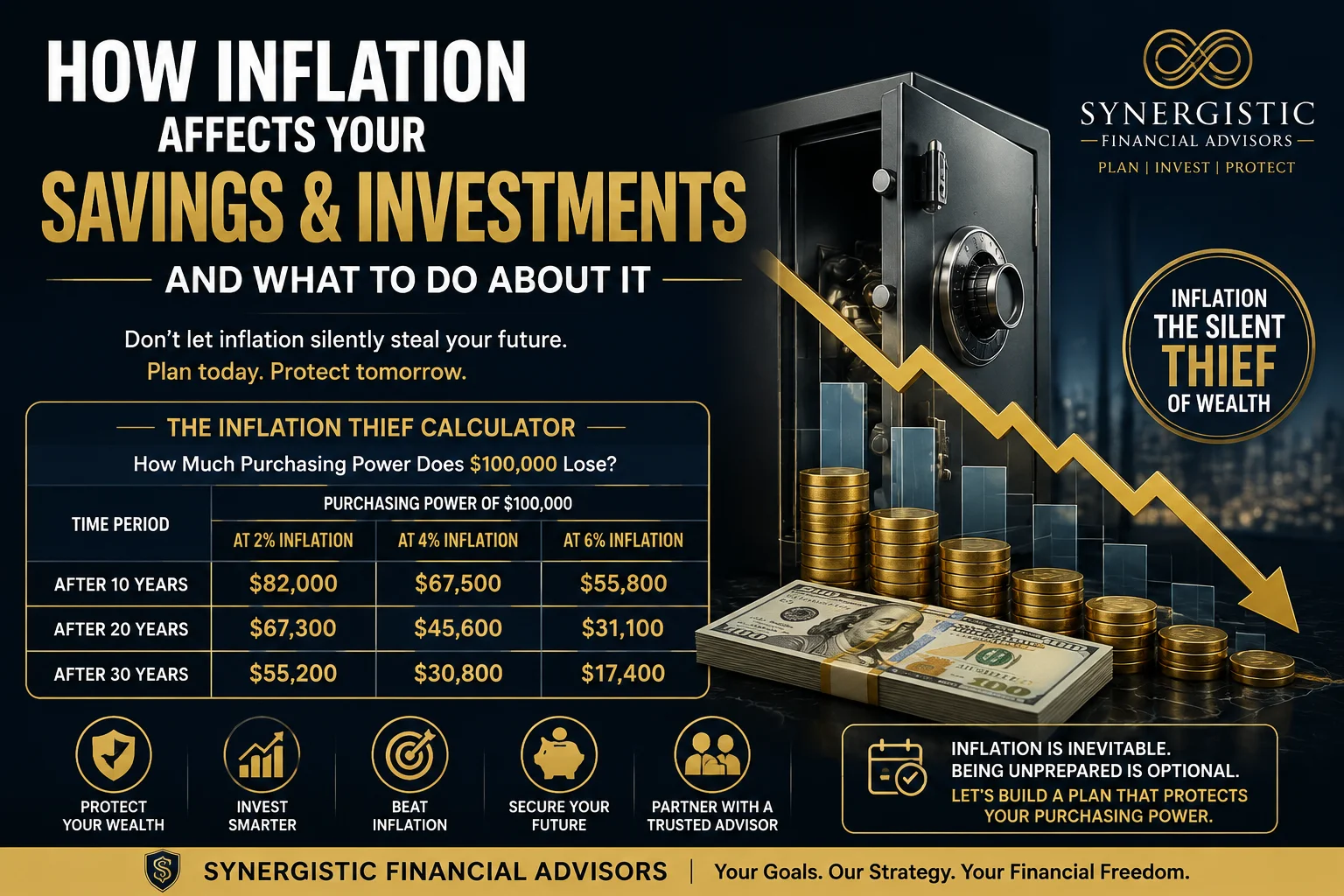
Inflation is often called the “silent thief” because it rarely takes money directly from your bank account.
Instead, it quietly reduces what your money can buy.
The $100,000 sitting safely in your savings account today may still show the same number years later, but its real purchasing power could be dramatically lower.
A retirement account, emergency fund, or investment portfolio that ignores inflation risk may leave you financially unprepared in the future.
This is why understanding how inflation affects savings is one of the most important parts of modern financial planning.
Inflation continues to influence household finances, investment decisions, and retirement strategies around the world. In 2026, consumers are still facing elevated price pressures in many economies, making protecting purchasing power a central concern for investors.
The key question is not:
“How much money do I have?”
The better question is:
“How much will my money actually be worth in the future?”
The Inflation Thief: How Much Purchasing Power Does $100,000 Lose?
Imagine you have $100,000 today.
It feels like a significant amount.
But inflation changes the equation.
If prices increase every year, your money buys fewer goods and services in the future.
The Inflation Thief Calculator
Starting amount: $100,000
| Time Period | At 2% Inflation | At 4% Inflation | At 6% Inflation |
|---|---|---|---|
| After 10 years | ~$82,000 purchasing power | ~$67,500 | ~$55,800 |
| After 20 years | ~$67,300 | ~$45,600 | ~$31,100 |
| After 30 years | ~$55,200 | ~$30,800 | ~$17,400 |
The lesson is simple:
Money that does not grow may actually shrink.
A person who keeps large amounts of cash without considering inflation risk may experience a significant decline in financial purchasing power over time.
This is why a strong wealth management strategy focuses not only on saving money but also on growing money.
What Is Inflation and Why Does It Matter?
Inflation is the increase in prices of goods and services over time.
When inflation rises:
- Groceries become more expensive
- Housing costs increase
- Healthcare expenses rise
- Retirement expenses become higher
- The value of cash declines
For example, if inflation averages 4% annually, something costing $100 today could cost approximately $324 after 30 years.
Inflation affects everyone differently depending on spending habits, income growth, and investment choices.
A professional financial advisor considers inflation when creating long-term strategies because future expenses must be calculated using realistic purchasing power.
How Inflation Affects Your Savings
Many people believe saving money automatically protects their financial future.
Saving is important.
However, saving alone may not be enough.
If your bank account earns less than the inflation rate, your money loses value in real terms.
For example:
- Savings account return: 2%
- Inflation rate: 4%
Your money grows numerically but loses purchasing power.
This is known as a negative real return.
A good financial planner helps clients understand the difference between:
- The amount shown on an account statement
- The actual future value of that money
This distinction is critical for successful financial management.
Why Cash Alone May Not Protect Your Wealth
Cash has an important role.
Everyone needs liquidity for:
- Emergency expenses
- Short-term goals
- Unexpected situations
However, keeping all wealth in cash creates inflation risk.
A balanced approach usually involves separating money into different categories:
Short-Term Money
Used for:
- Emergency funds
- Upcoming expenses
- Financial safety
Medium-Term Money
Used for:
- Major purchases
- Future opportunities
- Conservative investments
Long-Term Money
Used for:
- Retirement
- Wealth creation
- Financial independence
A qualified certified financial planner can help determine the right balance based on your goals and risk tolerance.
Inflation and Investments: The Good and the Bad
Inflation does not affect every investment equally.
Some assets struggle during inflationary periods, while others may provide better protection.
Investments That May Struggle With Inflation
Traditional Cash Holdings
Large cash balances may lose purchasing power when inflation rises.
Fixed-Rate Bonds
If inflation rises significantly, fixed payments may become less valuable.
Low-Growth Assets
Investments that fail to grow above inflation may reduce long-term wealth creation.
Inflation-Proof Investments: What Can Help Protect Wealth?
There is no investment that completely eliminates inflation risk.
However, some assets have historically helped investors maintain purchasing power.
1. Stocks and Equity Investments
Companies can often increase prices and grow earnings over time.
Long-term investors frequently use diversified stock exposure as part of their inflation protection strategy.
A disciplined investment advisor can help investors build portfolios designed for different economic environments.
2. Real Estate
Real estate is often considered an inflation-sensitive asset because property values and rental income may rise over long periods.
However, location, interest rates, and market conditions matter.
Real estate should be evaluated as part of a broader portfolio management approach.
3. Inflation-Protected Securities
Certain government securities are specifically designed to adjust with inflation.
These can provide protection for investors looking for lower-risk options.
4. Diversified Investment Portfolios
The strongest defense against inflation is often diversification.
A properly designed portfolio may include:
- Equities
- Bonds
- Real assets
- Alternative investments
- Cash reserves
The goal is not predicting inflation perfectly.
The goal is building financial resilience.
How Inflation Impacts Retirement Planning
Inflation is one of the biggest risks facing retirees.
Why?
Because retirement may last 20, 30, or even 40 years.
A retiree who needs $50,000 annually today may require significantly more in the future to maintain the same lifestyle.
This makes retirement planning impossible without considering inflation.
Common retirement inflation mistakes include:
- Underestimating future healthcare costs
- Keeping excessive cash
- Ignoring rising living expenses
- Assuming today’s lifestyle costs will remain unchanged
A strong retirement strategy considers inflation from the beginning.
What Investors Should Do About Inflation in 2026
Instead of reacting emotionally to inflation headlines, investors should focus on a long-term plan.
Here are practical steps:
1. Review Your Current Savings Strategy
Ask:
- Is my money growing faster than inflation?
- Is my emergency fund appropriate?
- Am I investing enough?
2. Increase Your Investment Contributions
Even small increases can make a major difference over decades because of compounding.
3. Review Your Asset Allocation
Your investment mix should match:
- Your goals
- Your timeline
- Your risk tolerance
4. Protect Your Income Growth
Your ability to earn more money is one of your biggest financial assets.
Higher income provides more opportunities for:
- Investing
- Saving
- Building wealth
5. Consider Tax Efficiency
Inflation reduces purchasing power, but taxes can reduce investment returns further.
Effective tax planning helps investors keep more of their wealth.
How Synergistic Financial Advisors Helps Protect Your Wealth From Inflation
Inflation management requires more than simply choosing investments.
It requires a complete strategy.
Synergistic Financial Advisors helps clients develop personalized approaches around:
- Financial planning
- Investment management
- Portfolio management
- Retirement planning
- Tax planning
- Long-term wealth management
Whether you are searching for financial advisors near me, a trusted financial consultant near me, or an experienced independent financial advisor, professional guidance can help you make better decisions during uncertain economic conditions.
Your financial future depends not only on how much you save — but how effectively you protect and grow those savings.
Connect with Synergistic Financial Advisors to create a strategy designed around your goals and future purchasing power.
The Biggest Inflation Mistake Investors Make
The biggest mistake is doing nothing.
Inflation rewards investors who plan ahead and penalizes those who ignore its impact.
A person who invests consistently, diversifies properly, and reviews their strategy regularly has a stronger chance of preserving wealth.
The goal is not simply having more dollars.
The goal is maintaining the ability to buy what matters most.
Final Thoughts
Inflation is one of the most powerful forces affecting personal wealth.
It quietly reduces savings, changes investment outcomes, and increases retirement challenges.
But inflation does not have to destroy your financial progress.
With proper financial planning, smart investment management, and a carefully designed strategy, investors can protect their purchasing power and continue building long-term wealth.
The question every investor should ask is:
“Is my money working harder than inflation?”
If the answer is no, it may be time to review your financial strategy.