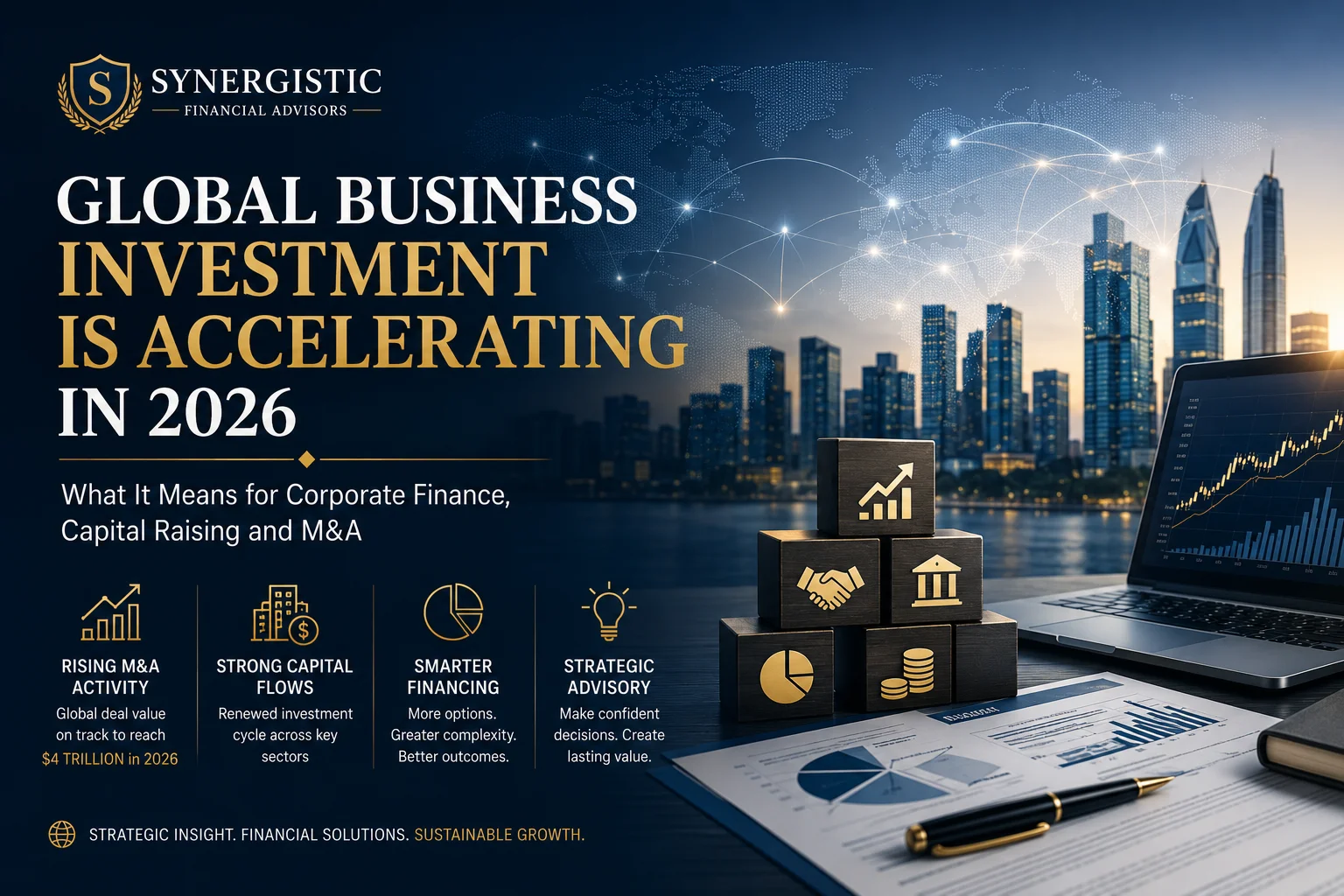
Global businesses are entering a new investment cycle — and companies that prepare their capital structure, financing strategy and valuation now could be better positioned for the opportunities ahead.
The global business environment in August 2026 is sending an important message to corporate decision-makers: capital is moving again, but the cost and structure of that capital matter more than ever.
Global M&A activity is gaining momentum, corporate investment remains strong in key sectors, private credit continues to expand, and artificial intelligence is creating enormous demand for infrastructure, energy and technology investment.
PwC’s 2026 mid-year M&A outlook says global deal value is on track to reach approximately $4 trillion in 2026, making this the strongest year for global deal value since 2021. At the same time, deal volumes remain more selective, with large transactions accounting for an increasingly significant share of overall activity.
For businesses, this creates a critical question:
Is your company financially prepared for the next investment, acquisition, refinancing or expansion opportunity?
The Global Investment Cycle Is Changing
The current business environment is being shaped by several forces at once.
Companies are investing heavily in artificial intelligence, data centres, energy infrastructure and technology. Strategic buyers are looking for growth opportunities. Private equity firms are becoming more active as exits reopen. Meanwhile, businesses are reassessing their financing structures as interest rates, geopolitical risks and long-term borrowing costs remain uncertain.
Deloitte’s 2026 corporate finance outlook describes a market characterized by renewed capital flows and stronger corporate investment, while warning that volatility continues to complicate deal financing.
This means the next phase of corporate growth may not simply be about finding capital.
It may be about finding the right capital at the right price and with the right structure.
That is where strategic corporate finance becomes increasingly important.
Why Capital Raising Is Becoming More Strategic
Businesses have traditionally viewed financing as a straightforward process: determine how much money is required and approach lenders or investors.
Today’s environment is more complicated.
A company considering expansion may have several possible financing options:
- Bilateral bank financing
- Syndicated debt
- Private credit
- Mezzanine financing
- Equity capital
- Strategic investors
- Multilateral financing
- Project finance
- Asset-backed financing
- Internal cash generation
Each option has different implications for cost, control, repayment obligations, risk and the company’s balance sheet.
For example, choosing additional debt may allow shareholders to retain ownership but increase financial obligations. Raising equity may strengthen the balance sheet but dilute existing shareholders.
The best solution therefore isn’t necessarily the financing option with the lowest headline cost.
It is the structure that best matches the company’s cash flows, risk profile, growth strategy and long-term objectives.
Private Credit Is Becoming an Important Financing Channel
Another major development is the growth of private credit.
According to EY, domestic funds accounted for 74% of India’s private-credit investment in the first half of 2026, with investments reaching approximately $3.5 billion during the period.
The broader trend matters beyond India.
Private credit can provide businesses with another potential source of financing, particularly when traditional bank lending does not perfectly match the company’s requirements.
For businesses considering acquisition financing, growth capital, refinancing or structured funding, this expanding financing ecosystem creates more choices.
But more choices also mean more complexity.
Borrowers need to evaluate pricing, covenants, security requirements, repayment structures, flexibility and potential refinancing risk before selecting a funding source.
AI Is Creating a New Corporate Financing Challenge
Artificial intelligence isn’t only transforming technology companies.
It is changing the financing requirements of entire industries.
The OECD’s 2026 Global Debt Report notes that AI investment is expected to significantly increase financing requirements across technology, energy, real estate and infrastructure. It estimates that meeting global demand for AI computing power could require approximately $5.2 trillion of investment worldwide by 2030, excluding some additional spending by cloud providers and AI developers.
That creates opportunities for companies involved in:
- Data centres
- Energy generation
- Power infrastructure
- Telecommunications
- Real estate
- Technology
- Semiconductor supply chains
- Industrial equipment
- Infrastructure development
But large-scale investment also requires careful capital planning.
Businesses need to determine how much capital they need, when they need it, how it should be financed and what return the investment needs to generate.
M&A Is Back — But Valuation Matters
The renewed M&A environment is another important development.
PwC’s latest outlook indicates that global M&A value could reach approximately $4 trillion in 2026, with megadeals contributing heavily to overall activity. The firm also highlights strong interest in areas such as power and data centres, while buyers remain more cautious in some software markets because of uncertainty surrounding technological disruption.
For companies considering acquisitions, this creates both opportunity and risk.
A transaction can accelerate growth, provide access to new markets, expand capabilities or create operational synergies.
But paying too much can destroy shareholder value.
That makes valuation services, financial modelling and due diligence essential components of an effective M&A process.
A buyer should understand:
- What the target business is actually worth.
- What strategic value it creates.
- Whether projected synergies are realistic.
- How the acquisition will be financed.
- What the combined company’s cash flows could look like.
- Whether the transaction improves long-term shareholder value.
Why Financial Modelling Matters More Than Ever
In a volatile environment, a financial model should do more than produce one projected return.
It should help management understand different possible outcomes.
For example:
Base case: What happens if growth continues as expected?
Downside case: What happens if revenue falls or financing costs increase?
Upside case: What happens if the investment produces stronger-than-expected growth?
Stress case: What happens if several negative events occur simultaneously?
This type of scenario analysis can help companies make better decisions before committing significant capital.
It can also strengthen discussions with lenders, investors and potential transaction partners.
Companies Should Reassess Their Capital Structure
The current environment is also a good reason for businesses to review their existing capital structure.
A company that raised debt several years ago may now have different financing requirements.
Management should consider:
- Current debt levels
- Maturity dates
- Interest costs
- Fixed versus floating-rate exposure
- Working-capital requirements
- Debt-service capacity
- Available borrowing capacity
- Equity requirements
- Future acquisition plans
A capital structure optimization exercise can reveal opportunities to improve financial flexibility.
In some cases, refinancing may be appropriate.
In others, a business may benefit from restructuring debt, raising additional working capital or combining multiple financing sources.
What This Means for SMEs and Large Corporations
The global investment cycle is not limited to multinational companies.
Small and medium-sized businesses can also benefit from stronger access to capital if they are properly prepared.
For an SME, financing may support:
- Capacity expansion
- New equipment
- Working capital
- Export growth
- New locations
- Technology investment
- Acquisitions
- Debt refinancing
- Business restructuring
For larger corporations, the requirements can be more complex and may involve syndicated financing, project finance, M&A, multilateral agencies or sophisticated capital-market solutions.
The underlying principle remains the same:
Capital should support strategy — not simply fill a funding gap.
What Should Business Leaders Do Now?
Companies considering expansion or major financial decisions should avoid waiting until capital is urgently required.
A stronger approach is to prepare early.
1. Review Your Financial Position
Understand your current debt, cash flow, working capital and borrowing capacity.
2. Identify Your Capital Requirements
Estimate how much funding the business may require over the next 12–36 months.
3. Build Multiple Scenarios
Model different interest rates, revenue assumptions, operating costs and investment outcomes.
4. Review Your Capital Structure
Determine whether your current combination of debt and equity remains appropriate.
5. Evaluate Financing Options
Compare bank debt, syndicated financing, private credit, equity, mezzanine financing and other potential sources.
6. Prepare for Strategic Transactions
If an acquisition or merger is being considered, begin valuation, due diligence and financial modelling before negotiations become advanced.
7. Get Independent Advice
Complex financing and M&A decisions can benefit from independent analysis rather than relying solely on the party providing the capital.
Where SFA Can Help
The current global business environment reinforces an important principle: financial decisions should be connected to the broader business strategy.
Synergistic Financial Advisors provides corporate and financial advisory support across areas including corporate finance, capital raising, debt advisory, financial modelling, valuation, M&A advisory, due diligence, working capital financing and capital structure optimization.
For companies evaluating expansion, refinancing, acquisitions or strategic restructuring, the objective should be more than simply obtaining funding.
It should be building a financial structure that supports sustainable growth.
The Bigger Picture
The global business environment in 2026 is creating a fascinating combination of opportunity and uncertainty.
M&A activity is recovering. Corporate investment is accelerating in important sectors. Private credit is expanding. AI is creating enormous infrastructure requirements. At the same time, businesses continue to face geopolitical uncertainty, elevated borrowing costs and changing market conditions.
For corporate decision-makers, this means financial strategy cannot be an afterthought.
Companies that understand their capital requirements, valuation, financing alternatives and risk exposure before making major decisions can be better prepared to act when opportunities appear.
The next major business opportunity may not arrive with months of warning.
The companies that are financially prepared today may be the ones capable of moving fastest tomorrow.