The outlook for U.S. interest rates has shifted again.
After months of investors debating whether persistent inflation could force the Federal Reserve to raise rates further in 2026, weaker economic data is making another immediate rate increase look less certain.
On August 17, global markets moved higher as investors reduced expectations for a near-term Federal Reserve rate hike following softer U.S. economic indicators. Recent weakness in retail sales and consumer sentiment has added another complication to the Fed’s balancing act between controlling inflation and maintaining economic stability.
For investors, this matters far beyond the next Federal Reserve meeting.
Interest rates influence almost every part of the financial system — from stocks and bonds to savings accounts, mortgages, business financing, retirement portfolios and investment valuations.
So what could changing Federal Reserve expectations mean for your money?
And more importantly, should investors change their portfolios?
Let’s examine what is happening and what investors should consider during the remainder of 2026.
What Is Happening With Interest Rates in August 2026?
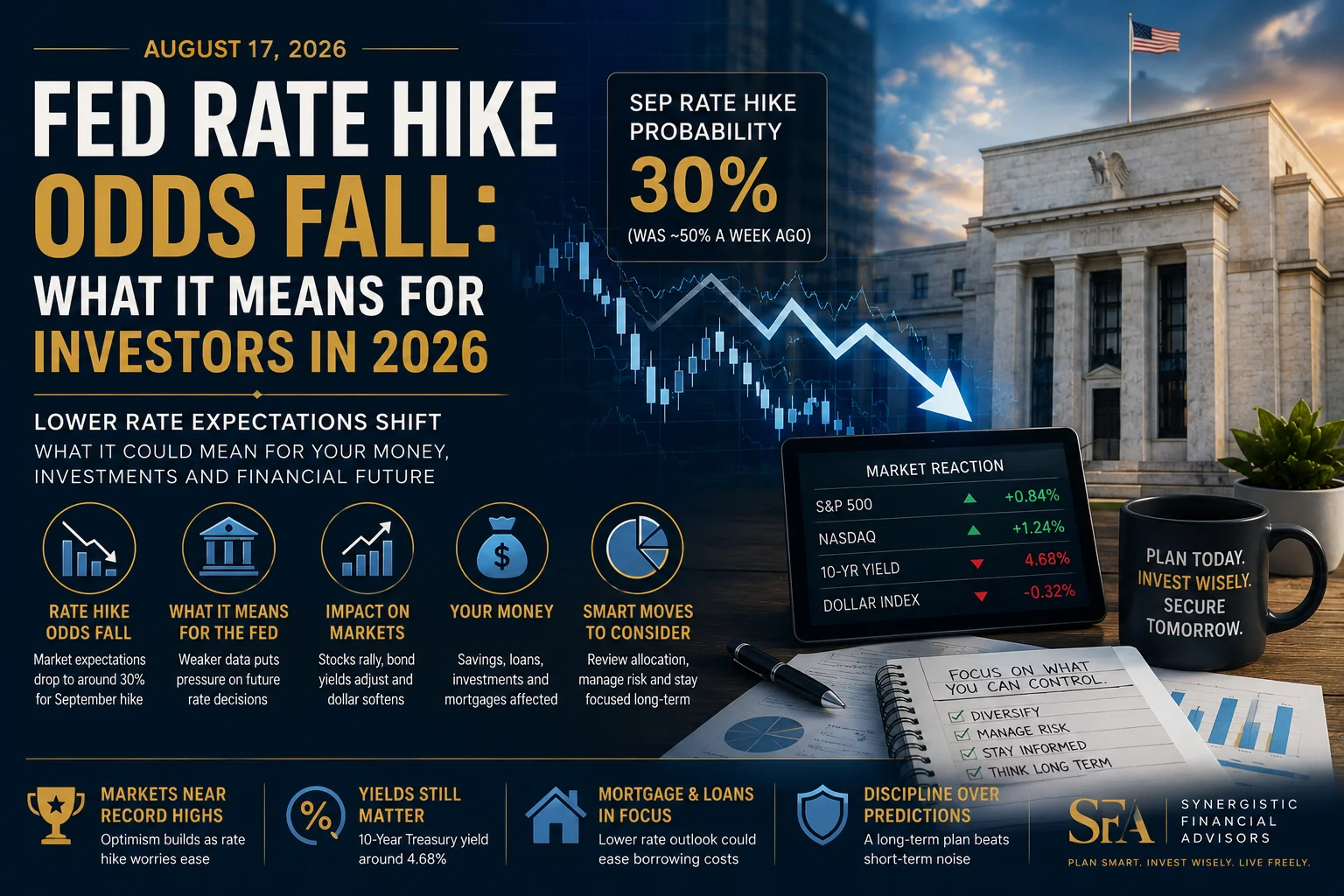
The Federal Reserve has maintained its benchmark federal funds target range at 3.50%–3.75%, while policymakers continue evaluating inflation, employment and broader economic conditions.
Inflation remains an important concern.
But economic growth and consumer activity matter as well.
Recent weaker economic indicators have reduced market expectations that the Federal Reserve will immediately tighten monetary policy again.
On August 17, Reuters reported that traders had reduced the probability of a rate increase at the next meeting to around 30%, compared with approximately 50% a week earlier.
That is a significant shift in expectations within a relatively short period.
It does not mean interest rates are guaranteed to remain unchanged.
It means financial markets are recalculating the probability of different outcomes as new economic information becomes available.
Why Did Expectations Change?
Several economic forces are pulling policymakers in different directions.
Inflation Has Not Completely Disappeared
Inflation remains above the Federal Reserve’s long-term 2% objective.
That makes policymakers cautious about allowing financial conditions to become too loose.
If inflation accelerates again, additional monetary tightening could remain possible.
Consumer Spending Is Showing Signs of Weakness
Consumer spending represents a major component of the U.S. economy.
Weak retail-sales figures can therefore indicate that households are becoming more cautious.
Consumers may be responding to:
- Higher borrowing costs
- Elevated living expenses
- Credit-card debt
- Housing costs
- Economic uncertainty
If consumer demand weakens substantially, companies can experience slower revenue growth.
The Labor Market Is Also Important
Employment conditions are another major consideration for monetary policy.
A cooling labor market could make aggressive monetary tightening increasingly difficult to justify, particularly if economic activity begins slowing at the same time.
The Fed therefore faces a complicated trade-off.
Keep rates too high for too long, and economic growth could weaken further.
Ease too quickly, and inflation could reaccelerate.
That tension is likely to remain one of the most important themes for investors during the remainder of 2026.
What Does This Mean for the Stock Market?
Stocks often respond positively when expectations for higher interest rates decline.
There are several reasons.
Interest rates affect the discount rate investors use when valuing companies’ future earnings.
When expected rates decline, those future earnings can become more valuable in today’s dollars.
Lower borrowing costs can also eventually benefit companies that rely on financing to expand operations, purchase equipment, acquire competitors or refinance existing debt.
But there is an important catch.
Lower Rate Expectations Are Not Always Good News
Investors need to understand why interest-rate expectations are declining.
There is a major difference between:
Scenario A: Inflation falls while economic growth remains healthy.
and
Scenario B: Interest rates stay lower because the economy is deteriorating.
The first scenario can be supportive for financial markets.
The second can create significant challenges for corporate earnings.
This is why professional investment management cannot simply follow the rule:
Lower rates = buy stocks.
The economic context matters.
Stocks Are Already Near Record Highs
The interest-rate debate is occurring while U.S. equity markets are already trading near record levels.
The S&P 500 recently reached another record closing high, reflecting substantial investor optimism.
That creates an interesting situation.
Investors may benefit if economic growth remains resilient and rate pressures ease.
But elevated valuations can also make markets more sensitive to disappointing economic or earnings data.
When markets have already priced in substantial optimism, even good news may not always produce significant additional gains.
Investors therefore need to distinguish between:
A good company
and
a good investment at the current price.
Valuation still matters.
What Falling Rate Expectations Mean for Bonds
Changing interest-rate expectations can have an important effect on fixed-income investments.
Bond prices and yields generally move in opposite directions.
When market interest rates decline, existing bonds paying relatively attractive fixed rates can become more valuable.
When rates rise, older lower-yielding bonds may become less attractive.
However, different bonds respond differently.
Short-Term Bonds
Short-duration bonds generally have less sensitivity to changing interest rates.
Long-Term Bonds
Long-duration bonds can experience significantly larger price movements when market rates change.
Corporate Bonds
Corporate bonds introduce another variable: credit risk.
If the economy weakens significantly, lower interest rates do not necessarily eliminate the possibility that financially vulnerable companies could struggle with debt obligations.
A diversified bond strategy should therefore consider both interest-rate risk and credit risk.
Treasury Yields Remain Important
The U.S. Treasury market provides another important signal.
As of August 14, the 10-year Treasury yield finished around 4.68%, while the 2-year Treasury yield was approximately 4.17%.
Those yields matter because Treasury rates influence financing conditions throughout the economy.
They affect:
- Mortgage rates
- Corporate borrowing
- Business valuations
- Bond markets
- Equity valuations
- Consumer credit
For investors, monitoring Treasury yields can sometimes provide more useful information than focusing exclusively on the Federal Reserve’s headline policy rate.
What Does This Mean for Savings Accounts?
Higher interest rates have created an unusual benefit for conservative savers.
Cash can actually earn meaningful interest again.
As of August 17, some competitive high-yield savings accounts were offering yields approaching 4%–4.5%, although rates vary by institution and account requirements.
That can make cash attractive for:
- Emergency funds
- Short-term expenses
- Upcoming home purchases
- Near-term tuition
- Other financial obligations
But investors should distinguish between short-term savings and long-term investing.
Cash can provide stability.
It does not necessarily provide sufficient long-term growth to fund retirement or other multi-decade financial goals.
If interest rates eventually decline, savings-account yields could also move lower.
Should You Lock In Higher Bond Yields?
This is becoming an increasingly relevant question.
If an investor expects interest rates to decline eventually, today’s bond yields may look attractive.
But attempting to perfectly predict the peak in interest rates is extremely difficult.
A more disciplined approach may involve evaluating bond exposure according to:
- Investment horizon
- Income requirements
- Risk tolerance
- Portfolio allocation
- Liquidity requirements
- Tax circumstances
Some investors may use a bond ladder, where bonds mature at different dates.
Others may use diversified bond funds.
The appropriate strategy depends on the investor’s overall financial position.
What Does the Changing Rate Outlook Mean for Mortgages?
Interest-rate expectations also matter for housing.
Mortgage rates are not determined directly by the federal funds rate, but they are influenced by broader bond-market conditions, particularly longer-term Treasury yields.
If long-term yields decline, mortgage rates may eventually receive some relief.
That could improve affordability for certain homebuyers.
However, potential buyers should be cautious about trying to perfectly time mortgage rates.
Waiting indefinitely for a dramatically lower rate can create other risks if:
- Home prices increase
- Personal circumstances change
- Housing inventory becomes tighter
- Rates remain elevated longer than expected
Housing decisions should therefore be evaluated within a broader financial planning framework.
What Lower Rates Could Mean for Growth Stocks
Growth-oriented companies can be particularly sensitive to interest rates.
Many growth businesses are valued based on earnings expected several years into the future.
Higher discount rates reduce the present value of those distant cash flows.
Lower rates can have the opposite effect.
This partly explains why technology and other growth-oriented sectors can sometimes respond strongly when bond yields decline.
But investors should not assume every growth stock automatically becomes attractive when rates fall.
Business fundamentals remain essential.
Investors should still evaluate:
- Revenue growth
- Profitability
- Cash flow
- Competitive advantages
- Debt
- Valuation
Interest rates are one variable — not the entire investment thesis.
What About Dividend Stocks?
Dividend-paying companies may also become more interesting when interest rates decline.
When safe fixed-income yields are extremely high, income-focused investors may have less incentive to accept equity risk simply to receive dividends.
If bond yields decline, high-quality dividend-paying companies may become relatively more attractive.
However, dividend yield alone should never determine an investment decision.
An unusually high dividend yield can sometimes indicate financial stress or expectations that the dividend may eventually be reduced.
Quality and sustainability matter.
What Could Lower Rates Mean for Real Estate?
Real estate is another interest-rate-sensitive asset class.
Higher financing costs can pressure:
- Residential property
- Commercial real estate
- Real estate investment trusts (REITs)
- Property developers
If borrowing costs eventually decline, some of that pressure could ease.
REITs may also become relatively more attractive to income investors if competing bond yields move lower.
But real estate sectors behave very differently.
Data centers, warehouses, apartments, offices, hotels and retail properties each face different economic conditions.
Broad statements such as “lower rates are good for real estate” therefore oversimplify the investment landscape.
The Biggest Question: Are We Heading Toward a Soft Landing or Stagflation?
One of the most important questions facing investors is not simply whether the Fed raises or lowers rates.
It is what happens to growth and inflation simultaneously.
Soft-Landing Scenario
Inflation gradually declines while economic growth remains positive.
This could provide a relatively constructive environment for diversified investors.
Economic Slowdown
Growth deteriorates significantly and corporate profits weaken.
The Fed may eventually respond with easier policy, but markets could experience volatility first.
Persistent Inflation
Inflation remains elevated despite weaker growth.
This is particularly challenging because policymakers have less flexibility.
Stagflation
Weak economic growth combined with persistent inflation can create one of the more difficult environments for both policymakers and investors.
Rather than betting everything on one scenario, investors should consider building portfolios capable of functioning across several possible outcomes.
What Should Investors Do Now?
Changing interest-rate expectations do not necessarily require dramatic portfolio changes.
Instead, this is a good time to review several fundamentals.
1. Review Your Asset Allocation
Ask whether your current mix of:
- Stocks
- Bonds
- Cash
- Real estate
- Other investments
still reflects your financial goals.
Market gains can gradually cause portfolios to become more concentrated in equities than originally intended.
2. Check Your Cash Position
High savings yields make cash attractive.
But holding excessive cash can create long-term opportunity costs, particularly if rates eventually decline.
Separate money needed soon from money intended for long-term growth.
3. Review Bond Duration
Understand how sensitive your fixed-income holdings are to interest-rate changes.
Do not simply assume all bonds behave the same way.
4. Rebalance if Necessary
Strong equity-market performance can cause asset allocations to drift.
Periodic rebalancing can restore the portfolio to its intended risk level.
5. Avoid Chasing Headlines
Markets frequently move before individual investors have time to react.
By the time a headline says rate expectations have changed, professional markets may already have incorporated much of that information into asset prices.
6. Keep Your Long-Term Objectives in Focus
Someone investing for retirement 25 years from now should approach today’s interest-rate uncertainty differently from someone retiring next year.
Investment decisions should reflect your timeline.
What Should Retirees Consider?
Interest-rate changes are particularly important for retirees.
Many retirees depend on a combination of:
- Social Security
- Pension income
- Bonds
- Investment withdrawals
- Cash reserves
- Dividend income
Higher yields have created attractive income opportunities in recent years.
If rates eventually decline, retirees may face lower yields when bonds mature or savings products reset.
That creates reinvestment risk.
At the same time, moving aggressively into long-duration investments simply to lock in yields can introduce greater price volatility.
Retirement portfolios therefore require careful coordination between income, liquidity and growth.
A professional financial advisor can help evaluate these competing objectives.
Why Diversification Matters More Than Predicting the Fed
Investors spend enormous amounts of time trying to predict Federal Reserve decisions.
Will rates rise?
Will they fall?
When will the Fed move?
How many times?
Those questions matter.
But consistently predicting monetary policy — and then correctly predicting how markets will respond — is extraordinarily difficult.
A diversified portfolio reduces the need to get every macroeconomic prediction exactly right.
Different investments respond differently to changing conditions.
Stocks may provide long-term growth.
Bonds may provide income and diversification.
Cash provides liquidity.
Other assets may behave differently depending on inflation and economic growth.
The objective of portfolio management is not to perfectly predict the future.
It is to construct a portfolio capable of navigating an uncertain future.
When Should You Speak With a Financial Advisor?
Periods of changing interest rates can expose weaknesses in financial plans.
Consider reviewing your strategy if:
- You are approaching retirement
- A large portion of your wealth is sitting in cash
- Your portfolio is heavily concentrated
- You own substantial long-duration bonds
- You are unsure how much investment risk you are taking
- You recently received an inheritance
- You sold a business or property
- Your financial goals have changed
A qualified financial advisor or investment advisor can help evaluate how monetary policy fits into the larger picture.
Good advice should not simply answer:
“What will the Fed do next?”
It should answer:
“What should my financial strategy look like regardless of exactly what the Fed does next?”
What Investors Should Watch Next
Several developments could shape markets during the coming weeks.
Federal Reserve Meeting Minutes
Minutes from the Federal Reserve’s July meeting are expected to provide more insight into how policymakers are balancing inflation risks against signs of softer economic activity.
Investors will pay close attention to differences of opinion among policymakers.
Inflation
Future CPI and other inflation readings will remain critical.
A renewed acceleration could bring rate-hike expectations back quickly.
Employment
A significantly weaker labor market could shift the conversation from inflation toward economic growth.
Consumer Spending
Retail sales and corporate earnings from major retailers can reveal whether households are becoming more cautious.
Treasury Yields
Bond-market movements will continue influencing borrowing costs and valuations across financial assets.
These indicators should be evaluated together rather than individually.
Frequently Asked Questions
Will the Federal Reserve raise interest rates again in 2026?
Another increase remains possible, but market expectations can change quickly as new inflation, employment and economic-growth data arrive. Investors should avoid treating current market probabilities as guarantees.
What happens to stocks when interest rates fall?
Lower rates can support stock valuations by reducing discount rates and financing costs. However, stocks may still decline if rates are falling because economic growth and corporate earnings are deteriorating.
Are bonds a good investment when interest rates are high?
Higher yields can make bonds more attractive, but suitability depends on duration, credit quality, investment objectives and the investor’s overall portfolio.
Should I keep my money in a high-yield savings account?
High-yield savings accounts can be appropriate for emergency reserves and near-term financial needs. Money intended for long-term goals may require a different investment strategy depending on risk tolerance and objectives.
Should I buy stocks before the Fed cuts rates?
Trying to precisely time stocks around Federal Reserve decisions is difficult. Long-term investors may benefit more from maintaining an appropriate diversified portfolio than attempting to trade individual policy decisions.
How do interest rates affect retirement planning?
Interest rates affect bond income, savings yields, investment valuations, borrowing costs and retirement withdrawal strategies. Retirees and people approaching retirement should consider these factors when constructing their portfolios.
Can a financial advisor help during changing interest rates?
A financial advisor can evaluate asset allocation, bond exposure, cash reserves, investment risk, retirement income and other financial decisions within a coordinated long-term strategy.
Final Thoughts: Don’t Build Your Portfolio Around One Fed Decision
The latest shift in interest-rate expectations illustrates how quickly financial markets can change.
Only recently, investors were increasingly concerned that persistent inflation could lead to additional monetary tightening.
Now weaker economic indicators have reduced expectations for an immediate rate increase.
Those expectations could change again with the next inflation report, employment release or Federal Reserve communication.
Investors therefore face a choice.
They can attempt to predict every move.
Or they can build a financial strategy designed to withstand uncertainty.
For most long-term investors, the second approach is more sustainable.
At Synergistic Financial Advisors (SFA), we believe effective financial planning, investment management and portfolio management should be built around individual goals rather than short-term market predictions.
Interest rates will change.
Markets will change.
Economic forecasts will change.
A disciplined financial strategy should be designed with that reality in mind.