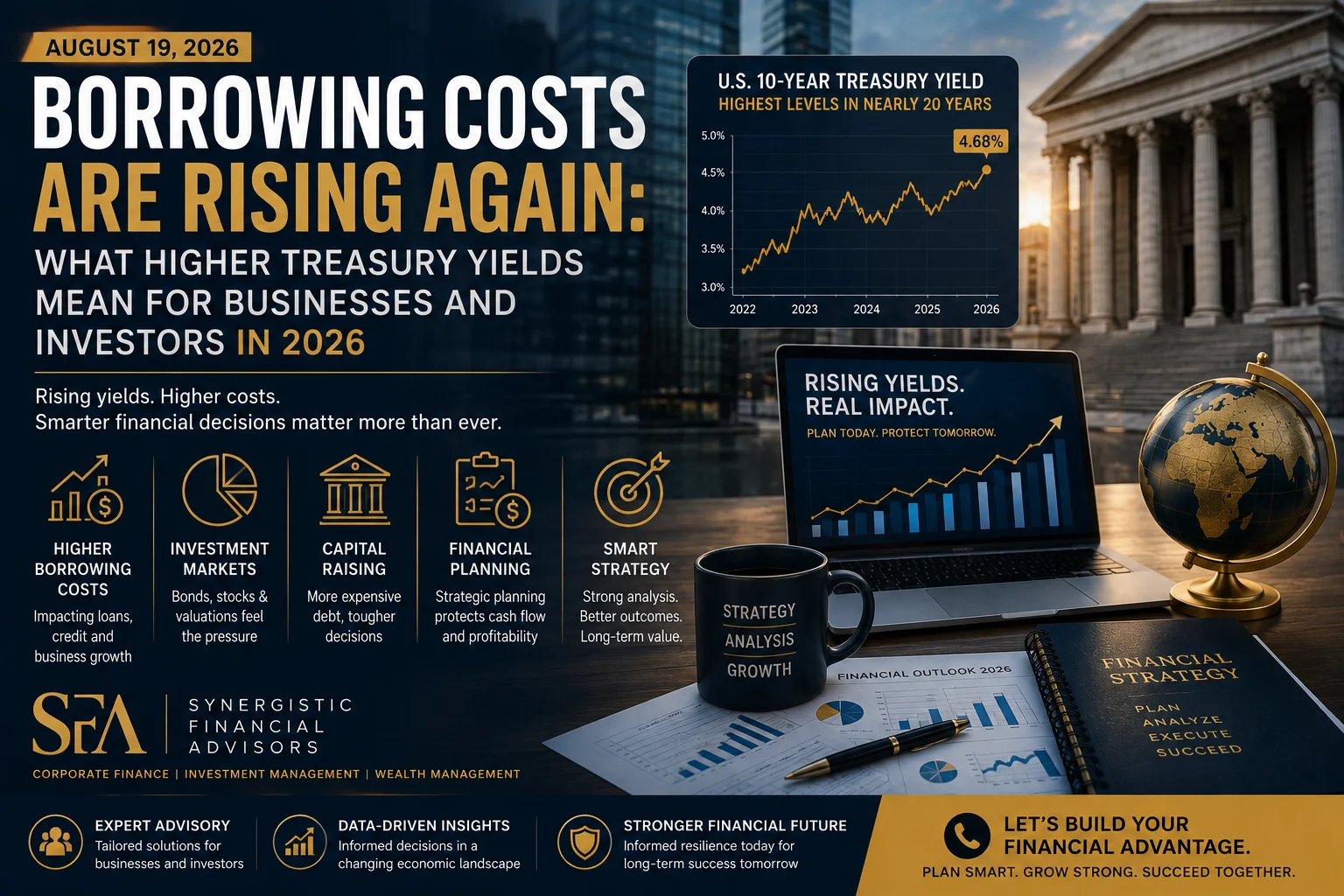
The cost of money is becoming one of the biggest financial stories of 2026.
Long-term government bond yields have climbed sharply across major economies, increasing borrowing costs for governments, businesses and consumers. In the United States, long-term Treasury yields have recently reached levels not seen in nearly two decades.
For businesses, this is more than a bond-market story.
Higher yields can affect the cost of raising capital, refinancing corporate debt, funding acquisitions, investing in new projects and valuing companies.
For investors, rising yields can influence stocks, bonds, real estate and portfolio allocations.
And for business owners, CFOs and corporate decision-makers, the message is becoming increasingly important:
Capital is no longer cheap.
Understanding how to finance growth efficiently in a higher-cost environment is therefore becoming a critical part of corporate finance and financial management in 2026.
Why Are Borrowing Costs Rising?
Government bond yields are influenced by several factors, including:
- Inflation expectations
- Economic growth
- Central-bank policy
- Government borrowing
- Investor demand for bonds
- Fiscal deficits
- Global capital flows
In August 2026, investors have become increasingly concerned about the enormous amount of government debt that major economies need to finance.
When governments issue more debt, they must find investors willing to purchase it.
If investors demand greater compensation for lending money over long periods, yields rise.
The result can spread throughout the financial system.
U.S. Treasury securities are particularly important because Treasury yields serve as benchmarks for many other borrowing rates.
That means a rise in Treasury yields can ultimately affect everything from corporate loans to mortgages.
Why Higher Treasury Yields Matter for Businesses
Imagine a company wants to borrow $100 million to build a new manufacturing facility.
The economics of that project may look attractive when financing costs are 4%.
But if the company’s borrowing cost rises to 6% or 7%, the calculation changes.
Interest expense increases.
The project needs to generate greater returns to justify the investment.
Management may decide to:
- Reduce the size of the project
- Delay the investment
- Raise equity instead
- Seek another financing structure
- Cancel the project altogether
Multiply that decision across thousands of companies and higher interest rates can influence overall business investment.
This is why corporate finance decisions become especially important when borrowing costs rise.
The Cost of Capital Is Increasing
Every business effectively has a cost of capital.
Companies generally finance themselves through some combination of:
Debt + Equity
Debt has a cost because lenders require interest.
Equity also has a cost because shareholders expect a return for taking investment risk.
Financial professionals often combine these factors into a company’s weighted average cost of capital (WACC).
When interest rates rise, the cost of debt usually increases.
Higher risk-free rates can also increase the return investors demand from equities.
That means the company’s overall cost of capital can rise.
This has significant implications.
A project that previously generated an attractive return may no longer create sufficient value.
For example:
Suppose a proposed investment is expected to generate an 8% return.
If the company’s cost of capital is 6%, the investment may appear attractive.
But if financing conditions push the cost of capital toward 9%, the same project may destroy rather than create shareholder value.
This is why sophisticated financial modelling becomes particularly important during periods of changing interest rates.
Refinancing Risk Is Becoming More Important
Not every company needs to borrow new money.
But many companies already have debt.
Eventually, that debt matures.
When it does, businesses often refinance.
Suppose a company issued debt several years ago at 3.5%.
If that debt matures in 2026 or 2027 and replacement financing costs 6.5%, interest expense could increase substantially.
That can affect:
- Net income
- Free cash flow
- Dividend capacity
- Capital expenditure
- Hiring
- Acquisition budgets
- Credit ratings
Companies with significant debt maturities therefore need to understand their refinancing risk.
This is particularly important for businesses that relied heavily on inexpensive financing during previous low-interest-rate periods.
What Higher Borrowing Costs Mean for Small and Mid-Sized Businesses
Large public corporations can often access multiple sources of capital.
Smaller businesses may have fewer options.
A privately owned company may depend heavily on:
- Bank loans
- Business credit lines
- Equipment financing
- Commercial mortgages
- Owner capital
Higher interest rates can therefore have an immediate impact on cash flow.
Consider a business borrowing $2 million.
At a 4% interest rate, annual interest would be approximately:
$80,000
At 7%:
$140,000
That is an additional:
$60,000 per year
before considering principal repayment or other financing costs.
For a smaller business, that difference can materially affect profitability.
Capital Raising Is Becoming More Strategic
When debt becomes expensive, companies often reconsider how they raise capital.
Businesses generally have several options.
Bank Financing
Traditional loans may remain appropriate when the company has predictable cash flows and sufficient debt capacity.
Corporate Debt
Larger businesses may access bond markets or private credit.
But higher benchmark yields can increase borrowing costs.
Equity Capital
Companies can issue equity rather than take on additional debt.
However, equity financing dilutes existing shareholders.
Private Capital
Private equity, private credit and strategic investors can provide alternative funding structures.
Internal Cash Flow
Some businesses may delay investments until they can finance projects using retained earnings.
There is no universally superior solution.
The correct structure depends on:
- Cash flow
- Leverage
- Business risk
- Growth expectations
- Ownership objectives
- Market conditions
- Cost of capital
A professional financial consultant or corporate finance advisor can help businesses compare these alternatives before committing to long-term financing.
Higher Rates Can Change Business Valuations
Interest rates also influence company valuations.
Many valuation methodologies estimate the present value of future cash flows.
The basic concept is straightforward:
Money expected years in the future is worth less today than money available immediately.
The discount rate determines how much less.
When discount rates increase, the present value of future cash flows generally declines.
That means rising interest rates can reduce theoretical business valuations even when the underlying company’s operations have not changed dramatically.
This can affect:
- Mergers and acquisitions
- Business sales
- Private-company valuations
- Startup fundraising
- Public-equity valuations
- Investment decisions
Businesses considering a transaction should therefore update their valuation assumptions as market conditions change.
Using an outdated discount rate in a financial model can produce misleading results.
What Higher Rates Mean for Mergers and Acquisitions
M&A transactions are often financed partly with debt.
When financing becomes more expensive, buyers may be less willing to pay aggressive valuations.
Consider a private-equity buyer evaluating an acquisition.
If the buyer can finance the transaction cheaply, leverage can help generate attractive equity returns.
If borrowing costs rise significantly, the same purchase price may no longer generate the required return.
The buyer may therefore:
- Offer a lower valuation
- Use less debt
- Require more equity
- Change the deal structure
- Abandon the acquisition
This can create a valuation gap between buyers and sellers.
Sellers may still expect valuations based on previous market conditions while buyers calculate value using today’s financing costs.
Strong corporate finance advisory can help businesses navigate this gap.
AI Investment Is Making the Capital Question Even Bigger
One of the largest corporate investment themes of the current market is artificial intelligence.
Companies are spending enormous amounts on:
- Data centers
- Semiconductors
- Cloud infrastructure
- Power generation
- Networking equipment
- AI research
- Software infrastructure
Many of these investments require substantial capital.
When borrowing costs increase, companies need to become even more selective about whether expected AI-related returns justify the financing required.
This does not necessarily mean AI investment will stop.
But investors and corporate decision-makers increasingly need to ask:
How much capital is being invested?
How is that investment being financed?
When will it generate cash flow?
What return will it generate relative to the company’s cost of capital?
These are classic financial analysis questions.
Higher Treasury Yields Also Affect Investors
Businesses are not the only ones affected.
Higher government-bond yields change the opportunity set available to investors.
If relatively low-risk government securities offer attractive yields, investors may demand greater expected returns before accepting the additional risk of equities.
That can influence stock valuations.
Investors effectively compare opportunities.
Why accept substantial business risk for a modest expected return when government bonds offer increasingly competitive yields?
This doesn’t mean investors should abandon equities.
Stocks and bonds serve different purposes.
But the relative attractiveness of different asset classes changes as yields change.
Why Growth Stocks Can Be Particularly Sensitive
Growth companies often derive a large portion of their valuation from profits expected many years in the future.
Those distant cash flows are particularly sensitive to discount rates.
When yields rise, their present value can decline.
This is one reason technology and other growth-oriented stocks can experience pressure when long-term bond yields rise sharply.
However, interest rates are only one variable.
A company with extraordinary revenue growth, profitability and competitive advantages may continue performing well even in a higher-rate environment.
Investors should therefore evaluate:
Growth + profitability + valuation + financial strength
rather than making decisions based solely on interest rates.
What Higher Yields Mean for Bonds
Higher yields create both pain and opportunity for bond investors.
When yields rise, prices of existing fixed-rate bonds generally fall.
That can produce losses for investors holding longer-duration bonds.
However, new investors can potentially purchase bonds at higher yields.
This creates an interesting transition.
Existing bond portfolios may experience price pressure.
But future expected income from newly purchased bonds may become more attractive.
Professional portfolio management therefore considers:
- Bond duration
- Credit quality
- Yield
- Maturity
- Liquidity
- Interest-rate sensitivity
rather than treating all bonds as interchangeable.
What Higher Rates Mean for Real Estate
Real estate is another highly interest-rate-sensitive sector.
Property investors frequently use debt.
When financing becomes more expensive, monthly debt-service requirements increase.
At the same time, higher bond yields may cause investors to demand higher returns from real estate.
That can put pressure on property valuations.
Commercial real estate can be particularly sensitive when loans mature and need to be refinanced.
A property financed years ago at a low rate may face substantially higher financing costs today.
Investors should therefore evaluate both the property itself and its financing structure.
What Higher Borrowing Costs Mean for Business Owners
For business owners, the current environment should trigger several important questions.
1. When Does Our Existing Debt Mature?
Companies should understand their refinancing calendar well before debt becomes due.
Waiting until the maturity date can reduce financing flexibility.
2. How Much Variable-Rate Debt Do We Have?
Variable-rate borrowing can become more expensive when benchmark rates increase.
Management should understand how additional rate increases would affect cash flow.
3. What Is Our Current Cost of Capital?
Investment decisions based on old financing assumptions may no longer be appropriate.
4. Which Projects Still Create Value?
Businesses should stress-test capital expenditure under different financing scenarios.
5. Do We Need to Raise Capital?
If significant investment is required over the next several years, management should evaluate financing options before liquidity becomes urgent.
These questions belong at the center of modern financial management.
Financial Modelling Becomes More Important When Rates Are Uncertain
When capital is inexpensive and financial conditions are stable, businesses can sometimes survive imperfect forecasts.
That becomes more difficult when borrowing costs are volatile.
A good financial model should test multiple scenarios.
For example:
| Scenario | Borrowing Cost | Revenue Growth | Business Impact |
|---|---|---|---|
| Optimistic | 5% | 10% | Strong cash-flow coverage |
| Base Case | 6.5% | 6% | Manageable financing |
| Stress Case | 8% | 2% | Pressure on cash flow |
| Downside | 9% | -3% | Potential financing challenge |
This allows management to understand how much financial flexibility the business actually has.
Professional financial modelling should therefore not simply predict one future.
It should help decision-makers understand several possible futures.
What CFOs Should Consider in the Second Half of 2026
The current environment makes several corporate-finance priorities particularly important.
Review Debt Maturities
Map all upcoming debt repayments and refinancing requirements.
Stress-Test Interest Expense
Calculate how cash flow changes if borrowing costs remain elevated or increase further.
Protect Liquidity
Businesses should understand how much cash and available credit they need under different operating scenarios.
Reevaluate Capital Expenditure
Projects should be measured against today’s cost of capital rather than historical borrowing costs.
Review Business Valuations
Companies considering acquisitions, fundraising or a sale should update valuation assumptions.
Explore Alternative Capital
Traditional bank debt is not the only financing option.
Improve Financial Forecasting
Management should have reliable forecasts for revenue, margins, cash flow and financing requirements.
These are precisely the areas where experienced financial advisory can create substantial value.
What Should Long-Term Investors Do?
Investors face a similar challenge.
The goal should not be to predict the exact peak in Treasury yields.
Instead, review whether your investment portfolio remains aligned with your objectives.
Ask:
- Am I overly concentrated in growth stocks?
- Is my bond portfolio taking excessive duration risk?
- Does my asset allocation still match my goals?
- Am I holding too much cash?
- Does my portfolio generate sufficient diversification?
- Have market movements changed my risk exposure?
A disciplined investment management strategy can respond to changing financial conditions without turning every market movement into a trading decision.
Financial Planning Is About More Than Interest Rates
Interest rates receive enormous attention because they affect so many financial decisions.
But they are only one component of a complete financial strategy.
Individuals and businesses should consider:
- Cash flow
- Taxes
- Investment objectives
- Debt
- Liquidity
- Retirement goals
- Business growth
- Risk management
- Estate planning
- Capital requirements
A qualified financial advisor or financial planner can help connect these pieces rather than evaluating each decision independently.
For companies, experienced financial consultants can provide financial modelling, valuation analysis, capital-raising support and strategic financial advice.
Why Businesses Should Not Simply Wait for Rates to Fall
It can be tempting for companies to postpone every major financing decision until borrowing costs decline.
That may not always be practical.
Nobody knows exactly where long-term interest rates will be six months or two years from now.
Rates could fall.
They could remain elevated.
They could rise further.
The better approach is to determine whether a business decision creates value under realistic financing assumptions.
If an investment only works under the assumption that borrowing costs will quickly return to extremely low levels, management should understand that risk before proceeding.
Financial strategy should be built around resilience rather than a single interest-rate forecast.
Frequently Asked Questions
Why are Treasury yields rising in 2026?
Long-term yields are being influenced by factors including government borrowing requirements, inflation concerns, economic growth and investor demand for government debt.
How do higher Treasury yields affect businesses?
Treasury yields influence broader borrowing costs. Higher yields can make corporate loans and bonds more expensive, increase refinancing costs and raise the hurdle rate for new business investment.
What is the cost of capital?
The cost of capital represents the return required by the providers of debt and equity financing. Businesses use it when evaluating investments and company valuations.
How do higher interest rates affect company valuations?
Higher discount rates generally reduce the present value of future cash flows, which can put downward pressure on valuations, all else being equal.
Should businesses borrow when interest rates are high?
It depends on the company’s cash flow, financial position, investment opportunity and expected return. Borrowing can still make sense if the project generates sufficient value relative to financing costs and risks.
How can financial modelling help businesses?
Financial modelling allows businesses to forecast cash flow, evaluate investments, test financing alternatives and stress-test performance under different economic assumptions.
What does a corporate finance advisor do?
A corporate finance advisor can assist businesses with areas such as capital raising, valuations, financial modelling, financing structures, restructuring, acquisitions and strategic financial decisions.
How do higher bond yields affect investors?
Higher yields can pressure existing bond prices and certain equity valuations, but they can also provide investors with more attractive income opportunities from newly issued fixed-income securities.
Should I speak with a financial advisor when interest rates change?
A financial advisor can help determine whether changes in rates materially affect your asset allocation, borrowing decisions, retirement strategy or broader financial plan.
Final Thoughts: The Era of Cheap Capital Has Changed
Rising long-term bond yields are sending an important message to companies and investors.
Capital has a price.
And that price matters.
For businesses, higher financing costs can change whether an acquisition, expansion, property purchase or investment project creates value.
For investors, higher yields can change the relative attractiveness of stocks, bonds, cash and other assets.
The answer is not necessarily to stop borrowing or stop investing.
It is to make better financial decisions.
Businesses need stronger forecasting.
They need realistic valuations.
They need to understand refinancing risk.
They need to compare financing alternatives.
And they need to ensure new investments generate returns that justify today’s cost of capital.
At Synergistic Financial Advisors (SFA), our approach to corporate finance, financial advisory, financial modelling, portfolio management and investment management focuses on helping businesses and investors make informed decisions based on financial analysis rather than short-term assumptions.
When capital becomes more expensive, financial discipline becomes more valuable.