Most people approach retirement planning the same way they approach buying a house — they focus intensely on one big number, assume the rest will work itself out, and then discover years later that the details they ignored were the ones that mattered most.
A global survey of 2,700 financial advisors across 16 countries identified the most common mistakes people make when preparing for retirement — and almost every one of them comes down not to a lack of savings, but to a lack of comprehensive financial planning around what those savings actually need to do.
In 2026 — with CPI at 4.2%, a new Federal Reserve Chair eliminating forward guidance, markets at record highs, new SECURE 2.0 rules reshaping contribution strategies, and a generation of near-retirees carrying more financial complexity than any previous generation — the cost of retirement planning mistakes has never been higher.
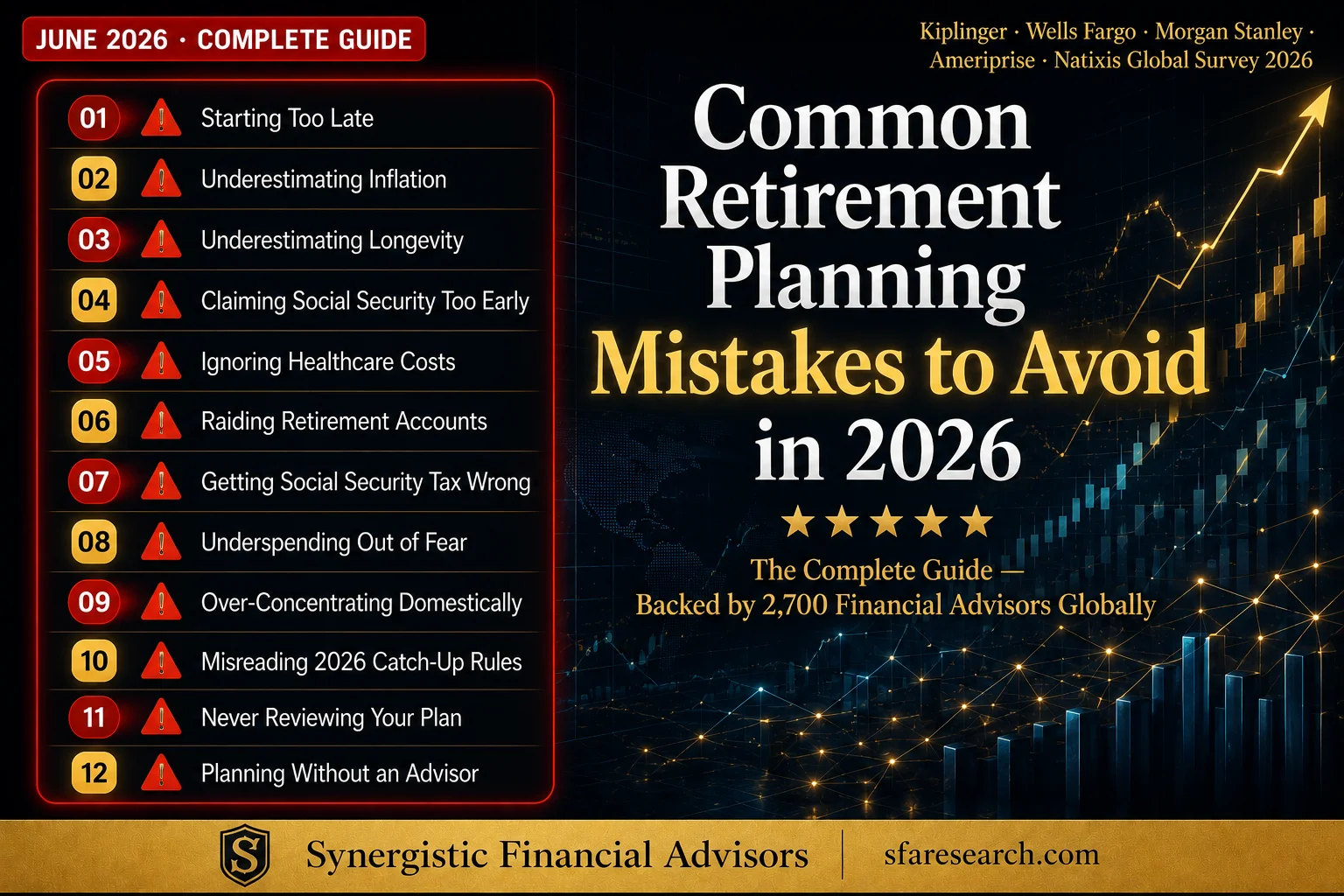
This guide covers the 12 most damaging retirement mistakes — what they are, why they happen, how much they cost, and exactly how a qualified financial advisor helps you avoid every single one.
Mistake 1 — Starting Too Late
This is the foundational mistake that compounds every other one. Many people do not start aggressively saving for retirement until they reach their 40s or 50s — and while it is never too late to start, the cost of delay is staggering and mathematically unforgiving.
To build a $1 million nest egg by age 65 — assuming an 8% annual return and $0 in prior savings — you need to save $300 per month starting at age 25, $700 per month starting at age 35, $1,700 per month starting at age 45, and $3,000 per month starting at age 50.
The difference between starting at 25 and starting at 45 is not double the monthly contribution — it is nearly six times as much. That is the compounding penalty for delay, and no investment strategy can fully recover it.
The honest truth is that there are no perfect conditions for starting — no ideal income level, no perfect age, no moment when everything aligns cleanly. The right time to start retirement planning is always now, regardless of how far away retirement feels. A certified financial planner can build a realistic, achievable contribution strategy from wherever you are starting today.
Mistake 2 — Underestimating Inflation
Nearly half of all financial advisors surveyed — 49% — say underestimating the impact of inflation is the single most common retirement planning mistake they observe. Over time, rising prices erode the purchasing power of savings. What costs $50,000 today could easily cost double or more in 20 years.
In 2026, with CPI running at 4.2%, this is not a theoretical concern — it is a lived reality that every person approaching retirement must factor into their financial planning with genuine precision. An inflation rate of just 3% — well below today’s actual reading — cuts purchasing power in half over approximately 24 years.
The practical implication for your retirement planning strategy is that maintaining appropriate equity exposure is not optional — it is essential. Investing too conservatively by moving money into bonds or CDs reduces risk but also limits growth — and may not keep pace with inflation over decades of retirement.
A portfolio management strategy that generates real returns above inflation is the only way to ensure your purchasing power actually holds through a 25-30 year retirement. Your financial advisor can help you build the asset allocation that delivers genuine inflation protection without taking on inappropriate risk.
Mistake 3 — Underestimating Longevity
46% of financial advisors say clients don’t plan for the possibility of living longer than average — yet thanks to advances in healthcare, many people are now living well into their 80s and 90s.
Younger investors often think of retirement as 15 to 20 years of their life, but as they get closer to retirement age, they recognise that their retirement years may actually span 30 years or more — and with that longevity typically comes changing financial priorities, especially around healthcare, that might require more savings than originally thought.
A retirement savings strategy designed to last 15 years that actually needs to last 30 years will fail — not because of poor investment performance, but because of a fundamental mismatch between the plan’s time horizon and reality. This single mistake — underestimating longevity — is responsible for more retirement crises than almost any other factor.
The fix is not complicated, but it is non-negotiable: your retirement planning must be built around the realistic possibility of a 30-year retirement, with sustainable withdrawal rates, inflation protection, and healthcare cost reserves sized accordingly.
Mistake 4 — Claiming Social Security Too Early
You are entitled to start taking Social Security benefits as early as age 62, but most financial planners recommend holding off at least until your full retirement age — 67 for anyone born after 1959 — before tapping Social Security. Waiting until 70 can be even better, with benefits increasing by 8% for every year you delay past full retirement age.
The mathematics of Social Security timing are among the most consequential in all of retirement planning — and most people get them wrong by defaulting to early claiming without properly analysing the break-even calculation, their health outlook, or their other income sources.
Because Social Security income lasts your entire life, deciding when to file for it is key. Filing as early as age 62 may reduce your monthly benefits for life — making Social Security timing one of the most important decisions in your entire retirement planning strategy.
A certified financial planner can model the precise break-even analysis for your specific situation — accounting for your health, your spouse’s benefit, your other income sources, and your tax planning position — to determine the optimal claiming age that maximises your lifetime benefit.
Mistake 5 — Ignoring Healthcare Costs
39% of financial advisors say health expenses are one of the most overlooked aspects of retirement planning — and the numbers explain why this oversight is so costly.
Health care costs can be severely underestimated when planning for retirement — especially for those who retire early and must purchase their own coverage before qualifying for Medicare at age 65. Premiums and co-pays may be manageable in early retirement alongside other spending, but as you get older, you may spend more on health-related expenses than anything else.
The average 65-year-old couple can expect to spend approximately $172,500 on healthcare throughout retirement — and that figure does not include long-term care costs. A 2023 survey by the Nationwide Retirement Institute found that 72% of adults age 50 or older fear their retirement costs will go out of control, and two-thirds believe that a single health-related issue could ruin their finances for years.
For 2026, Medicare Part B premiums cost $202.90 per month — up from $185 in 2025 — and usually increase each year to match rising healthcare costs. A genuine retirement planning strategy must build a specific, dedicated healthcare reserve rather than assuming general savings will cover whatever medical costs arise.
Mistake 6 — Raiding Retirement Accounts Early
If possible, don’t use retirement savings — whether through loans or early withdrawals — to support children or parents. Using your nest egg sacrifices the potential for tax-deferred growth and you may owe taxes and penalties upon withdrawal that could eventually force you to depend on your own children for financial support in retirement.
Early withdrawals from traditional 401(k)s and IRAs before age 59½ trigger a 10% penalty plus ordinary income tax on the full withdrawal — a combined cost that can easily consume 30-40% of every dollar taken out. And beyond the immediate penalty, the lost compounding on withdrawn funds represents the most devastating long-term cost of all.
This mistake is particularly common among those in the “sandwich generation” — the 40s and 50s demographic juggling children’s education costs and aging parents’ care needs simultaneously. The critical principle, stated plainly by every financial advisor who addresses this: there are no retirement loans. Your children can borrow for college. You cannot borrow for retirement.
Mistake 7 — Getting the Social Security Tax Calculation Wrong
One of the most technically complex and most consistently overlooked retirement mistakes involves the taxation of Social Security benefits — and getting it wrong costs thousands of dollars per year in unnecessary taxes.
Smart tax planning — including Roth conversions, early IRA withdrawals, qualified charitable distributions (QCDs), and proper withholding — can significantly reduce lifetime taxes and unnecessary tax penalties in retirement.
Up to 85% of Social Security benefits can be subject to federal income tax depending on your combined income — and many retirees are shocked to discover this for the first time when they file their return in year one of retirement. Strategic management of your other income sources — the sequence in which you draw from taxable, tax-deferred, and tax-free accounts — can meaningfully reduce how much of your Social Security becomes taxable.
When your adjusted gross income exceeds certain amounts, you will also pay higher Medicare premiums based on your income — making it critical that this extra cost be factored into your tax planning well in advance.
This is precisely the dimension of retirement planning where a financial advisor with integrated tax planning expertise delivers the most measurable, tangible value — identifying strategies that save real dollars rather than simply managing portfolio allocation.
Mistake 8 — Underspending Out of Fear
This is the retirement mistake that nobody warns you about — and according to recent research, it may be as financially damaging as the more obvious mistakes that dominate most retirement guides.
Research by financial planner Michael Kitces found that a retiree withdrawing at 4% is equally likely to finish a 30-year retirement with less than their starting balance as they are to finish with more than six times the original total. The median outcome isn’t scraping by — it’s finishing with nearly triple your starting principal, after three decades of inflation-adjusted spending.
That unspent wealth isn’t sitting in a bank waiting for you. It’s years of trips not taken, grandchildren’s educations not funded, experiences permanently out of reach because you spent your most active retirement years spending less than you could have.
A retirement planning strategy built only around the fear of running out of money is structurally blind to the other direction. Without explicit rules for when to spend more, most retirees default to spending less — year after year — regardless of what their portfolio is doing. The solution is not to abandon caution but to build advance rules for both directions with your financial advisor.
Mistake 9 — Over-Concentrating in Domestic Investments
Wealthy clients often over-concentrate their portfolio management in domestic markets — with US investors typically allocating around 80% of their equity portfolio to the US market even though it constitutes closer to 50% of the total global market. Historically over long periods, these markets often perform in opposite directions — when one is experiencing a long-term bull market, the other may be lower.
In 2026 — with emerging market stocks up more than 20% year-to-date and European monetary policy diverging meaningfully from the US — international diversification has delivered exactly the uncorrelated performance that domestic-only portfolio management strategies missed entirely.
Diversification matters not just across asset classes but across geographies — and a financial advisor who builds genuine international exposure into your retirement planning investment strategy creates portfolio resilience that domestic-only approaches simply cannot deliver across a 30-year retirement horizon.
Mistake 10 — Misunderstanding the New 2026 Catch-Up Contribution Rules
This is a mistake that only became possible in 2026 — and it is already catching thousands of near-retirement savers by surprise.
Starting this year, individuals who earn more than $150,000 per year can only make catch-up contributions to a Roth plan — meaning they’ll pay higher taxes now as they fund the Roth plan but can make tax-free withdrawals later. That change might counter the tax-sheltering strategies of high earners who planned to pay taxes at a lower bracket during retirement by slowly withdrawing funds from a traditional account.
The 2026 rules now mean that those aged 50-59 or 64+ can save an additional $8,000 in their 401(k) above the $24,500 standard limit — for a total of $32,500. Those between 60 and 63 can make a “super catch-up” of $11,250, pushing the total to $35,750. But high earners must direct all catch-up contributions to a Roth account — losing the upfront deduction they may have relied on for years.
A certified financial planner can model the after-tax impact of this rule change for your specific income situation and build a revised retirement planning strategy that captures the maximum available contribution while managing the tax cost intelligently.
Mistake 11 — Failing to Review Your Plan Regularly
It is wise to revisit your retirement plan at least once a year or after major life or financial changes — to make sure spending, investments, taxes, and estate documents stay aligned with your goals.
A retirement planning strategy built in 2023 was not designed for 4.2% CPI, a 9-of-18 Fed hike signal, a new Federal Reserve Chair who has eliminated forward guidance, or the new 2026 tax rules that affect catch-up contributions, SALT deductions, and estate exemptions simultaneously.
The financial environment of 2026 has changed dramatically enough that any retirement planning strategy not reviewed in the last 12 months may be operating on assumptions that no longer reflect reality. This is not a minor administrative concern — it is a genuine financial risk that compounds with every month the review is delayed.
Working with a financial advisor to take inventory of your expenses, identify all sources of income, and develop a strategy to maintain your retirement lifestyle for as long as you live is one of the most valuable ongoing activities in all of personal financial planning.
Mistake 12 — Planning Without a Qualified Financial Advisor
The cumulative cost of the 11 mistakes above — starting late, underestimating inflation and longevity, claiming Social Security incorrectly, ignoring healthcare costs, raiding retirement accounts, mismanaging taxes, underspending, over-concentrating domestically, misunderstanding 2026 rule changes, and failing to review regularly — runs into hundreds of thousands of dollars over a 30-year retirement for the average individual who navigates these decisions alone.
Retirement planning is complex, and one wrong move can cost you thousands in taxes, healthcare expenses, or missed benefits. Understanding these pitfalls can help you protect your retirement income, reduce taxes, and avoid costly surprises.
The research is unambiguous: individuals who work with qualified financial advisors consistently achieve better retirement outcomes than those who navigate these decisions independently — not because advisors have access to secret investment strategies, but because they systematically prevent the expensive, compounding mistakes that individuals consistently make on their own.
At Synergistic Financial Advisors, our certified financial planner team provides the comprehensive, integrated retirement planning expertise that avoids every mistake on this list — from contribution optimisation and Social Security timing to tax planning, portfolio management, healthcare cost reserve building, and the ongoing annual review that keeps your strategy aligned with today’s actual financial environment rather than yesterday’s assumptions.
What a Great Retirement Plan Actually Looks Like in 2026
A genuinely great retirement planning strategy in June 2026 is built around six integrated dimensions that a qualified financial advisor coordinates simultaneously.
Contribution optimisation — maximising every available tax-advantaged savings vehicle, including the new 2026 catch-up rules, HSA contributions, and Roth conversion opportunities during lower-income years.
Social Security strategy — modelling the precise optimal claiming age for your specific health, income, and spousal benefit situation — a decision worth tens of thousands of dollars over your lifetime.
Healthcare planning — building specific, quantified reserves for both pre-Medicare healthcare costs and the long-term care costs that Medicare does not cover.
Tax-efficient withdrawal sequencing — drawing from taxable, tax-deferred, and tax-free accounts in the optimal order to minimise lifetime tax liability on your retirement income.
Inflation-protected portfolio management — maintaining the appropriate equity exposure and real asset allocation that ensures your purchasing power genuinely holds across 30 years of retirement spending.
Annual review and scenario stress-testing — regularly updating every assumption in your financial planning strategy against the actual financial environment — inflation, interest rates, tax laws, and personal life changes — that has emerged since your last review.
Final Thoughts — The Most Expensive Retirement Mistakes Are the Preventable Ones
The mistakes in this guide are not rare. They are the norm — observed across 2,700 financial advisors in 16 countries as the most consistently damaging patterns in retirement planning worldwide.
What makes every single one of them genuinely preventable is the same thing: the guidance of a qualified, fiduciary financial advisor who understands your complete financial picture and builds a retirement planning strategy around your specific situation rather than a generic template.
At Synergistic Financial Advisors, we help individuals, families, and business owners avoid every mistake on this list — through genuinely comprehensive financial planning that integrates retirement planning, tax planning, investment management, portfolio management, and wealth management into one coordinated strategy built entirely around your goals.
Do not let a preventable mistake define your retirement. Contact Synergistic Financial Advisors today for a personalised retirement planning consultation.
👉 Visit sfaresearch.com — because the most expensive retirement mistakes are the ones nobody told you to avoid.