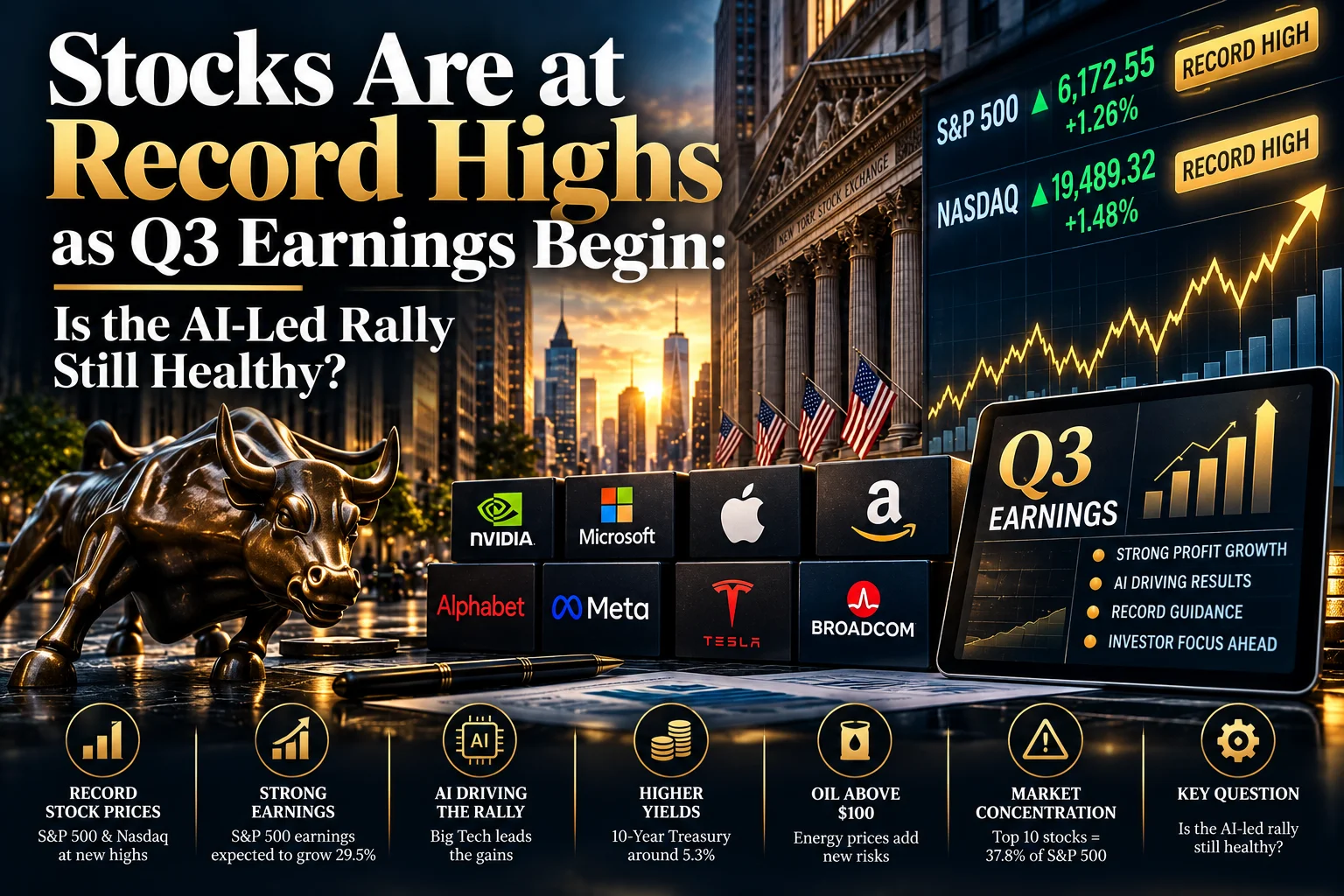
The U.S. stock market has entered earnings season from an unusual position.
Stocks are not recovering from a major selloff.
They are sitting near record highs.
On October 6, the S&P 500 and Nasdaq both reached record closing levels as technology and artificial-intelligence-related shares advanced and investors turned their attention toward third-quarter corporate earnings.
At the same time, investors are confronting an economic backdrop that hardly looks easy.
Long-term Treasury yields remain around multi-decade highs. Oil is again trading around $100 a barrel. Inflation risks have not disappeared. And a relatively small group of enormous technology companies continues to influence a significant portion of the U.S. equity market.
Yet corporate earnings expectations are remarkably strong.
FactSet estimates that S&P 500 companies could report 29.5% year-over-year earnings growth for Q3 2026, which would mark the third consecutive quarter of earnings growth above 25%. Even more unusually, analysts actually raised aggregate Q3 earnings estimates by 1.4% during the quarter—rather than reducing estimates as they typically do.
That creates the central question for investors:
Are record stock prices being supported by equally impressive fundamentals—or is optimism becoming too concentrated in AI and mega-cap technology?
The answer matters for anyone managing a long-term portfolio in late 2026.
The Bull Market Has Strong Fundamental Support
It is easy to look at record stock-market levels and immediately conclude that prices must be irrational.
But high prices alone do not prove that a market is unhealthy.
Corporate earnings matter.
And right now, earnings expectations are unusually optimistic.
FactSet reported that 116 S&P 500 companies had issued Q3 earnings-per-share guidance heading into reporting season. Of those companies, 72 issued positive guidance, compared with 44 issuing negative guidance.
That is the highest number of companies issuing positive EPS guidance for a quarter since FactSet began tracking the measure in 2006. The 62% positive-guidance rate is also substantially above its five- and ten-year averages.
This is important because stock-market rallies are generally healthier when profits are growing alongside prices.
Investors are not simply betting on distant possibilities.
Many companies are reporting or forecasting significant earnings growth today.
But that does not mean valuation and concentration risks should be ignored.
The Market Is Increasingly Dependent on a Small Group of Companies
An investor can own an S&P 500 index fund and reasonably believe they are broadly diversified across hundreds of companies.
Technically, they are.
Economically, however, the picture is more complicated.
As of August 31, 2026, the 10 largest companies represented 37.8% of the S&P 500’s total weight, according to S&P Dow Jones Indices.
The single largest constituent represented 8.1% of the index.
That level of concentration means a relatively small number of companies can have an unusually large influence on overall market performance.
Many of the largest constituents are also directly or indirectly tied to the artificial-intelligence investment cycle.
The top group includes companies such as Nvidia, Apple, Microsoft, Amazon, Alphabet, Broadcom, Meta, Micron and Tesla.
That creates an important distinction:
Owning many stocks is not necessarily the same as having many independent sources of risk.
If several of the largest companies depend on similar themes—AI infrastructure spending, semiconductor demand, cloud computing, data-center investment or technology valuations—the portfolio may contain more thematic concentration than the number of individual holdings suggests.
AI Is Driving Both Earnings and Expectations
Artificial intelligence is no longer simply a speculative market narrative.
AI investment is influencing:
- Semiconductor demand
- Cloud infrastructure
- Data-center construction
- Electricity demand
- Corporate capital expenditure
- Software spending
- Financing markets
- Technology valuations
That helps explain why technology and semiconductor stocks have continued supporting major U.S. indexes.
Reuters reported that the October 6 rally was supported by gains across most of the “Magnificent Seven” and strong semiconductor performance as investors positioned for an earnings season expected to feature significant technology-sector growth.
But AI creates an unusual investment problem.
A technology can be economically transformative and still produce periods of excessive valuation.
Those two statements are not contradictory.
The internet fundamentally changed the economy.
Some internet-era stocks were still dramatically overpriced.
Railroads transformed commerce.
Railway speculation still produced financial bubbles.
Artificial intelligence may ultimately increase productivity, create new industries and generate substantial corporate profits.
That does not mean every AI-linked asset will produce an attractive investment return from every starting valuation.
The IMF Is Also Warning About AI-Related Financial Risk
On October 7, IMF Managing Director Kristalina Georgieva highlighted several threats facing the global economy, including high energy prices, rising public debt and risks associated with the scale of AI investment.
The IMF’s concern is not that AI has no economic value.
Rather, rapid investment can create both positive economic effects and financial vulnerabilities if valuations, financing or spending move too far ahead of sustainable returns.
This distinction should matter to investors.
The relevant question is not:
“Will AI succeed?”
A better question is:
“What assumptions about AI success are already reflected in today’s stock prices?”
Great companies can still become expensive investments.
And mediocre companies can sometimes become attractive investments at sufficiently low valuations.
Price matters.
Earnings Season Will Test Whether Optimism Is Justified
Q3 earnings season could therefore be one of the most important tests of the 2026 rally.
Markets will be evaluating several questions.
Are AI Investments Producing Revenue?
Investors increasingly want evidence that enormous spending on chips, data centers, infrastructure and AI development can translate into sustainable revenue and cash flow.
Are Profit Margins Holding Up?
Strong revenue growth becomes less impressive if labor, energy, financing and infrastructure costs rise even faster.
Is Growth Broadening Beyond Technology?
A healthier bull market would ideally involve improving earnings across multiple industries rather than depending primarily on a small set of mega-cap businesses.
What Are Companies Saying About 2027?
Markets discount the future.
Management guidance about demand, investment and margins may therefore matter as much as the actual Q3 numbers.
Record Highs Do Not Automatically Mean “Sell”
Investors often become nervous when indexes reach new records.
That reaction is understandable.
But an all-time high is not, by itself, an investment signal.
Growing companies and economies naturally push market indexes toward new highs over long periods.
Selling solely because an index has reached a record can create another difficult decision:
When do you buy back?
Instead of treating record prices as an automatic reason to exit the market, investors may find it more useful to review whether their portfolios have quietly become more aggressive.
For example, years of strong mega-cap technology performance may have pushed a portfolio’s technology exposure far above its original target.
That is a portfolio management issue.
It does not necessarily require making a prediction about whether the S&P 500 will rise or fall next month.
Five Questions Investors Should Ask Right Now
1. How Concentrated Is My Portfolio Really?
Do not simply count the number of holdings.
Measure exposure.
An investor may own several index funds, technology funds and individual stocks that all contain substantial positions in the same companies.
The portfolio may look diversified while repeatedly owning similar underlying assets.
2. Has My Asset Allocation Drifted?
Suppose an investor originally intended to hold:
60% stocks / 40% bonds
Several years of strong equity returns could move that portfolio materially away from its strategic target.
The investor may now be taking substantially more risk without consciously deciding to do so.
Rebalancing can restore the intended risk structure.
3. Am I Chasing Recent Performance?
Strong returns attract capital.
That is human nature.
But increasing exposure after an investment has already experienced exceptional gains can create a classic behavioral problem:
Buy because it went up. Sell because it went down.
A stronger investment process begins with expected return, risk and portfolio role.
Not recent popularity.
4. What Happens If AI Stocks Correct?
You do not need to predict whether a correction will happen.
Stress-test the possibility.
If several major AI-related companies fell 20%, 30% or more, what would happen to your portfolio?
Would your financial plan still work?
Would you panic and sell?
Would retirement withdrawals be affected?
Would the portfolio remain diversified?
Those questions tell you more than trying to guess next week’s market direction.
5. Am I Still Being Paid Enough to Take Equity Risk?
This question has become more important because bond yields are dramatically higher than they were during the ultra-low-rate years.
On October 7, the U.S. 10-year Treasury yield was around 5.3%, while markets continued to digest elevated inflation, fiscal concerns and future Federal Reserve policy.
When government bonds yield more than 5%, the opportunity cost of holding expensive risky assets changes.
That does not automatically make stocks unattractive.
It raises the hurdle investors should use when evaluating risk.
Oil Above $100 Adds Another Complication
The market also faces a challenge that technology optimism cannot eliminate: energy inflation.
Brent crude was trading above $101 per barrel on October 7 amid continued geopolitical tensions and supply concerns.
Higher energy prices can affect companies through:
- Transportation costs
- Manufacturing expenses
- Utility costs
- Consumer spending
- Profit margins
- Inflation expectations
Persistent energy inflation can also complicate Federal Reserve policy.
That matters because a market expecting strong earnings and lower interest-rate pressure could react differently if inflation forces policymakers to remain restrictive for longer.
The Market Is Pricing Two Powerful Stories at Once
The investment environment in October 2026 is unusual because two narratives are competing.
The Bullish Story
Corporate earnings are growing rapidly.
AI is driving significant capital investment.
Technology companies remain highly profitable.
Economic demand has remained resilient.
S&P 500 companies are issuing unusually positive earnings guidance.
The Risk Story
Treasury yields exceed 5%.
Oil remains around $100.
Equity indexes are heavily concentrated.
AI valuations have risen dramatically.
Public debt and geopolitical risks remain elevated.
Both stories can be true simultaneously.
That is why binary predictions—“the market is safe” or “the market is a bubble”—are not particularly helpful.
A disciplined investor instead asks:
Am I positioned appropriately if either narrative becomes dominant?
What Should Long-Term Investors Do?
The answer is usually less dramatic than financial headlines suggest.
Review Diversification
Understand actual exposure across companies, sectors, regions and asset classes.
Rebalance When Appropriate
Strong-performing assets can become disproportionately large parts of a portfolio.
Revisit Valuation
A great business is not automatically a great investment at every price.
Maintain Appropriate Fixed-Income Exposure
Higher bond yields may allow fixed income to play a more meaningful role in income generation and diversification.
Keep Near-Term Cash Needs Separate
Money needed soon generally should not depend entirely on short-term stock-market performance.
Avoid Making the Entire Portfolio an AI Bet
AI may be transformative.
Your financial future does not need to depend on one investment theme being correct.
The 2026 Record-High Market Checklist
| Issue | Current Situation | What Investors Should Review |
|---|---|---|
| U.S. Stocks | S&P 500 and Nasdaq at record highs | Valuation and portfolio drift |
| Q3 Earnings | S&P 500 earnings expected to grow 29.5% | Whether profits justify prices |
| Corporate Guidance | Record 72 companies gave positive EPS guidance | Sustainability of growth |
| Market Concentration | Top 10 S&P 500 stocks = 37.8% | Hidden concentration |
| AI | Major driver of technology investment | Exposure and valuation |
| Treasury Yields | Around 5.3% | Stock/bond allocation |
| Oil | Above $100 per barrel | Inflation and margin risks |
| Fed | Near-term hike expectations have eased | Rate sensitivity |
| Portfolio Strategy | Multiple conflicting market signals | Diversification and discipline |
How SFA Can Help Investors Evaluate the Current Market
Record markets can create a surprisingly difficult planning environment.
Investors may wonder whether they should:
Take profits.
Increase equity exposure.
Buy bonds.
Reduce technology exposure.
Hold more cash.
Or simply stay invested.
There is no universal answer because the correct decision depends on the investor’s objectives, risk capacity, taxes, liquidity requirements, time horizon and existing portfolio.
Synergistic Financial Advisors can help investors evaluate the broader structure through areas including portfolio management, investment research, financial advisory and strategic financial analysis.
The objective should not be predicting every short-term move.
It should be determining whether the portfolio remains appropriate across multiple possible market outcomes.
Final Thoughts
The stock market entering Q3 earnings season at record highs is not automatically a warning sign.
In fact, current earnings expectations provide substantial fundamental support for the rally.
S&P 500 profits are expected to grow nearly 30% year over year in the third quarter, and corporate guidance has been unusually positive.
But strong fundamentals do not eliminate risk.
The S&P 500 remains unusually concentrated.
AI expectations are enormous.
Treasury yields remain above 5%.
Oil is around $100.
And the market is already pricing a considerable amount of future success.
That makes Q3 earnings season about more than whether companies “beat estimates.”
It is a test of whether profits are catching up with expectations.
For long-term investors, the most important response is not to predict the next record high or correction.
It is to make sure the portfolio does not require one narrow market outcome to succeed.
When markets are expensive, concentrated and optimistic, diversification becomes more important—not less.