The bond market is sending investors a message they should not ignore.
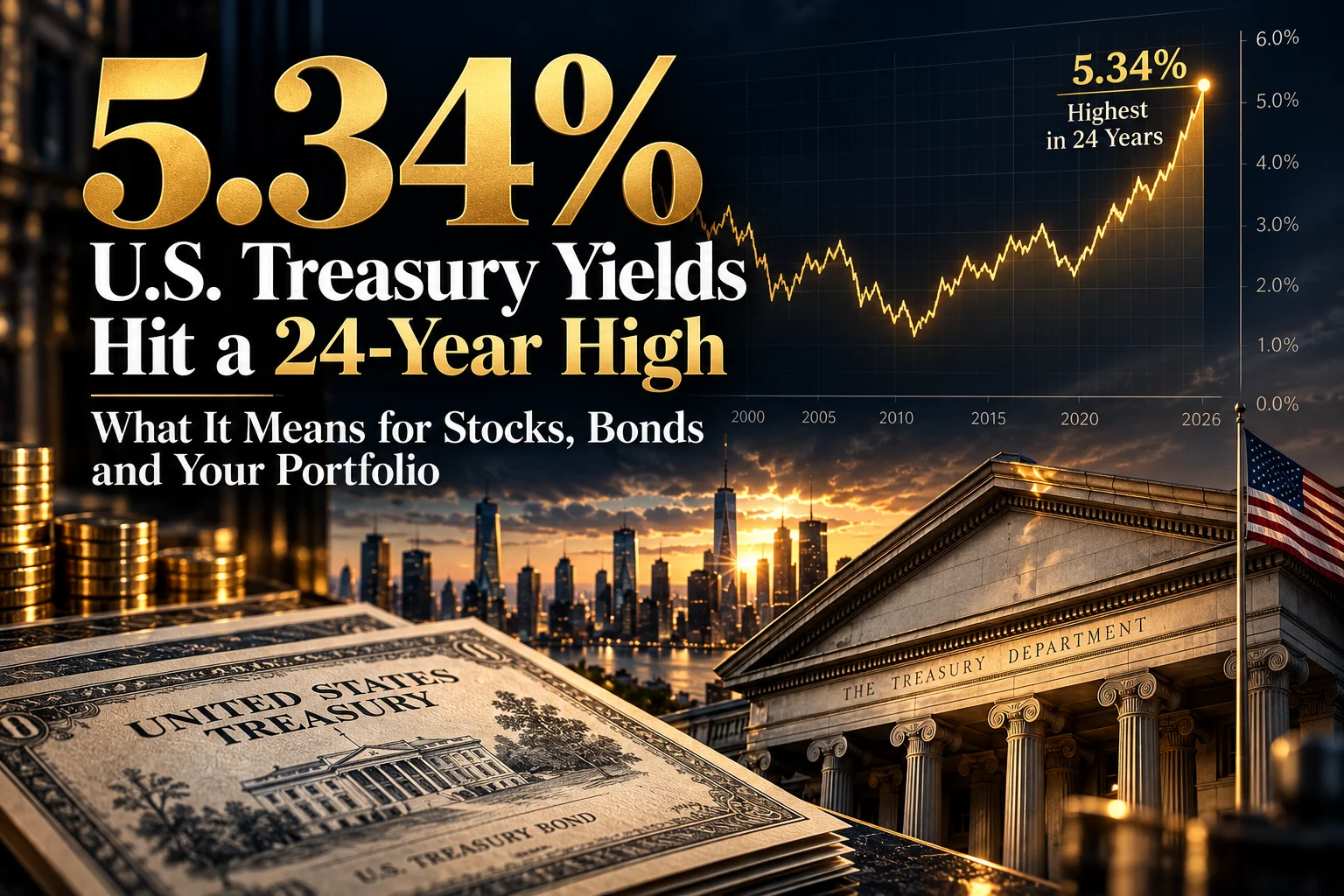
On October 1, 2026, the yield on the benchmark 10-year U.S. Treasury briefly reached roughly 5.34%—its highest level in 24 years. The move followed an extraordinary quarter in which Treasury yields recorded their largest quarterly increase since 1994.
By early October 2, the 10-year yield had retreated toward the 5.2% range as buyers returned to the market, but the broader message has not disappeared:
The era of cheap money is no longer the market’s default assumption.
This matters far beyond the bond market.
Treasury yields influence:
- Stock valuations
- Corporate borrowing costs
- Mortgage rates
- Real estate
- Government financing
- Business investment
- Bond prices
- Portfolio allocation
- Investor expectations about the Federal Reserve
For investors, the key question is not simply whether the 10-year Treasury yield moves from 5.3% to 5.1% next week.
The more important question is:
What happens to your financial strategy if interest rates stay higher for longer than markets previously expected?
That is the question investors should be asking in October 2026.
Why Are Treasury Yields So High?
Several forces are pushing bond yields higher at the same time.
The Federal Reserve raised its target federal funds range by 25 basis points in September to 3.75%–4.00%, its first rate increase of 2026. The Fed said economic activity was expanding at a solid pace while inflation remained elevated.
Inflation has moderated from earlier levels, but it is still above the Federal Reserve’s long-term 2% objective.
The latest Bureau of Economic Analysis data show that the Personal Consumption Expenditures Price Index increased 3.4% year over year in August 2026, while core PCE inflation—which excludes food and energy—was 3.0%.
That leaves markets dealing with an uncomfortable combination:
Resilient economic activity + inflation above target + higher energy prices + elevated government borrowing + uncertainty over future Fed policy.
Bond investors generally demand higher yields when they believe inflation risk, interest-rate risk, or the opportunity cost of holding long-term bonds has increased.
That is why today’s Treasury-market story matters.
A 5% Treasury Yield Changes the Investment Equation
For years, investors frequently described stocks as attractive partly because yields on relatively safe government bonds were extremely low.
When Treasury yields rise above 5%, that comparison changes.
An investor choosing between a volatile equity investment and a high-quality government bond now has a very different set of alternatives than when Treasury yields were 1%, 2%, or even 3%.
This does not automatically mean:
“Sell stocks and buy bonds.”
It means the required return for taking additional risk becomes more important.
When investors can obtain materially higher yields from government debt, expensive stocks, speculative assets, highly leveraged companies, and low-quality credit may face more scrutiny.
What Rising Treasury Yields Mean for Stocks
Higher long-term interest rates can pressure equities in several ways.
1. Future Earnings Become Less Valuable Today
Stock valuations are partly based on the present value of future corporate cash flows.
Higher discount rates reduce the present value of those future earnings.
This effect can be particularly important for companies whose valuations depend heavily on profits expected many years into the future.
That is one reason high-growth and highly valued stocks can sometimes become more sensitive to changes in Treasury yields.
2. Companies Face Higher Financing Costs
Businesses regularly borrow to:
- Expand operations
- Purchase equipment
- Finance acquisitions
- Refinance existing debt
- Repurchase shares
- Fund working capital
Higher market interest rates can increase those costs.
Companies with large debt loads or frequent refinancing needs may therefore feel the effects more quickly than businesses with strong balance sheets and substantial free cash flow.
3. Bonds Become More Competitive
A 5%+ Treasury yield gives investors another potentially attractive source of return.
That can influence how investors allocate capital between:
Stocks → Bonds → Cash → Real Estate → Private Markets
This competition for investor capital can put pressure on equity valuations even when corporate earnings remain healthy.
Why Today’s Jobs Report Matters So Much
Markets are also focused on the September U.S. employment report scheduled for October 2.
Before the release, economists surveyed by Reuters expected roughly 90,000 new nonfarm payrolls, compared with 162,000 in August, while the unemployment rate was expected to remain around 4.1%.
Why does employment data matter to bond investors?
Because a very strong labor market can support consumer spending and economic growth.
That can make it harder for inflation to return sustainably to 2%, potentially encouraging the Federal Reserve to keep monetary policy restrictive.
On the other hand, a meaningful deterioration in employment could reduce pressure on policymakers to continue raising rates.
That makes the jobs report more than just a labor-market statistic.
It is another signal in the market’s attempt to answer:
What will the Federal Reserve do next?
The Fed’s Next Move Is No Longer Obvious
The Fed’s September decision raised the policy rate to 3.75%–4.00%.
But expectations for another immediate rate increase have recently shifted.
As Treasury yields retreated on October 1 and Federal Reserve officials signaled patience, market-implied expectations of an October rate increase fell sharply from where they had been earlier in the week.
That does not guarantee a pause.
It highlights how quickly expectations can move.
Investors should therefore be cautious about constructing portfolios around a single prediction such as:
“The Fed will definitely hike again.”
or:
“Rates have peaked and will fall from here.”
A more durable investment management approach asks what happens under several possible interest-rate scenarios.
What High Treasury Yields Mean for Bond Investors
The bond story is more complicated than simply saying that rising rates are bad.
When yields rise, existing bond prices generally fall.
That can hurt investors who already own longer-duration bonds.
But higher yields can also improve the potential future income available to new bond investors.
This creates an important distinction:
Rising rates can hurt yesterday’s bond prices while improving tomorrow’s bond opportunities.
For investors building fixed-income portfolios today, yields are materially different from those available during much of the previous decade.
Depending on risk tolerance and objectives, investors may now evaluate opportunities across:
- Treasury bills
- Treasury notes
- Treasury bonds
- Investment-grade corporate bonds
- Municipal bonds
- Short-duration fixed income
- Intermediate-duration bonds
Credit quality, maturity, duration, taxes, liquidity, and reinvestment risk still matter.
A high headline yield should never be evaluated in isolation.
Duration Risk Matters Again
One concept investors should understand in this environment is duration.
Duration helps estimate how sensitive a bond’s price may be to changes in interest rates.
Generally:
Longer duration = greater sensitivity to rate changes.
If rates rise sharply, long-duration bond prices can experience larger declines than shorter-duration bonds.
If rates eventually fall, longer-duration bonds can potentially benefit more strongly.
Neither outcome is guaranteed.
For portfolio management, the right duration exposure should depend on:
- Time horizon
- Income needs
- Liquidity requirements
- Risk tolerance
- Interest-rate exposure across the rest of the portfolio
Investors should not choose duration solely by trying to predict the next Federal Reserve announcement.
What Higher Rates Mean for Real Estate
The Treasury market also matters for property investors and homeowners.
Long-term borrowing costs are influenced by bond-market rates.
When benchmark yields remain elevated, financing can become more expensive for:
- Homebuyers
- Property developers
- Commercial real estate investors
- Businesses purchasing property
- Owners refinancing existing loans
Higher financing costs can reduce the amount buyers are able or willing to pay.
For investment properties, rising borrowing costs can also affect expected returns and valuation assumptions.
This is particularly important for highly leveraged real estate strategies.
An asset may still generate strong operating income, but a materially higher financing rate can change the economics of the investment.
What Higher Rates Mean for Business Owners
Business owners should pay attention as well.
Higher long-term rates can affect:
- Commercial loans
- Acquisition financing
- Working-capital facilities
- Refinancing
- Private-credit costs
- Business valuations
- M&A activity
A company that borrowed comfortably at much lower rates may face a very different cash-flow equation when debt needs to be refinanced.
Business owners should therefore consider reviewing:
Debt maturity schedules + interest-rate exposure + liquidity + capital allocation + refinancing needs
before financing becomes urgent.
For SFA clients, this is where corporate finance and personal financial planning can intersect.
A higher-rate environment can affect both the value of a business and the owner’s personal investment portfolio.
Energy Is Adding Another Layer of Inflation Risk
Bond markets are also watching oil closely.
Oil prices have remained volatile amid geopolitical tensions, supply concerns, and changing expectations around emergency reserves.
Early on October 2, Brent crude moved back below $100 per barrel after sharp gains in the previous session, while investors continued to assess Middle East supply risks and possible European emergency-stock releases.
Energy matters because sustained increases in fuel costs can feed into:
- Transportation
- Manufacturing
- Logistics
- Aviation
- Consumer prices
- Corporate margins
That complicates the Federal Reserve’s job.
If energy prices remain elevated while the broader economy stays resilient, inflation could prove harder to push back toward target.
Should Investors Change Their Portfolios Now?
A 24-year high in Treasury yields deserves attention.
But it does not automatically justify a major portfolio overhaul.
A better approach is to use the changing rate environment as a reason to review the portfolio systematically.
Review 1: Equity Valuation
Does the portfolio depend heavily on expensive companies whose valuations assume strong growth many years into the future?
Review 2: Fixed Income
Are higher-quality bonds now capable of serving a more meaningful income or diversification role?
Review 3: Duration
Is the bond portfolio taking more interest-rate risk than intended?
Review 4: Debt
Are there major personal or business loans that will need refinancing?
Review 5: Liquidity
Is sufficient cash available for near-term needs without forcing investment sales?
Review 6: Diversification
Is the portfolio concentrated in one sector, investment style, asset class, or interest-rate outcome?
This is where disciplined wealth management becomes more valuable than reacting to the latest headline.
Three Possible Rate Scenarios Investors Should Consider
Rather than making one prediction, investors can test their portfolios against several possibilities.
Scenario 1: Rates Stay Higher for Longer
Inflation remains persistent and economic growth stays resilient.
Potential implications:
- Bonds continue offering relatively high income
- Expensive equities may face valuation pressure
- Borrowing remains costly
- Leveraged businesses and real estate face challenges
Scenario 2: Rates Fall Gradually
Inflation continues cooling without a major economic downturn.
Potential implications:
- Existing longer-duration bonds could benefit
- Financing conditions may gradually improve
- Equity valuations could receive some support
Scenario 3: Rates Fall Because Growth Weakens Sharply
A meaningful slowdown causes the Fed to shift policy.
Potential implications could be very different from Scenario 2 because declining rates would be accompanied by weaker economic activity and potentially softer corporate earnings.
This demonstrates why:
Falling interest rates are not automatically bullish, and rising interest rates are not automatically bearish.
The reason rates are moving matters.
2026 Investor Checklist
| Market Issue | What Investors Should Review |
|---|---|
| 10-Year Treasury above 5% | Equity valuation and fixed-income opportunities |
| Higher Fed policy rate | Cash, borrowing and portfolio allocation |
| Bond volatility | Duration and maturity structure |
| Persistent inflation | Real purchasing power and diversification |
| Oil volatility | Inflation exposure and sector risk |
| Strong labor market | Potential implications for Fed policy |
| Expensive financing | Business and real-estate leverage |
| Higher bond income | Role of fixed income in the portfolio |
| Market uncertainty | Liquidity and rebalancing strategy |
What This Means for Long-Term Investors
Perhaps the biggest lesson from the current bond-market move is that financial conditions can change significantly even when the stock market has not experienced a crisis.
Investors who built portfolios during years of extremely low interest rates may need to revisit old assumptions.
The opportunity set has changed.
So have the risks.
A strong financial advisor or portfolio strategy should therefore consider not only which investments may rise next, but how the entire portfolio behaves under different combinations of:
Growth + Inflation + Interest Rates + Energy Prices + Market Volatility
That is a much more useful framework than trying to predict tomorrow’s Treasury yield.
How SFA Can Help Investors Navigate a Higher-Rate Market
Synergistic Financial Advisors can help investors evaluate how changing interest rates affect their broader financial strategy.
That can include reviewing:
- Asset allocation
- Equity concentration
- Fixed-income exposure
- Portfolio duration
- Liquidity
- Risk tolerance
- Investment objectives
- Business-financing considerations
- Long-term financial goals
SFA’s capabilities across portfolio management, investment research, financial advisory, and corporate finance can provide a broader perspective when financial markets, borrowing conditions, and economic policy are moving together.
Final Thoughts
The U.S. Treasury market has entered territory investors have not seen in more than two decades.
A 10-year yield above 5% changes the financial landscape.
It raises the hurdle rate for risky assets.
It changes bond opportunities.
It affects mortgages and business financing.
It influences equity valuations.
And it forces investors to reconsider assumptions built during years of much lower rates.
But the answer is not to predict every move in the bond market.
The stronger response is to build a portfolio that can function across multiple interest-rate environments.
Higher rates should change the questions investors ask—not encourage them to abandon disciplined investing.
For investors and business owners, October 2026 is a useful moment to review whether today’s portfolio, debt structure, liquidity, and financial plan still make sense in a world where the risk-free rate is once again a meaningful competitor for capital.