Choosing a financial advisor can feel surprisingly difficult.
Search online and you may encounter titles such as:
Financial advisor.
Financial planner.
Investment advisor.
Wealth manager.
Portfolio manager.
Financial consultant.
The titles may sound similar, but the services, compensation structures, conflicts of interest, credentials, regulatory requirements, and standards of conduct behind them can be very different.
That is why one of the most common questions investors ask is:
How do I find a fiduciary financial advisor I can trust?
The answer should involve more than finding someone whose website says “fiduciary.”
You should understand when the person is required to act in your best interest, how they are paid, what conflicts exist, what services you are actually receiving, and whether their professional history supports the trust you are placing in them.
The SEC states that, under federal law, an investment adviser is a fiduciary. That fiduciary duty includes duties of care and loyalty, with the scope of those obligations determined by the advisory relationship.
CFP Board also requires CFP® professionals to act as fiduciaries—and therefore in their clients’ best interests—whenever they are providing financial advice.
But investors should still perform their own due diligence.
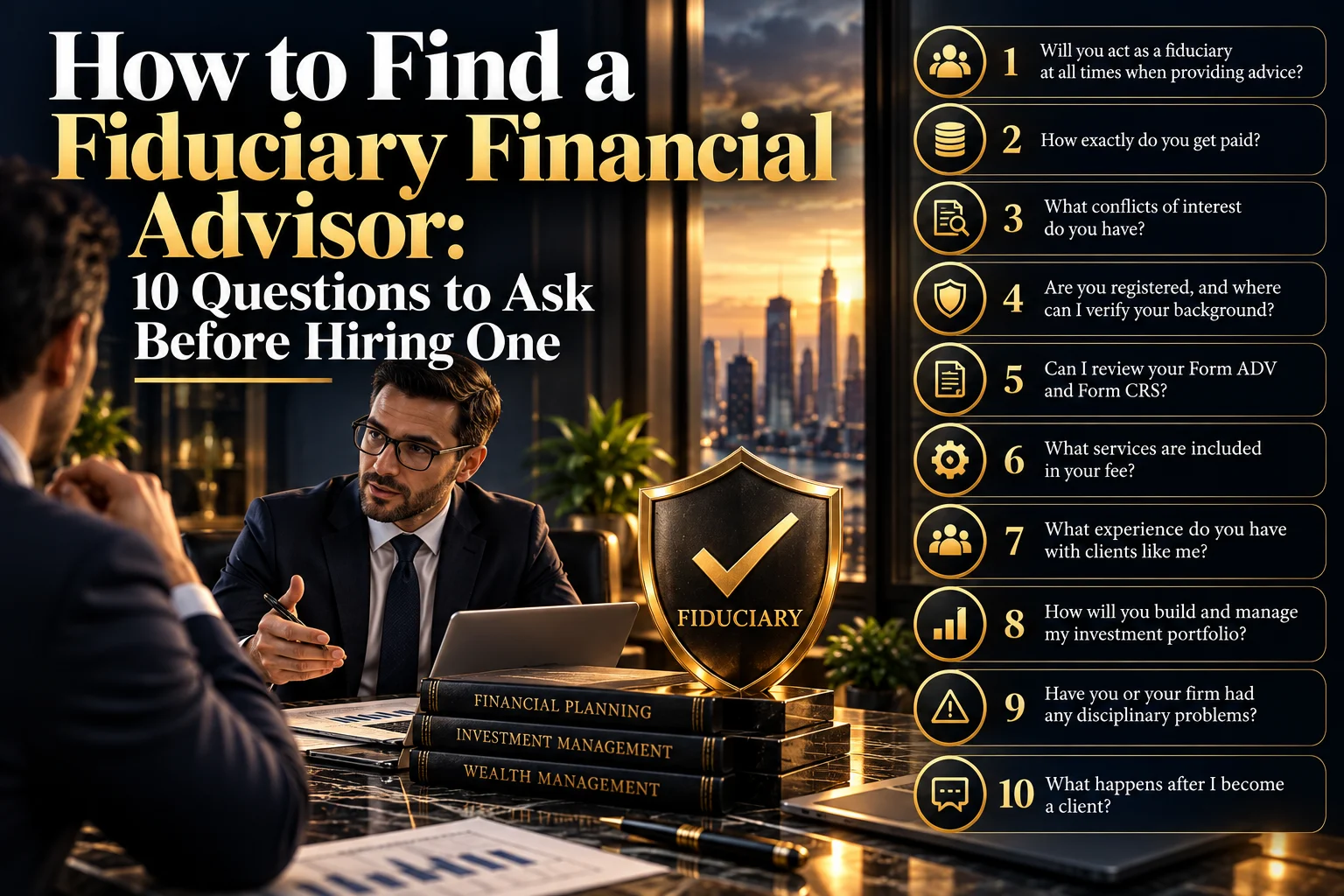
Here are 10 questions to ask before hiring a financial advisor.
First: What Does “Fiduciary” Actually Mean?
A fiduciary relationship generally requires the advisor to put the client’s interests ahead of the advisor’s own interests when carrying out the duties covered by that relationship.
For investment advisers, the SEC describes the fiduciary obligation as including a duty of care and a duty of loyalty.
CFP Board’s standards similarly require CFP® professionals providing financial advice to:
- Put the client’s interests above their own
- Exercise appropriate care, skill, prudence and diligence
- Address material conflicts of interest
- Follow reasonable and lawful client instructions
That sounds straightforward.
In practice, however, financial professionals can operate under different registrations and business models. Some professionals may also be dually licensed, meaning they can provide advisory services in one capacity and brokerage services in another.
That makes your first question especially important.
1. “Will You Act as a Fiduciary for Me at All Times When Providing Advice?”
Do not stop at:
“Are you a fiduciary?”
Ask:
“Will you act as a fiduciary for me at all times when providing financial or investment advice, and will you confirm that in writing?”
Why does the wording matter?
Because you want to understand the legal and professional capacity in which the person will serve you.
An investment adviser and a broker-dealer do not operate under identical regulatory frameworks. The SEC created Form CRS partly to help retail investors compare brokerage and investment-advisory relationships, including their services, fees, conflicts and applicable standards of conduct.
If a professional operates in multiple capacities, ask when each applies.
Clarity before signing an agreement is far better than discovering the distinction later.
2. “How Exactly Do You Get Paid?”
Compensation can influence recommendations.
An advisor might be compensated through:
- A percentage of assets under management
- A fixed or flat planning fee
- Hourly fees
- Subscription fees
- Commissions
- Product-related compensation
- Referral arrangements
- A combination of different methods
None of these structures should automatically determine whether an advisor is right or wrong for you.
But you should understand every meaningful way the advisor and firm can make money from your relationship.
Investor.gov specifically recommends asking how an adviser is compensated and reviewing fees, services, product limitations and conflicts before choosing one.
Ask for an estimate in actual dollars where possible.
A 1% fee may sound small.
On a $2 million portfolio, however, 1% represents $20,000 per year before considering underlying fund expenses, transaction costs or other charges.
Evaluate the total cost against the services you receive.
3. “What Conflicts of Interest Do You Have?”
Every financial business model can create incentives.
The important question is whether those conflicts are identified, disclosed and appropriately managed.
Potential conflicts might arise when an advisor or firm:
- Receives different compensation for different products
- Recommends affiliated products or services
- Receives referral compensation
- Has incentives to move assets into certain account types
- Earns more when a client trades or invests differently
- Has outside business relationships
Do not settle for:
“We always put clients first.”
Ask for specific examples of conflicts within the firm’s actual business model.
The SEC’s Form ADV Part 2 brochure is particularly useful because it describes an investment adviser’s business practices, fees, conflicts of interest and disciplinary information in narrative form.
Read it.
4. “Are You Registered, and Where Can I Verify Your Background?”
Never rely solely on a website biography, social-media profile or personal recommendation.
Verify the professional independently.
Investor.gov recommends checking whether an investment professional is registered or licensed and reviewing both the individual and the firm.
Two particularly useful resources are:
Investment Adviser Public Disclosure (IAPD)
Used to research SEC- and state-registered investment advisers and their representatives.
FINRA BrokerCheck
Used to research current and former FINRA-registered brokerage firms and brokers.
These tools can provide information about professional history, registrations and, where applicable, disclosures involving complaints, regulatory actions, customer disputes or other reportable events.
A referral from a trusted friend is valuable.
Verification is still necessary.
5. “Can I Review Your Form ADV and Form CRS?”
For an investment adviser, these documents can tell you far more than a polished marketing brochure.
Form ADV Part 1
Provides information about the advisory business, ownership, clients, affiliations and certain disciplinary events.
Form ADV Part 2
The adviser brochure explains business practices, services, fees, conflicts and disciplinary information in plain-language narrative form.
Form CRS
For firms subject to the requirement, the relationship summary provides a shorter overview of services, fees and costs, conflicts, standards of conduct and disciplinary history.
Think of these documents as part of your due-diligence file.
If what an advisor tells you in a meeting appears inconsistent with regulatory disclosures, ask why.
6. “What Services Are Included in Your Fee?”
Two advisors charging the same percentage can provide very different services.
One may primarily provide investment management.
Another may coordinate:
- Financial planning
- Portfolio management
- Retirement planning
- Tax-aware investment strategies
- Cash-flow planning
- Estate-planning coordination
- Insurance review
- Business-owner planning
- Education planning
- Charitable planning
- Wealth-transfer planning
Ask what is actually included.
Also ask what is not included.
For example, an advisor may discuss tax-efficient investment strategies without preparing tax returns or providing legal tax advice.
Likewise, a financial planner may identify estate-planning needs but rely on an estate attorney to prepare legal documents.
A clear scope of service helps prevent mismatched expectations.
7. “What Experience Do You Have With Clients Like Me?”
An advisor can be competent but still not be the best fit for your circumstances.
Consider whether your needs involve:
- Retirement
- High-net-worth planning
- Business ownership
- Executive compensation
- Concentrated stock
- Inherited wealth
- Real estate
- A business sale
- International assets
- Family wealth transfer
Investor.gov specifically recommends asking about an adviser’s experience, including experience serving people with circumstances similar to yours.
Imagine two prospective clients.
One is a 35-year-old employee building a retirement portfolio.
The other is a 61-year-old business owner preparing to sell a $10 million company.
Both need financial advice.
They do not necessarily need the same expertise.
8. “How Will You Build and Manage My Investment Portfolio?”
An advisor should be able to explain their investment process without hiding behind unnecessary complexity.
Ask how they determine:
Asset allocation
How much goes into equities, fixed income, cash and other suitable investments?
Risk
How does your risk tolerance and capacity influence the portfolio?
Diversification
How does the advisor address concentration across companies, sectors, markets and asset classes?
Rebalancing
When and why is the portfolio adjusted?
Taxes
Are taxable consequences considered when making changes?
Investment selection
Why are particular securities, funds or strategies selected?
Monitoring
How often is the portfolio reviewed?
The investment philosophy should make sense even if markets become volatile.
If a strategy can only be explained through predictions about what markets will do next, investors should understand how the portfolio is expected to perform if those forecasts are wrong.
9. “Have You or Your Firm Had Any Disciplinary Problems?”
This can feel uncomfortable to ask.
Ask anyway.
Investor.gov specifically recommends asking whether the adviser or firm has ever been disciplined by a regulator and, if so, why and how the issue was resolved.
Then verify the answer independently.
Investor.gov notes that regulatory databases can contain information regarding certain customer complaints, lawsuits, arbitrations, regulatory actions, employment terminations, bankruptcies and other reportable civil or criminal proceedings.
A disclosed event does not automatically tell you whether someone should or should not be hired.
The nature, age, circumstances and resolution matter.
But undisclosed information that contradicts what you were told deserves careful attention.
10. “What Happens After I Become a Client?”
Many investors focus heavily on the first meeting.
The long-term relationship matters more.
Ask:
Who will actually manage my relationship?
The person making the sales presentation may not always be the person providing ongoing advice.
How often will we meet?
Quarterly? Semiannually? Annually? Based on need?
What will you monitor?
Only investment performance—or also taxes, retirement projections, liquidity and financial goals?
When will my financial plan be updated?
Life changes.
So should planning assumptions.
How quickly can I reach someone when something important happens?
Markets, businesses, families and financial circumstances do not always change according to an annual review calendar.
A strong advisory relationship should have a clear ongoing service model.
Red Flags to Watch For
The following should encourage additional scrutiny:
| Potential Red Flag | Why It Deserves Attention |
|---|---|
| Guarantees of investment returns | Markets involve risk |
| Pressure to act immediately | Important financial decisions deserve due diligence |
| Refusal to explain compensation | You should understand how the advisor gets paid |
| Vague answers about fiduciary status | The capacity and obligation should be clear |
| No written description of services | Expectations may become unclear |
| Reluctance to provide Form ADV or CRS | Regulatory disclosures are important due-diligence documents |
| Strategy cannot be explained simply | Complexity should have a clear purpose |
| One product solves every problem | Financial needs are rarely identical |
| Credentials that cannot be verified | Titles alone do not establish competence |
| Background information conflicts with disclosures | Investigate before investing |
Is a CFP® Professional Automatically a Fiduciary?
CFP Board requires CFP® professionals to act as fiduciaries at all times when providing Financial Advice to a Client. Its standard includes duties of loyalty, care and following client instructions.
That is an important professional standard.
But investors should still investigate the individual, firm, compensation structure, services, regulatory registration and disciplinary record.
Credentials are one part of due diligence—not a substitute for it.
Is “Fee-Only” the Same as “Fiduciary”?
Not necessarily.
These terms describe different things.
Fee structure describes how a professional receives compensation.
Fiduciary duty describes a standard of conduct applying within a particular advisory relationship.
That is why asking only:
“Are you fee-only?”
does not replace questions about fiduciary obligations, conflicts, services or registration.
Understand both.
Financial Advisor vs. Investment Adviser: Why the Difference Matters
“Financial advisor” is a broad term.
The SEC’s regulatory framework makes an important distinction between investment advisers and broker-dealers.
Under federal law, an investment adviser is a fiduciary to its clients. Broker-dealers operate under a different regulatory framework that includes Regulation Best Interest when making covered recommendations to retail customers.
Some financial professionals are registered in both capacities.
That is another reason Form CRS can be valuable: it is designed to help investors compare the relationships and understand services, costs, conflicts and standards of conduct.
Your Fiduciary Advisor Checklist
Before hiring someone, make sure you can answer:
| Question | What You Want to Understand |
|---|---|
| Are you acting as a fiduciary? | The standard applying to your relationship |
| How are you compensated? | Total costs and economic incentives |
| What conflicts exist? | Factors that could influence recommendations |
| Are you registered? | Regulatory status |
| Can I see Form ADV/CRS? | Services, fees, conflicts and history |
| What services are included? | What you are actually paying for |
| Do you serve clients like me? | Relevant experience |
| How do you invest? | Philosophy, risk and portfolio process |
| Any disciplinary history? | Professional background |
| What happens after hiring? | Ongoing service and communication |
How SFA Approaches Financial Advisory
A financial relationship should begin with understanding the client’s broader financial circumstances—not simply selecting investments.
For investors evaluating a Fiduciary Financial Advisor, important areas may include financial goals, risk tolerance, portfolio structure, liquidity, investment objectives, business interests, retirement plans and longer-term wealth priorities.
Synergistic Financial Advisors brings together capabilities across financial advisory, portfolio management, investment research and corporate finance, allowing financial decisions to be considered within a wider strategic context.
For business owners and high-net-worth investors in particular, this can be important because the investment portfolio may represent only one part of total wealth.
Final Thoughts
Finding a fiduciary financial advisor should not be a popularity contest.
Do not choose solely because someone:
Has a professional-looking website.
Was recommended by a friend.
Works for a recognizable firm.
Uses impressive credentials.
Or says, “You can trust me.”
Trust should be supported by information you can verify.
Review the person’s registration.
Read their disclosures.
Understand their fees.
Ask about conflicts.
Investigate their background.
Understand exactly what services you are buying.
And ask directly when and how they will act as a fiduciary.
The most valuable question may ultimately be this:
“Can you clearly explain why your advice is in my best interest, what it will cost me, what conflicts exist, and how I can independently verify what you are telling me?”
A good advisory relationship should make that question easier—not harder—to answer.