Pakistanis are facing an unusual financial environment in 2026.
Inflation remains high.
Interest rates are still in double digits.
The Pakistan Stock Exchange has experienced large swings.
Global oil prices and geopolitical tensions continue to influence domestic markets.
At the same time, Pakistan has made progress on external financing and continues to receive support under its IMF programs.
For households, professionals, investors and business owners, this creates an important question:
Where should your money actually go in an environment where cash loses purchasing power, interest rates remain high and financial markets are volatile?
There is no single investment that solves this problem.
The stronger answer is financial planning.
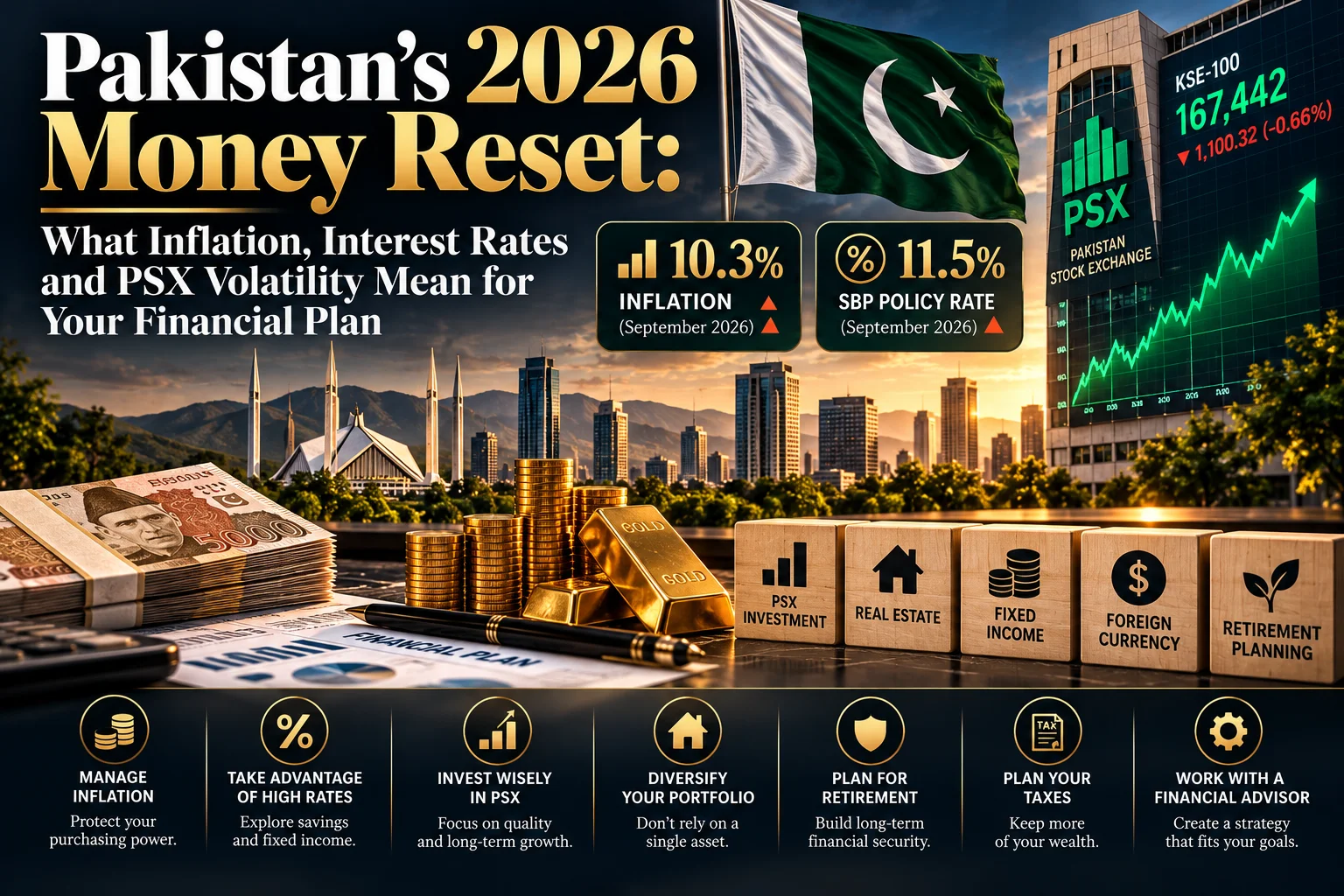
As of September 2026, Pakistan’s Consumer Price Index was 10.26% higher than a year earlier, although inflation had eased from 11.15% in August. Prices still increased 1.27% during September alone.
Meanwhile, the State Bank of Pakistan kept its policy rate unchanged at 11.5% at its September 14 monetary-policy meeting.
These two numbers—10.3% inflation and an 11.5% policy rate—should influence how Pakistani investors think about saving, borrowing, investing and building wealth.
But they should not encourage people to chase whichever asset currently offers the highest return.
First Understand the Real Enemy: Loss of Purchasing Power
Many people think investment risk means:
“My investment went down.”
That is only one form of risk.
Another risk is that your money remains the same while everything around you becomes more expensive.
Imagine you hold PKR 1,000,000 in cash.
If inflation remains around 10% for a year, the amount in your bank account is still PKR 1,000,000.
But that money can buy significantly less than before.
This is called purchasing-power risk.
It means that keeping too much long-term wealth in non-returning cash can also be risky.
A good financial planner therefore separates money according to its purpose rather than treating every rupee the same.
The Four-Bucket Money Framework for Pakistani Households
A useful way to organize finances in Pakistan is to divide money into four broad categories.
Bucket 1: Emergency Money
This is not investment capital.
It is money available for:
- Medical emergencies
- Temporary unemployment
- Unexpected household expenses
- Urgent travel
- Business interruptions
- Family emergencies
Depending on individual circumstances, several months of essential expenses may need to remain highly liquid.
The purpose is stability, not maximum return.
Bucket 2: Short-Term Money
This may include money needed for:
- Education fees
- A vehicle
- House renovation
- Wedding expenses
- Business working capital
- A property down payment
If you know you will need money in one or two years, exposing all of it to volatile equities may create unnecessary risk.
Bucket 3: Long-Term Investment Money
This is capital that may not be needed for many years.
Longer time horizons can potentially allow investors to consider growth-oriented assets such as equities as part of a diversified portfolio.
Bucket 4: Retirement and Wealth Capital
This is money being accumulated specifically for:
- Financial independence
- Retirement
- Children’s future
- Intergenerational wealth
- Long-term family security
This category requires deliberate retirement planning, diversification and ongoing review.
High Interest Rates Change the Saving Equation
Pakistan’s 11.5% policy rate means interest-bearing financial assets may currently appear attractive compared with periods of significantly lower rates.
But investors should understand an important principle:
Nominal return is not the same as real return.
Suppose an investment earns 11%.
If inflation is approximately 10%, the increase in purchasing power is much smaller than the headline 11% return suggests.
And taxes can reduce the investor’s effective return further.
This is why tax planning, inflation and investment returns should be evaluated together.
An investment should not automatically be considered attractive simply because its percentage return looks high.
What About the Pakistan Stock Exchange?
The PSX has provided Pakistani investors with both substantial opportunities and significant volatility.
On October 8, the KSE-100 fell more than 1,100 points to close around 167,442, as rising international oil prices and geopolitical concerns triggered profit-taking. During October 9 trading, the index initially climbed to approximately 168,134 before giving back much of that advance.
That is a useful reminder:
Stock markets do not move in straight lines.
The wrong question is:
“Will the PSX go up tomorrow?”
A more useful question is:
“What role should Pakistani equities play in my long-term portfolio?”
For an investor with a long time horizon, equities may provide exposure to business growth and potential capital appreciation.
But an investor should still consider:
- Company quality
- Valuation
- Sector exposure
- Dividend sustainability
- Business fundamentals
- Debt
- Profitability
- Governance
- Economic conditions
This is where professional investment management should differ from speculation.
Do Not Turn Your Portfolio Into a Single Bet
One of the most common mistakes investors make is confusing investing with concentration.
Examples could include putting nearly all available wealth into:
- Property
- One stock
- One business
- Gold
- Foreign currency
- Bank deposits
- The PSX
- Cryptocurrency
Every asset can have a role.
Few assets should normally represent an entire financial strategy.
That is the central principle behind portfolio management.
A portfolio may potentially combine different sources of return so that one economic event does not determine the investor’s entire financial future.
For Pakistani investors, depending on suitability and access, this could involve some combination of:
Cash + Fixed Income + Equities + Property + Business Assets + International Exposure + Other Appropriate Investments
The exact allocation should depend on the investor—not on a social-media recommendation.
Property Is an Asset, But It Is Not a Complete Portfolio
Real estate has traditionally played a major role in wealth creation in Pakistan.
That is understandable.
Property is tangible.
It can generate rent.
It may appreciate.
It can also provide emotional security.
But property also has risks:
- Low liquidity
- Large transaction sizes
- Maintenance costs
- Legal and title risks
- Concentration in one location
- Periods of weak demand
- Rental vacancies
Someone with 90% of net worth in two properties may be wealthy but not necessarily diversified.
Strong wealth management considers total net worth rather than looking at each asset independently.
Gold Can Protect Against Certain Risks—but It Is Not a Financial Plan
Pakistani households have historically used gold as a store of value.
Gold may potentially help diversify exposure to inflation, currency weakness or global uncertainty.
But gold:
- Does not produce corporate earnings
- Does not pay rent
- Does not automatically generate income
- Can also experience substantial price swings
It may have a place within a diversified strategy.
It should not automatically replace an entire investment portfolio.
Foreign Currency: Hedge or Speculation?
The Pakistani rupee’s history encourages many households to hold dollars or other foreign currencies.
Some foreign-currency exposure can be logical when future liabilities are also in foreign currency—for example:
- Overseas education
- International travel
- Import-related business costs
- Foreign property purchases
But repeatedly buying dollars simply because the rupee has depreciated in the past can become a speculative decision.
Currency exposure should ideally be connected to actual financial objectives.
A financial consultant can help distinguish between legitimate currency hedging and performance chasing.
Pakistan’s Economy Still Faces External Risks
Pakistan is particularly sensitive to global energy prices because imported fuel affects inflation, foreign-exchange requirements and business costs.
Recent oil-price increases have already weighed on the PSX because investors are concerned about the impact of energy costs on inflation, the external account and company profitability.
The World Bank’s latest regional assessment also highlights elevated energy prices as a major risk for developing oil-importing economies, including Pakistan.
This is one reason Pakistani investors should follow international markets even if they invest only locally.
Oil prices, U.S. interest rates, global currencies and geopolitical events can eventually affect:
Pakistan’s inflation → interest rates → exchange rate → corporate profits → stock valuations → household finances.
Pakistan Has Also Received an Important IMF Signal
On October 7, the IMF reached a staff-level agreement with Pakistan that could unlock approximately $1.2 billion, subject to approval by the IMF Executive Board.
Such developments matter because Pakistan’s external financing position influences investor confidence, foreign-exchange reserves and macroeconomic stability.
But an individual financial plan should not depend entirely on one IMF review, one interest-rate decision or one PSX rally.
Long-term wealth should be constructed to withstand changing economic cycles.
How Much Should You Invest?
There is no percentage that works for every Pakistani household.
An individual earning PKR 150,000 per month with three dependents has a different financial situation from someone earning PKR 1 million with no debt.
Likewise, a 28-year-old professional has a different time horizon from someone retiring in five years.
A financial advisor should therefore consider:
- Income
- Expenses
- Dependents
- Debt
- Emergency reserves
- Job stability
- Business interests
- Age
- Time horizon
- Retirement goals
- Risk tolerance
- Existing assets
- Tax position
Only then should the discussion move toward investment products.
Why Retirement Planning Is Especially Important in Pakistan
Many Pakistanis depend on:
- Family support
- Property
- Business income
- Pension benefits
- Savings
for retirement.
But lifestyles and family structures are changing.
Healthcare costs can increase significantly with age.
Children may live abroad.
Businesses may not always continue generating the same income.
Property may not sell when needed.
That makes deliberate retirement planning increasingly important.
Instead of asking:
“How much money do I need at retirement?”
consider:
“How much monthly income will I need, and which assets will sustainably generate it?”
That shift changes retirement planning from a single number into an income strategy.
Business Owners Face an Even Bigger Concentration Problem
Many Pakistani entrepreneurs have nearly all their wealth tied to their businesses.
The company may represent:
- Income
- Investment
- Retirement
- Family wealth
- Inheritance
all at once.
This can create substantial concentration risk.
Business owners should consider gradually developing personal assets outside their companies through appropriate financial management, investment management and long-term planning.
A successful business should ideally create personal wealth.
It should not become the only place that wealth exists.
How to Choose a Financial Professional in Pakistan
Online searches such as financial advisors near me, financial planner near me, financial consultant near me, or even best financial advisors may help identify firms.
But search rankings alone should not determine whom you trust with your money.
Evaluate:
- Credentials
- Experience
- Regulatory status where applicable
- Investment philosophy
- Fees
- Conflicts of interest
- Services offered
- Reporting
- Risk-management process
- Client suitability
If someone describes themselves as a certified financial planner, independent financial advisor, investment advisor, or similar professional, verify the credential and understand exactly what services and legal obligations apply in Pakistan.
Do not select an advisor purely because of a title.
Pakistan Financial Planning Checklist for 2026
| Area | Question to Ask |
|---|---|
| Inflation | Is my money growing faster than my long-term cost of living? |
| Emergency Fund | Can I handle several months of unexpected expenses? |
| Debt | Am I carrying expensive unnecessary borrowing? |
| Cash | Am I holding more cash than my short-term needs require? |
| Fixed Income | What is my return after inflation and taxes? |
| PSX | Is my equity exposure diversified and long-term? |
| Property | Does real estate dominate my total wealth? |
| Gold | Is it diversification or my entire investment strategy? |
| Currency | Do I have genuine foreign-currency liabilities? |
| Business | Is most of my personal wealth dependent on my company? |
| Retirement | How will I generate income after I stop working? |
| Tax | Are investment decisions being evaluated after tax? |
| Portfolio | Does my asset allocation match my goals and risk? |
The Most Important Financial Lesson for Pakistanis in 2026
The financial environment will continue to change.
Inflation will rise and fall.
The SBP will eventually change interest rates.
The rupee will move.
The PSX will experience rallies and corrections.
Property cycles will change.
Gold prices will fluctuate.
The goal of financial planning is therefore not to predict every market movement.
It is to create a system that can survive them.
A resilient financial plan should answer four fundamental questions:
What money do I need now?
What money might I need soon?
What money can remain invested for many years?
What assets will create long-term financial independence?
Once those questions are answered, investment decisions become much more rational.
How SFA Can Help Pakistani Investors
Synergistic Financial Advisors combines financial advisory, portfolio management, investment research, corporate finance and strategic financial analysis.
For Pakistani investors, professionals and business owners, a coordinated approach can help connect:
Cash Flow → Financial Planning → Portfolio Management → Investment Management → Retirement Planning → Wealth Creation
The objective should not simply be identifying the investment with the highest recent return.
It should be building a financial structure appropriate to the client’s goals, liquidity needs, risk and time horizon.
Final Thoughts
Pakistan’s current financial environment presents both opportunities and risks.
Inflation has eased from August but remained above 10% year over year in September.
The SBP policy rate remains 11.5%.
The PSX remains volatile around historically elevated index levels.
Energy prices and geopolitical events continue to influence Pakistan’s economy.
And the country has just reached another important staff-level agreement with the IMF.
None of those facts tells you exactly where to invest tomorrow.
Together, however, they reinforce one important lesson:
In an uncertain economy, wealth is built through a financial plan—not through one lucky investment.
Save with purpose.
Invest according to time horizon.
Diversify risk.
Understand inflation.
Plan for retirement.
Manage taxes.
And review your strategy as your life and the economy change.
That is the foundation of sustainable wealth management in Pakistan.
This article reflects economic and market information available on October 9, 2026. It is intended for educational purposes only and does not constitute individualized investment, tax, accounting or legal advice.