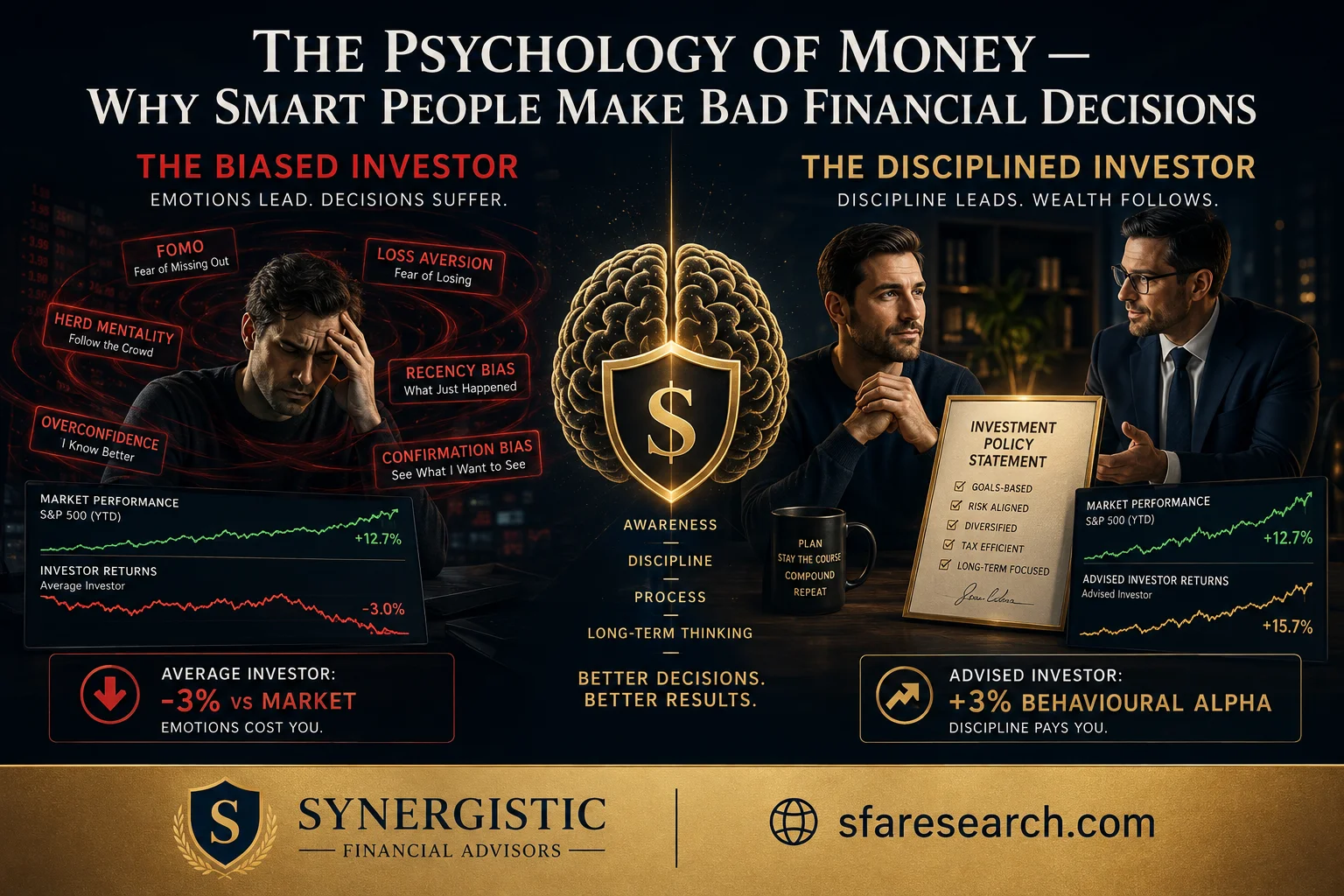
Here is the most humbling fact in all of personal finance: intelligence is not protection against bad financial decisions.
The doctors who panic-sold their entire equity portfolios on June 9, 2026, when the S&P 500 fell 2.6% in a single session. The engineers who poured savings into AI infrastructure stocks at their peak after reading nothing but bullish headlines for six straight months. The executives who held concentrated employer stock positions worth millions — unwilling to diversify — and watched years of wealth erode in a single earnings miss. The perfectly rational professionals who claimed Social Security at 62 without running the break-even analysis because “I want my money now.”
None of these people lacked intelligence. None of them lacked financial information. What they lacked was awareness of the specific, predictable, research-documented psychological mechanisms that cause every human brain — regardless of IQ — to make financially destructive decisions in predictable, repeatable patterns.
This is the central insight of behavioral finance — a field that has fundamentally changed how we understand financial planning, investment management, and wealth management by acknowledging what traditional economics refused to admit: investors are not rational. They are human. And human brains come factory-installed with cognitive shortcuts that served our ancestors well on the African savanna but consistently destroy portfolio management outcomes in modern financial markets.
Behavioral finance, a multidisciplinary field combining psychology and economics, offers insights into the complexities of investor decision-making — explaining why individuals often make irrational investment decisions that deviate from rational theory, resulting in market inefficiencies and suboptimal outcomes.
This guide identifies the 7 most financially destructive cognitive biases — with real 2026 market examples — and gives you the specific, practical framework for overcoming each one.
Why Smart People Make Bad Financial Decisions — The Foundational Insight
Traditional economic and financial theory posits that individuals are well-informed and consistent in their decision-making — but the cyclical investment process is rife with psychological pitfalls. Only by becoming aware of and actively avoiding innate behavioral biases can investors reach impartial decisions.
The problem runs deeper than occasional lapses in judgment. Behavioral finance integrates insights from psychology and neuroscience to explain and predict financial behaviors, revealing that cognitive biases originate in brain regions linked to emotional processing, social cognition, and reward anticipation — resulting in systematic deviations from rational investment behavior.
These are not random errors. They are systematic, predictable, and consistent — which makes them both genuinely dangerous and genuinely manageable. You cannot eliminate your cognitive biases. But you can build the financial planning systems and advisory relationships that prevent them from destroying your wealth management outcomes.
Understanding how people see risk is especially crucial in financial settings — because people rely on limited or secondhand information like stories, personal experiences, or word of mouth to judge risk, causing them to either underestimate or overestimate the danger involved, leading to poor decisions.
Here are the 7 cognitive biases that destroy investment management returns — with the 2026 market events that illustrate each one in real time.
Bias 1 — Loss Aversion: Why Losses Hurt Twice As Much As Gains Feel Good
Loss aversion is the most well-documented and most financially costly cognitive bias in existence. The research finding that has held across every culture and every economic context studied: the psychological pain of losing $1,000 is approximately twice as powerful as the pleasure of gaining $1,000.
Loss aversion, one of the most influential behavioral biases in investment decisions, originates in brain regions linked to emotional processing — causing investors to make systematically irrational decisions to avoid the pain of realising losses, even when holding losing positions is objectively the worse financial choice.
What it looks like in 2026:
The investor who watched their AI infrastructure stocks fall 30% from their peak — Coherent dropped 12% in a single session in August 2026 — and refused to sell because “I haven’t actually lost money until I sell.” The pain of realising that loss was so aversive that holding a deteriorating position felt psychologically safer than crystallising the loss, even when the rational analysis clearly supported reallocation.
Loss aversion also explains why most investors hold losing positions far too long and sell winning positions far too early — the exact opposite of optimal portfolio management behaviour. Selling a winner “locks in” a positive feeling but removes the opportunity for further compounding. Selling a loser “locks in” the painful feeling of being wrong. So the brain manufactures reasons to do the opposite of what rational investment management demands.
The Fix: Establish predetermined exit rules for every position before you buy it. A rule like “if this position falls 20% and the investment thesis has not changed, I will reassess and decide” removes the in-the-moment emotional override. Pre-committed rules replace loss-aversion-driven decisions with disciplined, pre-rational frameworks.
Bias 2 — Recency Bias: Why Recent Events Feel Permanent
Recency bias is the tendency to weight recent events dramatically more heavily than historical patterns — causing investors to extrapolate short-term trends indefinitely into the future.
Recency bias causes investors to place excessive weight on recent market events, leading to systematic overreaction to both positive and negative market developments — amplifying volatility and causing investors to make decisions based on the most recent data point rather than the full historical context.
What it looks like in 2026:
After nine consecutive winning weeks for the S&P 500 in mid-2026, surveys showed investor sentiment at near-record bullish levels — with the majority of retail investors expecting the rally to continue indefinitely. Then June 9 arrived and the index fell 2.6% in a single session. The same investors who had been confidently bullish for months suddenly expected further declines — because the most recent experience was a sharp correction. Both the excessive optimism and the sudden pessimism were recency bias in action.
The investors who bought aggressively into AI and semiconductor stocks at their 2026 peaks — after months of seeing nothing but positive returns in that sector — were expressing recency bias. The sector’s recent performance felt like permanent reality rather than a data point in a longer, more volatile history.
The Fix: Ground every investment management decision in long-term historical data rather than recent performance. A financial advisor who provides the full historical context — showing that the S&P 500 has recovered from every single correction in its history — replaces recency-biased present-tense thinking with the long-term perspective that disciplined wealth management requires.
Bias 3 — Overconfidence: The Most Expensive Bias You Cannot See
Overconfidence bias is the systematic tendency to overestimate your own knowledge, ability, and the accuracy of your predictions — and it is particularly dangerous precisely because it is invisible to the person experiencing it.
Investor overconfidence can lead to excessive or active trading, which can cause underperformance. The abundance of online information can exacerbate this behavioral bias in finance, creating an illusion of comprehensive knowledge that causes investors to trade more frequently, diversify less, and take on more risk than is objectively appropriate for their situation.
What it looks like in 2026:
The individual investor who spent six months reading AI investment newsletters, watching financial YouTube channels, and following analyst commentary on X — and then concluded that they understood the SpaceX IPO opportunity well enough to concentrate 40% of their savings in a single position at the $135 IPO price. The confidence felt justified by the quantity of information consumed. The quality of that analysis versus professional investment management research was not comparable — but overconfidence made it feel equivalent.
Studies consistently show that the investors who trade most frequently underperform those who trade least — not because frequent traders are less intelligent, but because overconfidence leads them to believe their judgement is accurate enough to justify the transaction costs and tax consequences of frequent trading. It is not.
The Fix: Track your actual investment predictions. Write down what you expect to happen with each investment decision and why — then review the record honestly six and twelve months later. Most investors discover quickly that their prediction accuracy is significantly lower than their confidence level suggested. This record creates the humility that prevents overconfidence from driving portfolio management decisions.
Bias 4 — Anchoring: Why the First Number You Hear Distorts Every Decision After It
Anchoring is the cognitive tendency to rely disproportionately on the first piece of information encountered when making subsequent decisions — even when that initial information is arbitrary or irrelevant.
Anchoring bias causes investors to rely excessively on initial reference points — such as purchase prices, analyst price targets, or historical highs — when evaluating current investment decisions, leading to systematic distortions in how value and risk are assessed.
What it looks like in 2026:
The investor who bought SpaceX shares at the $135 IPO price and, when the stock subsequently pulled back, evaluated every decision relative to that $135 anchor — “it’s only a good buy if it gets back to $135” or “I can’t sell until I get back to what I paid.” The $135 purchase price became an anchor that distorted every subsequent evaluation of the investment’s actual current value and future prospects.
Anchoring also affects how people evaluate financial advisor fees, investment returns, and asset valuations. When a stock trades at $200 per share and then falls to $140, investors often see it as “cheap” relative to the $200 anchor — even when $140 may still be significantly overvalued on fundamental grounds. The anchor replaces objective analysis with relative comparison.
The Fix: Evaluate every investment decision based on current fundamentals and future prospects — not relative to what you paid, what the analyst target was, or what the stock once traded at. Ask: “If I did not own this position and had no prior exposure, would I buy it today at this price?” This mental reset removes the anchor and restores fundamental analysis to its proper role in investment management decisions.
Bias 5 — Herd Mentality: Why FOMO Destroys Portfolios
Herd mentality — the tendency to follow the crowd rather than conduct independent analysis — is one of the most socially reinforced and most systematically destructive cognitive biases in investment management.
Herd mentality represents one of the most impactful behavioral biases in investing, emerging when investors make decisions based primarily on group behavior rather than independent analysis. This psychological factor often manifests through fear of missing out, leading market participants to skip crucial steps like due diligence and to follow crowd behavior into positions they would never have taken through independent rational analysis.
What it looks like in 2026:
The extraordinary concentration of capital into AI and semiconductor stocks through the first half of 2026 — driven not primarily by independent fundamental analysis but by the powerful social proof that “everyone is buying AI.” The Morningstar warning that the S&P 500’s top 10 constituents now represent 36% of index weight — the highest concentration since 1932 — was itself a product of herd behaviour at scale. When everyone buys the same stocks, those stocks become overrepresented in passive index funds, which creates more buying, which creates further price appreciation, which creates more social proof that justifies further concentration — a self-reinforcing herd cycle that historically ends badly.
Herd mentality is why market bubbles form and why corrections are so violent. The crowd rushes in during the appreciation phase, concentrating positions in the most popular assets. When the narrative shifts — as it always eventually does — the crowd rushes out simultaneously, creating the sharp, painful corrections that recency-biased latecomers experience as shocking and unprecedented.
The Fix: Measure the crowd’s positioning before following it. When a trade, sector, or asset is universally discussed as obvious and inevitable, that consensus itself is a risk signal — not a buying signal. A financial advisor who constructs your portfolio management strategy around genuine diversification rather than crowd-following themes protects you from the inevitable correction that follows every herd-driven concentration.
Bias 6 — Present Bias: Why Tomorrow’s Wealth Always Loses to Today’s Spending
Present bias is the cognitive tendency to overweight immediate rewards relative to future ones — even when the rational long-term calculation clearly favours patience and deferral.
Present bias explains why people consistently undersave for retirement planning despite knowing intellectually that they should save more. The pleasure of spending $500 today is vivid, immediate, and certain. The value of that same $500 compounded at 8% annually for 30 years — growing to approximately $5,032 — is abstract, distant, and psychologically far less compelling in the moment of decision.
What it looks like in 2026:
The professional who has been meaning to increase their 401(k) contribution rate from 6% to 12% for three years — but keeps deciding to do it “next quarter” because the immediate take-home pay reduction feels more real than the future retirement security the additional contribution would build. Each quarter, the present bias wins. Each quarter, thousands of dollars of compounding potential are permanently lost.
Present bias also explains why people raid retirement accounts for current expenses — triggering the 10% early withdrawal penalty plus ordinary income tax to fund consumption today — and why credit card debt at 22% APR persists even when people intellectually know the mathematics of compound interest working against them.
The Fix: Remove the present-bias decision entirely through automation. When your 401(k) contribution, Roth IRA transfer, and investment deposit happen automatically on payroll day — before the money ever reaches your checking account — present bias has no decision to distort. You cannot choose the present over the future if the future is funded before you can spend the present. This is why the pay-yourself-first budgeting method that removes human decision-making from the savings process is the single most effective behavioural intervention for present-bias-prone investors.
Bias 7 — Confirmation Bias: Why We Only Hear What We Already Believe
Confirmation bias is the tendency to seek out, interpret, and remember information that confirms pre-existing beliefs — while discounting, ignoring, or misinterpreting information that challenges them.
The abundance of online information can exacerbate behavioral biases in finance, creating an illusion of comprehensive knowledge — where investors surround themselves with confirming sources that reinforce their existing positions rather than challenging their investment thesis with genuinely contradictory evidence.
What it looks like in 2026:
The investor who believes the S&P 500 is heading to Goldman Sachs’s 8,000 target — and therefore reads every bullish analyst report, follows every optimistic commentator on X, and interprets every positive market development as confirmation of their thesis. When Bank of America’s research flagged that 70% of stock market warning signals were flashing simultaneously in June 2026, this investor dismissed that report as overly cautious — because it contradicted the conclusion they had already reached.
Confirmation bias is particularly dangerous in the age of algorithmic content feeds — which are explicitly designed to show you more of what you have previously engaged with. An investor who engages with bullish AI content will receive more bullish AI content, reinforcing their existing thesis until the echo chamber they have constructed feels like independent evidence of their correctness.
The Fix: Actively seek the strongest version of the argument against your current position before acting on it. If you are bullish on a position, spend 30 minutes reading the most credible bearish analysis available. If you are considering selling, read the strongest case for holding. This deliberate exposure to contradictory evidence does not require you to change your conclusion — but it ensures your conclusion is genuinely tested rather than simply confirmed.
The Quantifiable Cost of Cognitive Biases — Real Numbers
The financial cost of these seven biases is not abstract or theoretical. It is measurable, documented, and consistent across decades of research.
Vanguard’s research on advisor alpha consistently shows that investors who work with qualified financial advisors earn approximately 3% more annually than those who manage independently — with behavioural coaching accounting for approximately 1.5% of that annual advantage. On a $500,000 portfolio, 1.5% annually equals $7,500 per year in behavioural coaching value alone — before counting tax planning, rebalancing, and asset allocation contributions.
Historical case studies, including the Dotcom bubble, 2008 financial crisis, and Black Monday, illustrate how aggregated biases can trigger market-wide instability — with decision fatigue significantly impairing investors’ rational decision-making capabilities during periods of maximum market stress.
The 2026 data reinforces these patterns. The investors who panic-sold during June 9’s 2.6% selloff locked in losses and missed the subsequent recovery. The investors who concentrated in AI stocks at peak euphoria because “everyone is buying them” now hold positions 20-30% below their entry points. The investors who delayed claiming Social Security at 62 because “I want my money now” locked in a 30% permanent monthly reduction they will carry for the rest of their lives.
These are not hypothetical losses. They are the quantifiable cost of cognitive biases operating without a systematic countermeasure.
The 5-Step Framework for Overcoming Financial Cognitive Biases
Understanding your biases is the first step. Building the systematic framework that prevents them from driving your decisions is the second — and more important — one.
Step 1 — Write an Investment Policy Statement. Define your asset allocation, rebalancing rules, exit criteria, and contribution schedule in advance — when you are calm and rational — so that the document governs decisions during emotional market episodes rather than the biases that dominate in-the-moment thinking.
Step 2 — Automate Every Decision You Can. Contributions, rebalancing, tax-loss harvesting, and savings transfers that happen automatically cannot be overridden by loss aversion, present bias, or herd mentality. The system governs, not the emotion.
Step 3 — Seek Genuinely Contradictory Evidence. Before every major investment management decision, actively find the strongest version of the opposing argument. If you cannot articulate the bear case as compellingly as the bull case, you have not done sufficient analysis.
Step 4 — Track Your Predictions Honestly. Keep a decision journal — recording what you expected to happen and why. Review it quarterly. Most investors discover that their prediction accuracy humbles their confidence level significantly — creating the epistemic modesty that prevents overconfidence from driving decisions.
Step 5 — Work With a Fiduciary Financial Advisor. Practical strategies to mitigate the adverse effects of cognitive biases include structured decision-making frameworks, professional guidance, and emerging technologies like AI. A fiduciary financial advisor who understands behavioral finance provides the systematic countermeasure to every bias on this list — maintaining the disciplined long-term financial planning framework when your brain is manufacturing reasons to abandon it.
How Synergistic Financial Advisors Manages Behavioral Finance for Every Client
At Synergistic Financial Advisors, we understand that the most important financial planning work we do is not picking the right investments — it is preventing the wrong decisions.
Our certified financial planner team builds every client relationship around the behavioral finance reality that markets test every human brain’s cognitive architecture in predictable ways. We provide the investment policy statement framework that prevents loss aversion from driving sell decisions during corrections. We maintain the diversified portfolio management strategy that prevents herd mentality from concentrating your savings in the consensus trade. We conduct the quarterly performance reviews that replace recency bias with long-term perspective. And we provide the behavioural coaching that keeps every client invested and disciplined through the June 9 selloffs, the AI bubble anxieties, and the Fed policy shocks that make clear thinking genuinely difficult.
The difference between what smart investors earn and what the average investor earns is not intelligence. It is the presence or absence of a disciplined system that prevents cognitive biases from overriding the rational financial planning decisions that build genuine, lasting wealth management outcomes.
Ready to build the behavioral finance framework that prevents smart people from making predictably bad financial decisions? Contact Synergistic Financial Advisors today for a personalised consultation.
👉 Visit sfaresearch.com — because the most expensive financial mistakes are not the ones that feel wrong in the moment. They are the ones that feel completely rational.
Final Thoughts — The Brain Is Not Built for Modern Financial Markets
The human brain evolved over hundreds of thousands of years to solve survival problems — detecting predators, evaluating immediate threats, following the herd away from danger. It was not built to evaluate 30-year compound interest projections, hold concentrated positions through 30% corrections, or maintain disciplined diversification when the crowd is generating spectacular returns from a single sector.
Understanding behavioral biases in investment decision-making is crucial for developing sound investment strategies and maintaining financial stability — with the most effective mitigation combining financial education, structured decision-making processes, and professional guidance.
The seven cognitive biases in this guide — loss aversion, recency bias, overconfidence, anchoring, herd mentality, present bias, and confirmation bias — are not character flaws. They are human universals. They affect every investor, regardless of intelligence, regardless of education, regardless of financial knowledge.
What separates the investors who build genuine wealth management outcomes from those who perpetually underperform their own portfolios is not the absence of these biases — it is the presence of the systems, frameworks, and professional guidance that prevent biases from making the final call.
At Synergistic Financial Advisors, building those systems is the most important work we do.