This is the week that changes the trajectory of 2026.
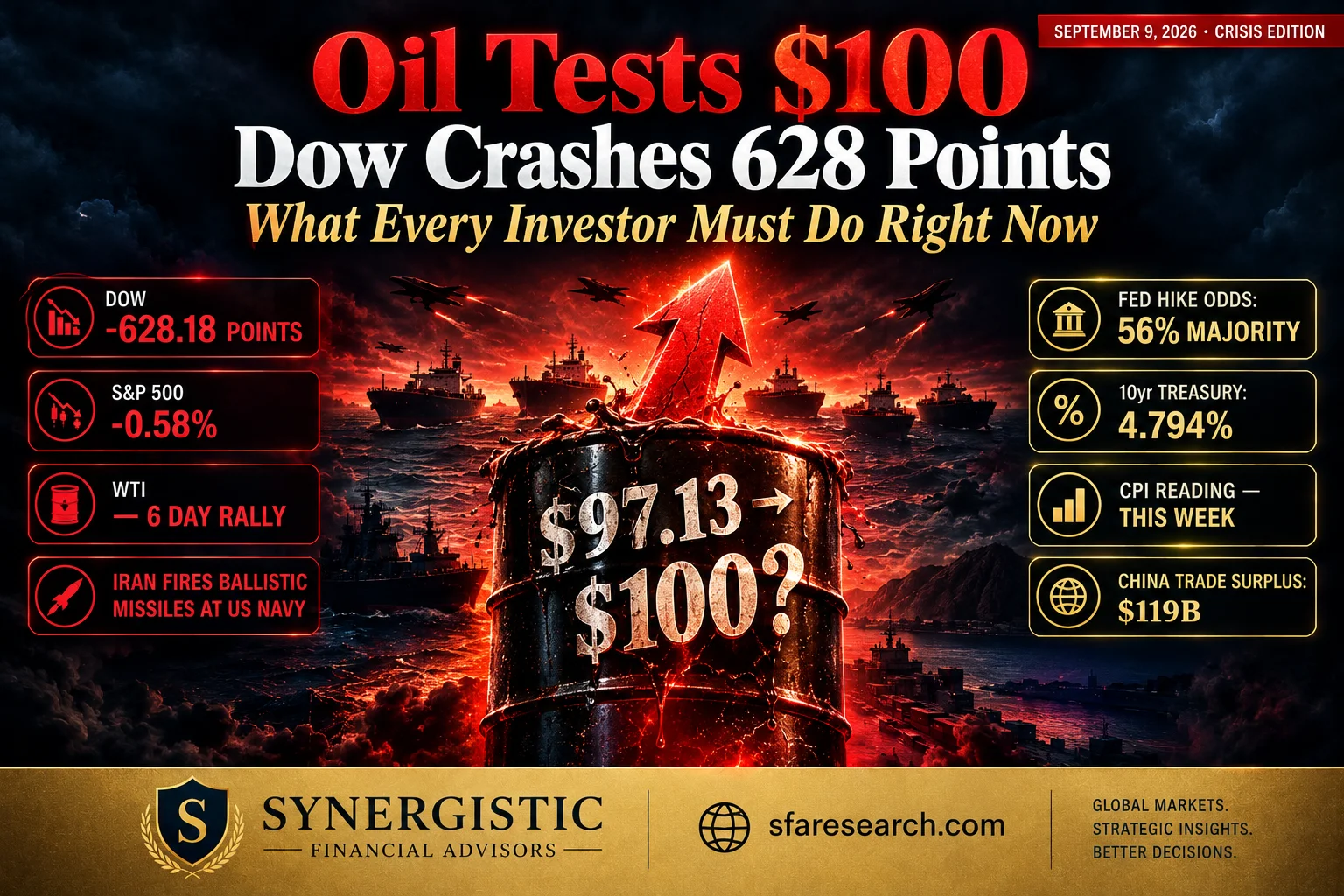
The U.S. military struck five Iranian tankers after Iran fired ballistic missiles at a U.S. Navy warship. Oil prices surged. The Dow Jones Industrial Average tumbled 628.18 points, or 1.18%, to 52,786.07. The 30-stock index was down for a second straight session after Friday’s 272-point loss. The S&P 500 was down by 0.58% to 7,673.52, while the Nasdaq Composite was lower by 0.32% to 26,421.41.
West Texas Intermediate futures climbed for a sixth straight day — its longest rally since a seven-day streak back in March. Brent crude is testing $97 with $100 directly in its sights. And this morning, overnight price action is being steered more by the bond market than by equities, as the US 10-year yield sits at 4.794%.
But here is the number that changes every financial planning calculation you have made this year: market-implied probabilities now put a 25bp hike at the September FOMC meeting near 56%, after Chair Kevin Warsh’s hawkish Jackson Hole speech was tempered by Governor Christopher Waller’s conditional support for holding rates.
From a coin flip last week to a 56% majority probability this week. The Federal Reserve is now more likely than not to raise interest rates at its September meeting — and every single retirement planning projection, every investment management strategy, and every wealth management framework that assumed the next Fed move was a cut is now operating on an outdated assumption.
This is the blog your Wednesday morning demands — the complete, honest picture of what is happening right now and exactly what every serious investor should do about it.
The Escalation Nobody Planned For — Five Tankers in 72 Hours
In our Monday blog, we reported that the US had struck three Iranian oil tankers over the weekend. By Tuesday, that number had risen to five — with Iran simultaneously firing ballistic missiles at US Navy warships in direct military retaliation.
Stocks came under pressure as oil prices continued to rise. The market’s reaction was immediate, sustained, and directionally clear — this is no longer a geopolitical uncertainty story. It is a geopolitical escalation story, and the difference between those two framings has specific, material implications for every portfolio management strategy currently holding energy, fixed income, or rate-sensitive equity positions.
Oil prices test $100/bbl and the 10-year nears a two-decade high — that headline from TheStreet this morning captures precisely the dual threat that September’s escalation has created. Crude approaching $100 is not merely an energy cost story. It is a core inflation story, a Fed policy story, a bond yield story, and ultimately a valuation story for every asset class simultaneously.
The mechanism is direct and rapid. Higher oil → higher energy costs → higher CPI → higher inflation expectations → higher bond yields → higher equity discount rates → lower equity valuations, particularly for long-duration growth assets. This chain of consequences is not theoretical — it is playing out in real time in today’s market prices.
For every individual investor navigating this environment, the most important insight is this: the escalation was not priced into your financial plan at the start of September. It needs to be priced in now — before CPI drops this week and either validates or challenges the rate-hike narrative that is currently dominating market psychology.
The CPI Reading That Could Determine the Rest of 2026
This week’s most consequential data point has not yet arrived — and its arrival will reshape the trajectory of markets, Fed policy, and your financial planning strategy for the remainder of the year.
The August CPI reading — releasing this week — arrives in the most consequential context possible. US 10-year Treasury yields are near 4.8%, reflecting persistent inflation concerns, with the global risk tone soft as long yields grind higher. If August CPI confirms that oil-driven inflation is genuinely re-accelerating — which six consecutive days of WTI price gains strongly suggest it is — the 56% Fed hike probability moves toward certainty. If CPI surprises to the downside, the hike probability retreats and markets stage the relief rally that has been building behind every dovish Fed communication this week.
Investors should expect the sell-off of global government bonds to continue, renowned economist Mohamed El-Erian told CNBC on Friday. “I don’t see any appetite in the U.S. for immediate fiscal consolidation. So I suspect we will continue to see upward pressures on yields,” he told CNBC.
Mohamed El-Erian — one of the world’s most respected macro economists — explicitly forecasting continued bond yield pressure. The 10-year at 4.794% and rising. WTI oil on a six-day rally. Five Iranian tankers struck. Iran firing ballistic missiles at US Navy ships. These are not the inputs of a disinflationary environment. They are the inputs of a world where the Fed’s 2% inflation target remains genuinely, stubbornly distant — and where the September rate hike that seemed impossible in June 2026 is now the most likely single outcome.
For your retirement planning specifically, every projection built on declining rates needs rebuilding around the 56% probability that rates go higher before they go lower. A certified financial planner who stress-tests your retirement planning income strategy against a 5%+ rate environment — rather than the declining rate path that dominated planning assumptions for the past 18 months — delivers the most urgently needed planning value of the entire year.
China’s $119 Billion Trade Surplus — The AI Demand Signal in Real Data
Amid the geopolitical and monetary policy noise, one of the most genuinely significant economic data points of the week arrived from Beijing — and its implications for investment management portfolios with technology exposure are directly material.
China’s trade surplus swelled to $119.09 billion from $112.5 billion in July. Exports grew 25% in US dollar terms in August from a year earlier. Exports have become the primary growth driver for China’s economy, as surging demand for high-tech components amid a global build-out of AI infrastructure has helped cushion the drag from geopolitical shocks, sluggish domestic demand and a slump in investment.
China’s exports growing 25% year-on-year. A $119 billion trade surplus in a single month. And the explicit attribution: AI infrastructure demand as the primary driver of that export surge.
This data point matters for your investment management strategy in a specific way. When China’s export data shows $119 billion monthly surpluses driven by AI infrastructure components, you are not looking at narrative or analyst projection — you are looking at trade statistics that directly measure the physical buildout of AI infrastructure in real time. The semiconductors, the memory chips, the networking components that power AI data centres are being manufactured and shipped at record volumes.
The Nasdaq Composite held up better, slipping just 0.32% to 26,421, suggesting investors are trimming cyclical exposure rather than abandoning tech.
The Nasdaq’s relative outperformance against the Dow — down only 0.32% versus the Dow’s 1.18% decline — is itself a signal. In an environment of genuine economic uncertainty, rising yields, and geopolitical stress, technology and AI-adjacent equities are holding value better than the broad cyclical market. This is the market’s way of distinguishing between companies whose earnings are tied to the domestic economic cycle and companies whose earnings are tied to the structural AI infrastructure buildout that China’s $119 billion trade surplus confirms is real and accelerating.
For your portfolio management strategy, this distinction — between cyclical exposure that is under genuine economic pressure and AI infrastructure exposure that is confirmed by actual global trade data — is one of the most actionable signals available in today’s market.
The Bond Market Is Now Running the Show
One of the most important structural developments of September 2026 is the shift in which market is driving the others — and understanding this shift is essential for every investor’s financial planning framework.
Overnight price action is being steered more by the bond market than by equities, as the US 10-year yield sits at 4.794%, up 0.10% on the day.
The bond market is now the primary driver of equity market direction — not the other way around. This represents a structural shift from the AI-narrative-driven equity market of early 2026, where strong technology earnings and SpaceX IPO excitement pulled yields along as a secondary consideration. In September 2026, every basis point move in the 10-year Treasury is being watched more carefully than any earnings release, any analyst upgrade, or any corporate announcement.
The Dow Jones Industrial Average fell 1.18% to 52,786, the weakest of the major US benchmarks, while the S&P 500 lost 0.58% to 7,674.
The Dow’s 1.18% decline versus the S&P’s 0.58% decline and the Nasdaq’s 0.32% decline is a clear sectoral signal. The Dow’s heavier weighting toward financials, industrials, and consumer staples — all sectors with direct earnings sensitivity to borrowing costs and economic cycle — made it the worst performer in an environment where the bond market is tightening financial conditions.
For your wealth management strategy, the bond-driven market environment creates a specific and actionable implication: the yield on every fixed income instrument in your portfolio management is now being priced against a backdrop where 56% of market participants expect the Fed to raise rates this month. Duration risk — the sensitivity of your existing bond holdings to further yield increases — deserves immediate assessment against your retirement planning timeline.
What Warsh Said at Jackson Hole — And Why It Matters Today
The Fed policy context for today’s market requires understanding what Chair Kevin Warsh communicated at the Jackson Hole symposium — because his words are directly shaping the 56% September hike probability that is driving bond yields and weighing on equities.
Chair Kevin Warsh’s hawkish Jackson Hole speech was tempered by Governor Christopher Waller’s conditional support for holding rates.
Warsh hawkish. Waller conditionally dovish. The committee genuinely split — reflecting the same 9-of-18 dot plot division that shocked markets when Warsh eliminated forward guidance at his June press conference. In that environment — with the committee divided and incoming data genuinely ambiguous before this week’s CPI — the August CPI number becomes the swing factor that determines which camp wins the September 17 FOMC decision.
This is precisely why this week’s CPI release is the most consequential economic data point of the month. The Fed is genuinely undecided. The market is genuinely split. And the inflation reading that arrives this week will be the primary input that resolves the ambiguity — one way or the other, with immediate, material consequences for bond yields, equity valuations, and every financial planning strategy built around a specific rate path assumption.
6 Specific Actions for Your Financial Plan — Today, Wednesday September 9
Given the extraordinary convergence of today’s developments — five Iranian tankers struck, ballistic missiles fired at US Navy ships, oil testing $100, Dow down 628 points, Fed hike odds at 56%, 10-year yield at 4.794%, CPI due this week, and China’s $119 billion AI-driven trade surplus — here is the specific, disciplined action plan for every serious investor.
Action 1 — Reposition Around the 56% Hike Reality. The September Fed hike is now more likely than not. Every retirement planning income projection, every fixed income allocation, and every rate-sensitive equity position deserves immediate reassessment against this revised probability. A financial advisor who recalibrates your strategy today — before the FOMC decision on September 17 — positions you ahead of the market rather than behind it.
Action 2 — Assess Your Oil and Energy Inflation Exposure. WTI on a six-day rally. Brent testing $97. Five tankers struck overnight. The $100 oil threshold that seemed extreme two weeks ago is now a genuine near-term possibility. A certified financial planner can model the specific impact of $100 sustained oil on your retirement planning projections, your fixed income real returns, and your portfolio management sector allocation.
Action 3 — Distinguish AI Exposure from Cyclical Exposure. Today’s market is explicitly rewarding this distinction — the Nasdaq down only 0.32% while the Dow falls 1.18%. China’s $119 billion trade surplus confirms the AI infrastructure buildout in real trade data. A portfolio management review that separates your structural AI exposure from your cyclical economic exposure captures this market signal with deliberate strategy rather than passive drift.
Action 4 — Build Your CPI Response Framework Before Thursday. The August CPI arrives this week. Build your response framework for both scenarios right now — before the number drops. Hot CPI above 3.5% pushes hike odds toward certainty and extends the bond selloff. Cool CPI below 3.0% restores the hold case and triggers a relief rally. A financial advisor who has pre-built your response for both outcomes ensures you execute strategy rather than emotion when the headline hits.
Action 5 — Review Bond Duration Against Yield Risk. The 10-year at 4.794% and the 30-year above 5.3% represent both a risk to existing long-duration holdings and an opportunity for new deployments at the highest yields in nearly two decades. A portfolio management review that assesses your duration exposure against the 56% hike scenario identifies exactly where to reduce duration risk and where to lock in historically attractive yields.
Action 6 — Schedule Your Complete September Financial Review. September 9 brings five Iranian tankers struck, ballistic missiles fired, oil at $97+, 628-point Dow decline, 56% Fed hike odds, and a CPI number arriving this week that could determine the rest of 2026. If your financial planning strategy has not been reviewed against this specific environment, it is not the strategy for this specific moment. Schedule a comprehensive review — covering investment management, tax planning, retirement planning, and wealth management — this week.
How Synergistic Financial Advisors Navigates Today for You
At Synergistic Financial Advisors, the events of Tuesday September 8 through Wednesday September 9 — five Iranian oil tankers struck, Iran’s ballistic missile retaliation, oil testing $100, Dow down 628 points, Fed hike odds above 56%, and CPI due this week — are not surprises that require reactive scrambling. They are scenarios our team has modelled, planned for, and built specific client response frameworks around in advance.
Our certified financial planner team is reaching out to every client proactively this week — with specific, personalised guidance on how today’s developments affect their individual portfolio management positioning, their retirement planning income projections, their fixed income duration exposure, and their tax planning opportunities created by September’s market volatility.
The investors who navigate this moment successfully are not those who react fastest to this morning’s headlines. They are those whose financial planning frameworks were built to anticipate exactly this kind of multi-dimensional volatility — and whose financial advisors are already on the phone with a specific, data-grounded plan before the market makes the decision for them.
Ready to build the September 2026 financial plan that accounts for everything happening right now? Contact Synergistic Financial Advisors today.
👉 Visit sfaresearch.com — because when oil tests $100, the Dow falls 628 points, and the Fed is about to hike, the right financial plan is the only thing standing between you and reactive decisions you will regret.
Final Thoughts — The Most Important Week of September 2026 Is Happening Right Now
Five Iranian tankers struck overnight. Iran firing ballistic missiles at US Navy warships. Oil testing $100. The Dow down 628 points. The 10-year Treasury at 4.794% and rising. Fed September hike odds at 56% — a majority for the first time this year. CPI arriving this week. Chair Warsh hawkish at Jackson Hole. China’s $119 billion AI-driven trade surplus confirming the structural technology investment cycle in real data.
This is September 9, 2026. The most consequential Wednesday of the most consequential month of one of the most consequential years in financial history.
Your financial plan should be built for this moment — not the calmer one that existed three weeks ago.
At Synergistic Financial Advisors, we are here to make sure it is.
👉 sfaresearch.com