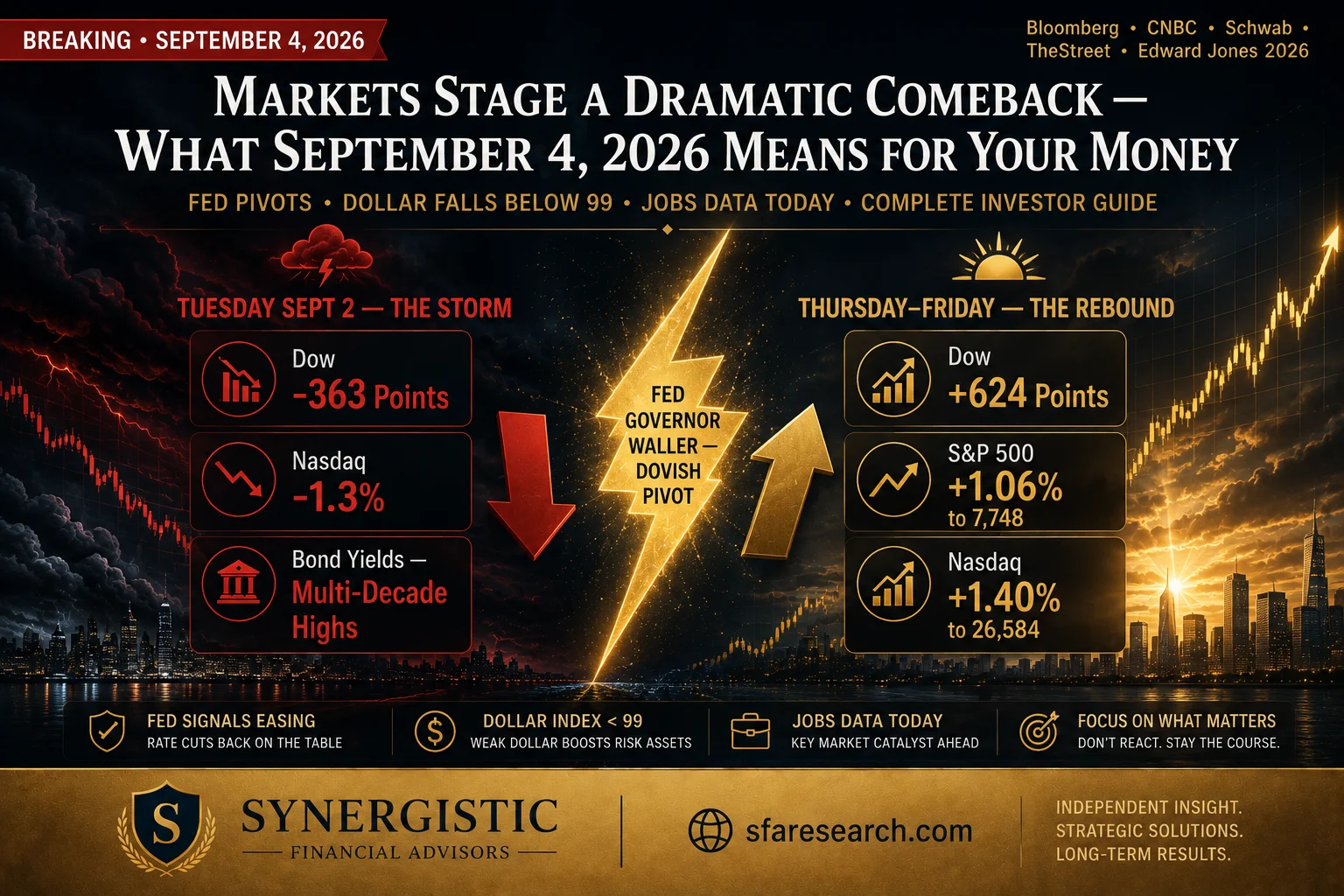
What a difference 72 hours makes.
On Tuesday September 2, markets opened with a thud — the Dow down 363 points, the Nasdaq falling 1.3%, global bond yields surging to levels not seen since the 2008 financial crisis, oil spiking on renewed US-Iran conflict, and the ECB preparing another rate hike. The financial headlines screamed “perfect storm” from every direction.
By Thursday, the picture had reversed dramatically. Wall Street rebounded as the Dow climbed 1.18% to 53,686, the S&P 500 rose 1.06% to 7,748 and the Nasdaq jumped 1.40% to 26,584 after Fed Governor Christopher Waller urged patience on rates, reviving risk appetite.
This is the market of September 2026 in miniature — violent swings in both directions, driven by a single Fed official’s comment, a currency move in Tokyo, and the anticipation of a single data release. And today, Friday September 4, every investor’s attention is focused on one number that could determine the direction of markets, the Federal Reserve’s next decision, and your financial planning strategy for the final quarter of 2026.
The Jobs Number That Could Change Everything
Today’s August nonfarm payrolls report is the most consequential economic data release of the month — and possibly the quarter.
The Federal Reserve’s next decision could hinge on Friday’s labor data and next week’s inflation readings. And the backdrop could not be more consequential: the Fed September still a coin flip — US July CPI rose 3.4% year-on-year and the economy lost 23,000 jobs, pulling market odds for a September hike down to roughly one-third to one-half.
July’s shocking loss of 23,000 jobs — when markets had expected gains — was the single data point that most significantly eased rate hike expectations this week. If August’s payrolls confirm that labour market cooling is genuine and sustained, the Federal Reserve’s case for hiking rates at its September meeting weakens considerably. If August delivers a strong jobs number, the rate hike probability swings back toward certainty — and the bond market selloff of earlier this week resumes with renewed conviction.
For your retirement planning and investment management strategy, this single data point — releasing today — has the potential to materially shift the interest rate environment for the remainder of 2026. A financial advisor who has pre-built your response framework for both scenarios — hot jobs data and cool jobs data — ensures you execute strategy rather than react emotionally to whatever number arrives.
The Fed Governor Who Changed the Week — Waller’s Dovish Pivot
The single most market-moving development of the week did not come from earnings, geopolitics, or economic data. It came from a Federal Reserve governor’s comments that immediately transformed the market mood from fear to relief.
Stocks rose on an early drop in Treasury yields as the yen climbed versus the dollar and a Fed governor made dovish remarks. Treasury yields fell, and rate futures trimmed the odds of a September move to roughly one-third to one-half. The case for a hold rests on cooler inflation and a shock July payrolls loss of 23,000 jobs.
Fed Governor Waller — signalling support for no rate hike in September — was effectively communicating that the data does not yet compel action. That single signal sent Treasury yields retreating from multi-year highs, the dollar tumbling below 99 on the index, and equities staging their strongest session of the week.
Treasury yields moved lower across the curve on Thursday — the 10-year Treasury note yield fell more than 2 basis points to 4.7680%, the longer-dated 30-year Treasury yield dropped 2 basis points to 5.2433%, and the shorter 2-year Treasury note yield was more than 2 basis points lower at 4.3609%.
The retreat from multi-year highs — while meaningful — does not eliminate the underlying tension that drove yields to those heights in the first place. Crude continued to rise with no sign of progress in the Middle East. The war is raising the price of money — and that structural challenge does not disappear because one Fed governor signals patience for one month.
For your portfolio management strategy, the important takeaway is not that the crisis is over — it is that the crisis is being actively repriced in real time by central bank communications, currency movements, and economic data. This is precisely the environment where wealth management discipline matters most.
The Dollar Decline — What It Means for Your Investments
One of the most significant but least-discussed developments of this week was the sharp decline in the US dollar — which carries direct implications for investment management strategies with international exposure.
The US Dollar Index crossed below 99 on Thursday, hitting levels it last traded on Aug. 26. The greenback also hit a session low against the yen of 155.50, which is the lowest level it has traded since Aug. 3. Its almost 2% decline against the yen is the biggest loss the dollar has experienced since July 30.
The US dollar slumped to start September as the yen surged on rate bets — with stocks rising as Fed hike bets eased and the dollar steadied.
A weakening dollar has specific, immediate implications for a diversified investment management portfolio. International equity holdings — which are denominated in foreign currencies — generate higher dollar-denominated returns when the dollar falls. The same international position that looked disappointing when the dollar was strong at 102 looks significantly better when the dollar falls to 98.
For investors whose portfolio management strategy includes meaningful international diversification — which Morningstar, Vanguard, and BlackRock all recommended entering 2026 given the extraordinary AI-driven concentration in US large-cap indices — the dollar’s September weakness is a genuine, measurable tailwind that validates that diversification decision.
The AI Trade Accelerates — Nvidia Acquisition Signals Continued Infrastructure Buildout
Amid all the macro volatility, the AI story continued advancing with a development that signals continued, accelerating infrastructure buildout.
Nvidia agrees to buy open-source — a transaction that underscores the continued aggressive capital deployment by the dominant AI infrastructure company even as it digests its extraordinary quarter. Recall that Nvidia reported $96.2 billion in revenue for its fiscal second quarter — up 106% year-over-year — and CEO Jensen Huang explicitly declared that “AI has reached its inflection point” and “compute is now revenue.”
Initial jobless claims were little changed last week while the US trade deficit surged on rising imports of technology-related goods as the artificial intelligence buildout continues to gain steam.
A surging trade deficit driven by AI infrastructure imports is a specific and telling data point. American companies are importing the components, equipment, and technology goods required to build out AI infrastructure at an accelerating rate — generating a trade deficit that simultaneously reflects the scale of AI investment and the global supply chain that supports it. This is the AI buildout translated into real economic activity — import data, jobs data, corporate earnings data — rather than narrative alone.
For your investment management strategy, the AI infrastructure story is maturing from narrative to measurable economic activity. The companies building AI infrastructure — and the investors positioned in them with appropriate diversification and disciplined portfolio management — are participating in one of the most consequential capital investment cycles in economic history.
4 Actions for Your Financial Plan — Right Now, This Friday
Given today’s jobs report, the week’s dramatic market reversal, the dollar decline, and the evolving AI infrastructure story, here are the four most important financial planning actions for every serious investor entering the weekend.
Action 1 — Watch the Jobs Number With a Pre-Built Response. Today’s August nonfarm payrolls will move markets. A strong number re-accelerates rate hike expectations and pressures equities. A weak number confirms the case for a September Fed hold and extends the relief rally. A financial advisor who has pre-built your response framework for both scenarios ensures you act on strategy rather than sentiment.
Action 2 — Reassess Your International Exposure. The dollar’s sharp decline this week — below 99 on the index — changes the relative return calculation for international versus domestic equity exposure. A portfolio management review that models your actual currency exposure across international holdings captures the strategic implication of this week’s currency shift.
Action 3 — Evaluate Fixed Income at Today’s Yields. Even after this week’s retreat from multi-year highs, the US 10-year Treasury at 4.77% and the 30-year at 5.24% represent genuinely compelling retirement planning income opportunities. For investors approaching or in the distribution phase, locking in a portion of fixed income allocation at these levels creates inflation-adjusted income security that has not been available since before the 2008 financial crisis in most markets.
Action 4 — Schedule a Q4 Financial Planning Review. September 4 marks the beginning of the final quarter of one of the most extraordinary years in financial history. A comprehensive financial planning review — covering investment management, tax planning opportunities before December 31, retirement planning projections updated for 2026’s actual rate environment, and wealth management strategy for 2027 — is the most valuable financial action available to any investor entering Q4 with genuine seriousness about their long-term financial security.
How Synergistic Financial Advisors Navigates This Moment
At Synergistic Financial Advisors, every development this week — Waller’s dovish signal, the dollar’s decline, the jobs data anticipation, the AI infrastructure acceleration, and the global bond yield retreat from multi-decade highs — is being actively translated into specific, personalised guidance for every client relationship we manage.
Our certified financial planner team builds financial planning strategies that perform through volatile weeks like this one — not by predicting which direction markets move, but by ensuring your portfolio management, tax planning, retirement planning, and wealth management strategy accounts for every scenario before markets make the choice for you.
Ready to enter Q4 2026 with a financial plan built for the world as it actually is? Contact Synergistic Financial Advisors today.
👉 sfaresearch.com — because in 2026, the investors who plan ahead are the ones who sleep well on Friday nights.