Over the weekend, the financial world changed again.
The US struck three Iranian oil tankers, and Iran responded by targeting US Navy warships with ballistic missiles — with US Energy Secretary Chris Wright saying Sunday that the Iran nuclear deal may not happen anytime soon. “There may not be a nuclear agreement. It may be simply destroying their capabilities to do it,” Wright said on ABC News’ “This Week.”
Read that again. The US Secretary of Energy — the cabinet official responsible for America’s energy policy — saying publicly on Sunday morning that military destruction of Iran’s nuclear capabilities may now be the outcome rather than a negotiated deal. That is not a headline from a geopolitical news wire. That is a direct, material input into every oil price, every inflation projection, every Federal Reserve rate decision, and every financial planning strategy built around the assumption that energy costs will eventually stabilise.
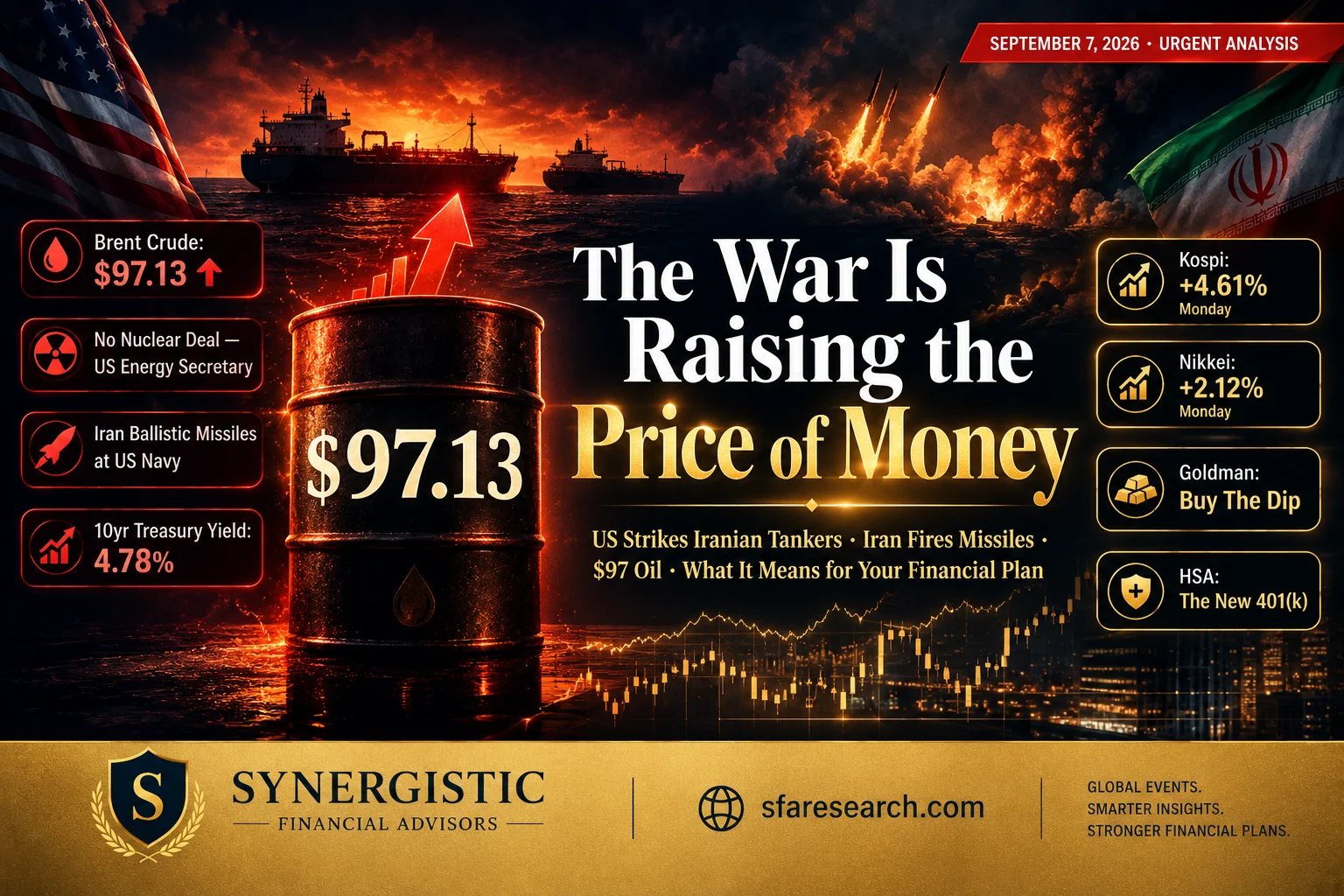
Oil prices rose Monday as renewed tensions in the Middle East stoked concerns that the conflict could drag on, threatening energy supplies. International benchmark Brent crude futures were up 0.88% at $97.13 a barrel. US West Texas Intermediate crude futures rose 0.92% to $92.32 a barrel.
Brent crude at $97.13 this morning. One significant escalation away from $100 oil. And a US Energy Secretary who just told the world that the conflict has no clear diplomatic resolution in sight.
The war is raising the price of money. The US economy grew “modestly,” though there is rising concern about the Iran war and its impact on prices, the Federal Reserve reported.
Five words. The most important sentence in this morning’s financial briefing. The war is raising the price of money. That sentence — from the Federal Reserve’s own assessment — connects the military conflict in the Strait of Hormuz directly to the interest rates that govern your mortgage, your credit cards, your business loan, your retirement planning projections, and the valuations of every asset in your portfolio management strategy.
This is the blog your Monday morning deserves — the complete, honest picture of what this weekend’s escalation actually means for your financial planning, and the specific actions that separate reactive investors from prepared ones.
How $97 Oil Changes Every Financial Calculation You Have Made This Year
When Brent crude trades at $97.13, the effect is not limited to what you pay at the petrol pump. It cascades through the entire economic system in ways that every individual investor needs to understand.
Energy is the foundational input cost of the global economy. When oil rises, the cost of manufacturing rises. The cost of shipping rises. The cost of agriculture rises — because farm machinery runs on diesel and fertiliser is derived from natural gas. The cost of airline tickets rises. The cost of plastics rises. The cost of heating and cooling homes and offices rises. Every one of these cost increases eventually appears in the Consumer Price Index — the inflation reading that determines Federal Reserve policy.
The benchmark US 10-year Treasury note yield hit a high of 4.818% on Wednesday — a level not seen since November 2023. Yields in the UK, Germany and France also rose.
Those multi-year yield highs — driven precisely by the oil-inflation-rate pathway described above — are the market’s way of pricing the war’s financial consequences in real time. When oil threatens $100, fixed income markets price more inflation, which prices more rate hikes, which raises yields, which raises the discount rate applied to every equity valuation, which pressures stock prices — particularly long-duration growth assets whose valuations are most sensitive to the rate environment.
For your specific financial planning position, the $97 oil price this morning demands honest reassessment of every projection that assumed energy costs had peaked. They have not. Not while the Strait of Hormuz remains contested and the US Energy Secretary is talking about military destruction of nuclear capabilities rather than diplomatic agreements.
The Asian Divergence — Why Tokyo and Seoul Are Rising While Europe Falls
One of the most important and most counterintuitive market stories of this Monday morning is the divergence between Asian and European equity markets in response to the weekend’s escalation.
European stocks traded lower on Monday as Asia-Pacific markets broadly rose, with investor attention focused on the latest developments in the US-Iran war. Europe’s main Stoxx 600 benchmark dipped almost 0.1%, with Germany’s DAX leading losses. The UK FTSE 100 fell 0.12%. In Asia, Japan’s Nikkei 225 closed 2.12% higher, while South Korea’s Kospi rose 4.61%. Mainland China’s CSI 300 gained 0.59%.
Japan’s Nikkei up 2.12%. South Korea’s Kospi up 4.61%. While European stocks fall.
The explanation lies in the specific sectoral composition of these markets and their different energy exposures. South Korea’s extraordinary 4.61% gain is significantly driven by its semiconductor sector — South Korea’s total shipments climbing 68.7% year on year to $98.25 billion, with the demand for semiconductors due to increased capital expenditures by hyperscalers such as Google and Amazon.
South Korean semiconductor exports up 68.7% year on year. In a single country. This is the AI infrastructure buildout measured in real trade data — not narrative, not analyst projection, but actual shipments of the chips that power the AI revolution. For investors evaluating where genuine, data-confirmed AI demand exists, South Korean export figures are one of the most reliable leading indicators available.
For your portfolio management strategy, the Asian divergence this morning illustrates a genuinely important principle: not all international exposure is equivalent. Markets with meaningful semiconductor and AI infrastructure exposure are responding very differently to the current environment than markets with heavy energy import dependence and proximity to geopolitical risk.
Goldman Sachs Says Buy the Dip — Here Is the Full Context
Goldman Sachs says buy the dip in these five stocks.
Goldman’s “buy the dip” call this weekend deserves both attention and context — because the most dangerous version of this advice is the one taken without understanding the specific conditions that make it valid.
Capital Markets expect the third-quarter volatility in the US economy could be followed by a strong fourth-quarter performance. “For the second half of the year, we continue to think increased volatility during Q3 is likely, with a better outlook in Q4 if inflation can moderate, perhaps helping Fed sentiment around the time investors might be gaining more comfort with a new Chair.”
The conditional language matters enormously here: “if inflation can moderate.” Goldman’s constructive Q4 outlook is explicitly contingent on inflation moderating — and this morning’s $97 Brent crude price is the single biggest threat to that moderation scenario. If oil continues toward $100 and beyond, the inflation moderation that Goldman’s Q4 optimism depends on becomes significantly more difficult to achieve.
This is not a reason to dismiss Goldman’s call — it is a reason to understand it precisely. The Q4 opportunity is real if the energy situation stabilises. It becomes less compelling if Brent crude reaches $100 and CPI re-accelerates above its current 3.4% reading.
For your investment management strategy, this means positioning for the Q4 opportunity Goldman identifies while maintaining explicit awareness of the oil-inflation-rate risk that is the primary threat to that scenario. A certified financial planner who models both the bull case and the specific risk that invalidates it is providing exactly the balanced, sophisticated analysis that this moment demands.
The HSA Story Nobody Is Talking About — But Every Employee Should Read
Amid all the geopolitical noise this week, one genuinely viral financial story emerged that has profound implications for personal financial planning — and almost no one outside the benefits world is paying attention to it.
With HSAs, employers are turning to the 401(k) playbook.
Employers are beginning to treat Health Savings Accounts the way they treated 401(k)s in their early adoption phase — with automatic enrolment, employer matching contributions, and the kind of systematic promotion that transformed 401(k)s from an obscure tax vehicle into America’s primary retirement savings mechanism.
This is one of the most significant personal finance developments of 2026 — and it is almost entirely below the radar of most individual investors. The HSA is the only triple-tax-advantage account in the US tax code: contributions are tax-deductible, growth is tax-free, and withdrawals for qualified medical expenses are tax-free. For investors enrolled in high-deductible health plans who treat their HSA as a long-term investment vehicle rather than a short-term medical expense account, the compounding advantage across a 20-30 year retirement planning horizon is genuinely extraordinary.
If your employer has recently added automatic HSA enrolment or introduced an employer matching contribution to your HSA — which is the trend this story documents — and you have not yet opted in or are not yet maximising your contribution, this morning’s news should be your prompt to act. The 2026 HSA contribution limit is $4,400 for individual coverage and $8,750 for family coverage — every maximised dollar compounds tax-free across your entire retirement planning timeline.
Berkshire’s Greg Abel Reveals Two Ways to Cash In on AI
Abel: Two ways Berkshire hopes to cash in on AI.
Greg Abel — the CEO who inherited Warren Buffett’s throne at Berkshire Hathaway — revealing Berkshire’s specific AI strategy is one of the most significant investment signals of the week. Berkshire’s investment discipline, its multi-decade track record, and its reputation for identifying genuine value rather than chasing narratives make Abel’s public articulation of an AI strategy a materially different signal than the typical technology company’s AI ambitions.
Berkshire’s AI positioning — whatever the two specific avenues Abel has identified — almost certainly reflects the same patient, value-oriented framework that has driven Berkshire’s performance across six decades. For investors who have been wrestling with how to participate in AI’s genuine long-term value creation without overconcentrating in the momentum-driven, narrative-heavy technology sector, Berkshire’s approach to AI may offer a more disciplined template.
This is consistent with what a sound financial advisor communicates to clients navigating the AI investment landscape: the goal is not to identify the most exciting AI story, but to find the genuine, durable value creation that AI enables — positioned within a disciplined portfolio management framework that accounts for concentration risk, valuation discipline, and the specific tax planning implications of position sizing.
5 Financial Planning Actions for Monday September 7, 2026
Given this morning’s extraordinary convergence — US strikes on Iranian oil tankers, Iran’s missile retaliation, Brent at $97.13, Energy Secretary Wright signalling no nuclear deal, Asian markets surging on semiconductor strength, Goldman’s buy-the-dip call, the HSA employer revolution, and Berkshire’s AI positioning — here are the five most important financial planning actions for every serious investor entering this week.
Action 1 — Review Your Energy Inflation Exposure. With Brent at $97.13 and diplomatic resolution off the table for now, energy-driven inflation re-acceleration is the primary risk to every financial planning projection built on stabilising prices. A financial advisor who stress-tests your retirement planning projections against a sustained $100+ oil scenario identifies specific adjustments needed before markets force them on you.
Action 2 — Maximise Your HSA Immediately. The employer HSA revolution documented this week is the most underreported personal finance development of September 2026. If you have not maxed your 2026 HSA contribution, do it today. The $4,400 individual or $8,750 family contribution limit generates triple tax advantages that no other vehicle in the US tax code can match.
Action 3 — Assess Your International Diversification. South Korea’s Kospi up 4.61% on semiconductor export strength — while European markets fall on energy exposure — illustrates in real time why geographic diversification within an international allocation matters as much as having international exposure at all. A portfolio management review that assesses your specific geographic exposure within international holdings captures this distinction.
Action 4 — Evaluate Goldman’s Buy-the-Dip Call Against the Oil Risk. Goldman’s Q4 optimism is genuine and data-supported — but explicitly conditional on inflation moderation that $97 Brent crude directly threatens. A certified financial planner can model the specific allocation implications of positioning for Goldman’s bull case while maintaining explicit protection against the oil-inflation-rate scenario that invalidates it.
Action 5 — Schedule Your September Financial Planning Review This Week. September 7 opens a week that includes the ECB rate decision, continued Iran conflict developments, Federal Reserve communication, and the ongoing bond yield repricing that has defined early September’s market character. A comprehensive financial planning review this week — covering investment management, tax planning, retirement planning, and wealth management — ensures your strategy accounts for the world as it actually is on Monday September 7, 2026.
How Synergistic Financial Advisors Navigates This Week for You
At Synergistic Financial Advisors, the events of this weekend — US strikes on Iranian oil tankers, Iran’s ballistic missile retaliation, Energy Secretary Wright’s statement that military destruction may replace diplomacy, Brent crude at $97.13, and Asian markets surging on AI semiconductor strength — are not surprises. They are scenarios we model, plan for, and build specific client response frameworks around before they become headlines.
Our certified financial planner team provides every client with proactive, personalised guidance on exactly these developments — connecting the geopolitical story to the oil price to the inflation trajectory to the Federal Reserve decision to the specific portfolio management and retirement planning implications for your individual financial situation.
We do not wait for clients to call us when markets move. We reach out proactively — with specific, actionable guidance built around your goals — before the market forces the decision for you.
Ready to navigate September 2026’s extraordinary financial landscape with a strategy built for this specific moment? Contact Synergistic Financial Advisors today for a personalised consultation.
👉 Visit sfaresearch.com — because when the war is raising the price of money, the right financial plan is the one that already knew it might.
Final Thoughts — The War Is Raising the Price of Money. Your Plan Should Account for It.
The Federal Reserve said it directly — the war is raising the price of money. Not might raise. Not could raise. Is raising — present tense, active voice, Federal Reserve attribution.
Every financial planning strategy that does not account for this reality is a strategy built for a world that no longer exists. The Strait of Hormuz contested. Brent at $97.13. The US Energy Secretary discussing military destruction of Iranian nuclear capabilities rather than diplomatic agreements. These are not tail risks. They are today’s news.
At Synergistic Financial Advisors, our financial planning, investment management, retirement planning, tax planning, and wealth management strategies are built for the world as it actually is — not the world as it was when your last financial plan was written.
The price of money is rising. Your financial plan should already know that.