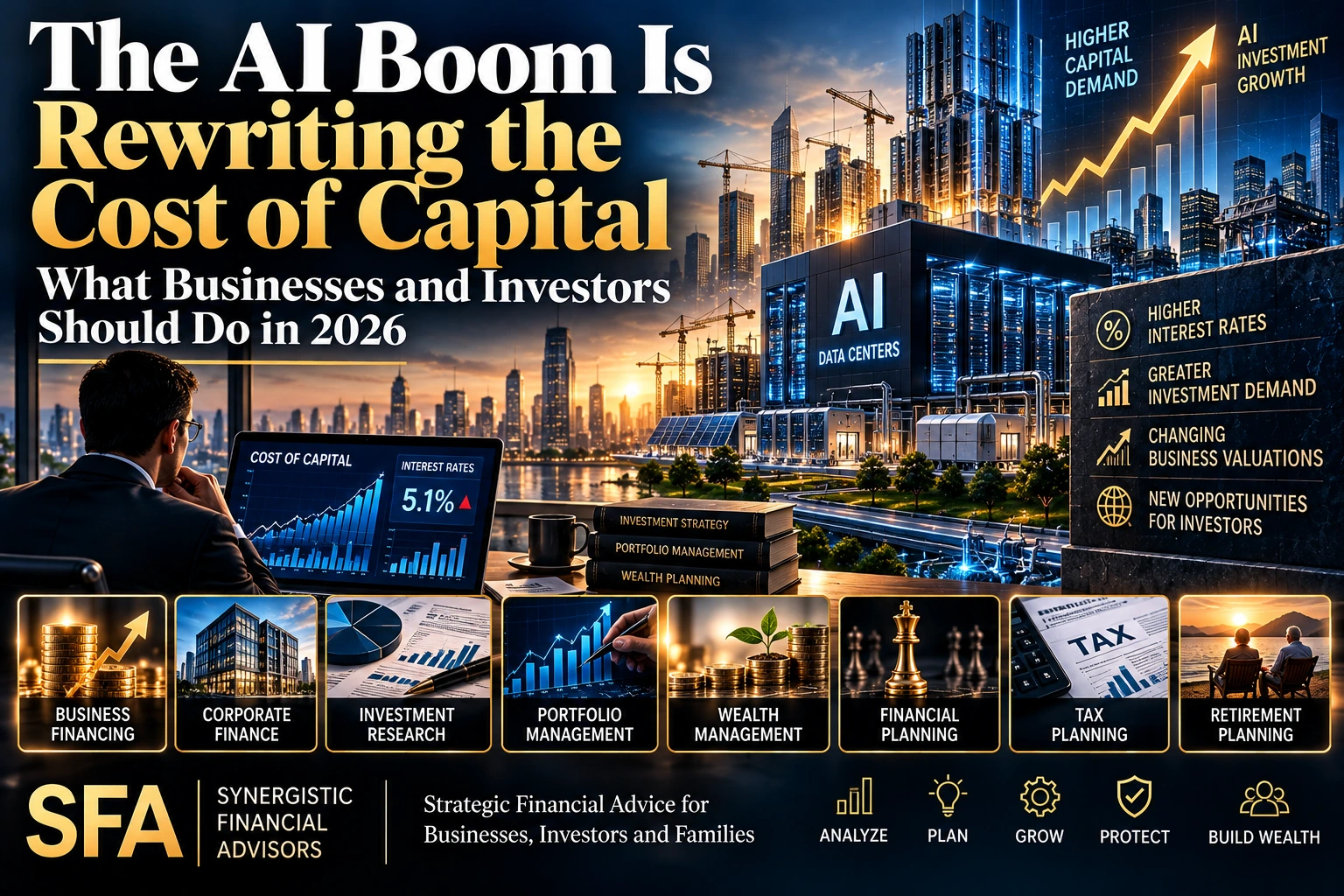
Artificial intelligence is no longer just changing technology.
It is beginning to change the price of money itself.
The enormous global investment required to build AI infrastructure—from data centers and semiconductor capacity to power generation, cloud computing and telecommunications—is creating intense demand for capital.
That demand is arriving at the same time governments are borrowing heavily, energy prices remain elevated and inflation is still above comfortable levels in many economies.
The result could reshape one of the most important assumptions businesses and investors have relied on for years:
How much should capital cost?
Federal Reserve officials are now openly debating how the AI investment boom may be adding to demand and complicating the inflation outlook. On October 19, Reuters reported that policymakers are confronting a difficult imbalance: technology companies with enormous cash resources can continue investing aggressively even when interest rates rise, while smaller companies, housing markets and consumers dependent on borrowing may absorb more of the impact of tighter monetary policy.
Federal Reserve Chair Kevin Warsh has also highlighted the scale of the shift. At Jackson Hole in August, he said U.S. investment in equipment and intangible assets had been growing at about 9% year over year, the strongest pace since 2021, and estimated that more than half of this year’s capital-expenditure growth could be associated with the AI buildout.
For businesses and investors, this creates a critical new question:
What happens if the AI boom creates strong economic growth—but also keeps the cost of capital higher for longer?
The answer could affect corporate investment, business valuations, financing decisions, stock portfolios, retirement strategies and long-term wealth creation.
AI Is Becoming a Capital-Allocation Story
Most AI discussions focus on technology.
Which model is better?
Which chip is faster?
Which company has the strongest AI platform?
For corporate leaders, there is a more fundamental question:
Where should the next dollar of capital go?
Companies now have to choose between competing uses of money:
- AI infrastructure
- Automation
- New employees
- Geographic expansion
- Product development
- Debt repayment
- Working capital
- Shareholder distributions
- Acquisitions
- Financial investments
Every one of those choices has an expected return.
This is why AI has become as much a corporate finance issue as a technology issue.
A company spending $50 million on AI should not evaluate the project simply by asking whether competitors are doing the same.
It should ask:
What financial return should this investment create?
The Cost of Capital Changes Every Business Decision
Imagine a company considering a major expansion.
At a low borrowing cost, the project may look attractive.
If financing becomes significantly more expensive, the economics change.
The business must reconsider:
- Expected cash flows
- Debt-service costs
- Payback period
- Return on invested capital
- Break-even point
- Downside risk
- Alternative uses of capital
This is the essence of financial management.
Capital is not free.
And when the cost of capital rises, companies need higher-quality projects to justify investment.
That principle matters enormously in today’s AI race.
Businesses that spend aggressively simply because AI is popular may eventually discover that the technology works—but the investment economics do not.
Why Central Banks Are Paying Attention
AI investment can potentially increase productivity over time.
That could be highly beneficial.
But the infrastructure required to get there needs to be built first.
Companies are competing for:
- Electricity
- Chips
- Land
- Data-center capacity
- Engineers
- Financing
- Network infrastructure
That can create immediate demand before the full productivity benefits arrive.
Reuters reported on October 16 that central bankers around the world are increasingly considering whether the AI capital boom could help keep interest rates structurally higher as companies, governments and infrastructure providers compete for financing.
The issue is not that AI is “bad for inflation.”
It is that investment demand is arriving faster than some of the productivity gains that may ultimately expand supply.
That timing difference matters.
Small and Mid-Sized Businesses Could Feel More Pressure
One of the most important implications is that higher interest rates do not affect every company equally.
Large technology companies may have:
- Huge cash balances
- Strong free cash flow
- Easy access to capital markets
- Investment-grade credit
- Large equity valuations
A smaller manufacturer, retailer or services business may depend much more heavily on:
- Bank financing
- Credit facilities
- Working-capital loans
- Equipment financing
- Commercial property loans
If central banks keep rates elevated partly because investment demand remains strong, smaller borrowers may experience higher financing costs even though they are not the companies driving the AI boom.
That creates a strategic reason for businesses to review their capital structures now rather than when refinancing becomes urgent.
Five Questions Businesses Should Ask Before Raising Capital
1. What Is the Capital Actually Funding?
Capital should have a defined purpose.
Is the company funding:
Growth?
Technology?
Working capital?
Debt refinancing?
New capacity?
The clearer the use of funds, the easier it is to evaluate whether financing makes sense.
2. What Return Should the Investment Generate?
Management should compare expected returns with the company’s cost of capital.
A project generating an 8% expected return looks very different when capital costs 4% versus when it costs 9%.
3. How Much Debt Can Cash Flow Support?
Companies should stress-test debt obligations under less optimistic scenarios.
What happens if:
Revenue falls 10%?
Margins compress?
Interest rates stay high?
A major customer leaves?
4. Should the Company Use Debt or Equity?
Debt preserves ownership but creates repayment obligations.
Equity can reduce financial pressure but dilutes existing shareholders.
The right choice depends on valuation, cash flow, risk and long-term strategy.
5. Does the Company Need the Investment Now?
Technology spending should not automatically be accelerated simply because competitors are announcing large AI budgets.
Sometimes waiting, testing or implementing in stages can improve capital efficiency.
AI Spending Is Starting to Face a Harder Financial Test
Markets are already becoming more demanding.
Last week, investors sold heavily indebted AI-related companies as concerns grew over whether enormous data-center spending could generate returns sufficient to justify rising financing and computing costs.
That is a healthy financial question.
The AI investment case should increasingly be evaluated through:
Revenue Growth
↓
Operating Margin
↓
Free Cash Flow
↓
Return on Invested Capital
↓
Value Created
A business can grow rapidly while still destroying shareholder value if the capital required to generate that growth is too expensive.
Business Valuations May Need a Reset
Higher interest rates can also influence business valuation.
When discount rates rise, the present value of future cash flows can fall.
This can particularly affect companies whose valuations depend heavily on profits expected far into the future.
Businesses with:
- Strong current cash flow
- Healthy balance sheets
- Sustainable margins
- Lower financing needs
may therefore look different from highly leveraged companies dependent on aggressive future growth.
A professional valuation should consider more than headline revenue.
It should evaluate:
- Cash flow
- Profitability
- Capital intensity
- Debt
- Growth
- Risk
- Cost of capital
- Competitive position
- Future investment requirements
That makes business valuation increasingly relevant even for companies that are not preparing for a sale.
Valuation can help management understand whether strategic decisions are actually creating economic value.
The Same Shift Matters for Investors
The cost-of-capital reset is not only a corporate issue.
It can reshape investment portfolios.
On October 19, the 10-year U.S. Treasury yield was around 5.1%, while markets were recovering from the previous week’s significant decline in AI-related stocks.
When government bonds offer yields above 5%, investors face a very different opportunity set than they did during years of near-zero interest rates.
The question becomes:
How much additional expected return should I demand before accepting equity, credit or private-market risk?
That can change portfolio construction.
Bonds Have Become More Relevant Again
The traditional idea of combining equities and bonds has attracted renewed attention because higher yields mean bonds can once again contribute meaningful income.
Reuters reported last week that investors are reconsidering variations of the classic 60/40 portfolio as fixed-income yields become more competitive.
That does not mean every investor should hold 60% equities and 40% bonds.
The bigger lesson is:
Asset allocation should change when the opportunity set changes.
Professional portfolio management should consider:
- Expected return
- Risk
- Income needs
- Liquidity
- Time horizon
- Taxes
- Interest-rate sensitivity
rather than automatically repeating an allocation designed for a different economic era.
AI Concentration Is Another Portfolio Risk
The IMF’s October Global Financial Stability Report notes that global markets remain resilient but specifically identifies an AI-related market correction as one potential trigger for financial stress if investment or profitability disappoints.
The IMF also warns that concentrated exposures and leverage could amplify such a correction.
That matters because many major stock indexes have become heavily influenced by large technology companies.
An investor may believe they own a diversified portfolio because they hold several funds.
But those funds may repeatedly own many of the same mega-cap companies.
A good investment advisor should therefore examine underlying exposure—not merely the number of funds in the account.
What Should Long-Term Investors Review?
Portfolio Concentration
How much of the portfolio depends on AI, semiconductors or large technology companies?
Fixed Income
Do today’s higher yields justify reconsidering the role of bonds?
Liquidity
Could the investor meet near-term needs without selling volatile assets?
Time Horizon
Money required soon should generally be treated differently from capital intended for decades.
Retirement
Investors approaching retirement should evaluate whether portfolio withdrawals are overly dependent on continued equity-market gains.
This makes retirement planning especially important in volatile, higher-rate environments.
Taxes
Large portfolio changes can have tax consequences.
Investment decisions should therefore be evaluated alongside tax planning, where appropriate.
AI Could Create Winners Outside Technology
Another important point is that investors should not think of the AI opportunity as limited to software and semiconductor companies.
The infrastructure buildout requires:
- Electricity
- Power equipment
- Cooling systems
- Construction
- Industrial equipment
- Networks
- Data centers
- Energy storage
For example, Schneider Electric recently raised its 2026 targets again as demand from data centers surged, reporting triple-digit growth in data-center demand and a 16.9% year-over-year increase in third-quarter organic revenue.
This demonstrates why investment research matters.
The economic beneficiaries of a major technology shift may extend well beyond the companies most closely associated with the technology itself.
The 2026 Capital Strategy Checklist
| Area | Question Businesses and Investors Should Ask |
|---|---|
| AI Spending | What measurable return will the investment generate? |
| Cost of Capital | Has the project’s hurdle rate changed? |
| Debt | Can cash flow support higher borrowing costs? |
| Equity | Is dilution justified by expected growth? |
| Valuation | Are future cash flows being valued realistically? |
| Liquidity | Is sufficient cash available for uncertainty? |
| Portfolio | Has technology exposure become too concentrated? |
| Fixed Income | Do higher yields improve the opportunity set? |
| Retirement | Can the plan withstand market volatility? |
| Research | Who actually benefits economically from AI investment? |
How SFA Can Help Businesses and Investors Navigate the New Capital Environment
The current environment aligns directly with several core capabilities of Synergistic Financial Advisors (SFA).
Businesses do not simply need to know that borrowing costs are higher.
They need to understand what those higher costs mean for their own decisions.
SFA’s financial and strategic capabilities can support areas including:
Corporate Finance
Evaluating investment decisions, financing alternatives and capital structures.
Capital Sourcing
Helping businesses assess appropriate sources of capital based on financial requirements and strategic objectives.
Business Valuation
Evaluating company value in an environment where growth expectations and discount rates are changing.
Financial Analysis
Testing investment decisions through cash flow, profitability, return and downside scenarios.
Investment Research
Studying sectors, companies and market developments to support informed decisions.
Portfolio Management
Helping individuals, families and institutions align investment exposure with risk, time horizon and financial objectives.
Financial Advisory
Connecting investment and business decisions with broader financial planning and long-term wealth objectives.
Businesses and investors can explore Synergistic Financial Advisors through sfaresearch.com.
Why This Matters Beyond 2026
The long-term productivity impact of artificial intelligence could be enormous.
But the transition will not be financially neutral.
The AI economy requires capital.
A lot of it.
That means companies, governments and investors will increasingly compete for the same global pool of money.
If that contributes to structurally higher interest rates, businesses may need to become more disciplined about every major investment decision.
Investors may also need to reconsider assumptions formed during the era of ultra-cheap capital.
The winners may not simply be the businesses investing the most.
They may be the companies achieving the highest return on capital.
Likewise, successful investors may not be those with the greatest exposure to whatever theme is currently popular.
They may be those who understand how changing capital costs affect valuation, risk and expected return.
Final Thoughts
Artificial intelligence is changing more than technology.
It is changing:
Capital spending.
Energy demand.
Financing requirements.
Business valuations.
Interest-rate expectations.
Investment portfolios.
Federal Reserve officials are now confronting the possibility that the AI investment boom itself could help sustain stronger demand and complicate efforts to return inflation sustainably toward target.
For companies, the response should not be to stop investing.
It should be to invest more intelligently.
For investors, the response should not be to abandon AI or technology.
It should be to understand concentration, valuation and the alternatives now available in higher-yielding markets.
The central principle is straightforward:
When capital becomes more expensive, every dollar needs a stronger reason to be invested.
That makes disciplined financial management, corporate finance, investment research, portfolio management and financial advisory more valuable—not less.