Global financial markets have survived an extraordinary combination of shocks in 2026.
Oil prices remain above $100 a barrel.
Government bond yields have climbed to levels not seen in decades.
Artificial-intelligence investment continues to support corporate earnings and economic growth.
Geopolitical tensions remain elevated.
And yet major financial markets have proved surprisingly resilient.
That sounds encouraging.
But the International Monetary Fund has just issued an important warning for investors:
Market resilience should not be confused with market safety.
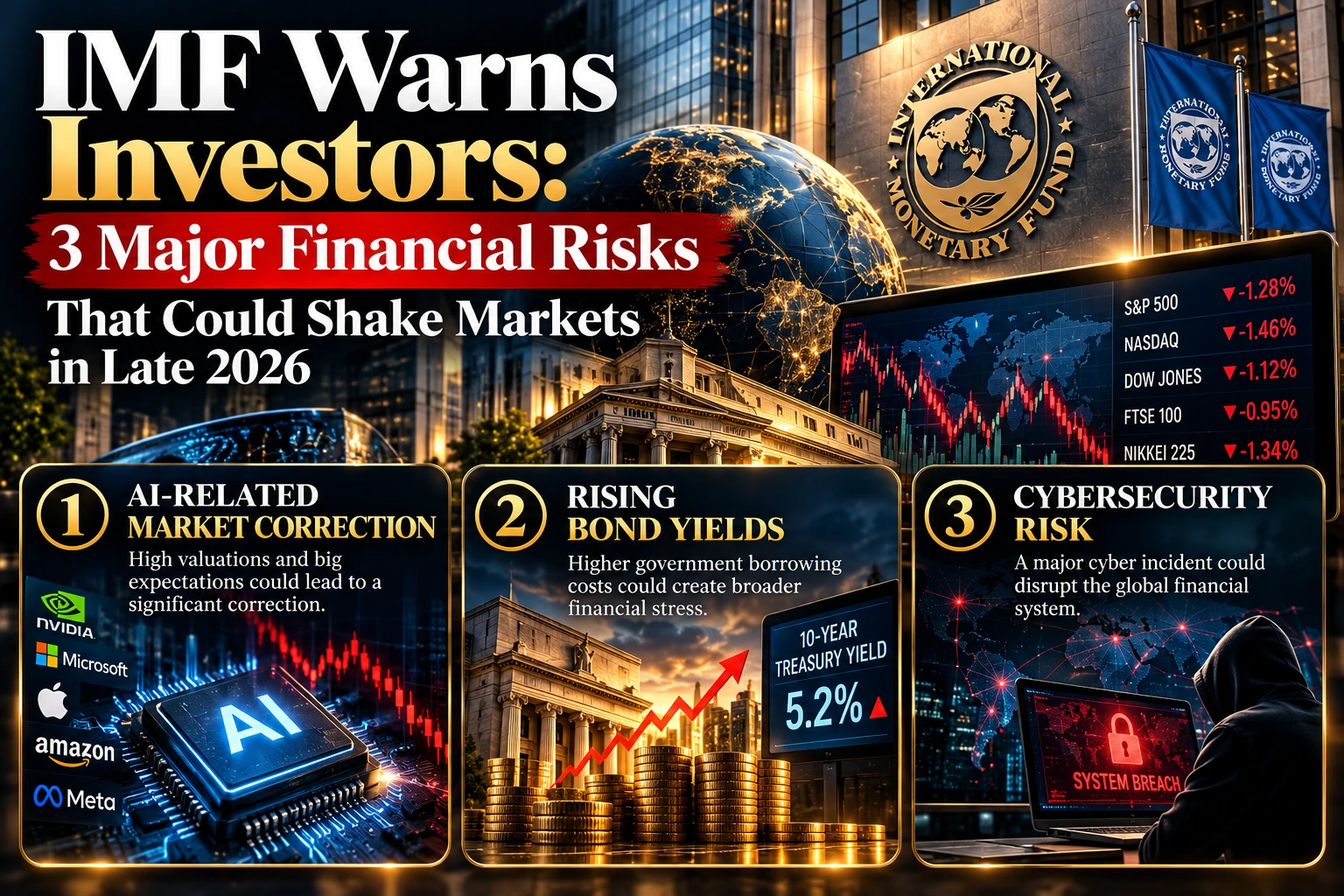
In its October 2026 Global Financial Stability Report, the IMF identified three major risks capable of triggering renewed market stress and sharply tighter financial conditions:
1. An AI-related market correction
2. A further surge in government bond yields
3. A major cyber incident affecting the financial system
The report was released during the IMF-World Bank Annual Meetings this week and comes at a time when investor risk appetite remains relatively strong despite unusually complicated economic conditions.
For investors, business owners and families, the report raises a more useful question than:
“Will markets crash?”
The better question is:
“Would my financial plan still work if one of these risks suddenly became reality?”
That is where disciplined financial planning, diversification and portfolio management become more important than short-term market predictions.
The Global Economy Is Still Growing—but the Risks Are Uneven
The IMF’s new World Economic Outlook projects global economic growth of approximately 3.1% in 2026 and 3.4% in 2027.
That may not sound alarming.
But underneath those headline numbers, performance across countries is becoming increasingly uneven.
Countries benefiting from the artificial-intelligence investment boom and favorable trade conditions are performing better, while many energy-importing and lower-income economies face greater pressure from higher commodity prices and financing costs.
The IMF also expects global inflation to remain elevated in the near term, with its 2026 forecast around 4.7%, partly reflecting higher energy and food prices.
That gives investors an unusual combination:
Economic growth remains positive.
But:
Inflation + Expensive Markets + High Interest Rates + Global Debt + Geopolitical Risk
are all present simultaneously.
This is exactly the type of environment where investors should pay attention not only to expected returns, but also to what could go wrong.
Risk 1: The AI Boom Could Become an AI Correction
Artificial intelligence has become one of the most powerful forces driving investment markets.
AI spending is supporting:
- Semiconductor demand
- Data-center construction
- Cloud infrastructure
- Electricity investment
- Technology company revenues
- Corporate capital expenditure
- Equity-market valuations
The IMF now says AI investment is also helping support global economic growth.
But there is another side to that story.
Its latest Global Financial Stability Report warns that if AI investment or profitability proves weaker or less durable than investors currently expect, AI-related asset prices could experience a meaningful correction.
The Problem Is Not Necessarily AI
AI can be transformational and still create investment risk.
Those ideas are not contradictory.
Consider the internet.
The internet transformed business, communication, shopping, media and finance.
But many internet-related investments made during periods of extreme optimism still produced enormous losses.
The same principle applies today.
The relevant question for an investment advisor should not simply be:
“Will AI change the world?”
It probably already is.
The better investment question is:
“How much future AI success is already reflected in today’s asset prices?”
Concentration Makes the Risk More Important
Another concern is market concentration.
When a small number of large technology and AI-related businesses represent an unusually large portion of major equity indexes, weakness in those companies can influence portfolios that investors believe are broadly diversified.
Someone may own an index containing hundreds of companies.
But if a large percentage of the index’s performance depends on a handful of businesses, the investor may have more concentration risk than expected.
This does not necessarily mean selling technology stocks.
It means understanding the exposure.
A strong portfolio management process asks:
- How much of the portfolio is tied to technology?
- How much is directly connected to AI?
- Are several funds holding the same underlying companies?
- Has recent performance increased concentration?
- Would the financial plan still work after a major technology correction?
That is risk management—not pessimism.
Risk 2: Government Bond Yields Could Rise Further
The second major IMF concern involves sovereign bond markets.
Government borrowing costs have increased substantially in 2026.
The IMF says inflation pressures, fiscal imbalances and enormous financing requirements could push sovereign yields even higher, with consequences extending across financial markets.
This issue deserves particular attention because government bond yields influence much more than bonds.
They affect:
Mortgage rates
Corporate borrowing
Real-estate financing
Government debt servicing
Business valuations
Equity valuations
Investment allocation
As of October 14, the U.S. 10-year Treasury yield was around 5.2%, close to multi-decade highs, while investors remained focused on inflation and future Federal Reserve policy.
Why High Yields Matter for Stocks
When government bonds offered extremely low yields, investors had powerful incentives to seek returns elsewhere.
That supported demand for:
- Equities
- Real estate
- Private markets
- Higher-risk credit
Today the calculation is different.
If relatively high-quality fixed-income assets can offer yields above 5%, investors can demand a greater expected return before accepting substantially more risk elsewhere.
This effectively raises the investment hurdle rate.
A company valued on earnings expected many years into the future becomes more sensitive to discount rates.
A highly leveraged real-estate transaction becomes more difficult to finance.
A business acquisition may produce a lower return once financing costs are included.
Higher rates therefore affect almost every part of financial management.
The Global Debt Problem Is Becoming More Expensive
The IMF’s Fiscal Monitor, released on October 14, warns that fiscal risks are increasing because government debt remains high while interest costs and spending pressures are rising.
The Fund is encouraging governments with significant fiscal vulnerabilities to address them before financial markets force more painful adjustments.
This is important for investors because government borrowing does not exist in isolation.
Heavy sovereign borrowing can compete for capital.
Higher yields can influence corporate borrowing costs.
Rising debt-service expenses can limit governments’ ability to respond to future economic shocks.
For emerging and developing economies, rising global interest rates can also make external financing more expensive.
Higher Bond Yields Also Create Opportunities
There is an important counterpoint.
Higher yields are not purely negative.
After years of extremely low interest rates, fixed income may once again provide a more meaningful combination of:
Income + Diversification + Capital Preservation Potential
depending on the security and investor.
Reuters reported this week that the traditional 60/40 stock-bond portfolio is receiving renewed attention because Treasury yields above 5% have made the bond portion of diversified portfolios significantly more attractive than during the ultra-low-rate era.
That does not mean every investor should use a 60/40 allocation.
But it does mean the opportunity set has changed.
A financial planner should periodically reconsider assumptions as market conditions evolve.
Risk 3: Cybersecurity Is Becoming a Financial-System Risk
The third IMF warning receives less attention than AI or interest rates.
It may eventually prove just as important.
The IMF identifies increasingly sophisticated cyberattacks as a growing financial-stability risk as the global financial system becomes more digital and interconnected.
Modern financial markets depend on:
- Banks
- Payment networks
- Trading platforms
- Cloud infrastructure
- Asset managers
- Data providers
- Custodians
- Software systems
- Digital communication networks
This creates enormous efficiency.
It also creates interconnected risk.
A serious disruption at one critical provider could potentially affect multiple institutions simultaneously.
Cyber Risk Is Also a Personal Wealth Issue
Investors often think about portfolio risk in terms of:
Stocks falling.
Interest rates rising.
Inflation increasing.
But financial security increasingly includes protecting access to the assets themselves.
Individuals should consider:
- Strong account passwords
- Multi-factor authentication
- Phishing awareness
- Secure email practices
- Account monitoring
- Verified instructions before transferring money
- Protection of financial documents
For high-net-worth families and businesses, cybersecurity can become part of broader wealth management and operational risk planning.
Another Vulnerability: Non-Bank Financial Institutions
The IMF is also monitoring vulnerabilities outside traditional banking.
The report highlights areas including:
- Hedge funds
- Private credit
- Insurance companies
- Pension funds
- Other non-bank financial institutions
These institutions now play major roles in global financial markets.
The IMF notes that some hold less-liquid assets, use leverage, or participate in crowded investment strategies that could amplify market movements during periods of stress.
A market decline alone may be manageable.
The greater danger appears when falling prices force leveraged investors to sell.
Those sales push prices lower.
Lower prices create additional margin calls.
That can produce further forced selling.
This is how ordinary volatility can become financial stress.
What Should Investors Do With This Information?
The answer is not:
Sell everything.
Nor is it:
Ignore the risks and stay permanently bullish.
A better strategy is to stress-test the portfolio.
1. Review Your Concentration
Look at your actual underlying holdings.
Do several funds own the same mega-cap technology companies?
Does one stock represent a major percentage of your portfolio?
Is your personal wealth also concentrated in your employer or private business?
Diversification should be measured economically—not simply by counting account statements.
2. Review Your Stock-Bond Allocation
Higher bond yields mean assumptions built during the near-zero-interest-rate era may deserve reconsideration.
Depending on goals and circumstances, fixed income may once again play a larger role in:
- Income
- Diversification
- Liquidity
- Risk management
This should be evaluated through investment management, not by simply buying whichever bond currently advertises the highest yield.
Credit quality, duration and liquidity matter.
3. Keep Adequate Liquidity
One of the best defenses against market volatility is avoiding forced selling.
If near-term expenses depend on selling risky investments at whatever price happens to exist, short-term volatility becomes much more dangerous.
An emergency reserve and appropriate short-term liquidity can help separate immediate financial needs from long-term investment decisions.
4. Revisit Retirement Assumptions
People approaching retirement face a different problem from young investors.
Someone still accumulating assets may have decades to recover from market downturns.
Someone drawing money from a portfolio may not.
Good retirement planning should examine:
- Withdrawal needs
- Inflation
- Fixed income
- Liquidity
- Market risk
- Longevity
- Other income sources
A financial plan should not depend on markets rising every year.
5. Coordinate Taxes With Portfolio Changes
Market volatility can create both gains and losses.
Before making large portfolio adjustments, investors should consider possible tax consequences.
That makes tax planning an important component of portfolio decisions.
The objective should generally be:
Improve the portfolio after tax—not merely before tax.
6. Stress-Test the Financial Plan
Ask:
What happens if technology stocks fall 30%?
What happens if bond yields rise another percentage point?
What happens if inflation stays elevated?
What happens if my business income falls?
What happens if I cannot access one financial account temporarily?
The purpose is not to predict which scenario will occur.
The purpose is to avoid building a financial plan that only works when everything goes right.
2026 Investor Risk Checklist
| Risk | IMF Concern | Investor Question |
|---|---|---|
| AI Valuations | Expectations may outrun profits | Is my portfolio too dependent on AI? |
| Market Concentration | Similar exposures can amplify losses | Am I genuinely diversified? |
| Bond Yields | Inflation and debt could push yields higher | Is my portfolio too rate-sensitive? |
| Global Debt | Higher borrowing costs increase fiscal pressure | How would tighter financial conditions affect me? |
| Private Markets | Leverage and illiquidity can amplify stress | Do I understand my liquidity risk? |
| Cybersecurity | Digital interconnectedness creates vulnerabilities | Are my financial accounts protected? |
| Inflation | Energy and food pressures remain significant | Is my real purchasing power protected? |
| Retirement | Market timing matters more near withdrawals | Is my retirement plan resilient? |
| Business Risk | Higher rates affect capital and valuations | Is business wealth too concentrated? |
| Taxes | Portfolio adjustments can create tax costs | Are decisions evaluated after tax? |
What Does This Mean for Business Owners?
The IMF’s warning is particularly relevant for entrepreneurs.
Business owners can be exposed to several of these risks simultaneously.
Higher interest rates may increase financing costs.
Slower capital markets can reduce company valuations.
A market correction can affect personal investments.
Higher energy costs can pressure operating margins.
And many entrepreneurs already have most of their personal wealth concentrated in one private business.
That makes corporate and personal financial planning increasingly interconnected.
Business owners should consider:
Cash Flow → Debt → Business Valuation → Liquidity → Personal Investments → Exit Planning
as one financial system.
A successful company should help create diversified personal wealth—not become the only asset on which the owner’s future depends.
How SFA Can Help Investors Navigate a More Complex Market
Periods like 2026 demonstrate why financial advice involves more than selecting investments.
Synergistic Financial Advisors brings together capabilities across financial advisory, portfolio management, investment research and corporate finance.
For investors, families and business owners, a coordinated financial strategy can examine:
- Portfolio structure
- Asset allocation
- Concentration risk
- Investment objectives
- Liquidity
- Business interests
- Long-term wealth goals
- Market and economic research
A professional financial advisor or financial consultant should not promise to predict every market move.
The more useful role is helping clients build strategies capable of adapting when markets do something unexpected.
Frequently Asked Questions
Is the IMF predicting a stock market crash?
No. The IMF is identifying vulnerabilities that could trigger significant market stress. Its overall global growth forecast remains positive. The warning is about risk management rather than a specific crash prediction.
Is AI currently helping or hurting the global economy?
Both opportunities and risks exist. AI-related investment is currently supporting economic activity and corporate spending, but the IMF warns that disappointing profitability or weaker investment could create a meaningful market correction.
Should investors buy bonds because yields are above 5%?
Not automatically. Higher yields make fixed income more attractive than during the ultra-low-rate period, but investors must still consider duration, credit quality, liquidity, taxes and financial objectives.
Should long-term investors reduce stock exposure?
There is no universal answer. Allocation should depend on goals, time horizon, risk capacity, liquidity and current portfolio structure rather than one economic report.
Why is diversification important right now?
Because several major risks—including AI concentration, interest rates, inflation, energy prices and geopolitical uncertainty—could affect asset classes differently. Diversification reduces reliance on one investment outcome.
Final Thoughts
The most important message from the IMF’s October 2026 reports is not that investors should panic.
It is that strong markets can still contain significant vulnerabilities.
The global economy remains resilient.
Corporate earnings remain strong.
AI continues to generate enormous investment.
But simultaneously:
AI expectations are high.
Government borrowing costs are elevated.
Public debt continues to rise.
Energy prices remain under pressure.
Cyber threats are becoming more sophisticated.
Today’s markets therefore require something more useful than optimism or pessimism.
They require preparation.
A well-designed financial strategy should be capable of surviving multiple outcomes—not just the one investors currently expect.
That means maintaining appropriate liquidity.
Diversifying investments.
Managing concentration.
Reviewing fixed income.
Planning for retirement.
Considering taxes.
And connecting investment decisions to a broader wealth management strategy.
The goal of financial planning is not to predict every crisis. It is to make sure one crisis does not destroy the plan.