Twenty-five years ago today, the world changed in ways nobody was prepared for.
In 2026, the financial markets are navigating their own September reckoning — not from a single catastrophic moment, but from the slow, compounding accumulation of seven months of war, surging energy costs, and central bank tightening that has quietly reshaped every financial calculation most investors made at the start of this year.
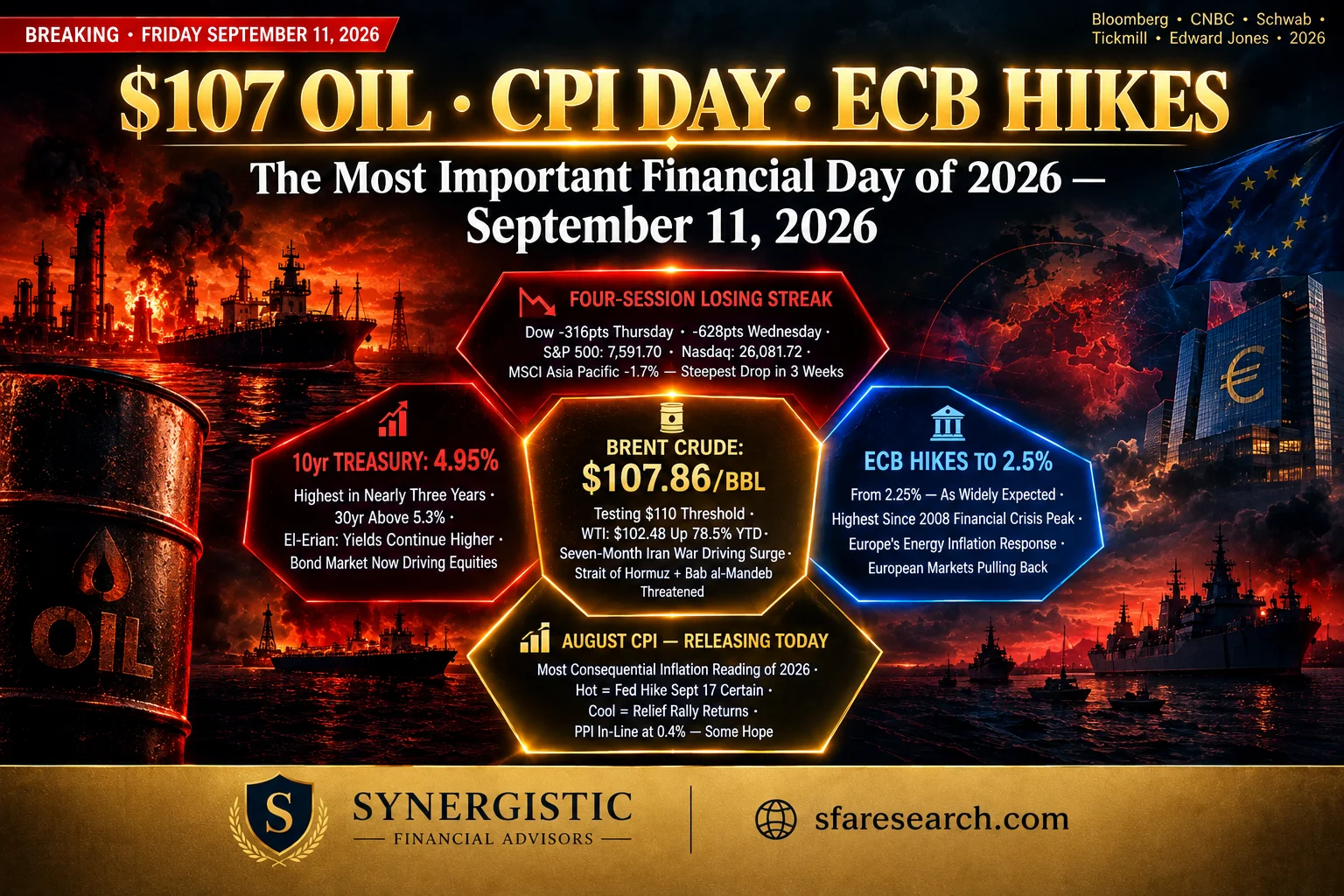
Today — Friday September 11, 2026 — is the most consequential single day in financial markets this year. Not because of any single headline, but because of what is converging simultaneously in the next few hours.
Brent crude edged up 0.2% to $107.86 per barrel, having flirted with the $110 threshold as security risks around the Strait of Hormuz and Bab al-Mandeb Strait intensify.
The 10-year Treasury yield reached 4.95%, its highest level in nearly three years. The European Central Bank raised its key deposit rate to 2.5% from 2.25%, as widely expected.
Today brings August CPI and core CPI — the most anticipated inflation reading of the entire year.
Oil at $107.86. The ECB raising rates to 2.5%. The 10-year Treasury at 4.95% — its highest in nearly three years. And the August CPI number landing today — the data point that will determine whether the Federal Reserve raises rates on September 17 and locks in a rate environment that reshapes every retirement planning, investment management, and wealth management strategy for the remainder of 2026.
This is the blog your Friday morning demands.
Oil at $107 — The Number That Changes Everything
Let’s start with the most visually dramatic and most economically consequential development of the past two weeks.
U.S. West Texas Intermediate closed at $102.48, up 6.7%. Brent crude futures gained 5.9% to settle at $107.63. It was the highest close since May 19 for both benchmarks. Since the Iran war began at the end of February, WTI is up 52.9%, and it’s up by 78.5% year-to-date.
WTI up 78.5% year-to-date. Brent at $107.63 and testing $110. The Iran war — now in its seventh month — has driven one of the most significant and most sustained energy price surges in modern financial history.
The financial mechanism connecting $107 oil to your personal financial planning is direct and unavoidable. Energy costs feed into every component of the Consumer Price Index — transportation, food production, manufacturing, utilities, and services. When Brent rises from $60 to $107, the inflationary pressure that generates does not remain contained in the petrol price. It cascades through every cost in the economy.
While markets have experienced occasional bouts of turbulence, strong investment in artificial intelligence, data centres and other new technologies has helped support economic growth and financial markets.
The AI infrastructure investment cycle has been the primary counterweight to oil-driven economic drag throughout 2026 — and it remains intact. But $107 oil is testing the resilience of that counterweight in ways that every investor needs to understand before today’s CPI release.
For your portfolio management strategy, the sustained nature of this oil surge — not a spike but a seven-month grinding escalation — means it is now embedded in the cost structure of virtually every business you hold in your investment portfolio. The companies that can pass through energy cost increases to their customers are performing. The companies that cannot are under genuine margin pressure that is showing up in earnings.
The ECB Just Raised Rates to 2.5% — What It Means for Global Markets
European markets pulled back after the European Central Bank raised its key deposit rate to 2.5% from 2.25%, as widely expected.
The ECB’s rate hike to 2.5% — its highest level since the 2008 financial crisis peak — is the specific, concrete manifestation of what $107 oil does to central bank policy globally. Europe is a net energy importer. $107 Brent crude hits European consumers and businesses harder than it hits American ones, where significant domestic production partially offsets import costs.
Asian stocks and bonds were set for declines after a surge in oil prices sparked a selloff in US markets, while the latest inflation data reinforced bets on an imminent Federal Reserve rate hike.
The ECB hiking. Asian stocks declining. US bond yields at 4.95%. This is coordinated global monetary tightening — driven by a single geopolitical conflict in the Strait of Hormuz that has turned the global energy market upside down over seven months.
For your financial planning strategy, the ECB’s 2.5% rate represents something genuinely important beyond its headline number. It signals that European central bankers believe inflation — driven by energy costs that show no sign of abating while the Iran conflict continues — is persistent enough to require active tightening even at the risk of slowing an already-fragile European economic recovery. That institutional conviction about inflation persistence is the most relevant signal for your own retirement planning and investment management assumptions.
The implication for globally diversified portfolio management strategies is specific: European equity exposure is now operating in a tightening monetary environment simultaneously with elevated energy costs and geopolitical uncertainty proximity. These are compounding headwinds that require deliberate assessment — not panic-driven repositioning, but honest evaluation of whether your European allocation reflects today’s actual risk profile.
The CPI Number That Drops Today — And Why It Changes Everything
Every data point this week has been building toward one climactic release. Today’s August CPI is not just another monthly inflation reading — it is the swing factor that determines the trajectory of Federal Reserve policy, bond yields, equity valuations, and your personal financial planning strategy for the rest of 2026.
Global equity markets faced selling pressure on Friday as surging energy costs and rising sovereign bond yields rattled investor sentiment ahead of crucial US inflation data. MSCI’s Asia Pacific Index tumbled 1.7% — marking its steepest single-day drop in three weeks — as a broad-based retreat swept through regional benchmarks across Japan, South Korea, Australia, and Taiwan.
The Asian market reaction this morning — MSCI Asia Pacific down 1.7%, the steepest single-day drop in three weeks — is the global market community pricing the CPI risk before the number arrives. When oil is at $107 and the PPI already came in at 0.4% for August, the probability of an above-consensus CPI reading has risen significantly.
August wholesale prices rose roughly as expected — up 0.4% for the headline Producer Price Index and 0.2% for core, excluding food and energy. That was in line with consensus for headline and just under the 0.3% average core estimate.
The PPI in line with expectations is the one piece of good news entering today’s CPI release. Core PPI — excluding food and energy — came in below consensus. If that dynamic carries through to core CPI, the Federal Reserve may find sufficient justification to hold rates on September 17 despite the oil-driven headline pressure.
Here is the exact framework for interpreting today’s CPI number and its implications for your financial planning:
Hot CPI scenario — headline above 3.8%, core above 3.5%: September Fed hike becomes near-certainty. Bond yields surge further from 4.95%. Equity markets extend their four-session losing streak. Retirement planning projections built on any rate relief in 2026 need immediate reconstruction. The higher-for-longer rate environment becomes the base case for investment management strategy through year-end.
In-line CPI scenario — headline 3.4-3.7%, core 3.2-3.4%: September hike remains a coin-flip. Markets stabilise. The bond yield selloff pauses if not reverses. A brief relief rally is possible as the worst fears are not confirmed. Portfolio management strategies can maintain current positioning with heightened vigilance.
Cool CPI scenario — headline below 3.3%, core below 3.0%: September hold is restored as base case. Bond yields retreat materially. Equities stage their strongest session in weeks. The Q4 optimism Goldman Sachs identified becomes immediately more accessible. Investment management strategies with rate-sensitive exposure benefit most immediately.
The most likely outcome, given $107 oil and the PPI reading, is the in-line scenario — but in this environment, “most likely” carries genuine uncertainty bands that every investor needs to honestly account for.
The 10-Year at 4.95% — A Near Three-Year High With Real Consequences
The 10-year Treasury yield reached 4.95%, its highest level in nearly three years.
4.95% on the 10-year Treasury. The last time yields were this high was November 2023 — when the Federal Reserve was actively engaged in its most aggressive tightening cycle in four decades. The fact that we are back at those yield levels in September 2026 — driven not by domestic monetary policy hawkishness alone but by the compounding of oil-driven inflation, geopolitical uncertainty, and genuine Fed rate hike probability — tells a specific and important story about the nature of this rate environment.
This is not a yield spike driven by a single data surprise. It is the product of seven months of accumulated inflationary pressure, central bank credibility challenges, and the bond market’s genuine reassessment of the neutral rate in a world where energy costs have risen 78.5% in less than nine months.
For your retirement planning strategy, the 10-year at 4.95% creates both a challenge and an opportunity that deserve simultaneous attention.
The challenge: existing long-duration bond holdings have experienced significant mark-to-market losses as yields have risen from approximately 4.2% at the start of September to 4.95% today. For retirement planning portfolios that hold significant intermediate and long-term Treasury exposure, this yield move represents real, measurable portfolio impact.
The opportunity: new fixed income deployments at 4.95% on the 10-year — and potentially above 5% on the 30-year — represent the most attractive guaranteed income available since 2023. For investors approaching or in retirement planning‘s distribution phase who need reliable income rather than growth, locking in a portion of fixed income exposure at today’s yields creates income security that compounds powerfully across the first decade of retirement.
A certified financial planner who helps you distinguish between the mark-to-market pain of your existing holdings and the genuine income opportunity embedded in new deployments is delivering exactly the nuanced, personalised guidance that this rate environment demands.
Apple’s $2,000 Foldable iPhone — The Consumer Economy Signal
Apple stock gained 1% in pre-market trading on Thursday, as investors digested news from its biggest launch event of the year — including the debut of the $2,000 foldable iPhone Duo. The company also unveiled the iPhone 18 Pro, AirPods 5 and Apple Watch Series 12 on Wednesday.
In the middle of $107 oil, ECB rate hikes, and CPI anxiety — Apple launched a $2,000 foldable iPhone. And the market gave it a 1% pre-market gain.
This seemingly incongruous detail contains one of the most important signals for financial planning strategy in September 2026. A company that can launch a $2,000 consumer device — in an environment of elevated oil costs, rising interest rates, and four consecutive days of broad market declines — and receive a positive market response is demonstrating the kind of genuine pricing power and consumer demand resilience that represents genuine long-term investment management value.
Enterprise software provider Oracle provided a bright spot after reporting stronger-than-expected cloud revenue growth in after-hours trading.
Apple’s foldable iPhone pricing power. Oracle’s cloud revenue beat. These are the specific, earnings-grounded signals that distinguish durable long-term value in technology from the narrative-driven enthusiasm that drove some AI-adjacent positions to unsustainable valuations earlier in 2026.
For your portfolio management strategy, the Apple and Oracle signals this week suggest that selective technology exposure — in companies with genuine earnings power, genuine pricing power, and genuine demand visibility — continues to perform through the oil shock and rate tightening in ways that broad cyclical exposure cannot.
5 Financial Planning Actions for September 11, 2026
Today’s CPI release, combined with $107 oil, the ECB at 2.5%, the 10-year at 4.95%, and the four-session equity decline, creates the most consequential single-day financial planning environment of the entire year. Here are the five specific actions every serious investor should take today.
Action 1 — Watch the CPI Number With a Pre-Built Framework. Do not let today’s CPI surprise you into an emotional decision. Use the three-scenario framework above — hot, in-line, cool — to pre-determine your response before the number drops. A financial advisor who has built your response framework in advance ensures you execute strategy rather than react to whichever headline dominates the next 30 minutes.
Action 2 — Evaluate New Fixed Income at 4.95%. The 10-year at 4.95% is the most attractive guaranteed income level in nearly three years. For any investor with retirement planning income needs in the next five to ten years, building a portion of fixed income exposure at today’s yields creates compounding income security that will look exceptionally well-timed in retrospect when rates eventually normalise.
Action 3 — Assess Energy Inflation Impact on Your Portfolio. WTI up 78.5% year-to-date. Brent at $107.86. Seven months of sustained escalation. A certified financial planner can model the specific margin and earnings impact of $107 sustained oil across the companies and sectors in your portfolio management strategy — identifying which positions are genuinely resilient and which carry hidden energy cost vulnerability.
Action 4 — Tax-Loss Harvest September’s Four-Session Decline. Four consecutive sessions of equity market declines have created specific, measurable harvesting opportunities across most diversified portfolios. A financial advisor who identifies and executes these opportunities today — before any CPI-driven recovery closes the window — captures permanent tax planning value from temporary price movements that will almost certainly be recovered as this crisis eventually resolves.
Action 5 — Begin Your Q4 Financial Planning Review Today. September 11, 2026 is the most consequential financial day of the year. The eight and a half months since January 1 have delivered oil up 78.5%, a seven-month US-Iran war, the largest IPO in history, a new Fed Chair eliminating forward guidance, record AI earnings, ECB and Fed tightening cycles, and now a CPI reading that determines the rest of the year’s rate trajectory. Your financial planning strategy for Q4 must be built on this reality — not the assumptions of January.
How Synergistic Financial Advisors Navigates Today for Every Client
At Synergistic Financial Advisors, today — September 11, 2026 — is not a day of reactive scrambling. It is the culmination of the scenario planning, pre-built response frameworks, and continuous client engagement that defines every advisory relationship we build.
Our certified financial planner team is engaged with every client today — walking through the CPI implications for their specific retirement planning projections, assessing their fixed income duration exposure against the 4.95% yield environment, identifying specific tax planning harvesting opportunities in the four-session decline, and building the Q4 financial planning framework that accounts for every development of 2026’s extraordinary year.
We do not wait for markets to force the conversation. We initiate it — proactively, personally, and with the specific expertise in investment management, portfolio management, retirement planning, tax planning, and wealth management that your financial future deserves.
Ready to navigate September 11, 2026’s most consequential financial day with expert guidance built specifically for your situation? Contact Synergistic Financial Advisors today.
👉 Visit sfaresearch.com — because on the most important financial day of 2026, the right financial advisor makes all the difference.
Final Thoughts — September 11, 2026
Twenty-five years ago today, the world discovered that the most consequential events arrive without warning and reshape everything that follows.
In 2026, the financial world is experiencing its own slow-motion reckoning — seven months of war, $107 oil, central banks hiking across three continents, bond yields at decade highs, and today the CPI reading that determines whether the Federal Reserve adds another rate hike to a year that has already tested every investor’s discipline in ways January’s planning assumptions never anticipated.
Energy and fixed income markets remain the primary source of macro angst, with Brent crude edged up 0.2% to $107.86, having flirted with the $110 threshold as security risks around the Strait of Hormuz and Bab al-Mandeb Strait intensify.
The macro angst is real. The challenge is genuine. And the financial planning opportunity — for those who act with discipline rather than fear — is equally real.
At Synergistic Financial Advisors, we help every client see both simultaneously.