Most people think a financial advisor manages investments. That is true — but it is approximately 5% of what a genuinely great financial advisor actually does.
A financial advisor does more than manage investments. By connecting decisions around saving, investing, taxes, and planning, they can help make your path forward more cohesive and easier to navigate.
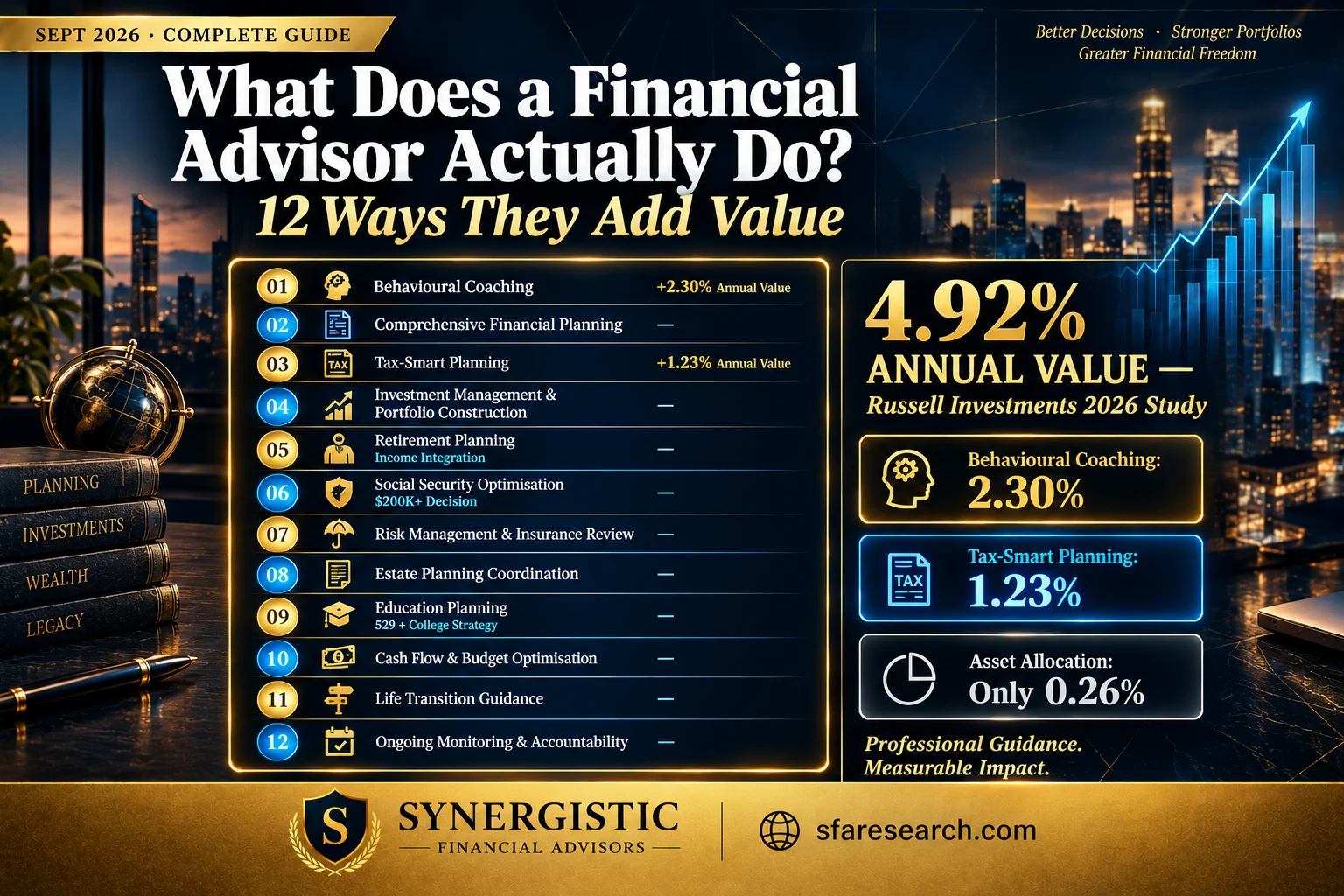
The research now quantifies this more precisely than ever before. The 2026 Value of an Advisor Study from Russell Investments estimates that disciplined decision-making, tax-smart planning and diversified allocation together can add roughly 4.92% in annual value — a figure that reshapes how individuals and families should think about managing financial complexity.
4.92% in annual value. On a $500,000 portfolio, that is $24,600 per year — every year — in measurable financial improvement above what the average unadvised investor achieves. Over 20 years at 8% annual return, the cumulative impact of that annual value-add exceeds $1.2 million on a $500,000 starting portfolio. The advisory fee typically costs a fraction of that.
But here is what makes this statistic even more significant: the breakdown of that 4.92% reveals that investment selection contributes only 0.26% of the total value. The other 4.66% comes from everything else a great financial advisor does — behavioural coaching, tax planning, customised wealth management planning, and the comprehensive coordination that most people never fully understand until they experience it.
This guide explains all 12 of those things — specifically, honestly, and with the real 2026 data that proves their value.
The Research That Changes How You Think About Financial Advisors
Before examining what a financial advisor actually does, the Russell Investments data deserves a complete breakdown — because it fundamentally reframes the question of whether professional financial advisory is worth the cost.
The 2026 Value of an Advisor Study from Russell Investments breaks down the 4.92% annual value into four specific components:
| Value Component | Annual Contribution |
|---|---|
| Behavioural coaching | 2.30% |
| Tax-smart planning | 1.23% |
| Customised wealth planning | 1.13% |
| Asset allocation | 0.26% |
| Total annual value | 4.92% |
The most important insight in this table: behavioural coaching — preventing emotional investment decisions — contributes 2.30% annually. That is nearly nine times more value than asset allocation (0.26%). The single most valuable thing a financial advisor does is not pick better investments. It is prevent you from making worse ones.
For high-net-worth families, this comprehensive approach helps navigate market complexities, minimise taxes, and ensure diversified portfolios.
With this framework established, here are the 12 specific ways a financial advisor adds value — across every dimension of your financial life.
Way 1 — Behavioural Coaching: The Most Valuable Thing an Advisor Does
The biggest driver of long-term returns is not stock picking — it is investor behaviour. And nobody has demonstrated this more vividly than September 2026 — with oil hitting $107, the Dow falling 628 points in a single session, the 10-year Treasury crossing 5% for the first time since 2007, and the Federal Reserve hiking rates to 4%.
Every one of those events created a powerful emotional temptation to abandon disciplined portfolio management in favour of reactive selling, concentrated positioning, or flight to cash. The investors who maintained their strategies through all of it — guided by a trusted financial advisor who provided context, confidence, and a pre-built framework for exactly these scenarios — captured the long-term compounding that reactive investors permanently surrendered.
Vanguard independently estimates that behavioural coaching adds approximately 1.5% annually. Russell Investments puts it at 2.30%. Both figures dwarf the value of investment selection — confirming that the most important thing a financial advisor does happens in the conversations during volatile markets, not in the portfolio construction before them.
The value delivered: Preventing the average investor’s 3-4% annual underperformance gap relative to their own fund’s return — caused by buying high and selling low at exactly the wrong moments.
Way 2 — Comprehensive Financial Planning: The Map That Connects Everything
At a practical level, a financial advisor helps you understand where you are today, define where you want to go, and build a plan designed to help you to get there. That plan often integrates retirement, tax planning, insurance, and major life goals.
This coordination is the core of what distinguishes great financial advisory from basic investment management. A certified financial planner does not simply manage your investment portfolio — they build the comprehensive framework that ensures every financial decision serves your overall goals rather than creating unintended consequences elsewhere in your financial life.
In 2026’s environment — with permanent new tax laws, a 4% federal funds rate, the 10-year Treasury at 5%, and the most complex wealth management landscape in recent memory — the coordination value of comprehensive financial planning has never been higher. 89% of clients now want more holistic advice than they currently receive.
The value delivered: A coherent, integrated strategy where your investment account, your tax situation, your estate documents, your insurance coverage, and your retirement timeline all work together rather than existing as disconnected, potentially conflicting pieces.
Way 3 — Tax-Smart Planning: The Second Largest Source of Advisor Value
Tax savings strategies are often nuanced, extending beyond the obvious credits and deductions and into realms where strategic planning can yield significant benefits. An advisor might guide a client toward an investing strategy that minimises tax liabilities, thereby increasing the effective rate of return. Or they might employ strategies like tax-loss harvesting, where losses are used to offset gains, thereby reducing a client’s tax liability.
Russell Investments attributes 1.23% of annual advisor value to tax-smart planning — and in 2026’s tax planning environment, this figure almost certainly understates the real opportunity.
The One Big Beautiful Bill Act permanently reshaped tax brackets, expanded the SALT deduction to $40,400, created new catch-up contribution Roth mandates for high earners, and established the $15 million estate tax exemption — simultaneously. A certified financial planner who coordinates your response to these changes — through Roth conversion optimisation, systematic tax-loss harvesting, asset location strategy, and qualified charitable distributions — creates measurable, compounding after-tax value that most individuals navigating the code independently never fully capture.
Although not every individual’s investment strategy will mirror this scenario, the advisor alpha of 2.47% serves as a stand-in for a range of value-added services including choosing the right accounts, trimming excessive fees, optimising contribution tactics and much more.
The value delivered: For a $500,000 portfolio, 1.23% annual tax-smart planning value equals $6,150 per year — before compounding. Over 20 years, that annual improvement generates hundreds of thousands of additional after-tax wealth.
Way 4 — Investment Management and Portfolio Construction
This is the dimension most people think of first — and while Russell Investments’ research confirms it contributes only 0.26% of total advisor value, that does not mean it is unimportant. It means the other dimensions are more valuable than most people realise.
A financial advisor manages your investments in alignment with your goals and comfort with risk. They review investments, review and adjust financial plans, conduct client meetings to adapt strategies as goals evolve, and stay current with market changes that could impact your portfolio.
In 2026’s specific environment — with the 10-year Treasury at 5%, AI infrastructure stocks in their worst two-day stretch of the year, semiconductors falling 5.9% in a session, and oil-driven inflation reshaping every sector’s earnings outlook — genuine investment management expertise means distinguishing between the AI companies whose revenue is confirmed by actual earnings and those whose narratives have outrun their commercial reality, between the bond duration that creates income opportunity and the duration that creates portfolio risk.
The value delivered: A diversified, evidence-based portfolio management strategy aligned with your specific goals and timeline — systematically rebalanced, deliberately constructed, and continuously monitored rather than periodically reviewed.
Way 5 — Retirement Planning: Integrating Every Income Source
A financial advisor can help you plan for retirement — and that retirement planning service encompasses far more than projecting a savings balance. It means integrating every income source — Social Security, pension if applicable, investment management portfolio withdrawals, annuity income, and part-time income — into a coordinated, tax-efficient income strategy that lasts 25-35 years without running out.
A research-backed structure for a $1 million retirement planning portfolio establishes a guaranteed income floor. Social Security plus a portion of the portfolio in an annuity covers all essential expenses. The remainder stays invested for growth. A cash/short-bond buffer of 1-2 years of expenses provides defence against sequence-of-returns risk.
In 2026, with the Federal Reserve having just raised rates to 4% and the 10-year Treasury at 5%, the income planning opportunity for retirement planning portfolios is the most compelling in nearly two decades. A financial advisor who positions your fixed income allocation at today’s yields while maintaining appropriate equity growth exposure creates an income structure that compounds powerfully across the entire distribution phase.
The value delivered: The difference between the best and worst Social Security claiming decisions alone can exceed $200,000 in lifetime household retirement income — a single retirement planning optimisation that typically pays for years of advisory fees.
Way 6 — Social Security Optimisation: The Six-Figure Decision Most People Get Wrong
The majority of Americans claim Social Security before age 65 — often because they default to the earliest available option without running the break-even analysis. The difference between claiming at 62 and waiting until 70 is a 30% permanent monthly reduction versus a 24% permanent monthly increase above full retirement age benefit — a gap of 54% in monthly income that lasts for the rest of your life.
A financial advisor who runs the complete Social Security claiming analysis — including spousal benefit coordination, survivor benefit optimisation, and tax implications of different claiming ages — is providing one of the most reliably high-value services in all of financial planning.
The value delivered: Up to $200,000-$300,000 in additional lifetime household Social Security income from optimal claiming strategy — for a married couple with two Social Security records — compared to suboptimal claiming.
Way 7 — Risk Management and Insurance Review
Studies have shown that financial advisors can benefit most people — and one of the most consistent ways is through insurance and risk management review that most individuals either ignore or handle suboptimally.
A financial advisor reviews your life insurance coverage against the DIME method — Debt, Income, Mortgage, Education — to determine whether your family is genuinely protected or carrying a coverage gap that a policy from work (typically 1-2x salary) will not adequately close. They review your disability insurance — which protects the income that funds every other financial goal — and your long-term care insurance, where buying in your 40s can cost a fraction of what the same coverage costs in your 60s.
For most families, insurance review reveals either meaningful underinsurance — particularly in life and disability coverage — or meaningful overinsurance and over-spending — particularly in whole life policies sold when term provided better value at lower cost.
The value delivered: Protection against the financial catastrophe that a single uninsured or underinsured risk event can inflict on decades of disciplined savings and wealth management planning.
Way 8 — Estate Planning Coordination: Ensuring Your Legacy Goes Where You Intend
A financial advisor coordinates estate planning strategies to ensure that wealth management outcomes are transferred efficiently and according to the client’s intentions across generations.
With the federal estate tax exemption now permanently at $15 million per individual under the One Big Beautiful Bill Act, many families no longer face estate tax — but the coordination of wills, trusts, beneficiary designations, powers of attorney, and healthcare directives remains essential for every adult at every wealth level.
The most consistently costly estate planning failure is not a legal document — it is an outdated beneficiary designation on a retirement account or life insurance policy. Beneficiary designations override wills entirely. An ex-spouse named on a 401(k) from a previous job receives those assets regardless of what a current will says — a mistake a financial advisor who reviews beneficiary designations annually catches and corrects before it becomes a family crisis.
The value delivered: Ensuring your life’s accumulated wealth management reaches the people you intended in the manner you designed — rather than being distributed by state intestacy laws, consumed by probate costs, or misdirected by an outdated beneficiary form.
Way 9 — Education Planning: Coordinating College Savings Without Derailing Retirement
A financial advisor helps clients plan for their children’s education and choose the right education savings options — integrating college funding with the broader financial planning framework to ensure education goals never come at the expense of retirement planning security.
The specific education planning value a financial advisor delivers includes 529 plan selection and state tax benefit optimisation, the new 2026 529-to-Roth IRA rollover rules that eliminate the overfunding risk, age-based portfolio automation that protects accumulated savings as college approaches, and the critical framework that establishes the right priority order — employer 401(k) match and basic retirement planning before any college funding begins.
The value delivered: A college funding strategy that is genuinely integrated with your retirement planning timeline — so that educating your children never creates the retirement crisis that can eventually make those same children responsible for supporting you.
Way 10 — Cash Flow and Budget Optimisation
For many clients, particularly those in the wealth-building phase of their careers, the most immediately impactful financial advisor service is cash flow analysis and budget optimisation — identifying the specific reallocation of existing income that funds investment goals, debt payoff, and emergency reserves simultaneously without requiring an income increase.
Value-add services are specialised offerings that go beyond standard investment or retirement advice. They are the proactive steps taken to protect a client’s entire life, not just their bank account.
A financial advisor who reviews your complete income and expense picture — identifying the subscription services you are paying for without using, the debt payoff sequence that minimises total interest cost, the savings automation that funds your goals before lifestyle spending can absorb your income — is often delivering the foundational financial planning work that makes every downstream investment and tax strategy possible.
The value delivered: The specific monthly cash flow surplus — directed into tax-advantaged accounts, debt elimination, and investment management — that turns an ordinary income into an extraordinary long-term financial outcome.
Way 11 — Proactive Life Transition Guidance
Eight life events typically signal it is time to talk to a financial advisor: marriage, inheritance, a job change, retirement planning, a business sale, divorce, a major illness, or an unexpected windfall. Each shifts your financial picture in ways professional guidance can clarify.
The value of financial advisory during major life transitions is not merely analytical — it is protective. The tax planning decisions made within 60 days of a business sale, an inheritance, or a windfall can determine how much of that event’s financial benefit you actually keep. The beneficiary update, QDRO filing, and insurance restructuring decisions made within 90 days of a divorce can determine whether that transition leaves your financial future protected or dangerously exposed.
When clients were asked how they’d perceive an advisor who offered digital estate planning as part of their service, 48% said it would strengthen their trust in the advisor — rising to 66% among higher-wealth clients.
The value delivered: Protection against the costly, often irreversible mistakes that most people make during the high-stakes, time-sensitive financial transitions that occur only once or twice in a lifetime.
Way 12 — Ongoing Monitoring, Adaptation, and Accountability
The final and most continuously delivered dimension of financial advisor value is the one that is hardest to quantify but most practically important: the ongoing monitoring, adaptation, and accountability that ensures your financial planning strategy stays aligned with your goals as life, markets, and laws evolve.
They review investments, review and adjust financial plans, conduct client meetings to adapt strategies as goals evolve, and stay current with market changes that could impact your portfolio.
In September 2026 alone, the monitoring and adaptation work a financial advisor has performed for clients includes: reassessing portfolio management against the Fed’s rate hike to 4%, modelling retirement planning income projections against the 10-year Treasury at 5%, identifying tax-loss harvesting opportunities in the semiconductor sector’s 5.9% single-session decline, reviewing Social Security strategy in light of the revised CPI projections, and stress-testing investment management allocations against the sustained oil price elevation that has reshaped both inflation expectations and sector valuations simultaneously.
The value delivered: A financial planning strategy that is continuously aligned with your actual life and today’s actual financial environment — not the strategy built three years ago for a world that no longer exists.
The Complete Value Summary — What 4.92% Actually Looks Like in Dollars
For a $1.5 million portfolio, even 1% in annual value-add from better planning decisions amounts to $15,000 per year. Compounded over a 25-year retirement, that’s a meaningful number. The research from Vanguard, Morningstar, and Envestnet suggests the actual value-add is often higher than 1%.
At the Russell Investments figure of 4.92% annual value:
| Portfolio Size | Annual Value Added | 20-Year Cumulative Impact |
|---|---|---|
| $250,000 | $12,300/year | $363,000+ |
| $500,000 | $24,600/year | $726,000+ |
| $1,000,000 | $49,200/year | $1,450,000+ |
| $2,000,000 | $98,400/year | $2,900,000+ |
These figures assume the 4.92% value-add compounds alongside the portfolio’s investment returns across the full period. For high-net-worth families, this comprehensive approach helps navigate market complexities, minimise taxes, and ensure diversified portfolios.
The 12 specific ways outlined in this guide — behavioural coaching, comprehensive planning, tax planning, investment management, retirement planning, Social Security optimisation, risk management, estate coordination, education planning, cash flow optimisation, life transition guidance, and ongoing monitoring — together generate that 4.92% annual value. No single one of them can be captured by a robo-advisor, a financial app, or self-directed investing. All of them together require a qualified, experienced, genuinely fiduciary human financial advisor.
How Synergistic Financial Advisors Delivers All 12 Dimensions of Value
At Synergistic Financial Advisors, we understand that the question “what does a financial advisor actually do?” deserves a complete, honest, specific answer — and that the answer extends far beyond the portfolio statement that arrives each quarter.
Our certified financial planner team delivers all 12 dimensions of advisor value described in this guide — from the behavioural coaching that keeps every client invested and disciplined through September 2026’s extraordinary market volatility, to the tax planning that captures every opportunity created by 2026’s permanent new tax legislation, to the retirement planning income strategy that positions every client’s fixed income allocation at today’s historically attractive 5% yields, to the estate coordination that ensures every client’s life’s work reaches the people they intend.
We do this within a fiduciary-standard, fee-transparent advisory relationship built entirely around your goals — with the genuine expertise in investment management, portfolio management, tax planning, retirement planning, and comprehensive wealth management that your financial future genuinely deserves.
The traditional financial advisory value proposition centred on investment management alone is no longer sufficient. The most valuable advisors in 2026 are those who educate, guide, and support clients through the emotional complexity of major financial transitions — while simultaneously delivering the technical expertise across tax planning, estate coordination, and comprehensive wealth management that most individuals simply cannot replicate independently.
Ready to experience all 12 dimensions of what a great financial advisor actually does for your specific financial life? Contact Synergistic Financial Advisors today for a personalised consultation.
👉 Visit sfaresearch.com — because a financial advisor does far more than manage your investments. The right one transforms your entire financial life.
Final Thoughts — The Value Is Far Greater Than Most People Imagine
The answer to “what does a financial advisor actually do?” is not a short one — because the service itself is not a simple one. It is 12 interlocking dimensions of expertise, coordination, protection, optimisation, and guidance that together add 4.92% in annual value according to the most comprehensive independent research available in 2026.
The biggest driver of long-term returns is not stock picking — it is investor behaviour. And the most valuable thing a financial advisor does is not manage your portfolio — it is manage your relationship with your portfolio through every market environment that tests your discipline, your patience, and your confidence in your long-term strategy.
At Synergistic Financial Advisors, all 12 dimensions of that value are delivered for every client — in every market environment — with the genuine expertise, genuine fiduciary commitment, and genuine personalisation that your financial future deserves.