Three things happened in the last 24 hours that every investor needs to understand before the most important data day of 2026 arrives tomorrow.
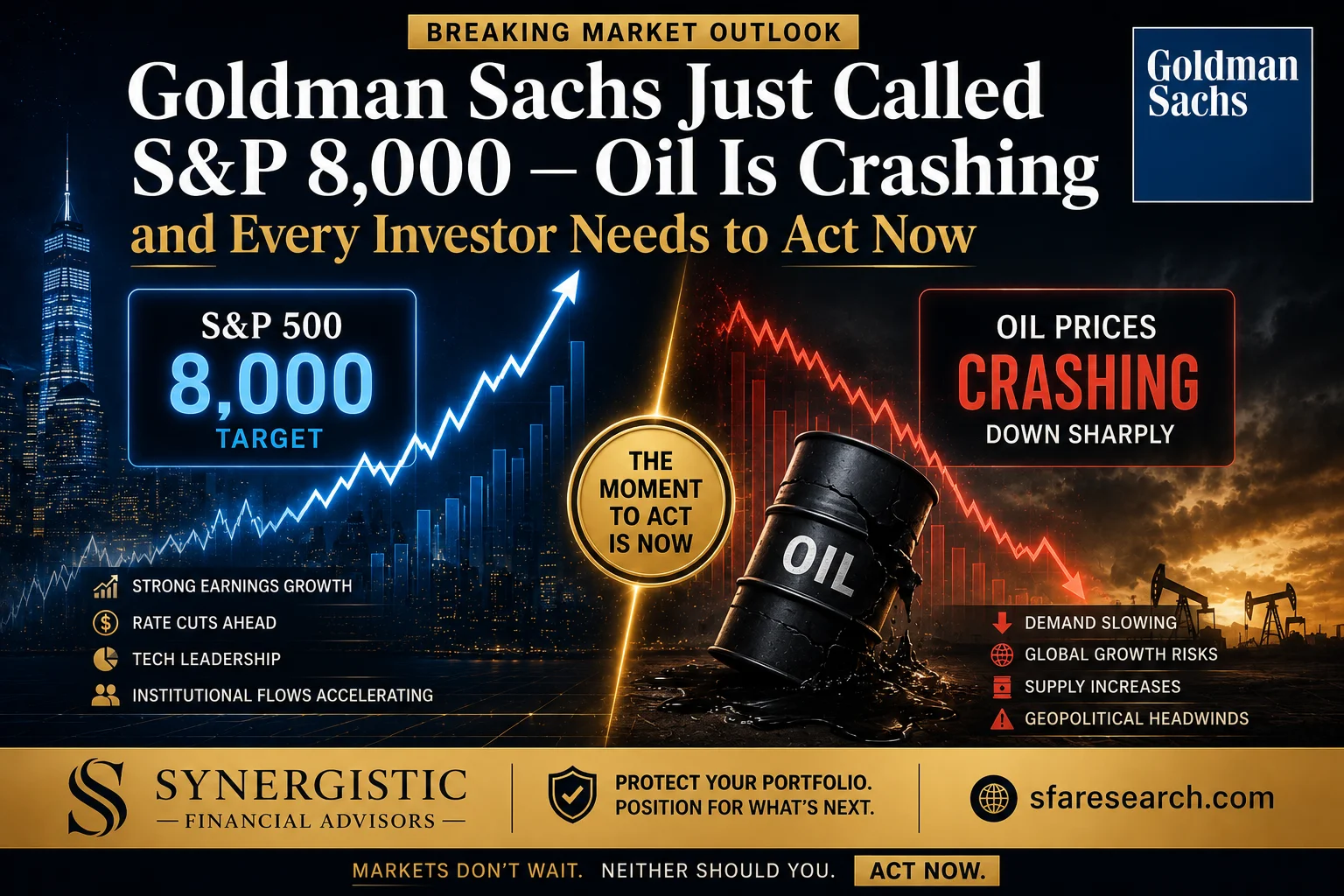
Goldman Sachs — Wall Street’s most closely watched investment bank — just raised its year-end S&P 500 target to 8,000. Oil just crashed to $88.68 a barrel — its lowest level since April — on extraordinary Iran peace news. And the Dow Jones hit yet another all-time record close of 50,644. Tomorrow brings the PCE inflation reading and Q1 GDP second estimate — the two data points that will determine whether Kevin Warsh’s Fed can finally begin cutting rates.
For investors, business owners, and anyone managing a financial planning strategy in 2026, this is a week unlike any other. Here is exactly what is happening, what it means, and what every serious investor needs to do right now.
Goldman Sachs Raises S&P Target to 8,000 — What This Signal Actually Means
Goldman Sachs raised its year-end forecast for the S&P 500 Index to 8,000 from 7,600, citing a solid earnings outlook — a call that aided bullish sentiment across markets and helped the index push toward new record territory.
Let that number sink in. The S&P 500 closed yesterday at 7,520. Goldman Sachs is calling for it to reach 8,000 by year-end — a further 6.4% gain from already record levels. If correct, 2026 will go down as one of the most extraordinary years in stock market history.
But what does this signal actually mean for your investment management and financial planning strategy — and how much weight should you give it?
Goldman’s upgraded call is built on three pillars. First, genuine earnings strength — the S&P 500 net profit margin hit a record 13.4% in Q1 2026, with the Information Technology sector posting a Q1 net margin of 29.1%, up from 25.4% a year earlier — confirming that the corporate earnings power markets are pricing is showing up in actual reported results, not just forecasts.
Second, the Iran peace dividend. US crude oil fell 5.55% to settle at $88.68 a barrel after Iranian state media said the country is committed to restoring commercial traffic through the Strait of Hormuz to pre-war levels within one month. Lower oil means lower inflation, which means more room for the new Fed Chair to ease policy — a powerful combination for equity valuations.
Third, the AI earnings cycle. Chip stocks kept climbing early Wednesday, lending the entire market a fresh tailwind — with memory chips leading the way as markets gathered strength on sliding Treasury yields and oil prices.
For your portfolio management strategy, the Goldman call is a signal worth taking seriously — but not one worth betting everything on. Wall Street forecasts have a well-documented history of being revised, reversed, and occasionally embarrassing. The more important question is not whether the S&P reaches 8,000 — it is whether your financial planning framework is built to benefit if it does, while protecting you if it doesn’t.
A certified financial planner builds strategies for multiple scenarios — not just the Goldman optimistic case.
Oil at $88 — The Iran Strait of Hormuz Breakthrough Explained
The most significant market-moving development of the past 24 hours is not Goldman’s target upgrade — it is the extraordinary collapse in oil prices driven by an Iran breakthrough that almost nobody saw coming this quickly.
US crude oil fell 5.55% to settle at $88.68 a barrel after Iranian state media said the country is committed to restoring commercial traffic through the Strait of Hormuz to pre-war levels within one month, per Reuters.
Energy prices fell for a second consecutive day, with Brent crude slipping below $95 per barrel and TTF natural gas dropping under €47 per MWh — despite the ongoing geopolitical uncertainty and contradictory headlines around potential US-Iran peace talks.
To understand why this matters so profoundly for every investor’s financial planning strategy, consider what oil above $100 has been doing to the global economy for months. It has been feeding directly into household energy bills, transportation costs, manufacturing inputs, airline tickets, and food prices. It has been the primary driver of the inflation that prevented the Fed from cutting rates. And it has been the biggest source of uncertainty in every retirement planning projection built around long-term inflation assumptions.
Oil at $88 — and potentially falling further if the Strait of Hormuz reopens as promised within a month — changes all of that simultaneously. Lower energy prices reduce headline inflation directly. They reduce pressure on the new Fed Chair to maintain restrictive policy. They reduce input costs for businesses across every sector. And they improve the real purchasing power of every household in the economy.
The selloff in long-term government bonds over recent months has been a reminder that traditional portfolio hedges are proving less reliable — with returns on US 10-year Treasuries having been negative since the onset of the Middle East conflict, driven by energy supply disruption concerns adding to already sticky inflation and persistent fiscal deficits
The reversal of the energy shock changes the bond market picture meaningfully. If oil continues falling toward $85 or below, Treasury yields face genuine downward pressure — which would be one of the most positive developments possible for portfolio management strategies with fixed income exposure.
For your investment management strategy, the oil crash creates both immediate winners and immediate losers that deserve active portfolio review today. Energy sector positions built around sustained high oil prices need reassessment. Consumer, industrial, and transportation stocks that have been pressured by high fuel costs stand to benefit significantly. And the inflation picture — which has been the single biggest obstacle to rate cuts and bond market performance — is materially improving in real time.
Dow 50,644 — Another Record, But Look Beneath the Surface
The Dow Jones Industrial Average gained 182.60 points, or 0.36%, for a record close of 50,644.28 — hitting an intraday all-time high. The broad market S&P 500 ticked 0.02% higher to 7,520.36, another closing record. The Nasdaq Composite edged up 0.07% to end at 26,674.73
Record closes. Again. But look carefully at those numbers and a story within the story emerges — the Dow gained 0.36% while the S&P gained just 0.02% and the Nasdaq barely moved. This divergence is telling.
The transformative impact of AI in the coming years and decades cannot be overstated — but the current valuations associated with many semiconductor stocks providing the compute infrastructure to make it all happen have gotten extremely frothy and way ahead of themselves, according to Eric Parnell, chief market strategist at Great Valley Advisor Group. In 2026 alone, shares of Micron have more than tripled, as have Intel shares. While we may be in the latest boom cycle for chip stocks today, it is important to remember that bust cycles have historically followed.
This is one of the most important warnings any serious investor can receive right now — and it comes from a credible, senior market strategist, not a permabear. Tripled in a single year. That is extraordinary performance — and extraordinary performance in individual names creates extraordinary concentration risk in portfolio management strategies that have held these positions without rebalancing.
SK Hynix jumped as much as 11% on Wednesday, lifting the South Korean chipmaker’s market capitalisation above $1 trillion as investors continued to pile into AI-linked semiconductor stocks.
A Korean chipmaker crossing $1 trillion in market capitalisation in a single session. The AI trade is producing genuinely historic wealth creation — and genuinely historic valuation risk simultaneously. The financial advisor who helps you navigate this distinction is delivering one of the most valuable services available in today’s market.
Jamie Dimon’s $20 Billion Acquisition Warning — What It Signals About Financial Markets
While markets celebrate record highs and oil crashing, one of Wall Street’s most respected voices is sending a different kind of signal.
JPMorgan shares were down 2% after CEO Jamie Dimon said that the bank could spend as much as $20 billion on an acquisition in the next couple of years.
Why does a CEO announcing an acquisition send the stock down 2%? Because when the world’s most successful banker signals he is willing to deploy $20 billion in acquisitions, it tells the market that he sees organic growth opportunities as limited enough to justify major external investment — and that the price of acquisitions in today’s record-high market environment will be elevated.
Read that in the context of your own financial planning and wealth management strategy. If Jamie Dimon — who manages more capital and sees more deal flow than virtually any other person on the planet — is willing to pay up for acquisitions in today’s environment, it tells you something important: quality assets are expensive right now. Cheap, undervalued opportunities are scarce. And the discipline to avoid overpaying — in your own investment management strategy — has never been more important.
The Dimon signal is a reminder that record markets create record prices for everything — and that disciplined portfolio management in this environment means being selective, patient, and willing to hold cash when genuinely compelling valuations are hard to find.
Tomorrow Is the Most Important Day of the Week — PCE and GDP Preview
Everything happening today — Goldman’s 8,000 call, oil at $88, Dow records, chip stock warnings — is prologue to what happens tomorrow morning. Because tomorrow brings the two data points that will determine the trajectory of markets, Fed policy, and financial planning strategy for the remainder of 2026.
Q1 GDP Second Estimate. The first estimate of Q1 GDP showed the US economy growing at a solid pace despite the headwinds of high energy prices and elevated rates. The second estimate either confirms that resilience or revises it — and any significant downward revision would send a powerful signal about the underlying health of the economy beneath the stock market’s record-breaking surface.
April PCE Inflation. This is the Fed’s preferred inflation measure — and Kevin Warsh’s first major policy signal will be shaped by what it shows. Fed speakers this week stressed their focus on inflationary risks stemming from the Iran conflict but remained vague on the timing of any rate action — with the ECB separately signalling a rate hike at its June meeting as likely.
If April PCE comes in at or below the 2.6% consensus expectation, the combination of falling oil prices and benign core inflation gives Warsh the cover to signal gradual easing — extending the rally toward Goldman’s 8,000 target and providing genuine relief for retirement planning projections built on lower long-term rate assumptions.
If April PCE surprises to the upside — as March CPI did — the picture reverses sharply. Rate cut hopes evaporate. Bond yields spike. Equity valuations come under pressure at 20.9 times forward earnings. And the “everything rally” narrative faces its most serious challenge of the year.
For every investor, business owner, and financial advisor, tomorrow’s data deserves your full attention — because the implications cascade across every dimension of financial planning, investment management, portfolio management, and retirement planning simultaneously.
What Smart Investors Are Doing Right Now — Your Action Plan for Today and Tomorrow
Given the extraordinary convergence of forces active right now — Goldman’s 8,000 call, oil crashing to $88, Dow at record 50,644, chip stock froth warnings, Dimon’s acquisition signal, and the most important data day of 2026 arriving tomorrow — here is the clear, disciplined action plan for every serious investor.
Rebalance your energy exposure today. Oil at $88 on Iran Strait of Hormuz news is a genuine, material development — not a temporary blip. If your portfolio management strategy has significant energy sector exposure built around sustained oil above $100, the thesis has changed and the allocation may need to change with it. A financial advisor can help you assess whether energy remains appropriate at current prices or whether the capital is better deployed elsewhere.
Take the chip stock warning seriously. Tripled in a year. Frothy valuations. Historical bust cycles following boom cycles. These are not abstract concerns — they are specific, data-grounded warnings from credible market professionals. Review your semiconductor and AI hardware exposure with a financial advisor today and assess whether your position sizing reflects appropriate risk management or accumulated drift from months of extraordinary performance.
Build your PCE response framework before 8:30 tomorrow morning. Do not wait for the data to decide what to do. Build your response framework in advance — with your financial advisor — so you are executing strategy rather than reacting emotionally to a number. A benign PCE reading validates the Goldman 8,000 call and justifies maintaining or adding equity exposure. A hot reading demands defensive repositioning in your portfolio management strategy.
Review your fixed income positioning for the rate cut scenario. Returns on US 10-year Treasuries have been negative since the onset of the Middle East conflict — driven by energy supply disruption concerns adding to already sticky inflation. As the energy shock reverses, the bond market picture is improving. Investors who are well-positioned in intermediate-duration bonds stand to benefit meaningfully from any further yield decline driven by falling oil and benign PCE data.
Integrate the SpaceX IPO into your complete financial plan this week. With the roadshow beginning June 4 and trading targeted for June 12, the tax planning and investment management decisions around SpaceX participation need to be made now — not in the excitement of the roadshow. A certified financial planner can help you build your participation framework before the deadline pressure arrives.
Stress-test your retirement planning projections against tomorrow’s data. Your retirement planning projections were built on specific assumptions about inflation, interest rates, and economic growth. Tomorrow’s PCE and GDP readings will either validate or challenge those assumptions. An annual review with a qualified financial advisor ensures your long-term strategy reflects today’s actual data — not the assumptions you built 12 months ago.
The Bigger Picture — What This Week Is Really Telling Investors
Step back from the daily headlines for a moment and look at what this week is collectively communicating about the state of financial markets in May 2026.
The Dow is at record highs. The S&P 500 is at record highs. Goldman Sachs is calling for 8,000 by year-end. Oil is crashing on Iran peace news. Corporate profit margins are at their highest level in history. The new Fed Chair favours lower rates. The SpaceX IPO — the largest in history — is two weeks away.
And simultaneously — chip stocks are described as “extremely frothy.” Traditional bond portfolio hedges are failing. The world’s most respected banker is planning a $20 billion acquisition in a market where cheap assets are scarce. ECB officials are signalling rate hikes. And tomorrow’s PCE reading could either confirm the bull case or deliver a sharp reminder that inflation is not yet defeated.
BlackRock’s Investment Institute specifically highlights that the selloff in long-term government bonds is a reminder that traditional portfolio hedges are proving less reliable today — making genuine diversification across uncorrelated assets more important than at any point in recent memory for every serious wealth management strategy. Shookresearch
This is the financial reality of May 2026. Extraordinary opportunity existing simultaneously with genuine, underappreciated risk. Record highs built on real earnings strength — but also on valuations that leave little room for disappointment. A peace dividend potentially transforming the inflation and rate outlook — but not yet signed, sealed, or delivered.
The investors who navigate this environment successfully are not the ones chasing every record. They are the ones with clear financial planning frameworks, disciplined portfolio management strategies, expert tax planning that captures opportunities efficiently, and qualified financial advisors who keep them focused on long-term wealth management goals when short-term noise makes clear thinking difficult.
Final Thoughts — Tomorrow Changes Everything
May 28, 2026 is a remarkable day in financial markets. But it is also a day that is fundamentally about tomorrow. Tomorrow’s PCE and GDP data will either confirm the Goldman 8,000 thesis or challenge it. Tomorrow will either validate the Iran peace dividend or reveal it as premature. Tomorrow will either give Kevin Warsh the data he needs to signal rate relief — or force him to maintain the restrictive stance that has kept borrowing costs elevated all year.
At Synergistic Financial Advisors, we help individuals, families, and businesses navigate exactly these kinds of high-stakes, data-driven financial moments with the clarity and discipline that genuine expertise provides. From investment management and portfolio management to retirement planning, tax planning, and comprehensive wealth management — our team is here to make sure tomorrow’s data works for your financial future, whatever it shows.
Want to know exactly what Goldman’s 8,000 call, oil at $88, and tomorrow’s PCE mean for your personal financial plan? Contact Synergistic Financial Advisors today for a personalised consultation.
👉 Visit sfaresearch.com — because tomorrow’s data deserves a strategy, not a reaction.