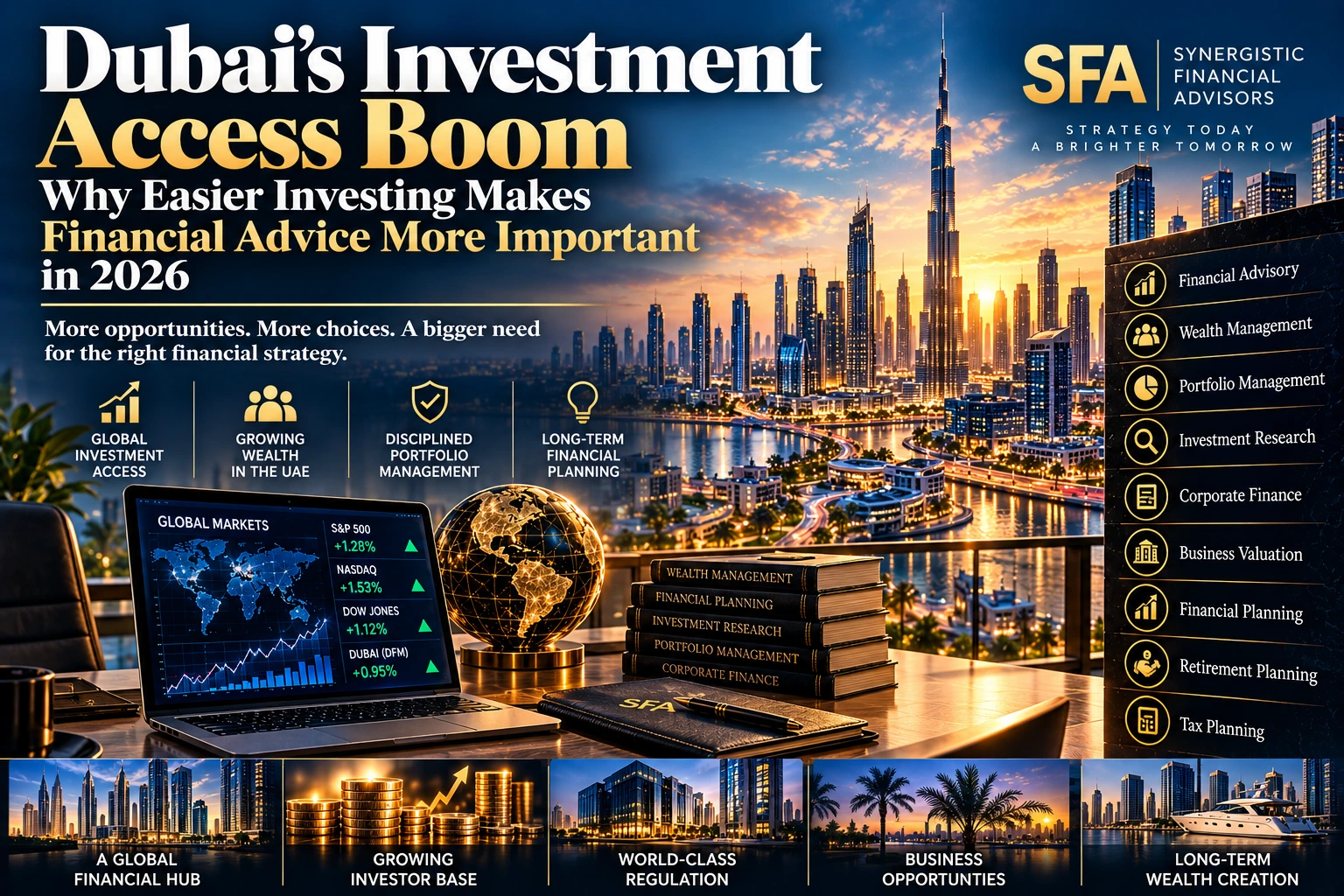
Dubai is rapidly becoming one of the world’s most important places for investors to access global financial markets.
The latest signal arrived on October 22, when Robinhood announced that it had received Dubai Financial Services Authority authorisation and selected Dubai International Financial Centre as its regional headquarters for Middle East expansion.
For Dubai investors, however, the bigger story is not Robinhood itself.
The bigger story is what its arrival represents.
Global investment platforms, private banks, asset managers and international financial firms are increasingly building operations in the UAE.
This means access to global investments is becoming easier.
But easier access creates a new challenge:
When investors can buy almost anything, deciding what they should own becomes more important than gaining access to investments in the first place.
That is why Dubai’s next financial-services opportunity may not simply be investment access.
It may be better financial advice, portfolio construction and long-term wealth strategy.
Dubai Is Becoming a Global Investment Gateway
Dubai’s financial ecosystem has expanded rapidly.
By the end of the first half of 2026, DIFC had more than 10,000 active registered companies and 1,134 regulated financial-services firms.
Its wealth and asset-management ecosystem included 592 firms, while family-business-related entities reached 1,408.
International investment companies continue to establish or expand operations in the city.
In September alone, firms including Carmignac, GRT Capital Management and Mirae Asset announced Dubai or DIFC expansion plans focused on investors across the UAE, GCC and wider Middle East.
Dubai was also ranked first globally for FinTech by industry professionals in the latest Global Financial Centres Index and second globally for professional services.
The direction is clear:
Dubai is moving from being a place where wealthy people live to being a place where global wealth is increasingly managed.
UAE Wealth Could Reach $6 Trillion by 2030
The size of the opportunity is also expanding.
Boston Consulting Group estimates that total UAE net wealth could reach approximately $6 trillion by 2030, increasing by more than $2.3 trillion over five years.
The UAE’s net wealth reached approximately $3.6 trillion in 2025, while cross-border wealth booked in the country reached about $721 billion.
The country’s high-net-worth population is also expected to expand.
The number of individuals with more than $100 million in assets could increase from roughly 500 to around 800 by the end of the decade.
This creates enormous opportunity for wealth management, investment advisory and financial planning.
But it also introduces greater complexity.
More assets do not automatically create a better financial strategy.
Access Is No Longer the Main Problem
Twenty years ago, an investor’s biggest challenge might have been gaining access to international financial markets.
Today a Dubai resident can potentially access:
- Global equities
- Bonds
- Exchange-traded funds
- Mutual funds
- Private-market opportunities
- Real estate
- Commodities
- International currencies
- Regional markets
The number of choices continues to increase.
That sounds entirely positive.
But unlimited choice can create poor financial decisions just as easily as limited choice.
An investor might own 15 different funds and still be heavily exposed to the same technology companies.
Another might own property in Dubai, shares in a UAE company and a private business—all ultimately dependent on the same regional economic conditions.
A third investor may constantly buy whichever investment performed best during the previous year.
The problem is no longer:
“What can I invest in?”
It becomes:
“What actually belongs in my portfolio?”
That is the purpose of professional portfolio management.
The Difference Between Investing and Portfolio Management
Buying an investment is a transaction.
Building a portfolio is a strategy.
Effective portfolio management considers how investments work together.
A portfolio should reflect:
- Financial objectives
- Time horizon
- Risk tolerance
- Risk capacity
- Liquidity needs
- Existing wealth
- Currency exposure
- Income requirements
- Tax considerations
- Retirement plans
For example, a 32-year-old professional building wealth over 25 years may reasonably have a very different portfolio from a 62-year-old business owner preparing to retire.
Both can access exactly the same investment platforms.
They should not necessarily own the same investments.
More Investment Platforms Can Increase Behavioural Risk
Easy investing has another consequence.
It makes reacting to markets easier.
An investor sees a stock rising sharply.
A few taps later, they own it.
A market falls.
Another few taps and the investment is sold.
This convenience can encourage:
- Performance chasing
- Excessive trading
- Concentrated positions
- Emotional selling
- Short-term speculation
Technology reduces the friction involved in transactions.
It does not automatically improve decision-making.
A financial advisor or investment advisor can potentially add value by creating a process before markets become emotional.
The question changes from:
“What should I buy today?”
to:
“What investment strategy supports my financial objectives over many years?”
Dubai Investors Often Have More Complex Financial Lives
Dubai’s population is highly international.
That means many investors may have assets or financial obligations in several countries.
For example, someone living in Dubai may simultaneously have:
- UAE income
- Property in Dubai
- Investments in the United States
- Family responsibilities in India or Pakistan
- Retirement assets in Europe
- Business interests elsewhere
- Future education costs in another currency
That creates financial-planning issues that cannot always be solved by selecting a better stock.
Currency exposure matters.
Liquidity matters.
Location of assets matters.
Future liabilities matter.
Family objectives matter.
This is where broader financial planning becomes important.
Wealth Management Is More Than Investment Returns
High-net-worth individuals frequently require an even wider perspective.
Their wealth may consist of:
Business + Property + Financial Investments + Cash + International Assets
A proper wealth management strategy should evaluate the entire balance sheet.
Suppose a Dubai entrepreneur has:
AED 15 million in a private business,
AED 10 million in property,
and AED 3 million in financial investments.
Their investment portfolio may appear diversified.
But most of the individual’s total wealth remains concentrated in the business and real estate.
A sophisticated strategy therefore considers total economic exposure rather than analysing one brokerage account independently.
Dubai’s Family-Wealth Market Is Growing Rapidly
This issue is particularly relevant to family wealth.
DIFC says approximately $1 trillion in assets could transfer to the next generation across the Middle East during the coming decade.
Its family ecosystem has expanded rapidly as business-owning families increasingly focus on governance, succession and preservation of wealth across generations.
In 2026, DIFC reported more than 1,400 family-related entities, while its Family Wealth Centre has been developing programmes specifically around next-generation leadership and family-enterprise continuity.
For family businesses, this means wealth strategy should address more than investment returns.
Important questions include:
Who will own the business next?
Who will manage it?
How much family wealth should remain inside the company?
How much should be diversified outside it?
How will wealth be transferred between generations?
These questions connect corporate finance with personal wealth management.
Business Owners in Dubai Need a Different Financial Strategy
Entrepreneurs frequently have most of their net worth concentrated in their company.
The business may represent:
- Income
- Investment
- Retirement
- Family wealth
- Future inheritance
all at once.
That creates concentration risk.
A successful company should ideally generate personal financial independence over time rather than becoming the only asset the owner possesses.
This is where business owners may benefit from coordinating:
Corporate Finance
with
Financial Planning
and
Investment Management
For example, excess business cash might be used for:
- Expansion
- Debt reduction
- New technology
- Business acquisition
- Personal diversification
- Liquidity reserves
Choosing between these options is a capital-allocation decision.
Business Valuation Can Also Support Personal Wealth Planning
A business owner cannot properly understand personal net worth without knowing what the company is realistically worth.
Business valuation can help answer:
- What is the business worth today?
- What drives that value?
- How dependent is the company on the founder?
- What could improve value over five years?
- Is the owner’s retirement target dependent on an unrealistic sale price?
That makes valuation useful even when there are no immediate plans to sell the company.
What Should UAE Investors Look for in a Financial Advisor?
Searches such as financial advisors near me, financial planner near me, financial consultant near me, and best financial advisors can help identify providers.
But Google rankings should only be the beginning.
Before hiring a provider, ask:
What services are actually included?
Is the relationship limited to investments?
Or does it include broader financial planning?
What experience does the advisor have?
Does the firm work with investors, entrepreneurs, families or institutions with similar needs?
How is the advisor compensated?
Understand fees and potential conflicts.
What regulatory permission applies?
For regulated activities, verify the appropriate authorisation for the jurisdiction and service being offered.
For example, financial firms conducting regulated activities from DIFC fall under the relevant DFSA framework.
What is the investment process?
A professional should be able to explain:
- Asset allocation
- Diversification
- Risk management
- Investment selection
- Rebalancing
- Performance monitoring
without relying on promises of exceptional returns.
What About a “Fiduciary Financial Advisor” in Dubai?
Some investors search specifically for a fiduciary financial advisor because the term is widely used in U.S. financial services.
Investors in the UAE should be careful not to assume that terminology used in another jurisdiction automatically carries exactly the same legal meaning in Dubai.
Instead, ask:
What regulatory obligations apply to this relationship?
What conflicts exist?
How is the advisor compensated?
What does the engagement agreement require?
The underlying objective should be transparency rather than a marketing label.
Do You Need a Certified Financial Planner?
A certified financial planner or another qualified professional may be useful where broad planning expertise is required.
But credentials should always be verified.
Also remember that one credential does not necessarily mean the individual provides every financial service.
The best professional fit depends on the client’s specific needs.
Retirement Planning Still Matters in a Wealthy City
Dubai’s strong wealth creation can make retirement feel less urgent.
But retirement planning remains essential.
A high income today does not guarantee sufficient future income.
Investors need to consider:
- Future lifestyle costs
- Inflation
- Healthcare
- Housing
- Longevity
- Investments
- Other income sources
For expatriates, there may also be an important additional question:
Where will I eventually retire?
If future expenses will be in another currency, that can influence investment and savings decisions today.
Tax Planning Should Be Cross-Border Aware
The UAE’s tax environment is one of its attractions.
But many residents have international assets, businesses or tax connections.
That means tax planning should not be reduced to the statement that the UAE has no personal income tax.
Individual circumstances can differ based on:
- Citizenship
- Tax residence
- Business ownership
- Foreign assets
- Investment income
- Property
- Inheritance
Tax advice should therefore be obtained from appropriately qualified professionals where required.
Dubai Investor Checklist for 2026
| Area | Question to Ask |
|---|---|
| Financial Planning | What am I actually investing for? |
| Portfolio Management | Is my portfolio genuinely diversified? |
| Wealth Management | Where is my total net worth concentrated? |
| Liquidity | Can I meet near-term needs without selling investments? |
| Currency | Which currencies will future expenses be in? |
| Business Wealth | Is too much of my wealth tied to one company? |
| Retirement | Where and how do I plan to retire? |
| Tax Planning | Do I have cross-border tax considerations? |
| Investment Research | Do I understand what I am buying? |
| Advisor Selection | Are services, fees and regulatory status clear? |
Where SFA Fits in Dubai’s Changing Financial Market
The growth of Dubai as a global investment hub creates an important opportunity for Synergistic Financial Advisors (SFA).
As investing becomes easier, clients increasingly need help connecting individual investment decisions to a broader financial strategy.
SFA’s capabilities include areas such as:
Financial Advisory
Helping clients evaluate financial decisions within a broader strategic framework.
Portfolio Management
Building investment strategies around risk, objectives and time horizon rather than market trends.
Investment Research
Supporting better decisions through analysis of markets, sectors and financial opportunities.
Corporate Finance
Helping business owners and companies evaluate capital, growth and financial strategy.
Business Valuation
Helping entrepreneurs understand the financial value and drivers of their businesses.
Wealth Management
Helping individuals and families consider investments alongside business interests, liquidity and long-term wealth objectives.
This broader perspective can be particularly relevant in Dubai, where many investors are entrepreneurs, international professionals or families with assets across multiple countries.
More information about Synergistic Financial Advisors is available at sfaresearch.com
Final Thoughts
Robinhood’s decision to establish its Middle East headquarters in DIFC is another sign that global investment access in Dubai continues to expand.
But easier investing does not automatically create better investors.
The UAE is becoming wealthier.
More international financial institutions are entering the market.
More investment products are becoming accessible.
And Dubai’s wealth and asset-management ecosystem continues to expand.
That makes professional financial decision-making increasingly important.
When access to investments becomes easy, deciding what not to buy can become just as important as deciding what to buy.
The objective of good financial advice should therefore not be to encourage more transactions.
It should be to create a coherent strategy.
Understand your goals.
Diversify your risks.
Manage liquidity.
Plan for retirement.
Coordinate business and personal wealth.
And make sure each investment has a clear role.
That is where financial planning, investment management, portfolio management and wealth management can add real long-term value.