Welcome back from the Memorial Day weekend. US markets reopened this morning to one of the most extraordinary financial environments of the entire year — and the next five days may be the most consequential trading week of 2026.
Here is what is happening right now, why it matters, and exactly what every investor needs to do about it.
Investors opened the week with a strong risk-on tone after US officials — including President Trump himself — signalled over the long weekend that negotiations with Iran were approaching a formal agreement. Energy prices dropped sharply on the optimism, with Brent crude falling below $97 per barrel and European gas prices declining to €45 per MWh.
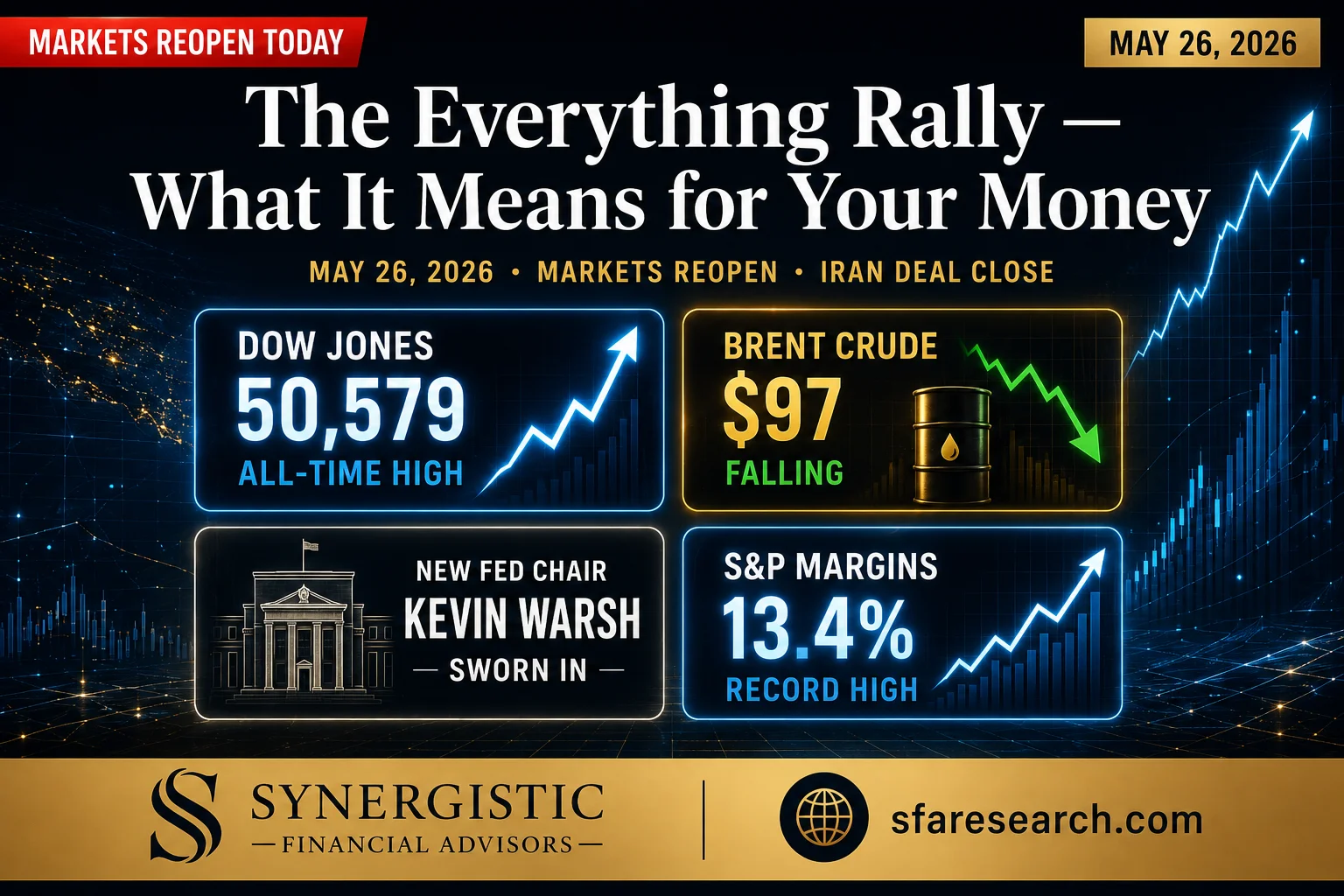
Before the Memorial Day break, the Dow Jones Industrial Average jumped 294 points to finish at 50,579 — hitting an intraday all-time high and posting another record close. The S&P 500 settled at 7,473, climbing 0.37% on the day. The Nasdaq Composite rose to 26,343.
Steve Sosnick, chief strategist at Interactive Brokers, described the mood perfectly heading into the weekend: “It’s the everything rally. The market is telling you today they’re much more concerned that they’re going to miss some sort of peace in the Middle East than they are about the risks of going home long over the weekend.”
The everything rally. That phrase captures this moment better than any chart or data point. Stocks are at records. Oil is falling. Gold remains elevated. The SpaceX IPO is 17 days away. A new Federal Reserve Chair has just been sworn in. And this week brings some of the most important economic data releases of the year.
For investors with a clear financial planning strategy, this is an environment full of genuine opportunity. For those without one — the risks hiding beneath the surface of “the everything rally” deserve serious attention.
The Iran Deal — Why Oil Below $97 Changes Everything
The single most market-moving development of the past 48 hours is the progress on a US-Iran peace agreement — and its direct, immediate impact on energy prices deserves careful analysis from every investor and financial advisor.
Energy prices dropped on optimism surrounding a potential US-Iran deal, with Brent falling below $97 per barrel and TTF gas prices declining to €45 per MWh — with US officials signalling over the weekend that negotiations were approaching a formal agreement.
To understand why this matters so much, consider the context. Earlier this month the 30-year Treasury yield hit a nearly 19-year high — driven in significant part by energy price-driven inflation from the Middle East conflict. Oil above $100 was feeding through to every corner of the economy — household energy bills, transportation costs, manufacturing inputs, and airline tickets.
Oil below $97 — and falling — changes that picture meaningfully. Lower energy prices reduce inflationary pressure, which reduces pressure on the new Fed Chair to maintain restrictive monetary policy, which improves the outlook for eventual rate relief. The chain reaction from an Iran peace deal to your financial planning strategy runs further and faster than most investors realise.
Against this backdrop, Eurozone sovereign yields declined sharply today with mild curve steepening as short-term rates fell more than long-dated ones — and peripheral spreads narrowed in line with the improved risk backdrop.
For portfolio management purposes, the Iran deal progress has immediate implications across multiple asset classes. Energy sector stocks face headwinds as oil falls. Consumer discretionary and transportation companies benefit from lower fuel costs. Bond markets are rallying as inflation expectations ease. And international equities — particularly European markets — are responding positively to the reduced geopolitical risk premium.
A qualified financial advisor can help you assess whether your current portfolio management strategy is positioned to benefit from this developing shift — or whether rebalancing is warranted given the rapid change in the energy and geopolitical landscape.
Kevin Warsh — The New Fed Era Begins Today
This week marks the first full trading week of Kevin Warsh’s tenure as Federal Reserve Chair — and the financial implications for every investor’s wealth management and retirement planning strategy are profound.
President Trump led a ceremony swearing in Kevin Warsh as Chair of the Federal Reserve on Friday — putting him in charge of a central bank that must navigate a tumultuous economy and a president with very specific expectations on interest rates. Warsh is the first Fed Chair to be sworn in at the White House since Alan Greenspan in 1987.
Incoming Fed Chairman Kevin Warsh has said he favours lowering the federal funds rate — a signal that markets are beginning to price in after a period of sustained rate holds driven by persistent inflation from the Middle East conflict.
But here is the critical nuance that separates sophisticated investment management from headline-driven reaction: Warsh favouring lower rates and Warsh being able to cut rates are two very different things. The Federal Reserve operates on data — and this week delivers some of the most important data of the year.
Today brings May consumer confidence data — a reading that will reveal whether American households are beginning to feel relief from the easing energy prices or whether the cumulative impact of months of elevated inflation has created a deeper confidence problem. Wednesday brings April new home sales and major technology earnings from Marvell Technology, Salesforce, and Snowflake. Thursday brings the critical Q1 GDP second estimate and April PCE inflation data — alongside earnings from Dell, Costco, Dollar Tree, and Best Buy.
The April PCE reading on Thursday is the week’s most important data point for financial planning strategy. PCE — the Fed’s preferred inflation measure — will tell us whether the energy price spike of recent months has fed through into broader core inflation, or whether price pressures remain contained enough to give Warsh the cover he needs to begin easing policy.
If PCE comes in hot, rate cut expectations will be pushed further out — pressuring bond markets and potentially ending the “everything rally” abruptly. If PCE comes in at or below expectations, the combination of falling oil prices and a new rate-friendly Fed Chair could extend the rally meaningfully through June.
Your financial planning and investment management strategy needs to be robust enough to navigate both outcomes — not just the optimistic one.
Record Corporate Margins — The Hidden Engine Behind the Rally
While geopolitical optimism is driving the market mood today, the more important — and more durable — story behind 2026’s extraordinary market performance is one of genuine fundamental strength.
The blended net profit margin for the S&P 500 in Q1 2026 stood at 13.4% — the highest level recorded since FactSet began tracking the metric in 2009, surpassing the prior record of 13.2% set in Q4 2025. Margin expansion was concentrated in the Information Technology sector, which posted a Q1 net margin of 29.1%, up from 25.4% a year earlier.
The implication is straightforward: the corporate earnings power that markets are pricing is not a forecast or a forward-looking estimate — it is showing up in actual reported results.
This distinction matters enormously for wealth management and investment management decision-making. Markets at record highs driven by genuine earnings growth are fundamentally different from markets at record highs driven by sentiment or multiple expansion alone. The former can sustain elevated valuations. The latter cannot.
Business investment has soared amid the build-out of AI data centres — and the economy has been more resilient than many had expected, with consumer spending holding up in the face of higher gasoline prices.
But resilience is not invulnerability. The forward 12-month price-to-earnings ratio for the S&P 500 stood at 20.9 — above both the five-year average of 19.9 and the ten-year average of 18.9. Current valuations are down from recent peaks, but the index is still being priced for a continuation of the current trajectory through the second half of 2026.
Continuation is possible — even probable given the fundamental strength. But it is not guaranteed. And at 20.9 times forward earnings, there is very little margin for error. A certified financial planner who builds your portfolio management strategy around realistic, data-grounded scenarios — rather than pure optimism — is worth their weight in gold in this environment.
The AI Earnings Divergence — What It Reveals About Smart Investing
One of the most important and most instructive stories from the recent earnings season is the divergence in how markets are responding to AI capital spending — and what it reveals about the evolution of investment management strategy in 2026.
The market’s reaction to megacap technology earnings revealed a meaningful new differentiation. Alphabet rose approximately 34% in April — its strongest monthly gain since 2004 — on a Q1 beat across cloud, advertising, and Waymo. Meta Platforms fell roughly 9% after raising 2026 capital expenditure guidance to a range of $125 billion to $145 billion, even as it beat on earnings. Microsoft fell approximately 4% on its results.
The pattern signals a fundamental shift: investors are now pricing AI capital spending against evidence of returns — not on the size of the commitment alone.
This is a critical evolution for anyone whose investment management or portfolio management strategy has significant technology exposure. The “buy anything AI” trade that characterised much of 2025 and early 2026 is maturing into something more discriminating. Investors are now asking: is this company generating returns from its AI investment — or is it simply spending more?
Alphabet said yes. The market rewarded it with 34% gains in a single month. Meta and Microsoft, for now, could not demonstrate returns clearly enough. The market penalised both.
For wealth management strategies with technology exposure, this earnings season is a powerful reminder that sector analysis and stock selection matter enormously — even in a structurally compelling theme like artificial intelligence. A financial advisor with genuine expertise in investment management can help you ensure your technology exposure is concentrated in the companies demonstrating actual AI returns, not just the largest AI spenders.
What the Everything Rally Means for Your Money — A Clear Action Plan
The convergence of forces active in today’s market — Iran deal progress, oil below $97, record corporate margins, Warsh’s first week, SpaceX IPO 17 days out, and critical economic data due this week — creates one of the most genuinely complex and consequential financial environments any investor has navigated in years.
Here is the clear, disciplined action plan for every serious investor this week:
Monitor the PCE data on Thursday with extreme attention. This is the single most important data release of the week for financial planning and investment management strategy. A hot reading changes the rate outlook significantly. A benign reading extends the everything rally and gives Warsh room to begin signalling easing. Build your response framework in advance — with your financial advisor — so you are executing strategy rather than reacting to headlines.
Reassess your energy sector exposure today. Oil below $97 on Iran deal optimism is a genuine shift — but “approaching an agreement” is not the same as a signed deal. If your portfolio management strategy has significant energy exposure that was built around sustained oil above $100, review whether that thesis still holds as the geopolitical picture evolves.
Do not let the everything rally create dangerous complacency. In the short run, the AI data centre build-out increases demand for resources and may be putting upward pressure on prices — while the bond market is tightening financial conditions by pushing yields higher, even in the absence of immediate Fed rate action. Record markets and a peace deal in progress are not the same as a risk-free environment. Your wealth management strategy should reflect genuine diversification — not just maximum exposure to the most exciting stories of the moment.
Prepare your SpaceX IPO strategy this week. With the roadshow beginning around June 4 and trading targeted for June 12, the window to build your participation framework — including position sizing, account selection, and tax planning — is narrowing fast. A certified financial planner can help you integrate the SpaceX decision into your complete financial planning framework before the deadline pressure arrives.
Review your retirement plan projections against this week’s data. The combination of a new Fed Chair, falling oil prices, record corporate margins, and an imminent SpaceX IPO means the economic assumptions underlying your retirement planning strategy may need updating. An annual review with a qualified financial advisor ensures your long-term projections reflect today’s actual environment — not the assumptions you built them on 12 months ago.
Consider your fixed income positioning carefully. Eurozone sovereign yields declined sharply today as the Iran deal optimism improved the risk backdrop — and US Treasury yields are likely to follow if Thursday’s PCE comes in benign. Investors who are well-positioned in intermediate-duration bonds stand to benefit meaningfully from any further yield decline. Those with excessive cash or very short-duration exposure may want to review their investment management strategy with a financial advisor this week.
The Week Ahead — Your Complete Financial Calendar
This week is packed with market-moving events that every investor needs on their radar. Here is your complete guide:
Today — Tuesday May 26: Markets reopen after Memorial Day. May consumer confidence data released — a critical gauge of whether households are beginning to feel relief from easing energy prices. Earnings from AutoZone and Zscaler.
Wednesday May 27: April new home sales — a key indicator for the real estate and mortgage market given the elevated rate environment. Major technology earnings from Marvell Technology, Salesforce, Snowflake, and Synopsys — all critical data points for the AI investment management thesis.
Thursday May 28: The week’s most important day. Q1 GDP second estimate — confirming or revising the initial reading of US economic growth. April PCE inflation — the Fed’s preferred inflation measure and the most important input to Kevin Warsh’s first major policy signal. Earnings from Dell, Costco, Dollar Tree, Best Buy, MongoDB, and Gap.
Friday May 29: No major data or earnings expected — giving markets time to digest what is likely to be an information-packed week.
For anyone managing a financial planning or wealth management strategy, this week’s calendar is as consequential as any in 2026. The PCE reading alone could shift retirement planning projections, tax planning timelines, and portfolio management strategy simultaneously.
Final Thoughts — The Everything Rally Has a Shelf Life
The everything rally is real. The Dow at 50,579. Oil below $97. Record corporate margins. A new Fed Chair who favours lower rates. An Iran peace deal potentially days away. The SpaceX IPO 17 days out. Every headline is pointing in the same direction.
But every experienced financial advisor knows that “everything rallies” — moments when every asset class rises simultaneously on a single optimistic narrative — are among the most dangerous environments for undisciplined investors. Because when the narrative shifts — when the Iran deal falls through, or the PCE comes in hot, or the SpaceX IPO disappoints — the reversal can be as fast and as powerful as the rally itself.
The investors who will look back on this week with genuine satisfaction are not those who piled into every exciting opportunity at once. They are those who maintained disciplined portfolio management, reviewed their financial planning assumptions against the new data, captured specific opportunities with appropriate position sizing, and kept their long-term wealth management goals firmly in focus while everyone else was celebrating the everything rally.
At Synergistic Financial Advisors, we help individuals, families, and businesses navigate exactly this kind of extraordinary, complex, high-stakes financial environment with clarity, discipline, and a personalised strategy built entirely around your goals. From investment management and portfolio management to retirement planning, tax planning, and comprehensive wealth management — our team is here to make sure the everything rally works for your financial future, not against it.
Want to know exactly what today’s market reopening, Iran deal progress, and this week’s critical data mean for your personal financial plan? Contact Synergistic Financial Advisors today for a personalised consultation.
👉 Visit sfaresearch.com — because in the everything rally, strategy separates the winners from the wishful thinkers.