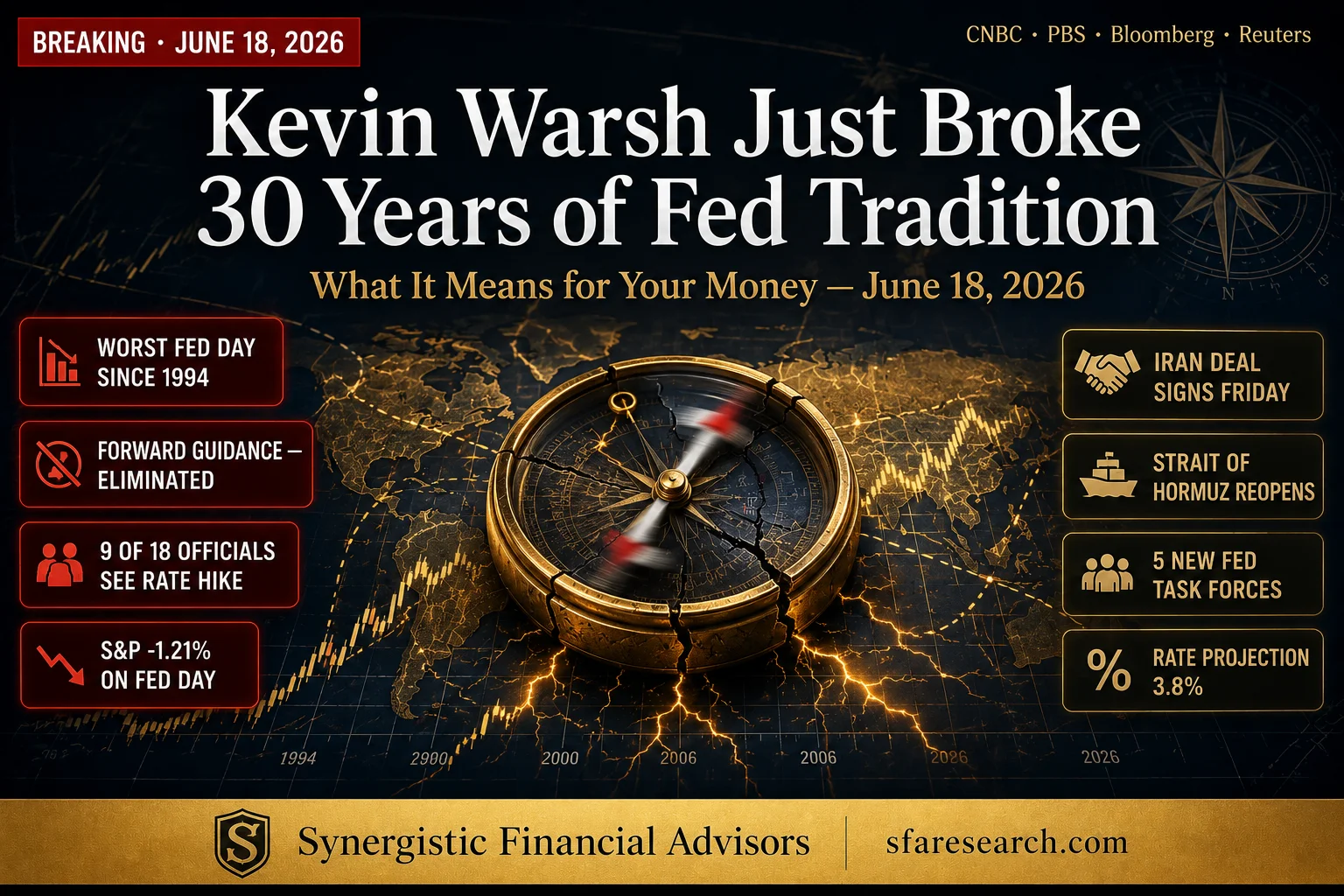
For three decades, every Federal Reserve Chair has followed the same basic communication playbook — careful forward guidance, telegraphed rate signals, and a dot plot that every market participant on earth uses to price risk. Yesterday, Kevin Warsh walked into his first press conference as Fed Chair and tore up the entire script.
The S&P 500 shed 1.21% on Wednesday, with losses steepening during and after Kevin Warsh’s inaugural press conference as chairman of the Federal Reserve — marking the worst performance for the index on the first “Fed day” under a new chair since 1994, according to data from Bespoke Investment Group.
This is not a routine market wobble. This is the worst debut for a new Fed Chair in 32 years — and it happened on the same week that SpaceX became the largest IPO in history, the same week that an Iran peace deal is scheduled to be formally signed in Switzerland tomorrow, and the same week that inflation sits at its highest level in three years.
For every investor managing a financial planning strategy, this is precisely the kind of week that separates disciplined, well-prepared portfolios from reactive, panicked ones. Here is exactly what happened, why it matters, and what it means for your investment management, retirement planning, and wealth management strategy right now.
What Kevin Warsh Actually Did — And Why It Shocked Markets
Federal Reserve Chairman Kevin Warsh used his debut press conference on June 17 to strip away decades of central bank communication habits — and markets spent the following day sorting out what that means for rates, risk, and every asset class simultaneously.
The most immediate break from recent Fed practice was the removal of forward guidance entirely. Warsh addressed it plainly: “We’ve dropped forward guidance.” He went further, saying that “as a general proposition, forward guidance isn’t the business we should be in.” The shift is significant for markets that spent years reading Fed language for signals on rate timing — without those signals, participants now have to price rate decisions based on incoming data rather than Fed telegraphing.
Think about what this actually means for your portfolio management strategy. For decades, the Fed has functioned almost like a navigation system for markets — providing forward guidance that let investors anticipate policy moves months in advance and position accordingly. Warsh just turned that navigation system off. Markets are now flying without the instrument panel they have relied on since the Greenspan era.
The FOMC released a revamped statement with significant changes from those under former chief Jerome Powell’s leadership, resulting in a much shorter and pared down version that dropped forward guidance and ended with a simple assertion: the FOMC “will deliver price stability.”
That is it. No roadmap. No telegraphed timeline. Just a commitment to an outcome with no guidance on how or when the Fed will get there. For an investor base that has built investment management strategies around anticipating Fed moves for three decades, this is a genuinely structural change in how markets need to operate.
The Dot Plot Shock — 9 of 18 Officials Now See a Rate Hike
Beyond the communication overhaul, the substance of yesterday’s meeting delivered its own significant shock.
The hawkish tilt to the dot plot was notable, with 9 of the 18 FOMC participants pencilling in a rate hike this year and the overall projection switching to one 25 basis point rate hike from at least one cut previously expected. The updated Summary of Economic Projections projected a federal funds rate at 3.8% at the end of 2026 — revised upward from 3.4% in the previous dot plot in March.
The Federal Open Market Committee split 9-9 between those expecting steady rates or one cut and those seeing at least one hike, with the median “dot” pointing to a quarter percentage point increase.
A perfectly split committee. Half expecting stability, half now pencilling in a hike. This is precisely the kind of genuine, unresolved uncertainty that markets price most uncomfortably — because it means no clear consensus exists about where rates are heading, at the exact moment when markets have spent months building strategies around the assumption that cuts were eventually coming.
Nine FOMC dot plot participants projected at least 1 rate hike by year-end 2026, with PCE seen at 3.6%. The CME Group’s FedWatch tool showed traders are pricing in a 60.7% chance of a rate hike taking place in October, following comments from newly minted Chairman Warsh.
A 60.7% probability of an October rate hike. Just months ago, the market consensus was firmly built around eventual rate cuts. The reversal in expectations over the past six weeks — driven by the 4.2% CPI reading, the strong May jobs report, and now Warsh’s hawkish debut — represents one of the most significant shifts in monetary policy expectations of the entire year.
For your retirement planning strategy specifically, this matters enormously. Every projection built around the assumption of declining rates through 2026 and into 2027 needs immediate reassessment. A certified financial planner can rebuild your retirement income modelling around a genuinely uncertain rate environment — one where hikes are now a real possibility rather than a remote tail risk.
Warsh’s Reformer Agenda — Five Task Forces and an Institution in Flux
Beyond rates and forward guidance, Warsh used his debut to signal something even more consequential — a fundamental institutional overhaul of how the Federal Reserve itself operates.
He announced the creation of five task forces to take a fresh look at areas long argued to be in deep need of reform. “The task force announcements signal an institution in active review rather than steady state, and investors should expect the operating framework of the Fed to look meaningfully different over Warsh’s tenure than it did under his predecessor,” noted Jason Pride, chief of investment strategy at Glenmede.
“Warsh wants his first impression to be as ‘the reformer,'” multiple analysts observed — a positioning that suggests the changes investors witnessed yesterday are not a one-time adjustment but the beginning of a sustained period of institutional transformation at the world’s most important central bank.
For wealth management strategy, an institution actively reviewing its own operating framework introduces a new category of uncertainty that did not exist six weeks ago. Markets that have spent decades calibrating to a predictable Fed communication style now need to build genuine flexibility into their portfolio management approach — anticipating that the rules of engagement with monetary policy itself may continue evolving throughout Warsh’s tenure.
The Inflation Target Question — Warsh’s Clearest Signal Yet
Perhaps the most reassuring moment of an otherwise unsettling press conference came when Warsh was asked directly about the Fed’s 2% inflation target.
Asked whether he is reconsidering the Federal Reserve’s 2% inflation target, Warsh said it’s the bank’s long-held position: “That is the Federal Reserve’s long-held objective of 2%. The ‘two’ is the left of the decimal point. For now, ‘zero’ is to the right.” He said any reconsideration of the target would follow its fulfilment, adding: “I see no reason until we have reestablished our commitment and ability to deliver on the 2% inflation objective to revisit that.”
This is genuinely important clarity in an otherwise ambiguous press conference. Markets had been speculating that a new, more dovish-leaning Fed Chair might consider loosening the inflation target to justify earlier rate cuts — a move that would have had significant implications for tax planning and inflation protection strategies. Warsh explicitly rejected that path. With CPI at 4.2% and PCE at 3.8%, the Fed under Warsh remains committed to the same 2% target that has governed policy for over a decade — meaning the path back to target, not a redefinition of the target itself, is what will determine the rate trajectory.
For your financial planning strategy, this clarity is valuable. It means inflation-protective strategies — real assets, TIPS, inflation-sensitive equities — remain genuinely necessary rather than becoming obsolete through a policy redefinition. The Fed is not moving the goalposts. It is working to actually reach the existing ones.
The Iran Peace Deal — Signing Tomorrow in Switzerland
While markets process the Fed shock, a second historic development is reaching its conclusion this week — and its implications for investment management strategy are equally significant.
A tentative United States-Iran peace agreement is scheduled to be formally signed in Switzerland this Friday, June 19. The agreement outlines the immediate reopening of the Strait of Hormuz toll-free, effectively ending a high-stakes maritime blockade that has choked 25% of the world’s seaborne energy trade since early February.
25% of global seaborne energy trade — reopening tomorrow, if the signing proceeds as scheduled. This is the single most significant geopolitical and energy market development of 2026, and it is happening in the same 48-hour window as the most consequential Fed transition in three decades.
This geopolitical breakthrough has triggered a massive collapse in crude oil prices, which in turn has rapidly altered global inflation expectations. With headline inflation pressures abruptly cooling, market participants have aggressively repriced their global monetary policy outlooks.
Here is the genuine complexity facing every investor right now: the Iran deal signing tomorrow should be disinflationary — pushing energy costs down and easing the exact price pressures that drove yesterday’s hawkish Fed dot plot. But Warsh’s press conference happened before the deal’s formal signing, meaning tomorrow’s developments could meaningfully shift the calculus that produced yesterday’s market selloff.
If the Strait of Hormuz reopens tomorrow as scheduled and energy prices fall meaningfully, the inflation data that justified 9 of 18 officials pencilling in a rate hike could look genuinely different within weeks. A financial advisor who is tracking both stories simultaneously — the Fed’s hawkish pivot and the Iran deal’s disinflationary potential — can help you build a portfolio management strategy positioned for the genuine possibility that these two narratives partially offset each other in the coming months.
What the Market Reaction Actually Tells Us
The combination of yesterday’s Fed shock and tomorrow’s anticipated Iran deal signing creates one of the most genuinely complex two-day windows of the entire year for financial markets.
Stocks closed out the holiday-shortened week in positive territory despite Wednesday’s selloff. The S&P 500 gained 0.9% in the period for its 11th winning week in 12. The Dow advanced 0.7% for the week, while the Nasdaq jumped 2.4%.
This is the critical context that matters most for your investment management decision-making right now: despite the worst single “Fed day” reaction since 1994, the broader week remained positive — the index’s 11th winning week out of the last 12. This tells you that yesterday’s selloff, while genuinely significant, occurred within a market that remains structurally resilient and broadly trending higher.
Bank of America’s research has flagged that 70% of stock market warning signals are now flashing — including elevated consumer confidence and bullish expectations, stretched long-term growth expectations, record merger and acquisition activity, and extreme valuations on a combined price-to-earnings ratio-plus-inflation basis. The 10-year/2-year Treasury spread, a classic late-cycle indicator, sits at 0.4% as of early June, down from 0.74% in early February — a compression that aligns with the late-cycle phase the warning signals describe.
This is not a reason to panic. It is a reason for genuine discipline. A market with 70% of warning signals flashing, an 11th winning week out of 12, a Fed Chair who just eliminated forward guidance, and an Iran deal signing tomorrow is a market that rewards careful, well-structured portfolio management far more than either blind optimism or reflexive pessimism.
6 Actions Every Investor Must Take This Week
Given the extraordinary convergence of events — Warsh’s hawkish debut, the dropped forward guidance, the 9-of-18 hike signal, and tomorrow’s Iran deal signing — here is the disciplined action plan every serious investor should follow right now.
Action 1 — Rebuild Your Rate Expectations Without Fed Guidance. With forward guidance eliminated, your financial advisor needs to shift from interpreting Fed signals to building data-dependent scenario frameworks. Review your retirement planning and portfolio management assumptions for an environment where the Fed itself has said it will no longer telegraph its next move.
Action 2 — Watch Friday’s Iran Deal Signing Closely. If the Strait of Hormuz reopens as scheduled, the disinflationary impact could meaningfully shift the calculus behind yesterday’s hawkish dot plot within weeks. Build your response framework for both outcomes — a smooth signing and any last-minute complications — with your financial advisor before Friday.
Action 3 — Stress-Test for a 3.8% Fed Funds Rate. The dot plot now projects 3.8% by year-end, up from 3.4% previously. A certified financial planner can model your retirement planning and fixed income strategy against this updated, genuinely higher-for-longer trajectory.
Action 4 — Review Concentration Given the 70% Warning Signal Reading. With Bank of America flagging elevated warning signals across multiple metrics simultaneously, this is a prudent moment for disciplined portfolio management rebalancing — not panic selling, but genuine concentration risk assessment.
Action 5 — Use Wednesday’s Selloff for Tax-Loss Harvesting. The 1.21% single-day decline created specific, measurable harvesting opportunities in positions that pulled back. A tax planning review this week with your financial advisor can capture value from yesterday’s volatility.
Action 6 — Schedule an Urgent Mid-Year Review. Between the SpaceX IPO, the Iran war and now imminent peace deal, the new Fed Chair’s historic policy overhaul, and inflation running at 4.2%, the first half of 2026 has been genuinely unprecedented. A comprehensive financial planning review this week ensures your strategy reflects all of it.
Final Thoughts — Markets Just Lost Their Map. Your Financial Plan Cannot.
Kevin Warsh’s first week as Fed Chair will be remembered as a genuine turning point — not just for monetary policy, but for how markets navigate it. For three decades, forward guidance gave investors a map. Yesterday, that map was deliberately removed.
The risk that they might need to raise rates has clearly risen given what we got today, noted Matthew Luzzetti, chief US economist at Deutsche Bank. Financial markets agreed — stock prices fell sharply, bond yields rose, and the worst “Fed day” reaction in 32 years confirmed that investors are genuinely unsettled by an institution that has just announced it is actively reforming itself.
In this environment — without Fed guidance, with a 60.7% probability of an October hike now priced, with 70% of market warning signals flashing, and with a historic Iran peace deal signing tomorrow — the value of a disciplined, expert financial planning partnership has rarely been higher.
At Synergistic Financial Advisors, we help individuals, families, and businesses navigate exactly these kinds of historic, complex, rapidly evolving financial moments — building investment management and portfolio management strategies that do not depend on Fed forward guidance, retirement planning frameworks stress-tested against genuine rate uncertainty, and comprehensive wealth management built for a world where the rules are actively being rewritten.
Want to understand exactly what Warsh’s historic Fed shake-up and tomorrow’s Iran deal mean for your personal financial plan? Contact Synergistic Financial Advisors today.
👉 Visit sfaresearch.com — because when the Fed loses its map, your financial plan needs its own.