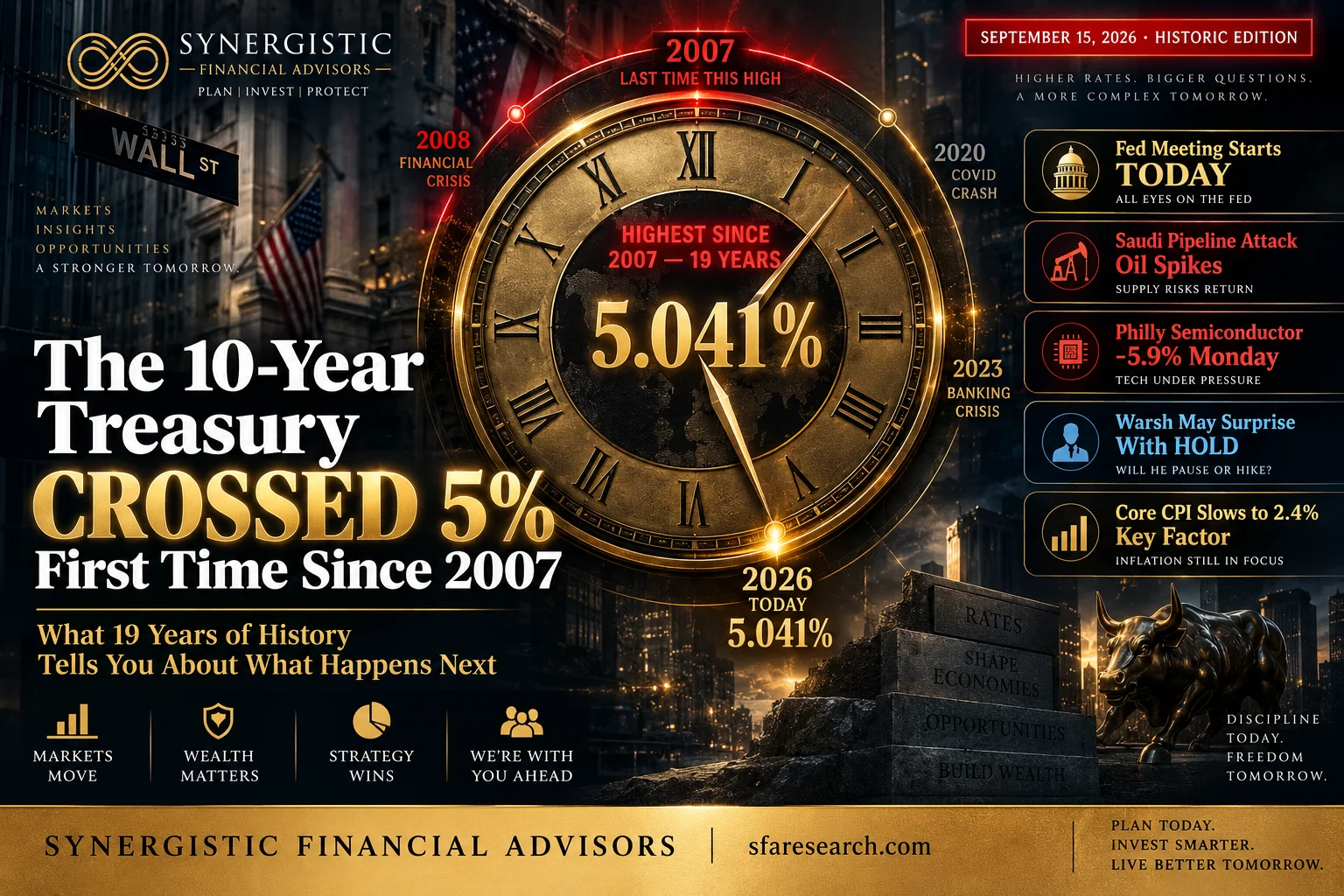
This morning, a number crossed a threshold that has not been reached in nearly two decades.
Inflation worries briefly pushed the 10-year Treasury yield above 5% for the first time since 2023. But this morning, the yield on the benchmark 10-year Treasury note rose to its highest since 2007, adding 8 basis points to trade at 5.041% by 4:02 a.m. ET.
5.041%. The last time the 10-year Treasury yield was this high, the iPhone had just been invented, the financial crisis had not yet begun, and a 30-year mortgage rate above 6% seemed like a temporary anomaly rather than the new normal.
This week’s economic calendar is firmly focused on the Federal Reserve, with the central bank kicking off its meeting on Tuesday, September 15, and concluding on Wednesday, September 16, with its latest policy decision. And the meeting begins today — with the 10-year yield at a 19-year high, oil spiking again on new Saudi pipeline attacks, AI stocks in their worst two-day stretch of the year, and Treasury Secretary Scott Bessent testifying before Congress at this very moment.
This is the most consequential Tuesday in financial markets since the 2023 banking crisis. And every individual investor — regardless of whether they track daily market moves — needs to understand what a 5% 10-year Treasury yield means for their financial planning, their retirement planning, their investment management, and their wealth management strategy right now.
Why 5% on the 10-Year Changes Everything
The 10-year Treasury yield is not just a bond market number. It is the foundational reference rate for virtually every financial decision in the modern economy.
Your mortgage rate is priced as a spread above the 10-year Treasury. Your corporate bonds are valued against it. Your equity portfolio’s price-to-earnings multiple is calculated using it as the discount rate. Your retirement planning projections assume a certain relationship to it. Your business loan costs reference it. Every financial asset in the world is valued relative to the risk-free rate that the 10-year Treasury represents.
When that rate crosses 5% — a level not seen since the pre-financial-crisis era of 2007 — the valuation mathematics of every asset class shift simultaneously. And they shift in predictable, specific ways that every informed investor needs to understand.
Global government bond yields have been in focus for equity markets in recent weeks, with government debt selling off amid mounting fears that the ongoing US-Iran war will fuel inflation and a hawkish turn among central banks.
The mechanism is direct: higher Treasury yields mean that the “risk-free” return available from simply owning government bonds is now 5%. Every other investment — equities, real estate, corporate bonds, private assets — must justify its risk premium against that 5% guaranteed alternative. For growth stocks with earnings expected far into the future, this higher discount rate compresses valuations immediately and significantly. For retirement planning portfolios built on a specific expected return assumption, the 5% risk-free rate changes the calculus of every asset allocation decision.
The Fed Meets Today — And Warsh May Actually Surprise Everyone
The September Fed meeting is the biggest economic event this week, with all eyes centered on what Chair Warsh and company decide to do with interest rates. With the labor market steady and energy prices keeping inflation elevated, it’s widely expected that the Federal Reserve will vote to raise the federal funds rate for the first time since 2023.
But here is the genuinely surprising development buried beneath the 90% hike probability that dominated Monday’s headlines.
Woods says that Warsh could cite core CPI in arguments to hold rates steady again, as the year-over-year increase slowed to 2.4% in August from 2.5% in July. Given that Warsh said in his Jackson Hole speech that the Fed should focus more on trends than isolated data points, Woods believes “this could be his one last line of defense and go against a growing chorus and odds that there is a hike.”
Core CPI slowing to 2.4% in August from 2.5% in July. Warsh explicitly committed at Jackson Hole to focusing on trends rather than isolated data points. If core inflation is genuinely trending downward — even as headline inflation is being distorted upward by oil — a disciplined, data-focused Fed Chair could make the case for holding rates this week rather than hiking into a potential oil-shock that may resolve quickly if Trump’s peace signal materialises.
This is the most consequential nuance of the entire September 16 Fed decision: the market is pricing a near-certainty hike, but the specific data Warsh cited at Jackson Hole — the core trend — is moving in the direction that justifies a hold. If Warsh surprises with a hold, the market reaction will be swift, dramatic, and broadly positive. If he hikes as expected, the dot plot becomes the swing factor — how many more hikes is the committee signalling?
For your financial planning strategy, the Fed decision tomorrow creates a specific and immediately actionable scenario: the surprise hold is the one outcome that most investors are not currently positioned for — and the one that would generate the most significant immediate positive market impact.
AI Stocks in Freefall — The Semiconductor Selloff Explained
AI stocks slammed the brakes early after a weekend of rising fears about the technology. OpenAI’s leader said the firm would likely delay its initial public offering following warnings of possible worst-case AI scenarios.
The Philadelphia Semiconductor Index tumbled 5.9%, with Nvidia Corp. and Intel Corp. dropping 3.4% and 5.6%, respectively.
The Philadelphia Semiconductor Index down 5.9% in a single session. Nvidia — the company that delivered $96.2 billion in revenue and 106% year-over-year growth just three weeks ago — falling 3.4% in a single day.
What changed? The fear is that this new scare might slow spending on data centres, chips, and computer equipment that’s been a dramatic tailwind for the entire market and economy since 2022.
This is the specific anxiety that the OpenAI IPO delay has injected into technology markets: if AI is genuinely “moving too fast” in the assessment of its own creators, does that signal a slowdown in the hyperscaler capital expenditure that has driven semiconductor demand to extraordinary levels? If Google, Microsoft, Amazon, and Meta begin to pace their AI infrastructure spending more carefully — prompted by safety concerns, regulatory pressure, or simply the natural digestion of enormous prior investment — the demand signal that drove South Korea’s semiconductor exports up 68.7% year-on-year begins to moderate.
For your portfolio management strategy, Monday and Tuesday’s semiconductor selloff creates both a risk and an opportunity that deserve simultaneous, honest assessment. The risk is real if AI capital expenditure genuinely slows. The opportunity is equally real if the selloff represents emotional overreaction to a CEO’s cautious public statement rather than a genuine shift in the underlying demand picture that trade data, earnings, and infrastructure investment all still confirm as robust.
A financial advisor who can distinguish between these two interpretations — and model your specific semiconductor exposure against both scenarios — is providing exactly the nuanced, data-grounded investment management guidance this moment demands.
Saudi Pipeline Attack — Oil Spike Adds Another Layer of Complexity
Oil prices spiked thanks to intensified fighting in the Gulf, attacks shutting down a major Saudi pipeline, and postponement of talks between Iran and the Gulf States.
The Iran-US conflict has now drawn in Saudi Arabian infrastructure — with pipeline attacks shutting down capacity and Iran-Gulf States talks postponed. This is a meaningful escalation beyond the tanker strikes and Strait of Hormuz tensions that defined the conflict’s earlier phases. Saudi Arabian pipeline infrastructure represents some of the world’s most critical energy supply capacity — and any sustained disruption adds a new, separate supply constraint on top of the Strait of Hormuz and Bab al-Mandeb risks already embedded in current oil prices.
For your financial planning strategy, the Saudi pipeline attack this week changes the oil price scenario analysis in a specific way: even if Trump’s “war ending very soon” peace signal proves accurate for the US-Iran dimension of the conflict, the broader regional destabilisation that the war has triggered — now including Saudi infrastructure attacks — may sustain energy price pressure beyond what a simple bilateral ceasefire would resolve.
This adds genuine complexity to the “oil falls sharply after peace” scenario that was the primary bullish catalyst for markets entering this week. A financial advisor who models the regional energy risk alongside the bilateral peace signal gives you a more complete and more honest picture of the oil price distribution than either the bullish or bearish headline alone provides.
5 Specific Actions for Your Financial Plan — Right Now, This Tuesday
Action 1 — Understand What 5% Means for Your Mortgage and Debt. The 10-year at 5.041% means new 30-year fixed mortgages are being priced above 7.5%. If you have a variable-rate mortgage, HELOC, or adjustable-rate debt, the 5% 10-year yield translates directly into higher monthly payments that your financial planning budget needs to account for immediately. A financial advisor can model your specific debt exposure against the current yield environment.
Action 2 — Evaluate the Income Opportunity at 5%. The same 5% 10-year yield that is painful for borrowers is genuinely compelling for savers and retirement planning investors. Locking in a portion of your fixed income allocation at 5% creates guaranteed income for a decade — at a level that was simply unavailable since before the 2008 financial crisis. This is the income opportunity of the past 19 years for retirement planning portfolios with income needs.
Action 3 — Reassess Your Semiconductor Exposure Quality Before Thursday. The 5.9% Philadelphia Semiconductor Index decline creates specific harvesting and repositioning opportunities. A portfolio management review that distinguishes between companies whose AI revenue is confirmed by actual earnings — Nvidia’s $96.2 billion quarter — and companies whose AI narrative has outrun their commercial reality identifies exactly where to add on weakness and where the weakness is genuinely warranted.
Action 4 — Build Your Fed Surprise Framework. The 90% hike consensus is exactly the environment where a surprise hold generates maximum market impact. A financial advisor who pre-builds your response for both the expected hike and the surprise hold gives you prepared, confident strategy rather than reactive emotion on Wednesday afternoon.
Action 5 — Schedule Your September 16 Post-Fed Review. Tomorrow’s Fed decision — hike or hold, hawkish dots or dovish dots, Warsh press conference tone — will reshape the trajectory of markets, rates, and your financial planning strategy for the remainder of 2026. Schedule your post-Fed review with your financial advisor for Thursday September 17 — when the full picture is clear and specific, informed action is possible.
How Synergistic Financial Advisors Navigates This Historic Moment
At Synergistic Financial Advisors, the 10-year Treasury crossing 5% for the first time since 2007, the semiconductor selloff, the Saudi pipeline attack, and the Fed meeting beginning today are not surprises requiring reactive scrambling. They are the specific scenarios our certified financial planner team has built client frameworks around — ensuring every individual we serve has a pre-built, personally calibrated response for exactly this kind of historic convergence.
Our wealth management approach integrates the fixed income income opportunity at 5%, the portfolio management quality assessment that distinguishes durable AI value from narrative-driven exposure, the tax planning harvesting opportunities in Monday and Tuesday’s declines, and the comprehensive retirement planning stress-testing that a 5% sustained rate environment demands — all within one coordinated, genuinely personalised advisory relationship.
Ready to navigate the 10-year at 5%, the Fed meeting, and the AI reality check with a financial plan built for this specific moment? Contact Synergistic Financial Advisors today.
👉 Visit sfaresearch.com — because when the 10-year crosses 5% for the first time since 2007, the right financial advisor turns a historic moment into a genuine financial opportunity.
Final Thoughts — 5% Is Not Just a Number
The 10-year Treasury at 5.041% is not just a bond market data point. It is a generational shift in the risk-free rate that changes the mathematics of every asset class, every retirement planning projection, every mortgage payment, and every investment management valuation simultaneously.
The investors who understand this — who work with qualified financial advisors to translate today’s 5% yield environment into specific, personalised action — are the ones who will look back on September 2026 as the moment that defined the most consequential financial opportunity of the decade.
At Synergistic Financial Advisors, we help every client see that opportunity clearly — and act on it confidently.
👉 sfaresearch.com