One million dollars. For most people, it feels like a number that belongs to someone else — someone luckier, higher-earning, or smarter with money than they are.
Here is the reality: building a $1 million retirement planning portfolio is not about luck, extraordinary income, or perfect stock picks. It is about monthly contributions, time, and the mathematical power of compound interest working on your behalf across a disciplined investing lifetime.
If you invest $500 per month starting at age 25, you reach $1 million by age 55. That requires total contributions of just $180,000 — with the remaining $820,000 coming entirely from investment returns.
$180,000 in contributions. $820,000 from compounding. That ratio — where your investment returns ultimately dwarf your actual contributions — is the most important number in this entire guide. And it is available to anyone who starts early enough and stays disciplined long enough.
In September 2026 — with the Federal Reserve having just raised rates to 4%, the 10-year Treasury at 5%, and the most consequential investment management environment in recent memory — understanding exactly how to build your $1 million portfolio has never been more important. This guide gives you the complete strategy — the monthly targets at every age, the account sequence that saves you over $200,000 in taxes, the investment framework that history consistently validates, and the specific 2026 adjustments that make the plan work in today’s actual market conditions.
Why $1 Million Is Both the Wrong and the Right Target
Before examining how to build a $1 million retirement planning portfolio, it is worth understanding what $1 million actually buys in retirement in 2026 — because the answer is more nuanced than the headline number suggests.
At a 4% withdrawal rate — the most widely cited sustainable withdrawal rate for a 30-year retirement — a $1 million portfolio generates $40,000 per year in annual income. Combined with Social Security benefits of $2,000-$3,500 per month at full retirement age, the total retirement income for most individuals reaches $64,000-$82,000 annually — a genuinely comfortable income for most retirement lifestyles in most parts of the country.
However, with CPI running at 4.2% in 2026 and the 10-year Treasury at 5%, the inflation-adjusted purchasing power of that $40,000 withdrawal deserves honest assessment. A certified financial planner who calibrates your withdrawal strategy to today’s actual inflation environment — rather than the 2% average that most 4% rule research assumed — delivers meaningfully more reliable income security across a 25-35 year retirement horizon.
For many individuals, $1 million is the right starting goal — achievable within a realistic career timeline, sufficient when combined with Social Security, and a level at which your portfolio’s own earnings ($80,000 at an 8% return) exceed what most people contribute annually. For others in high-cost areas or with more ambitious lifestyle goals, $1.5-$2 million may be the more appropriate target. The strategic framework below applies equally to every target — only the monthly contribution amounts change.
The Monthly Contribution Needed to Reach $1 Million at Every Age
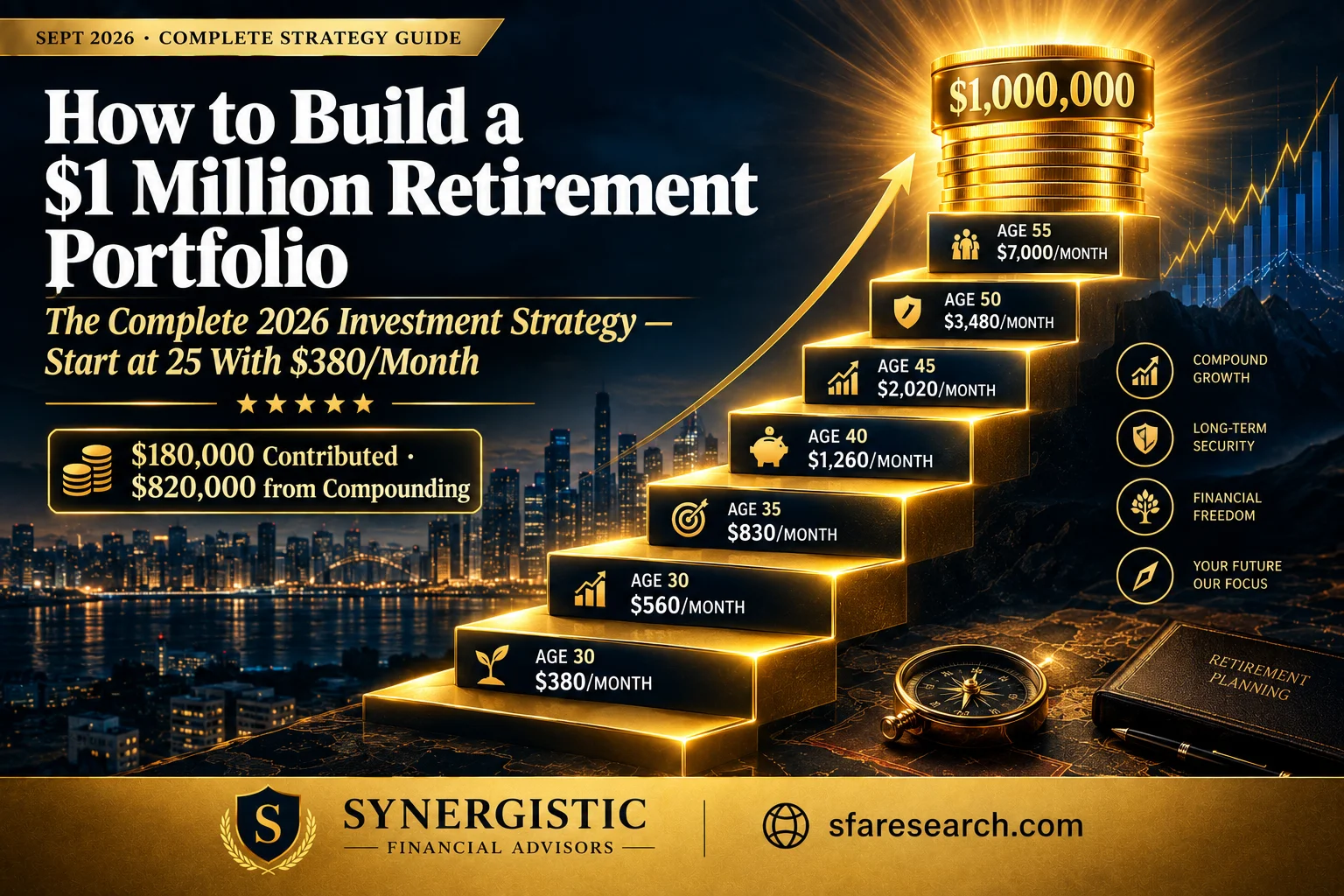
The single most important input to your $1 million retirement planning strategy is not which funds you choose or which account you use — it is how much you contribute each month and when you start. At a 7% real annualised return — the long-run US equity average after inflation — the monthly contribution needed to reach $1 million by age 60 is:
| Starting Age | Monthly Contribution Needed | Total You Contribute | Returns Provide |
|---|---|---|---|
| Age 25 | $380/month | $133,800 | $866,200 |
| Age 30 | $560/month | $168,000 | $832,000 |
| Age 35 | $830/month | $207,500 | $792,500 |
| Age 40 | $1,260/month | $252,000 | $748,000 |
| Age 45 | $2,020/month | $303,000 | $697,000 |
| Age 50 | $3,480/month | $417,600 | $582,400 |
| Age 55 | $7,000/month | $630,000 | $370,000 |
The lesson embedded in this table is the most powerful in all of retirement planning: every five-year delay roughly doubles the required monthly contribution to reach the same goal. The 25-year-old who contributes $380 per month and the 35-year-old who contributes $830 per month arrive at the same destination — but the 25-year-old contributes $73,700 less while allowing compounding to do $74,700 more work.
This is not a reason for those starting later to despair. It is a reason for those starting now to start immediately — and a reason for those who started late to maximise every available catch-up tool aggressively.
The Account Sequence That Saves You $200,000 in Taxes
Tax-advantaged accounts — 401(k), Roth IRA — can save you over $200,000 in taxes on a $1 million portfolio. The sequence in which you fund these accounts is as important as how much you contribute — and getting it right creates a $200,000+ advantage that requires no additional investment, no market timing, and no risk.
Here is the optimal 2026 account contribution sequence for most individuals building toward $1 million:
Step 1 — 401(k) up to the Full Employer Match
First, contribute to a 401(k) up to the employer match. That match is risk-free return. An employer who matches 50% of your first 6% of salary contributions is giving you an immediate, guaranteed 50% return on that portion of your investment — before a single market move occurs. This is the highest-return, lowest-risk step in your entire investment management journey.
For 2026, the base 401(k) contribution limit is $23,500. The employer match contribution does not count toward this limit — meaning a 6% employee contribution and a 3% employer match on a $80,000 salary adds $7,200 in employer contributions to your account completely free.
Never leave the employer match on the table. It is the only guaranteed double-digit return available in the modern financial system.
Step 2 — Roth IRA (Maximum Contribution)
Second, max a Roth IRA if eligible. The Roth IRA’s compounding advantage across 30-40 years is extraordinary — every dollar of growth accumulates completely tax-free, and withdrawals in retirement carry zero federal income tax. For a 30-year-old maxing a Roth IRA at $7,500 annually that grows at 8% per year until 67, the Roth balance at retirement exceeds $1.1 million — with zero taxes owed on any of the $1 million+ in compound growth.
The 2026 Roth IRA contribution limit is $7,500 per year ($8,600 for those 50 and older). Income limits apply — the phase-out begins at $146,000 for single filers and $230,000 for married couples filing jointly. High earners above these limits can access the Roth through the backdoor Roth conversion strategy, which a certified financial planner can implement correctly.
Step 3 — Maximise the Full 401(k) Contribution
After capturing the employer match and maxing the Roth IRA, return to the 401(k) and contribute to the annual maximum — $23,500 in 2026. At this level, your combined annual tax-advantaged contribution across 401(k) and Roth IRA reaches $31,000 per year — $2,583 per month — a savings rate that reaches $1 million in approximately 18-20 years from zero, even before employer match contributions are counted.
Step 4 — Health Savings Account (Triple Advantage)
The Health Savings Account is the most tax-efficient vehicle in the US tax code — with tax-deductible contributions, tax-free growth, and tax-free withdrawals for qualified medical expenses. For 2026, the HSA limit is $4,300 for individual coverage and $8,550 for family coverage.
For retirement planning investors who can fund current medical expenses from other sources and leave their HSA to compound untouched, the HSA functions as an additional tax-free retirement account — one that complements the Roth IRA with its own distinct triple-tax advantage.
Step 5 — Taxable Brokerage Account for Additional Growth
Once all tax-advantaged vehicles are maximised, a taxable brokerage account provides unlimited additional investment capacity with no contribution limits, no withdrawal restrictions, and — when invested in tax-efficient index funds with low annual turnover — minimal annual tax drag.
The Investment Framework That History Validates
The asset allocation framework that consistently produces $1 million outcomes across the longest possible time horizons is not complex. It is built on three foundational principles that history has validated across every market cycle, every economic environment, and every geopolitical disruption of the past century.
Principle 1 — Own Equities as the Core Growth Engine
With enough time, discipline, and consistency, this strategy can get most people to the $1 million mark. And history consistently shows that the strategy that gets most people there is broad, low-cost equity index investing — capturing the S&P 500’s historical 10% average annual return (or approximately 7% after inflation) through disciplined, consistent ownership across every market cycle.
A simple three-fund portfolio — US total stock market index, international stock market index, and bond market index — provides genuine diversification across thousands of companies, geographies, and asset classes at expense ratios as low as 0.03% annually. This combination gets most investors 90% of the way to $1 million without requiring any individual stock selection, market timing, or active management.
Principle 2 — Use a Glide Path as You Approach Retirement
A glide path is the planned shift from aggressive to conservative as you age. It keeps returns high while cutting sequence risk.
A broadly appropriate starting point for most investors is:
- In your 20s-30s: 90-100% equities — maximum growth exposure with decades to recover from corrections
- In your 40s: 80% equities, 20% bonds — maintaining growth orientation while introducing stability
- In your 50s: 70% equities, 30% bonds — beginning meaningful shift toward capital preservation
- Approaching retirement: 60% equities, 40% bonds — balancing growth needs against sequence-of-returns risk
The glide path is not a rigid formula — it is a framework that a financial advisor calibrates to your specific risk tolerance, income needs, and retirement planning timeline.
Principle 3 — Stay Invested Through Every Market Event
Staying invested through market downturns is more important than picking the perfect fund.
This is the principle that separates the investors who reach $1 million from those who perpetually fall short — not fund selection, not market timing, not finding the next great stock. Staying invested through June 9’s 2.6% S&P 500 selloff, through the semiconductor sector’s 5.9% single-day decline, through oil surging 78.5% in a year, through the 10-year Treasury crossing 5% for the first time since 2007 — this disciplined consistency is what allows compound growth to complete its mathematical work across the full timeline.
The 1% Annual Increase Rule — The Single Most Powerful Accelerator
Increasing contributions by 1% each year cuts 5 to 7 years off your timeline to $1 million.
This is one of the most practically powerful and most consistently underused retirement planning strategies available to any investor at any income level. A 1% annual increase in your savings rate — $800 per year on an $80,000 salary — is small enough to be psychologically painless, automatic enough to be maintained without willpower, and compounding enough to take 5-7 years off the timeline to $1 million.
Most 401(k) plans offer an auto-escalation feature that increases your contribution rate by 1-2% automatically every year. Setting this feature up once creates a compounding savings rate accelerator that runs indefinitely without requiring any further action or decision.
What to Do With $1 Million When You Have It — The Distribution Strategy
Once you reach $1 million, the investment management strategy shifts from accumulation to distribution — and the two require meaningfully different approaches.
Cover essential expenses — housing, food, utilities, health care — with guaranteed income where possible. Use your investments for discretionary or flexible spending.
The research-backed structure for a $1 million retirement planning distribution strategy combines three components that work together to ensure the portfolio lasts 30+ years:
Research-backed structure for a $1M retirement: establish a guaranteed income floor — Social Security plus a portion of $1M in annuity covers all essential expenses. Keep the rest invested for growth. Build a cash/short-bond buffer of 1-2 years of expenses.
The specific example that illustrates this framework: convert $250,000 to a fixed annuity generating $1,400-$1,600 per month in guaranteed income. Keep $750,000 invested at a 4% withdrawal rate generating $2,500 per month. Add Social Security at 70 generating $2,200-$3,000 per month. Total monthly income: $6,100-$7,100 — substantial, sustainable, and genuinely resilient to market volatility.
The cash buffer — 1-2 years of expenses in money market or short-duration bonds — is the specific defence against sequence-of-returns risk: the mathematically documented danger that portfolio withdrawals during the first years of retirement, combined with a market correction in those early years, can permanently reduce the portfolio’s ability to sustain withdrawals across a 30-year horizon.
The 2026-Specific Adjustments Every Investor Must Make
Building a $1 million retirement planning portfolio in September 2026 — with the Federal Reserve having just raised rates to 4%, the 10-year Treasury at 5%, and oil-driven inflation reshaping every projection — requires specific adjustments to the general framework.
Adjustment 1 — Maximise Fixed Income Income at 5%
The 10-year Treasury at 5% and money market funds at 4.8% are generating the most attractive guaranteed yields available in nearly two decades. For the bond allocation in your glide path, today’s rates mean your defensive allocation is actually generating meaningful real returns rather than merely providing stability. A financial advisor who deploys your bond allocation into today’s yield environment captures genuine income that was simply unavailable for most of the past 15 years.
Adjustment 2 — Maximise 2026 Catch-Up Contributions
The 2026 catch-up contribution rules are more generous than any prior year — and they are available right now for every investor 50 and older.
At age 50, the IRS allows catch-up contributions. In 2026: 401(k): standard limit of $23,500 plus $7,500 catch-up equals $31,000 total. IRA: standard limit of $7,000 plus $1,000 catch-up equals $8,000 total. HSA: $4,300 for individual plus $1,000 catch-up. If you’re behind, maxing out all of these simultaneously can add $39,000 or more per year to your retirement savings — before any investment return.
For investors ages 60-63 specifically, the SECURE 2.0 super catch-up contribution allows $11,250 in additional 401(k) contributions — bringing the 2026 total to $34,750 for this age group.
Adjustment 3 — Build Real Asset Protection Into Your Equity Allocation
With oil at $107 in early September and inflation running above 4%, the equity allocation of your $1 million portfolio deserves deliberate inflation protection. Energy sector exposure, real estate investment trusts, commodity producers, and infrastructure equities all provide returns that are less correlated with conventional equity market performance while providing genuine inflation pass-through that protects purchasing power across the specific threat that 2026’s energy-driven inflation represents.
Adjustment 4 — Roth Conversion at Every Opportunity
With permanent tax brackets now established under the One Big Beautiful Bill Act, 2026 provides the multi-year planning certainty for Roth conversion strategy that was absent during the legislative uncertainty of prior years. Every dollar converted to Roth in 2026 is a dollar that compounds tax-free across the remainder of your retirement planning horizon — and is withdrawn completely tax-free in retirement.
How Long Does $1 Million Last? The 2026 Reality Check
The answer depends on four variables that a certified financial planner models precisely for your specific situation: your annual withdrawal amount, your portfolio’s return, your Social Security income, and the inflation rate applied to your spending across retirement.
At a 4% withdrawal rate on $1 million — $40,000 per year — combined with Social Security of $2,500 per month at full retirement age, total annual income is approximately $70,000. At 4% inflation, the purchasing power of that $70,000 in year one is equivalent to $47,600 in today’s dollars by year 15 of retirement. This inflation erosion is the most important reason to maintain meaningful equity exposure in retirement rather than shifting entirely to fixed income.
The portfolio’s longevity improves significantly with every year Social Security is delayed. Delaying from 67 to 70 increases the monthly Social Security benefit by 24% — adding approximately $600-$900 per month to lifetime income while simultaneously reducing the portfolio withdrawal rate required during the delay period by a corresponding amount.
How Synergistic Financial Advisors Helps You Build Your $1 Million Portfolio
At Synergistic Financial Advisors, the $1 million retirement planning goal is not a fantasy we help clients aspire to — it is a specific, calculable, achievable outcome we build personalised roadmaps toward for every individual we serve.
Our certified financial planner team calculates your specific monthly contribution target based on your current age and savings, designs the optimal account contribution sequence for your income and tax situation, builds the glide path allocation that balances growth and stability appropriately for your timeline, implements the 2026-specific adjustments for catch-up contributions and Roth conversion, and provides the behavioural coaching that keeps you invested and contributing through the market events that test every investor’s discipline.
We integrate your $1 million portfolio building with your complete financial planning framework — coordinating tax planning, investment management, Social Security timing, wealth management, and estate coordination under one advisory relationship built entirely around your goals.
The mathematics of reaching $1 million work for anyone who starts where they are and stays consistent. A financial advisor ensures you do not get in your own way.
Ready to build your personalised $1 million retirement portfolio strategy? Contact Synergistic Financial Advisors today for a personalised consultation.
👉 Visit sfaresearch.com — because $1 million is not a fantasy. It is a calculation. And the right financial advisor knows exactly how to run it for you.
Final Thoughts — $1 Million Is a Calculation, Not a Dream
Building a $1 million retirement planning portfolio is not about exceptional circumstances. It is about monthly contributions, time, tax-advantaged account sequencing, disciplined equity investing, and the behavioural consistency that keeps all of it working through every market event that 2026 and beyond will inevitably deliver.
The investors who reach $1 million are not the ones who found the perfect stock, timed the market brilliantly, or had incomes that made saving easy. They are the ones who started early enough, increased contributions consistently, stayed invested through everything, and worked with a financial advisor who kept the plan on track when emotions made clear thinking difficult.
That plan is available to you — starting today, starting where you are.
At Synergistic Financial Advisors, we help every client build it.