If you are 40, 50, or 60 and wondering whether you have saved enough for retirement, you are asking one of the most important financial questions you can ask.
But there is a problem with the way retirement savings are usually discussed.
You will often see a headline telling you that you should have a specific dollar amount saved by a certain age.
The reality is more complicated.
Someone earning $60,000 per year does not have the same retirement requirements as someone earning $250,000. Someone planning to retire at 67 does not have the same target as someone hoping to retire at 55. And a homeowner with a paid-off house may have dramatically different retirement expenses from someone expecting to rent throughout retirement.
So instead of asking only:
“How much should I have saved?”
A better question is:
“How much do I need to support the retirement I actually want?”
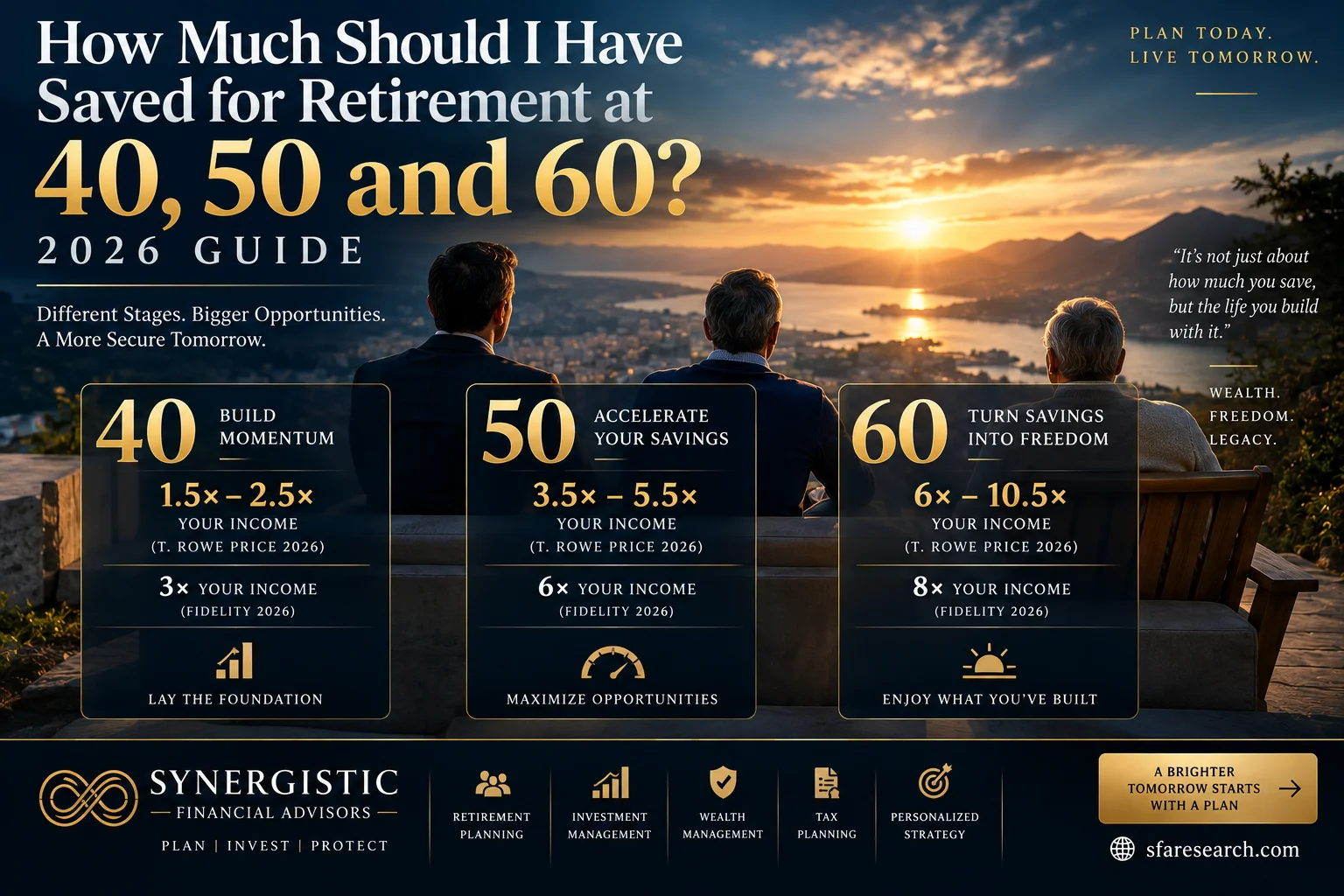
Current 2026 research provides useful benchmarks, but those benchmarks should be viewed as starting points rather than universal rules. T. Rowe Price’s April 2026 framework estimates retirement savings targets of roughly 1.5–2.5 times income by age 40, 3.5–5.5 times by age 50, and 6–10.5 times by age 60.
Fidelity uses a different methodology and suggests 3× income by 40, 6× by 50, and 8× by 60.
That difference tells you something important:
There is no single magic retirement number.
How Much Should You Have Saved by 40?
For someone approaching or at age 40, retirement may still be decades away.
That makes this an important accumulation period.
T. Rowe Price’s 2026 benchmark suggests having approximately 1.5 to 2.5 times your income saved by age 40. Fidelity’s guideline is higher at approximately 3 times income.
Consider a hypothetical professional earning $100,000.
Using these benchmarks:
| Age 40 Salary | 1.5× | 2.5× | 3× |
|---|---|---|---|
| $75,000 | $112,500 | $187,500 | $225,000 |
| $100,000 | $150,000 | $250,000 | $300,000 |
| $150,000 | $225,000 | $375,000 | $450,000 |
| $200,000 | $300,000 | $500,000 | $600,000 |
These are benchmarks, not individualized recommendations.
Your actual target depends on when you began saving, how much you contribute, investment returns, expected retirement spending, Social Security, pensions, taxes, and your planned retirement age.
A qualified financial advisor can help translate an age-based benchmark into a personal retirement target.
What If You Are 40 and Behind?
Being behind at 40 does not mean retirement is doomed.
You still potentially have decades for contributions and investment growth to work together.
The response should not be panic.
It should be recalibration.
Start by determining:
- Your current retirement balance
- Your annual contribution
- Employer contributions
- Expected retirement age
- Expected annual retirement spending
- Other assets available for retirement
A financial planner can then help determine how aggressively you need to save.
How Much Should You Have Saved by 50?
Age 50 is an important financial checkpoint.
You are closer to retirement, but you may still have 15 or more years to build assets.
T. Rowe Price’s 2026 benchmark places the age-50 range at approximately 3.5 to 5.5 times income.
Fidelity’s framework uses approximately 6 times income by age 50.
For a $150,000 annual income, that translates roughly to:
- 3.5× = $525,000
- 5.5× = $825,000
- 6× = $900,000
Again, the appropriate target can vary substantially.
Someone intending to retire at 60 may need a different savings trajectory than someone planning to work until 70.
This is where comprehensive financial planning becomes much more useful than simply comparing your account balance with an online benchmark.
Age 50 Has Another Advantage: Catch-Up Contributions
One of the most important changes around age 50 is that eligible retirement savers can generally make additional catch-up contributions.
For 2026, the IRS says the regular employee contribution limit for a 401(k), 403(b), governmental 457 plan, and federal Thrift Savings Plan is $24,500. The general catch-up contribution for people age 50 and older is $8,000, bringing the total to $32,500 where applicable. For participants aged 60, 61, 62, or 63, a higher catch-up limit of $11,250 applies for 2026.
For IRAs, the 2026 contribution limit is $7,500, with an additional $1,100 catch-up contribution for people age 50 and older, subject to the applicable rules.
That creates a valuable opportunity for people who realize at 50 that their retirement savings need to accelerate.
Instead of thinking:
“I’m behind.”
Think:
“I have an opportunity to increase my savings rate while my highest earning years may still be ahead.”
How Much Should You Have Saved by 60?
At 60, retirement planning becomes much more concrete.
You may be only five to ten years away from retirement — or potentially closer if you want to stop working early.
T. Rowe Price’s 2026 benchmark suggests approximately 6 to 10.5 times income saved by age 60.
Fidelity’s framework suggests approximately 8 times income by age 60.
For someone earning $150,000:
| Multiple | Retirement Savings |
|---|---|
| 6× | $900,000 |
| 8× | $1.2 million |
| 10.5× | $1.575 million |
This illustrates why asking whether you have “enough” without considering income and spending can be misleading.
A $1 million portfolio could be sufficient for one household and inadequate for another.
The Most Important Number Isn’t Your Age
Age-based benchmarks are useful.
But your retirement spending requirement may be even more important.
Imagine two 60-year-olds.
Person A
- Retirement assets: $1 million
- Annual retirement spending: $45,000
- Paid-off home
- Social Security income
- Modest lifestyle
Person B
- Retirement assets: $1.5 million
- Annual retirement spending: $100,000
- Mortgage
- Frequent travel
- Higher healthcare expectations
The person with $1 million may have a smaller funding gap than the person with $1.5 million.
That’s why sophisticated wealth management starts with goals and cash-flow requirements rather than arbitrary milestones.
Don’t Compare Your Retirement Account With Your Neighbor’s
Retirement savings comparisons can create unnecessary anxiety.
Fidelity’s June 2026 data, for example, reported average 401(k) balances ranging from $120,100 for people ages 40–44 to $260,800 for those ages 55–59.
But an average is not a retirement plan.
Your retirement resources could include:
- 401(k)
- IRA
- Roth IRA
- Taxable investment accounts
- Real estate
- Pension
- Social Security
- Business interests
- Other assets
A complete financial management review should consider the entire picture.
What If You Are Behind at 40, 50 or 60?
This is probably the most important section of the entire guide.
If you are below a benchmark, don’t conclude that you have failed.
Instead, determine the size of the gap.
At 40: Increase the Savings Rate
You potentially have decades remaining.
Focus on:
- Increasing retirement contributions
- Capturing the full employer match where available
- Eliminating expensive debt
- Building diversified investments
Your greatest advantage may be time.
At 50: Accelerate
At 50, look closely at catch-up contribution opportunities.
You may also need to examine:
- Retirement age
- Spending expectations
- Investment allocation
- Tax strategy
This is an excellent time for a comprehensive retirement planning review.
At 60: Shift From Accumulation to Distribution Planning
At 60, the question increasingly becomes:
“How will I turn my assets into sustainable retirement income?”
That can involve:
- Withdrawal strategies
- Social Security timing
- Tax-efficient distributions
- Investment risk
- Healthcare costs
- Longevity planning
Your investment management strategy may need to evolve as retirement approaches.
The 15% Rule: A Useful Starting Point
There is another benchmark worth knowing.
T. Rowe Price and Fidelity both identify roughly 15% of income as a useful baseline savings target for many investors, although individual circumstances can call for more or less.
The important point is that this may include employer contributions, depending on the methodology.
If you’re not currently saving 15%, don’t treat that number as a reason to give up.
Increase your savings rate gradually.
For example:
10% → 12% → 14% → 15%
You can also direct a portion of every future salary increase toward retirement rather than allowing lifestyle expenses to consume the entire raise.
Your Investment Strategy Matters as Much as Your Savings Rate
Saving more is important.
But how those savings are invested also matters.
Your investment strategy should consider:
- Time horizon
- Risk tolerance
- Diversification
- Tax considerations
- Retirement date
- Expected withdrawals
This is where professional portfolio management and investment management can become valuable.
An investment advisor can help evaluate whether your current allocation is aligned with your objectives rather than simply chasing the highest possible return.
Don’t Forget Inflation
Retirement may last 25, 30, or even more years.
That means today’s expenses cannot simply be copied into a future retirement plan.
If you spend $60,000 today, your future retirement budget may need to be considerably higher to maintain a similar lifestyle.
Inflation therefore needs to be incorporated into your projections.
It can affect:
- Food
- Housing
- Insurance
- Healthcare
- Travel
- Taxes
- Long-term care
This is one reason retirement projections should be updated regularly.
Tax Planning Can Change How Much You Need
Two people with identical retirement balances can have different after-tax incomes.
Why?
Because the tax treatment of their assets may differ.
Your retirement assets might include:
- Traditional 401(k)
- Traditional IRA
- Roth IRA
- Taxable brokerage account
The timing and order of withdrawals can therefore matter.
Strategic tax planning should be incorporated into retirement preparation rather than considered only when filing an annual tax return.
How Synergistic Financial Advisors Can Help
Retirement planning is ultimately about converting today’s resources into tomorrow’s financial security.
Synergistic Financial Advisors can help clients approach that process through integrated financial planning, wealth management, investment management, portfolio management, and retirement planning.
For someone searching for financial advisors near me, the important question is not simply how many years of experience an advisor has.
It is whether the advisor can help connect:
income → savings → investments → taxes → retirement income → long-term wealth.
An independent financial advisor can provide an outside perspective on the relationship between your financial goals and your investment strategy.
A fiduciary financial advisor may also be relevant for investors specifically seeking advice under a fiduciary standard, depending on the advisor and engagement.
Whether you are looking for a financial consultant, a financial consultant near me, or a financial planner near me, the objective should be to develop a strategy based on your actual circumstances rather than blindly following an age-based number.
Synergistic Financial Advisors provides financial advisory and wealth-management solutions designed to help individuals and organizations make informed long-term financial decisions.
Your 2026 Retirement Checkup
Use this simple checklist today.
If You’re 40
- Know your retirement balance
- Calculate your savings rate
- Review investment allocation
- Estimate your retirement spending
- Increase contributions if necessary
If You’re 50
- Review catch-up contribution opportunities
- Recalculate your retirement target
- Review taxes
- Evaluate investment risk
- Determine whether retirement age needs to change
If You’re 60
- Calculate your retirement income gap
- Review Social Security strategy
- Model healthcare expenses
- Build a withdrawal strategy
- Review portfolio risk
- Coordinate tax and estate planning
The Bottom Line
There is no universal retirement savings number for age 40, 50, or 60.
But 2026 benchmarks provide useful reference points.
A reasonable framework is:
| Age | 2026 Benchmark Range |
|---|---|
| 40 | 1.5×–2.5× income |
| 50 | 3.5×–5.5× income |
| 60 | 6×–10.5× income |
These ranges come from T. Rowe Price’s 2026 retirement research; other major providers use different assumptions and benchmarks. Fidelity, for example, uses 3× income at 40, 6× at 50, and 8× at 60.
The differences are not a reason to ignore benchmarks.
They are a reason to understand them.
Your retirement target should ultimately reflect your income, spending, retirement age, taxes, investments, Social Security, healthcare needs, and desired lifestyle.
If you’re ahead, keep building.
If you’re behind, adjust.
And if you’re unsure, calculate the gap before making assumptions.
The goal isn’t to have the same amount as everyone else. The goal is to have enough to support the life you want after your paycheck stops.
Synergistic Financial Advisors can help you turn that goal into a structured retirement strategy based on your individual financial picture.