Nearly 57% of people in the US do not have a financial advisor. More than half of all Americans are navigating one of the most complex financial environments in modern history — a year that has delivered $107 oil, a Federal Reserve rate hike to 4%, the 10-year Treasury crossing 5% for the first time since 2007, new permanent tax laws, record AI earnings, and the most turbulent market conditions since 2008 — entirely without professional guidance.
That is not a judgment. It is a symptom of the most common misconception in personal finance: that financial advisors are only for the wealthy.
Not everyone needs a financial advisor at every stage. If your finances are straightforward and you enjoy managing them, handling things on your own may work well for you. However, many people benefit from professional guidance once decisions start to feel overwhelming or more complex. LPL Financial
The real question is not whether you are wealthy enough to need a financial advisor. It is whether the financial decisions you are currently facing are consequential enough that getting them wrong would meaningfully damage your long-term financial security. For most adults in 2026, the answer to that question is yes — and they do not know it yet.
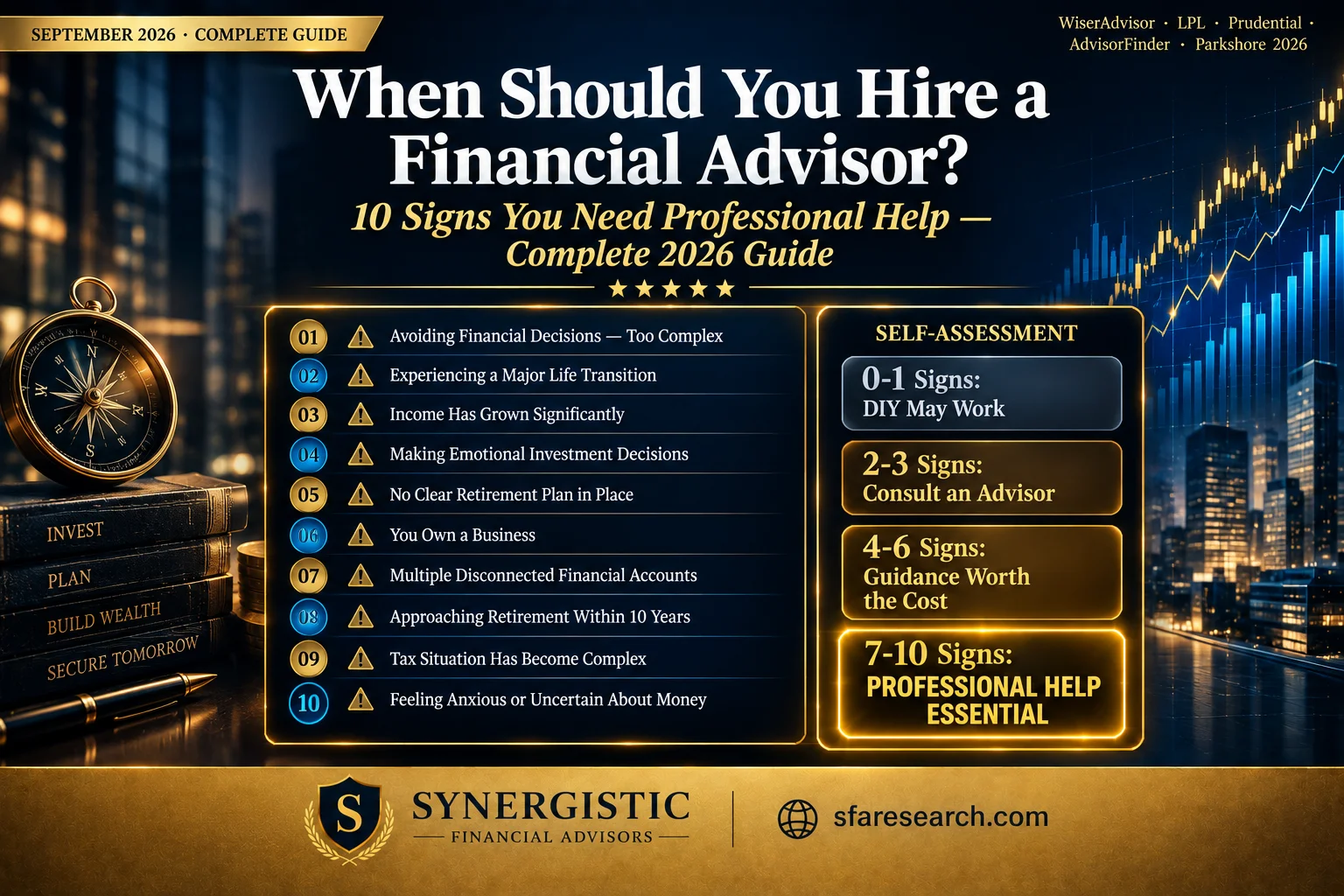
Here are the 10 clearest signs that the moment to hire a financial advisor has arrived — and what acting on each one is actually worth.
Sign 1 — You Are Avoiding Financial Decisions Because They Feel Too Complex
Certain signs indicate it is time for professional help: you are avoiding financial decisions due to complexity. Advisorfinder
Avoidance is the most expensive financial behaviour that most people never measure. Every month that a 401(k) rollover sits uninvested in a money market account, every year that an estate plan goes undrafted, every quarter that a concentrated stock position goes unaddressed — these are not neutral non-events. They are measurable, compounding costs accumulating in real time.
If you find yourself mentally flagging a financial task — retirement account consolidation, beneficiary updates, insurance review, investment management decisions — and repeatedly postponing it because the decision feels too complex to approach confidently, that avoidance pattern is the clearest single signal that professional guidance would immediately add value.
A financial advisor does not just make these decisions for you. They make the decisions manageable — converting an overwhelming, multi-variable question into a structured, specific, step-by-step conversation that produces a clear, confident answer.
Sign 2 — You Have Experienced a Major Life Transition
You are experiencing a major life change — marriage, new baby, loss of a loved one. You want expert guidance on retirement planning, investing, or estate planning.
Eight life events typically signal it is time to talk to a financial advisor: marriage, inheritance, a job change, retirement planning, a business sale, divorce, a major illness, or an unexpected windfall. Each shifts your financial picture in ways professional guidance can clarify.
These transitions share a common characteristic: they are high-stakes, time-sensitive, and typically encountered only once or twice in a lifetime. A divorce requires immediate action on QDRO (qualified domestic relations orders), beneficiary updates, credit separation, and insurance restructuring — all within tight legal timelines. An inheritance requires tax planning decisions on inherited IRA distributions, estate settlement, and investment deployment. A business sale requires exit structure optimisation, capital gains management, and retirement account maximisation — all in a compressed window.
Since people typically encounter these situations only once or twice, professional guidance can provide clarity, help work towards reducing stress, and support more confident decision-making during an already emotional time.
The cost of making these transition decisions without professional guidance — claiming the wrong Social Security filing status, missing the 60-day rollover window on an inherited IRA, failing to update beneficiaries after a divorce — can be permanent and irreversible. One conversation with a certified financial planner before the transition resolves avoids the expensive mistakes that most people only discover after they have made them.
Sign 3 — Your Income Has Grown Significantly
Complexity in investment portfolios or uncertainty in tax planning are clear signals. Experiencing significant life events often requires expert financial guidance — starting a business, getting married, or planning retirement.
A higher income is not simply more of the same financial situation — it is a qualitatively different one. As income grows, the tax planning complexity grows proportionally. The gap between what you could be doing to optimise your situation and what you are actually doing tends to widen significantly without professional guidance.
In 2026’s tax planning landscape — with new permanent tax brackets under the One Big Beautiful Bill Act, SALT deduction at $40,400, catch-up contribution Roth mandates for high earners, qualified business income optimisation, and IRMAA Medicare surcharge thresholds — a high-income earner managing their own tax planning is almost certainly leaving thousands of dollars on the table annually. If you are a high earner in a top tax bracket, there is a good chance you are paying more in taxes than you need to be. If you are maxing out all of your retirement accounts but still paying high taxes every year, it may be time to meet with a professional who is well-versed in strategies like backdoor Roth IRAs.
Sign 4 — You Are Making Emotional Investment Decisions
In 2026 alone, individual investors have been tested more brutally than in most entire decades. The S&P 500’s worst single day of the year. Semiconductor stocks falling 10% in a session. Oil surging 78.5% year-to-date. The 10-year Treasury crossing 5% for the first time since 2007. Each of these events created a genuine temptation to abandon disciplined portfolio management in favour of emotional reaction.
Market ups and downs are inevitable, and emotional reactions can make it tempting to stray from a long-term plan. During periods of volatility, an advisor provides perspective and context that help you stay focused on what matters most. That guidance can be especially valuable when headlines feel unsettling, reinforcing disciplined decision-making rather than short-term reactions.
Vanguard’s research consistently identifies behavioural coaching as the largest single component of the value a financial advisor delivers — approximately 1.5% annually in additional returns simply from preventing the emotional decisions that individual investors consistently make at the most costly possible moments. On a $500,000 portfolio, 1.5% annually is $7,500 per year — in pure behavioural coaching value, before any investment selection or tax planning contribution.
Sign 5 — You Have No Clear Retirement Plan
If you find yourself struggling to pay off existing debts and are considering taking on more debt, it may be prudent to consult with a financial advisor.
More specifically for retirement planning: if you cannot confidently answer how much you need, whether your current savings rate will get you there, and what your Social Security claiming strategy should be — you do not have a retirement planning strategy. You have a hope.
In 2026, the gap between what Americans think they need to retire ($1.46 million according to the Northwestern Mutual survey) and what they actually have saved (the median 55-64-year-old has $185,000) has never been wider. A certified financial planner converts that anxiety into a specific, achievable roadmap — calculating your actual number, modelling your current trajectory against it, and identifying the specific adjustments that close the gap.
Retirement planning is not a product — it is a comprehensive strategy that integrates savings rate, account structure, Social Security timing, healthcare cost planning, and withdrawal sequencing. It requires coordination that no single financial product can provide.
Sign 6 — You Own a Business
A financial advisor can be a game-changer. They offer expertise in cash flow management, tax compliance, and business valuation. These professionals help streamline financial processes, saving you time and reducing stress. Major life or business transitions often signal the need for expert guidance. Starting a business, expanding operations, or facing complex financial situations are prime examples. Partnering with a financial advisor can lead to significant cost savings and increased profitability.
Business ownership creates a financial complexity that most generic personal finance guidance is simply not designed to address. Entity structure optimisation, qualified business income deduction, SEP-IRA and Solo 401(k) maximisation, business succession planning, buy-sell agreements, exit structure for capital gains management — each of these represents a specific opportunity that a financial advisor with business owner expertise identifies and captures while most business owners are simply too busy running their businesses to pursue independently.
Sign 7 — You Have Multiple Disconnected Financial Accounts
Old 401(k)s from previous employers. Multiple IRA accounts. A taxable brokerage account. An HSA. Employer equity compensation. A personal savings account. Each individual account looks fine in isolation. Together, they represent a fragmented financial picture with invisible inefficiencies — overlapping investment exposures, misaligned tax efficiency, inconsistent risk management, and gaps that assets quietly slip through.
Timing a decision poorly, overlooking tax implications, or reacting emotionally in volatile markets can be hard to undo. The right financial advisor provides a framework for decision-making that helps reduce the odds of avoidable errors.
A financial advisor who consolidates the strategic picture — not necessarily the accounts themselves — across your complete financial life identifies the asset location inefficiencies, concentration risks, and coordination opportunities that account-by-account management consistently misses.
Sign 8 — You Are Approaching Retirement Within 10 Years
The decade before retirement is the most financially consequential period of most people’s financial lives — and the one where professional guidance creates the most measurable, lasting impact. Social Security timing, withdrawal sequencing, Roth conversion opportunities, healthcare cost reserves, Medicare planning, and the transition from accumulation to distribution all intersect in ways that require genuine, coordinated expertise.
A single optimised Social Security claiming decision — delaying the higher earner to 70 while the lower earner claims at FRA — can add $200,000+ to lifetime household retirement income. A strategic Roth conversion programme during the low-income gap years before Social Security claiming reduces lifetime tax liability by tens of thousands of dollars. These are not theoretical benefits — they are the specific, measurable outcomes that a qualified financial advisor delivers for clients in the pre-retirement decade.
Sign 9 — Your Tax Situation Has Become Complex
Seeking the counsel of financial planners who specialise in estate planning is a way to ensure your wealth is preserved and transferred in the way you wish it to be.
Beyond estate planning, tax planning complexity is one of the most reliable indicators that professional guidance has moved from beneficial to essential. Multiple income sources — salary, business income, rental income, investment dividends, capital gains, equity compensation — each interact with each other in ways that change your effective tax rate and the optimal strategy for managing each source.
In 2026, with the most consequential tax planning legislation in decades — permanent tax brackets, expanded SALT deductions, new catch-up contribution rules, enhanced charitable deduction provisions, and the $15 million estate tax exemption — the gap between what a qualified financial advisor with tax planning expertise captures and what an unadvised individual captures has never been larger. That gap is measured in real dollars every year.
Sign 10 — You Simply Feel Anxious or Uncertain About Money
If you are spending significant time worrying about financial choices, unsure whether you are on track, or facing a major decision you would rather not navigate alone, those may be signs an advisor could add value. Ultimately, the question is not whether you can manage on your own but whether professional insight could help you feel more confident and prepared for what is ahead.
Financial anxiety is information. It is telling you that your current financial situation requires more expertise, more structure, or more coordination than you currently have access to. It is not a character flaw — it is a signal that the complexity of your financial decisions has exceeded the framework you have available to navigate them.
Moving from DIY to professional help does not mean failure — it means growth. Like hiring your first employee in business, it is a sign of success creating complexity beyond individual capacity.
The Self-Assessment — Your 10-Sign Score
How many of these 10 signs apply to your current situation right now?
| Signs Present | What It Means |
|---|---|
| 0–1 signs | DIY may be entirely appropriate for your current situation |
| 2–3 signs | A one-time consultation with a financial advisor would likely add value |
| 4–6 signs | Ongoing professional guidance is almost certainly worth the cost |
| 7–10 signs | Professional financial advisory is not optional — it is essential |
Most advisors offer a free first conversation. The cost is your time.
What to Look for When You Are Ready to Hire a Financial Advisor
When the signs above tell you it is time, the most important single quality to verify is fiduciary status. A fiduciary financial advisor is legally required to act in your best interest at all times — without hidden commissions, without product sales incentives, and without conflicts of interest between what they recommend and how they are paid.
The certified financial planner credential — the CFP designation — is the gold standard in comprehensive financial planning expertise. Verifiable through the CFP Board’s public database, the designation requires rigorous examination, documented experience, and ongoing continuing education across investment management, tax planning, retirement planning, estate planning, and wealth management.
Choosing the right financial advisor can help you receive professional guidance. This decision can pave the way for long-term financial success and peace of mind.
How Synergistic Financial Advisors Serves Every Life Stage and Every Sign
At Synergistic Financial Advisors, we believe that the right moment to engage a financial advisor is not determined by your account balance — it is determined by the complexity and consequence of the financial decisions you are currently facing.
Our certified financial planner team works with individuals across every one of the 10 signs above — from the young professional whose income has grown beyond their DIY framework to the pre-retiree navigating Social Security optimisation and Roth conversion strategy, from the business owner who needs integrated personal and corporate financial planning to the family managing a major life transition with permanent financial implications.
We operate as genuine fiduciary financial advisors — fee-transparent, client-first, with zero product commissions and zero hidden conflicts. Our comprehensive financial planning covers investment management, portfolio management, retirement planning, tax planning, estate coordination, and complete wealth management — all under one advisory relationship built entirely around your goals.
Ready to find out how many of the 10 signs apply to your situation — and what addressing them is actually worth? Contact Synergistic Financial Advisors today for a personalised consultation.
👉 Visit sfaresearch.com — because the most expensive financial planning mistake is waiting until the cost of not having a plan becomes obvious.
Final Thoughts — The Right Time Is Almost Always Sooner Than You Think
The decision to hire a financial advisor is a prudent move. Seeking professional advice can provide valuable insights and a roadmap to achieve your financial goals with strategic planning.
In September 2026 — with the Federal Reserve just raised rates to 4%, the 10-year Treasury at 5%, oil up 78.5% year-to-date, and the most complex tax planning environment in decades — the financial decisions facing every individual investor are more consequential than in any recent year. The cost of getting them wrong has rarely been higher. The value of getting them right has rarely been greater.
The 10 signs in this guide are not a checklist to complete before calling a financial advisor. They are indicators — any one of which, present in your life right now, makes professional financial planning guidance both appropriate and immediately valuable.
At Synergistic Financial Advisors, we are here when any one of those signs applies to you.
👉 sfaresearch.com